


Help support our mission, donate today and be the change. Every contribution goes directly toward driving real impact for the cause we believe in.
RAFAH CROSSING/GAZA CITY, 13 May 2026 – For more than a year, the Rafah border crossing between Egypt and the Gaza Strip was sealed by Israeli military force, severing the enclave’s last remaining physical link to the outside world. When the gates finally inched open in February 2026 under Phase Two of the Trump‑brokered ceasefire, the world expected a humanitarian corridor. What unfolded instead, according to dozens of returnees, human rights monitors, and leaked security assessments, is a meticulously choreographed apparatus of control: systematic humiliation, coercive interrogation, recruitment of informants, and a thinly veiled campaign to permanently drive Palestinians from their land.
Over the past three months, Quds News Network and The New Arab have gathered the testimonies of the handful of men, women, and children who have endured what survivors describe as a “journey of horror” back into the devastated Strip. Their accounts, reinforced by photographic evidence, independent analysts, and statements from Israeli and Palestinian officials, expose a border regime that operates far beyond any legitimate security screening. Instead, Rafah has been transformed into a checkpoint not merely for vetting, but for breaking the will of those who dare to return, and for delivering a message that echoes from the interrogator’s chamber to the highest echelons of the Israeli government: “Gaza belongs to Israel.”
A Lifeline Turned Chokepoint:
For the 2.3 million Palestinians of Gaza, Rafah was once the only gateway not controlled by Israel. It allowed students to study abroad, patients to access life‑saving treatment, and families to reunite. That changed in May 2024, when Israeli forces seized the Palestinian side of the crossing during the full‑scale military assault that the International Court of Justice would later deem a plausible genocide. Bulldozers razed the terminal buildings; the Philadelphi Corridor became a closed military zone. The suffocating siege that followed, depriving the population of food, water, and medicine, was, for many, a death sentence.
The ceasefire agreement of October 2025, which halted large‑scale bombardments, explicitly required Israel to “open the Rafah crossing in both directions” for humanitarian aid and civilian movement. Implementation was delayed by months. When limited passage resumed on 1 February 2026, it was under conditions that human rights lawyers say amount to collective punishment and, in multiple documented instances, torture. To date, only around 180 Palestinians have been allowed back into Gaza, while more than 80,000 remain stranded in Egypt, according to the Palestinian Embassy in Cairo. Medical evacuations, the ostensible justification for reopening, have been a trickle: as of mid‑May 2026, only 127 patients and companions have been permitted to exit, out of over 2,400 applications approved by the World Health Organization.
“They call it a crossing, but it is a filtration camp,” said Hussam al‑Dajani, a Gaza‑based political analyst, in an interview with The New Arab. “Israel deals with the ceasefire as a security arrangement, not a humanitarian or political commitment. Every Palestinian movement is an opportunity for intelligence collection, pressure, and intimidation.”
The Three Checkpoints Of Dread:
Returnees describe a route broken into three distinct stages, each designed to strip away layers of dignity and hope.
First checkpoint — Egyptian side: Travellers report a calm, almost bureaucratic atmosphere. Egyptian officers stamp passports, search luggage, and in several cases quietly urge people to resist any future forced displacement. “In the Egyptian hall, everything was calm. We were treated with respect, given water, and allowed to rest,” Um Mohammed, a mother of three from Khan Younis, told TNA. “For the first time in years, we felt like human beings.”
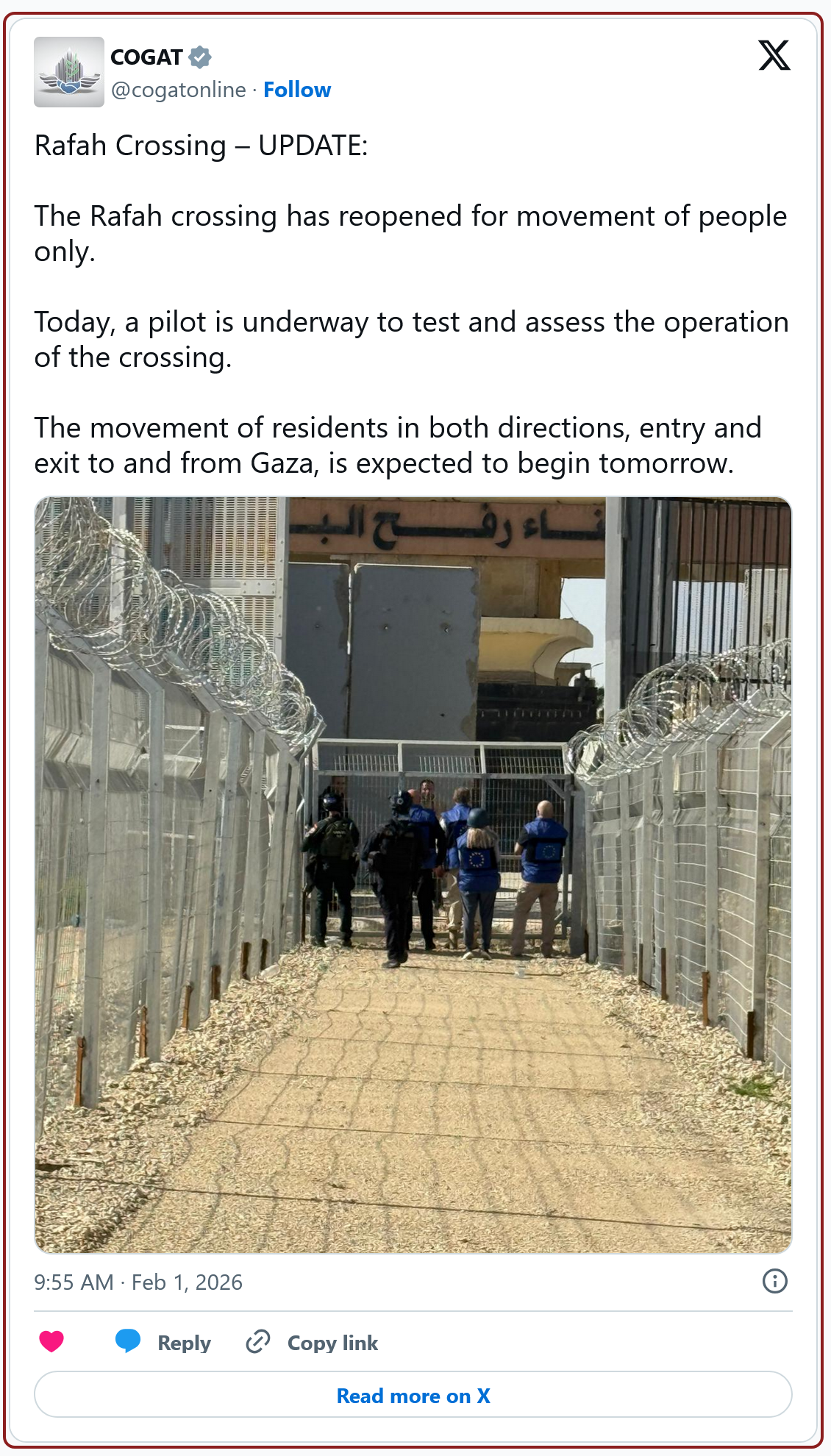
Second checkpoint — Karem Abu Salem (Kerem Shalom): Here, the scene shifts. A narrow corridor flanked by towering metal fences topped with concertina wire channels travellers toward a heavy iron gate. A photograph of this cage‑like passage that went viral on social media was captioned by Palestinian activists as the “gateway to an open‑air prison.” EU observers stand alongside members of a Palestinian‑affiliated security detail, reportedly linked to the Palestinian Authority. The PA personnel conduct physical inspections; the Europeans watch but do not intervene. One by one, an Israeli officer behind a biometric screening station verifies identities. Each individual is processed in isolation, a gate clanks open, a person passes, the gate slams shut. Returnees called this phase “humiliating,” a spectacle of total surveillance. Yet, compared to what lay ahead, it was the calm before the storm.
Third checkpoint — inside Rafah, “hell”: Escorted by Israeli military vehicles, the buses arrive at a makeshift facility run directly by Israeli forces and a local armed group known as “Abu Shabab,” led by Ghassan al‑Dahini. The group, which has operated in southern Gaza with reported Israeli backing since the 2024 invasion, serves as a proxy. Passports, mobile phones, and all electronic devices are confiscated. Travellers are separated, often mothers from children, and led into plastic‑sheeting structures open to the sky.
What happens next is, by every legal definition, a violation of the ceasefire and the Fourth Geneva Convention.
“Welcome To Hell”: Handcuffs, Blindfolds, And The Proxies.
Sana’a Dawood, an elderly woman who had travelled to Egypt for medical treatment after being wounded in an Israeli airstrike on Maghazi camp, recounted her experience to Quds News Network. Inside the plastic‑walled holding area, an Israeli female soldier entered screaming obscenities. “She suddenly placed her hand on my private body parts, an act of intimidation,” Dawood said. Another woman was handcuffed and blindfolded, then dragged away for interrogation. She wept, repeating that she had no affiliation with any resistance faction.
“She later told us that the Israelis and al‑Dahini’s men told her: ‘Tell the Palestinians in Gaza to leave. There will be no Gaza within a few years. Gaza belongs to Israel. We will take over Gaza,’” Dawood recounted.
Yasmeen Mohamed, a 22‑year‑old who fled the genocide with her family, confirmed Dawood’s account and filled in more details. “They even took my facial cream and my mother’s hand clock. They are petty and only want to provoke us.” Her husband’s passport, issued by the PA in the West Bank and transferred to the Palestinian side in Egypt, was seized as “evidence” of some undefined crime. Israeli soldiers and militia members confiscated nearly all personal belongings, permitting returnees to keep only a single mobile phone each. “It is our right to bring legal personal belongings into our own land,” Mohamed said, her voice trembling with anger.
Taghreed Marouf, whose husband works as a civilian policeman in the Hamas‑run administration, was subjected to a six‑hour interrogation while handcuffed to a steel chair, feet bound, eyes blindfolded. “They did not believe that he was a policeman. They kept insisting he is a member of the Qassam Brigades,” she told Quds News Network. When she refused to “confess,” an interrogator struck her with the butt of his rifle on the very hip where she had undergone surgery. “He kept kicking me in the same spot. I fell down and lost consciousness. When I next opened my eyes, I was in a hospital in Gaza.”
Um Bashir, an elderly wheelchair‑bound woman who lost a son to Israeli bombing, was wheeled from interrogator to interrogator and eventually delivered, blindfolded, directly to the Israeli army by al‑Dahini’s men. “They handed me over as if I were an object. No one asked about my chair, my health, nothing.” When the blindfold was removed, she found herself surrounded by soldiers, handcuffs still tight. “I could see everything but do nothing.”
The Interrogation Script: “Gaza Belongs To Us”.
Across more than two dozen testimonials collected by journalists over the past three months, a consistent script emerges from the interrogations. While one officer plays “good cop,” offering a house, a salary, and safe passage to a third country, the other slams tables, shouts obscenities, and makes explicit threats. The core questions, survivors say, almost never focus on security vetting. Instead, they are laser‑focused on two objectives: gathering intelligence on any perceived ties to armed resistance and pressuring the individual to renounce their right to return.
Sabah al‑Rakab, a grandmother interrogated for an hour and forty minutes, was offered reunification with her husband in Oman and a comfortable life outside Gaza, on the condition that she never return. “He said, ‘I will send you to your husband in Oman. I will give you what you need… on the condition that you never return to Gaza and that you turn back immediately.’” When she refused, the interrogator sprayed water on her back as she shivered in the cold and confiscated her woollen shawl.
Routana al‑Rakab was offered a home away from the rubble. When she insisted that all she wanted was to return to her land, the officer’s tone flipped from generosity to fury. “He said, ‘Gaza is ours, if not today, then in twenty years, in thirty years. We own Gaza now. Not a single Palestinian will remain. You will all leave, and it will belong to us.’”
“My family, my land, my home, my memories, everything I know and love can only be found in Gaza,” Routana al‑Rakab said. “Homeland is like the soul, it’s irreplaceable.”
The refrain has become a unifying explanation. “All of the questions revolved around why we wanted to return to Gaza,” Sabah al‑Rakab noted. “He told me Gaza has no life, that it’s completely destroyed. ‘Why do you want to go back?’ And I would tell him: ‘I want to see my family again.’”
The Intelligence‑Gathering Machinery And The “Abu Shabab” Factor:
The active involvement of al‑Dahini’s militia at the Rafah terminal adds a layer of legal and moral complication. In March 2026, an investigation by the Israeli outlets +972 Magazine and Local Call, based on interviews with former soldiers and Gaza sources, revealed that the “Abu Shabab” group operates with direct IDF logistical and financial support, manning checkpoints, conducting initial body searches, and handing over detainees to Israeli forces. The report detailed that the group functions as a deniable arm of the occupation, carrying out acts that would be illegal if performed directly by soldiers, while providing Israel with a veneer of local‑on‑local control.
“When Israel relies on local proxies to detain and hand over civilians, it creates a grey zone of responsibility,” said Ahed Ferwana, another Gaza‑based analyst. “But legally and politically, Israel remains the occupying power and bears full responsibility for every act of torture and coercion committed in those plastic tents.”
Human Rights Watch, in a report released on 10 May 2026 titled “Screened to Displace: Israel’s Border Regime at Rafah,” documented 45 cases of ill‑treatment and torture at the crossing between February and April. The organisation’s researchers verified photographs of bruising consistent with rifle‑butt strikes, testimonies of water‑spraying in cold weather, and forced stress positions. The report concludes that the interrogation procedures are not designed to identify security threats; genuine security checks, HRW notes, can be conducted professionally and quickly, but rather to “punish and deter the civilian population from exercising their right of return, and to extract intelligence under duress, amounting to collective punishment, a war crime under the Rome Statute.”
The office of the Israeli Prime Minister dismissed the report as “fabrications by Israel‑haters,” and an IDF spokesperson stated, “Security screenings are necessary to prevent terrorists from infiltrating into Israeli territory. All claims of misconduct are examined, and in isolated cases where deviations occurred, soldiers have been disciplined.” The military did not respond to specific questions about the involvement of al‑Dahini’s militia.
Ceasefire Or Coercion? Analysts Decry Militarised Return:
The contradiction between the ceasefire’s text and the reality at Rafah has not been lost on legal observers. The second phase agreement, mediated by the United States and Qatar, stipulated the “unimpeded” movement of humanitarian cases and the gradual return of displaced Palestinians. Yet, as of mid‑May 2026, movement remains anything but unimpeded.
“Permitting twelve people to return after two years is not a humanitarian gesture,” said Mohammed Yasin, a Gaza political analyst. “It is a message: Gaza remains under siege, and movement remains conditional on submission.” He pointed to the fact that out of the original plan to allow 50 injured Palestinians to exit in exchange for 50 stranded returnees, Israeli authorities approved only eight departures in that first batch. Subsequent “travel windows” have been sporadic and unscheduled, often announced with only hours’ notice, forcing families to race to the border with no guarantee of passage.
The European Union, which maintains a small observer mission at the second checkpoint, has thus far declined to issue a public condemnation. However, a confidential EU memo dated 28 April 2026, leaked to Middle East Eye, expressed “deep disquiet” over the treatment of returnees in the Israeli‑controlled zone and noted that “the EU’s observation mandate does not extend to the final screening site, leaving us unable to verify compliance with international humanitarian law.” The memo urged member states to raise the matter privately with Tel Aviv. Several EU diplomats, speaking on condition of anonymity, described growing frustration but acknowledged that no state was willing to jeopardise the fragile ceasefire by public confrontation.
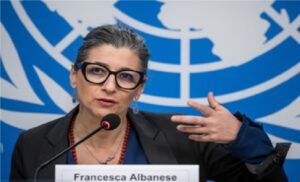
Francesca Albanese, the UN Special Rapporteur on the occupied Palestinian territories, was less restrained. In a statement issued on 3 May 2026, she called the Israeli screening procedures “a flagrant violation of the prohibition on torture and ill‑treatment, and an act of deliberate, collective humiliation designed to coerce permanent displacement, a crime against humanity.” She urged the International Criminal Court to include the Rafah crossing practices in its ongoing investigation into the situation in Palestine.
The Displacement Tactic: Bribes, Threats, And A 27% Compliance Rate.
Behind the handcuffs and insults lies a strategic objective: thinning Gaza’s population. The offers of housing, salaries, and safe passage out of the Strip are not isolated bribes but part of a pattern. A report published by Middle East Monitor in early 2026 tracked the fates of Palestinians processed at Rafah and found a stark statistic: only 27% of those who underwent the screening process were ultimately allowed back into Gaza. The rest were either turned away, pressured into accepting “voluntary” emigration, or detained indefinitely in holding facilities near the border. Israel’s Coordinator of Government Activities in the Territories (COGAT) has denied the existence of such inducements, saying that “assistance to those wishing to relocate is a humanitarian act.” But returnees say the choice is presented with menaces.
“They asked me to tell them what happens around me, what I see, and to do what they ask,” Sabah al‑Rakab recalled. “It was clear: cooperate as an informant, or leave forever.”
The interrogation logs, as reported by survivors, merge seamlessly with rhetoric emanating from the Israeli cabinet. Finance Minister Bezalel Smotrich and National Security Minister Itamar Ben‑Gvir have repeatedly called for the “voluntary emigration” of Palestinians from Gaza and the re‑establishment of Israeli settlements. In December 2025, Ben‑Gvir told a Knesset committee, “Gaza is the land of our forefathers. We will return and build, and those who wish to leave, we will help them.” The interrogators’ statement, “Gaza belongs to us”, is not a rogue soldier’s slogan; it is a policy position that has been mainstreamed.
International Silence And The Grey Zones Of Responsibility:
The muted international response has emboldened the architects of the screening regime. Egypt, which hosts the stranded Palestinians and has facilitated the crossing, finds itself in an uncomfortable position. A senior Egyptian security official, speaking on background to the Associated Press in April, expressed frustration: “We are doing our part to ensure that the crossing operates, but we have no control over the Israeli side. We hear the reports of abuse and have raised them with Tel Aviv, but our leverage is limited. We cannot endanger the ceasefire.” Egyptian civil society organisations have been less restrained, with the Egyptian Commission for Rights and Freedoms calling on the government to suspend cooperation until independent monitors are given full access.
The Palestinian Authority, which has personnel at the second checkpoint, has been accused by some returnees of complicity. “The PA‑affiliated security members searched us and said nothing when we were taken to the Israelis,” Yasmeen Mohamed said. The PA has defended its role, saying it is working to “facilitate the return of our people under extremely difficult conditions,” but it has not publicly condemned the interrogations. The Ramallah leadership’s ambivalence stems from its delicate political position: it seeks to demonstrate governance ability but is deeply unpopular in Gaza and wary of being seen as subcontractors of the occupation.
Gisha, Legal Centre for Freedom of Movement, an Israeli human rights group, petitioned the Israeli High Court of Justice on 5 February 2026, demanding that the screening procedures be brought into compliance with international law. In a deposition, Gisha director Tania Hary stated: “The Rafah crossing is not a border between two sovereign states; it is a passage point for people living under Israeli military occupation. Israel’s obligations are clear: it must facilitate the return of civilians to their homes, not subject them to a gauntlet of abuse designed to drive them away.” The court has yet to rule.
Meanwhile, the International Criminal Court prosecutor, Karim Khan, confirmed in March that his office is “closely monitoring” reports from Rafah. Several returnees, with the assistance of the Palestinian Centre for Human Rights, submitted formal complaints to the ICC in April, detailing torture and forcible transfer. If the Court eventually issues arrest warrants related to the 2024 genocide, legal experts say the border screening regime could form a separate, continuing count of the crime against humanity of forced displacement.
A Trickle Of Returns, A Sea Of Stranded:
For the 80,000 Palestinians still marooned in Egypt, many living in overcrowded apartments and reliant on dwindling aid, the wait is excruciating. The Rafah crossing’s limited reopening has so far served only to manage a symbolic number of cases, primarily women, children, and the elderly, while tens of thousands of men, including husbands separated from wives, remain blocked. Egypt’s security concerns about Hamas infiltration offer Israel a ready pretext to stonewall.
In the rubble‑strewn neighbourhoods of Rafah, where Yasmeen Mohamed returned, the shock of arrival is layered upon the trauma of the crossing. “I recognised my neighbourhood in Khirbat Al‑Adas only because I knew the distance from the crossing,” she said. “The entire area was levelled. There was only sand, no trees, no homes, no beautiful villas, not even the water well we dug in front of our house. I immediately remembered the clementine tree in our garden. I still see the clementine tree. I can even smell it.”
Israel’s control of the Morag Corridor just north of Rafah has carved the city off from the rest of the Strip, turning it into a depopulated buffer zone. Despite the ceasefire, military patrols continue, and reconstruction is blocked by the Israeli ban on the entry of construction materials, which are classified as “dual‑use.” The city that once housed 275,000 people now lies in silent testimony.
“I Would Choose Gaza Every Time”:
Despite the ordeal, those who have returned cling to an unshakeable resolve. Every returnee interviewed by Quds News Network, TNA, and Middle East Monitor, without exception, said they would choose Gaza again, even knowing the horror that awaited them at the border.
“I lived in an occupation‑free country. It’s really amazing to breathe freedom, but if it’s not in our homeland, then it’s not our freedom,” Routana al‑Rakab said. “Exile is a burden, and home is a blessing. I will never choose to leave without returning. It’s my homeland. Homeland is like the soul, it’s irreplaceable.”
Sabah al‑Rakab echoed the sentiment. “I lived in Egypt for more than a year and never felt comfortable or safe. I only feel safe in Gaza, even if it is destroyed.”
As the international community watches and largely averts its gaze, the machinery at Rafah grinds on. It is a system calibrated not for security, but for subjugation, a protracted act of violence dressed in the language of bureaucratic procedure. And at its heart lies a simple, chilling message delivered hour after hour inside those plastic tents: you have no home to return to. This land is no longer yours.
But the women, the wounded, the elderly who walk through the final gate, clutching a single permitted phone and the memory of a clementine tree, give the lie to that message. Their very presence in the rubble is an act of defiance, a refusal to cede identity, memory, or place to the forces that seek to erase them.
Source: Multiple News Agencies
Submissions:
For The Secure Submission Of Documentation, Testimonies, Or Exclusive Investigative Reports From Any Global Location, Please Utilise The Following Contact Details For Our Investigations Desk: enquiries@veritaspress.co.uk or editor@veritaspress.co.uk
Help Support Our Work:
Popular Information is powered by readers who believe that truth still matters. When just a few more people step up to support this work, it means more lies exposed, more corruption uncovered, and more accountability where it’s long overdue.
Help Protect Independent Journalism, Which Is Currently Under Attack.
If you believe journalism should serve the public, not the powerful, and you’re in a position to help, becoming a DONATOR or a PAID SUBSCRIBER truly makes a difference.
DONATION APPEAL: If You Found This Reporting Valuable, Please Consider Supporting Independent Journalism.
Help Support Our Work – We Know, We Know, We Know …
Seeing these messages is annoying. We know that. (Imagine what it’s like writing them … )
Your support fuels our fearless, truth-driven journalism. In unity, we endeavour to amplify marginalised voices and champion justice, irrespective of geographical location.
But it’s also extremely important. One of Veritas Press’s greatest assets is its reader-funded model.
1. Reader funding means we can cover what we like. We’re not beholden to the political whims of a billionaire owner. We are a small, independent and impartial organisation. No one can tell us what not to say or what not to report.
2. Reader funding means we don’t have to chase clicks and traffic. We’re not desperately seeking your attention for its own sake: we pursue the stories that our editorial team deems important and believe are worthy of your time.
3. Reader Funding: enables us to keep our website and other social media channels open, allowing as many people as possible to access quality journalism from around the world, particularly those in places where the free press is under threat.
We know not everyone can afford to pay for news, but if you’ve been meaning to support us, now’s the time.
Your donation goes a long way. It helps us:
- Keep the lights on and sustain our day-to-day operations
- Hire new, talented independent reporters
- Launch real-time live debates, community-focused shows, and on-the-ground reporting
- Cover the issues that matter most to our communities, in real time, with depth and integrity
We have plans to expand our work, but we can’t do it without your support. Every contribution, no matter the size, helps us stay independent and build a truly people-powered media platform.
If you believe in journalism that informs, empowers, and reflects the communities we serve, please donate today.
Donate Today.
GENEVA — A United Nations fact-finding mission has concluded there are “reasonable grounds to believe”
Iran’s GDP is projected to contract by 5.4 to 6.1% in 2026, its worst performance
The Trump administration is preparing a $2.8 billion weapons package for Israel containing 40,000 2,000-pound

Film alleges mass civilian deaths are routinely built into military decisions amid Israel’s genocidal war
The Israeli rights group says violence, displacement, economic strangulation, and settlement expansion form part of

Houthi forces have captured the historic Red Sea port of Mocha and are advancing on
London’s historic sanctions against Israeli settlements mark a watershed moment in UK foreign policy, but
With 95% of Gaza’s population now wholly dependent on aid and more than 90% stripped
India calls for Kashmir and Ladakh to appear only on its official map after a
ISLAMABAD – In the high-stakes political theatre of Pakistan, the battleground has shifted from the