Kamran Faqir is a volunteer investigative journalist and writer committed to exposing hidden truths and amplifying underreported stories. Driven by social justice, he brings sharp insight and fearless truth-telling to independent journalism. NUJ registered.
Online Article Date Published:
Article Date Modified:
16 minutes
Views:397
Listen to this article
Help support our mission, donate today and be the change. Every contribution goes directly toward driving real impact for the cause we believe in.
DEBEL, LEBANON— The Israeli military has bulldozed the solar power grid and water infrastructure of the predominantly Christian town of Debel in southern Lebanon, in a methodical operation that has cut off electricity and water to hundreds of civilians sheltering with Israeli permission. The destruction, captured on video and confirmed by local officials, the owner of the facility, and the Israel Defense Forces itself, marks the second major scandal to emanate from this single border village in less than ten days, following the smashing of a Jesus statue by an Israeli soldier that drew international condemnation.
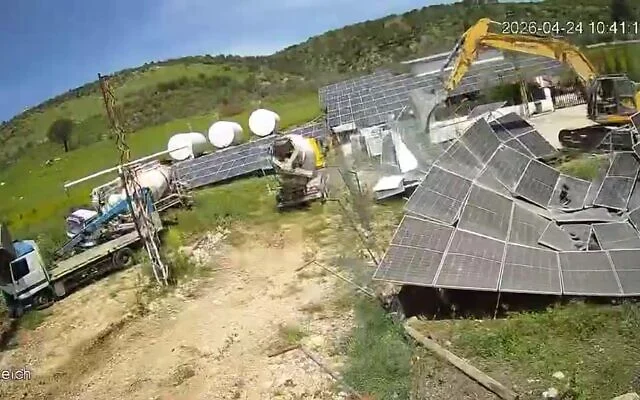
Israeli military excavators damage solar panels in the southern Lebanon Christian village of Debel, in footage aired by Lebanese media on April 25, 2026. (Screenshot X; used in accordance with Clause 27a of the Copyright Law)
The attack on Debel’s infrastructure has exposed a widening chasm between Israel’s public assurances and the reality on the ground, raising urgent questions about command responsibility, the intentionality of destruction in an uninhabitable campaign, and the deliberate weaponisation of water in a conflict that has already claimed over 2,500 lives.
The Debel Attack: “I Saw Everything”.
On April 24, 2026, Israeli military excavators methodically destroyed approximately 350 solar panels, three tractors, two generators, and multiple water pumps situated between the villages of Debel (also spelt Dibil), Qouzah, and Aita al-Shaab in the Bint Jbeil district. The facility, a private enterprise owned by George Hashem, supplied drinking water and water for daily use to all the villages in the area.
“An entire project has been destroyed,” Hashem told L’Orient Today, the agony palpable in his words. “My business supplies drinking water and water for daily use to all the villages in the area… Everyone is talking about the solar panels, but really, it is an entire project that was destroyed.”
Hashem, originally from Debel and now displaced to Beirut, was forced to watch the destruction of his life’s work in real-time. “I saw everything,” he said, as he witnessed the destruction live via his surveillance cameras before the Israeli army damaged those too.
The mukhtar of Debel, Lahoud Younes, confirmed it was impossible to reach the site to assess the full extent of the damage. He explained that the state electricity provider, Électricité du Liban (EDL), had long ceased supplying power to the locality due to damaged cables and infrastructure rendered inaccessible for repairs by the fighting. The solar grid and private generators were the town’s only lifeline, a lifeline now severed.
According to Lebanese media, the destruction was not confined to the solar and water installation. Israeli forces also damaged homes, roads, and olive trees. LBCI Lebanon News reported that the Israeli army “continued demolition and vandalism operations in the border town of Debel, where it proceeded to bulldoze the solar panels that feed the town with electricity and the water station, in addition to some homes, roads, and olive trees”.
A Village Caught In A Second Scandal.
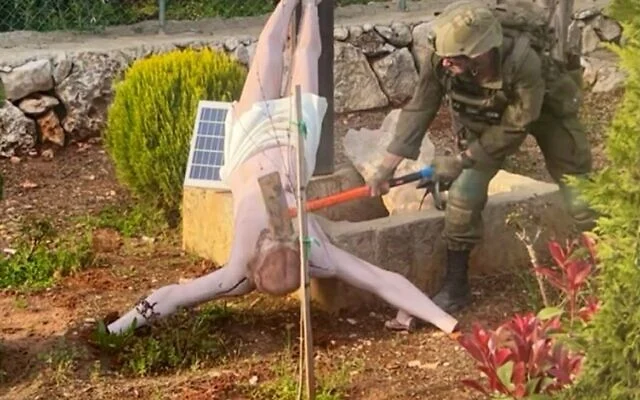
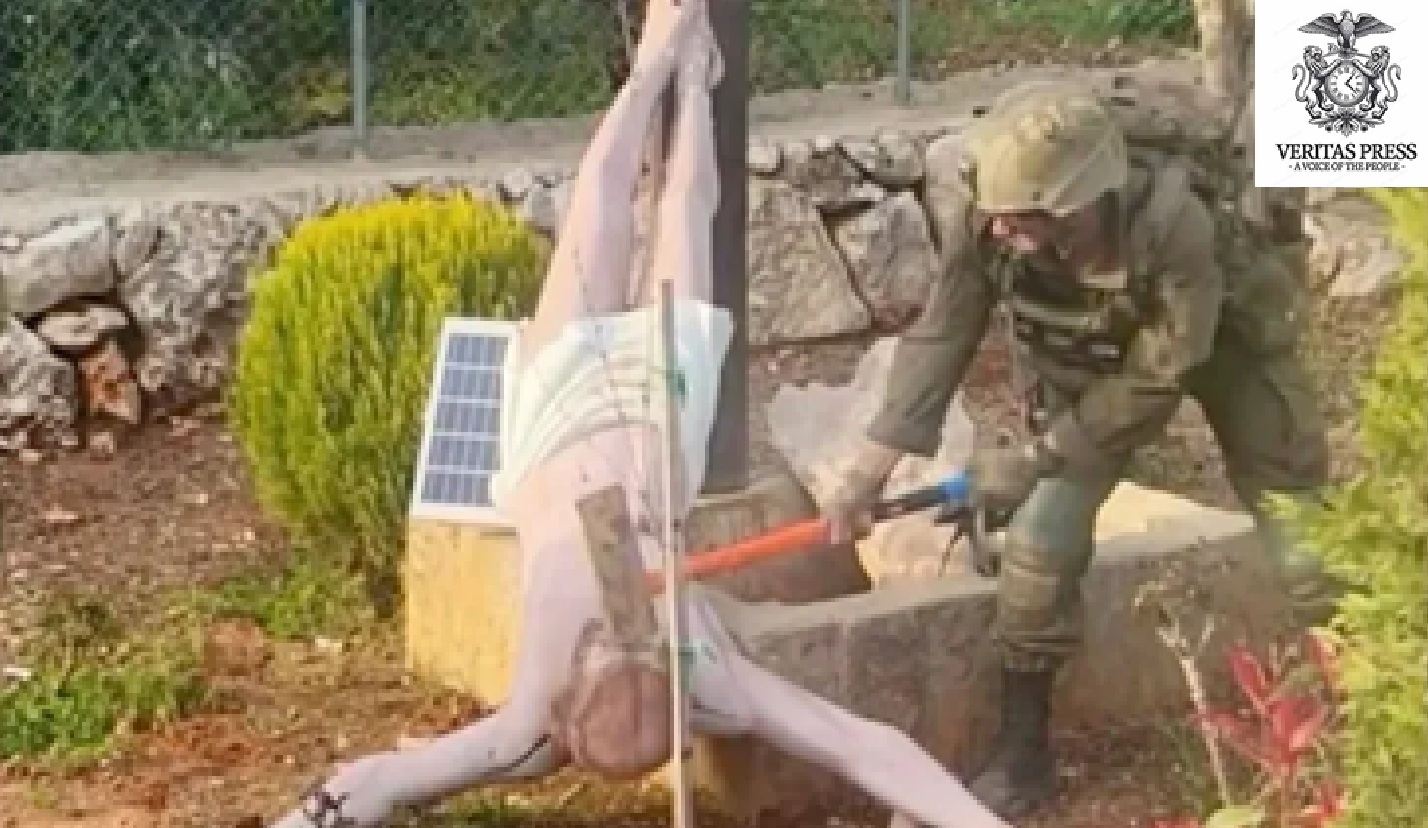
The infrastructure attack has landed with particular force because it followed just days after the desecration of a Christian religious symbol in Debel on April 19, 2026. An IDF soldier was photographed smashing a statue of Jesus with a sledgehammer at a small shrine in the garden of a family living on the edge of the village. A second soldier photographed the act while six others stood by without intervening.
An IDF soldier smashes a statue of Jesus in southern Lebanon, in an image uploaded to social media on April 19, 2026. (X/used in accordance with Clause 27a of the Copyright Law)
The response from the highest echelons of the Israeli government was swift and unequivocal. Prime Minister Benjamin Netanyahu wrote on X: “I was stunned and saddened to learn that an IDF soldier damaged a Catholic religious icon in southern Lebanon. I condemn the act in the strongest terms.” Foreign Minister Gideon Saar called the soldier’s actions “disgraceful and shameful,” adding, “We apologise for this incident and to every Christian whose feelings were hurt.”
The IDF subsequently announced that the soldier and the photographer had been dismissed from combat duty and sentenced to 30 days in military jail. Six other troops present were summoned for “clarification discussions.” IDF Chief of Staff Lt. Gen. Eyal Zamir condemned the incident, stating it “constitutes unacceptable conduct and a moral failure, far exceeding any acceptable standard and contradicting IDF values.”
In a deeply revealing detail, the Israeli military initially delivered a replacement statue, but it was reportedly smaller and styled differently from the original. Lebanese media published photos showing that a statue donated by the Italian contingent of UNIFIL more closely resembled the original. Photos later showed members of the community apparently relocating the IDF-donated statue elsewhere. The symbolism was unmistakable: a community, forced to accept a replacement from the force that had occupied them, rejecting that symbol on its own terms.
The IDF now faces a second investigation into its conduct in Debel. “The actions seen in the video do not align with the values of the IDF and the conduct expected of its soldiers,” the military stated, confirming the incident was under investigation.
However, some observers have expressed deep scepticism about the sincerity of these internal probes. As one outlet noted, “After a completely manufactured display of ‘remorse’…” over the Jesus statue, Israeli forces had returned to demolish parts of the same border town. The pattern appears to be one of infraction, apology, and repetition, a cycle that erodes the credibility of the investigations themselves.
Contradiction At The Heart Of Policy.
The Debel incidents have not only generated outrage; they have thrown into sharp relief what appears to be a fundamental contradiction at the heart of Israeli military policy in southern Lebanon. Debel is one of several Christian communities that Israel explicitly exempted from its mass evacuation orders. Defence Minister Israel Katz had publicly stated that the IDF would raze all Lebanese border villages with the exception of Christian communities.
Yet Debel, a majority Maronite Christian community, has now seen its religious symbols desecrated and its civilian infrastructure systematically destroyed. The contradiction points to a troubling gap between stated policy and the reality of what troops are doing on the ground, where the distinction between “evacuated” and “non-evacuated” villages appears to be collapsing in practice.
The Times of Israel reported that the IDF “has insisted that it is only destroying Hezbollah infrastructure, which it says is often embedded within civilian homes”. But in Debel, what was destroyed was a private water business supplying multiple villages, along with solar panels, tractors, and generators, hardly the material of a terrorist infrastructure. A source in the village informed Israeli public broadcaster KAN that the solar panels were “civilian infrastructure, being used by hundreds of residents of the village who had not been evacuated from their homes, with the IDF’s permission”.
The “Rafah And Beit Hanoun Model”.
To understand what happened in Debel, one must look beyond the incident itself to the stated doctrine of Israel’s defence minister. Israel Katz has been explicit about the military’s intentions for southern Lebanon. “All houses in villages near the border in Lebanon will be demolished in accordance with the Rafah and Beit Hanoun models in Gaza,” Katz declared last month. He added that after the military operations conclude, Israel would maintain control “over the entire area up to the Litani River”.
This is not an isolated statement but a repeatedly articulated policy. Katz reiterated that “all the houses in the villages adjacent to the border in Lebanon will be demolished in accordance with the Rafah and Beit Hanoun model in Gaza, in order to remove once and for all the border-adjacent threats from the residents of the north”.
The invocation of Rafah and Beit Hanoun is deeply significant. Satellite imagery reviewed by CNN reveals that the Israeli military destroyed 90% of homes in Rafah, in southern Gaza. Rights groups have described this tactic as “domicide”, the systematic destruction of civilian housing to render entire areas uninhabitable. “The possibility that Hezbollah may use some civilian structures in Lebanon’s border villages for military purposes does not justify the wide-scale destruction of entire villages along the border,” said Ramzi Kaiss, Lebanon researcher for Human Rights Watch.
CNN’s review of satellite imagery from April 2026 confirms that “bulldozers tearing down buildings and demolitions razing whole villages to the ground” have continued even after the ceasefire agreement. The Guardian documented mass remote detonations in the villages of Taybeh, Naqoura, and Deir Seryan, rigging homes with explosives and detonating them in massive blasts.
Water As A Weapon: The Gaza Playbook In Lebanon.
The destruction of Debel’s water infrastructure fits a larger, documented pattern. Experts and humanitarian organisations argue that Israel is systematically weaponising access to water in southern Lebanon as part of a deliberate strategy to displace the population and create an uninhabitable “buffer zone.”
“Israel is ‘deliberately’ attacking Lebanon’s water, experts say, aiming to displace or kill southern Lebanon’s population,” Al Jazeera reported in a comprehensive investigation published on April 22, 2026.
Oxfam International has been particularly blunt in its assessment. “It’s clear that the Israeli Forces are repeating the same pattern in Lebanon as they did in Gaza. Attacking civilians, critical civilian infrastructure, emergency services personnel,” said Bachir Ayoub, Oxfam’s Lebanon Country Director. He continued: “The impunity Israel enjoyed in Gaza as it committed water war crimes is again on full display. The world has shown Israel can do what it wants, whenever it wants, without repercussion and again it is civilians who are paying the ultimate price for this inaction.”
The numbers paint a devastating picture. During the 2024 escalation alone, Israel damaged more than 45 water networks in Lebanon, impacting almost half a million people and increasing the risk of disease outbreaks. In just the first four days of the renewed conflict in March 2026, Israel damaged at least seven critical water sources, including reservoirs, pipe networks, and pumping stations, that supplied water to almost 7,000 people in the Bekaa area alone.
“Not only is this about destroying access to water, but it’s also actually inducing waterborne diseases, the highest cause of infant mortality in developing countries, and inducing this in the population,” Rami Zurayk, professor at the American University of Beirut, told Al Jazeera. “So it’s an indirect biological weapon.”
International Humanitarian Law is clear on this matter. The Geneva Conventions, which Israel ratified in 1951, “obliges parties to a conflict to take constant care to spare water resources and water infrastructure,” according to Tadesse Kebebew, a legal researcher at the Geneva Water Hub. Using deprivation of water as a method of warfare is outlawed, and any intentional deprivation may constitute a war crime.
A Systematic Campaign Of Uninhabitability:
The attack on Debel’s infrastructure is not an isolated incident but part of what Lebanese officials describe as a systematic campaign to prevent the return of residents to southern Lebanon. Asharq Al-Awsat reported on April 22 that “Lebanese ministerial sources noted that the approach is part of a policy of displacement. Residents have been repeatedly warned not to return to more than 80 villages, in what appears to be an effort to create an uninhabited buffer zone lacking basic services.”
The breadth of destruction extends far beyond water and electricity. According to the same report, eight southern hospitals have been partially destroyed and are now completely out of service: Tebnin Governmental Hospital, Sheikh Ragheb Harb Hospital, Salah Ghandour Hospital, Hiram Hospital, Jabal Amel Hospital, Hasbaya Governmental Hospital, and Bint Jbeil Governmental Hospital. More than 100 ambulances have been destroyed, and 121 doctors and paramedics killed.
The education sector has been similarly devastated. Public schools in Dhayra, Bustan, Yarin, and Tayr Harfa have been destroyed. Vocational institutes in Khiam and Qantara have been completely destroyed, with a dozen more sustaining partial damage. A source at the education ministry stated that targeting schools aims “to undermine the population’s ability to remain in their towns,” forcing families to relocate in search of schooling for their children.
In Tyre, the destruction of all six bridges over the Litani River has isolated entire regions. Hassan Dbouk, President of the Union of Tyre Region Municipalities, stated: “Israel doesn’t respect international law. It’s destroying everything, mosques, religious places, schools, clinics, the vicinity of hospitals… To me, the scenario followed in Lebanon is the same as Gaza.”
Ali Khreis, a Lebanese Parliament member, framed the destruction in explicitly political terms: “They want to prevent people from going back home. This is a type of political pressure. Israel is doing this so that Lebanon will submit to its demands. Despite what is happening, we can’t submit to the Israeli pressure, whatever the cost is.”
The Fragile Ceasefire And Its Violations:
The destruction in Debel occurred under the shadow of a ceasefire that was implemented on April 16, 2026, and subsequently extended to mid-May. Yet, the truce has been characterised by systematic violations from its inception.
Israeli Prime Minister Benjamin Netanyahu has accused Hezbollah of dismantling the ceasefire: “It must be understood that Hezbollah’s violations are, in practice, dismantling the ceasefire”. The IDF has cited Hezbollah’s launch of explosive-laden drones as a “blatant violation of the ceasefire understandings”.
But Hezbollah has forcefully rejected these accusations, arguing that its operations are responses to Israeli violations that began the moment the truce took effect. In a statement, Hezbollah said its attacks were “a legitimate response to the enemy’s persistent violations of the ceasefire since the first day of the announcement of the temporary truce”. The group’s full statement carried a sharper edge: “Hezbollah affirms clearly and firmly that the enemy’s continued ceasefire violations… and above all its continued occupation of Lebanese territory and violations of its sovereignty will be met with a response and a resistance that is present and ready to defend its land and people.”
Hezbollah has also directed fierce criticism at the Lebanese authorities themselves, accusing the government of having “remained silent and been incapable of fulfilling their most basic national duties towards their land and people, watching as the enemy blows up homes and burns” Lebanese land. The group asserted it would “not wait for or bet on disappointing diplomacy that has proven its failure, nor on an authority that has failed to protect the nation”.
The Toll And The Silence:
Since the war was renewed on March 2, 2026, the human toll has been staggering. According to Lebanon’s Health Ministry, at least 2,509 people have been killed and 7,755 wounded by Israeli attacks. Other reports cite earlier figures of around 2,300 killed, more than 7,500 wounded, and over 1.2 million displaced.
Yet despite this toll and the mounting evidence of systematic infrastructure destruction, the international response has been muted. Oxfam has been direct in its accusation: “Despite the scale of destruction and mounting evidence of Israel’s atrocities in Gaza, Oxfam says the international community remains complicit in its silence and, in many cases, supports Israel as it continues to occupy and invade parts of Lebanon.”
Father Fadi Falfel, a priest in Debel, gave voice to the despair of those caught in the middle: “We have every kind of crisis. We thought the ceasefire would bring us some relief, but we’re still surrounded, unable to travel to and from the town. There are some houses on the edge of town that we’re barred from accessing.”
The Israeli military, for its part, maintains that it is “working with aid agencies to meet the humanitarian needs of Debel and other villages”. Yet for the residents of Debel, who have watched their holy symbols desecrated, their power grid bulldozed, and their water supply severed, all while living in a village explicitly exempted from evacuation, such assurances ring hollow.
In Debel, the water pumps are silent, the solar panels lie in twisted heaps, and a community that Israel promised to protect finds itself asking the same question that echoes across southern Lebanon: if this is what happens in a Christian village under Israeli protection, what fate awaits those villages given no such assurances at all?
Source: Multiple News Agencies
Submissions:
For The Secure Submission Of Documentation, Testimonies, Or Exclusive Investigative Reports From Any Global Location, Please Utilise The Following Contact Details For Our Investigations Desk: enquiries@veritaspress.co.uk or editor@veritaspress.co.uk
Help Support Our Work:
Popular Information is powered by readers who believe that truth still matters. When just a few more people step up to support this work, it means more lies exposed, more corruption uncovered, and more accountability where it’s long overdue.
Help Protect Independent Journalism, Which Is Currently Under Attack.
If you believe journalism should serve the public, not the powerful, and you’re in a position to help, becoming a DONATOR or a PAID SUBSCRIBER truly makes a difference.
DONATION APPEAL: If You Found This Reporting Valuable, Please Consider Supporting Independent Journalism.
Help Support Our Work – We Know, We Know, We Know …
Seeing these messages is annoying. We know that. (Imagine what it’s like writing them … )
Your support fuels our fearless, truth-driven journalism. In unity, we endeavour to amplify marginalised voices and champion justice, irrespective of geographical location.
But it’s also extremely important. One of Veritas Press’s greatest assets is its reader-funded model.
1. Reader funding means we can cover what we like. We’re not beholden to the political whims of a billionaire owner. We are a small, independent and impartial organisation. No one can tell us what not to say or what not to report.
2. Reader funding means we don’t have to chase clicks and traffic. We’re not desperately seeking your attention for its own sake: we pursue the stories that our editorial team deems important and believe are worthy of your time.
3. Reader Funding: enables us to keep our website and other social media channels open, allowing as many people as possible to access quality journalism from around the world, particularly those in places where the free press is under threat.
We know not everyone can afford to pay for news, but if you’ve been meaning to support us, now’s the time.
Your donation goes a long way. It helps us:
Keep the lights on and sustain our day-to-day operations
Hire new, talented independent reporters
Launch real-time live debates, community-focused shows, and on-the-ground reporting
Cover the issues that matter most to our communities, in real time, with depth and integrity
We have plans to expand our work, but we can’t do it without your support. Every contribution, no matter the size, helps us stay independent and build a truly people-powered media platform.
If you believe in journalism that informs, empowers, and reflects the communities we serve, please donate today.
Kamran Faqir is a volunteer investigative journalist and writer committed to exposing hidden truths and amplifying underreported stories. Driven by social justice, he brings sharp insight and fearless truth-telling to independent journalism. NUJ registered.
SEATTLE, TEHRAN — The U.S. Department of Homeland Security (DHS) will allow Iran’s national football team to enter the country 48 hours before their critical World Cup match against Egypt on Friday, a modest concession in a tournament where Team Melli’s travel conditions have sparked claims of oppression and competitive disadvantage.