Kamran Faqir is a volunteer investigative journalist and writer committed to exposing hidden truths and amplifying underreported stories. Driven by social justice, he brings sharp insight and fearless truth-telling to independent journalism. NUJ registered.
Original Article Date Published:
Article Date Modified:
13 minutes
Views:400
Listen to this article
Help support our mission, donate today and be the change. Every contribution goes directly toward driving real impact for the cause we believe in.
BEIJING/BANGKOK – On April 24, 2026, as a late-afternoon Bangkok sun softened the hard edges of Government House, a carefully choreographed piece of political theatre unfolded. Thailand’s new prime minister, Anutin Charnvirakul, gestured toward a sleek, dark-grey BYD Sealion 7 electric vehicle. He opened the front passenger door and waited for his guest, Chinese Foreign Minister Wang Yi, to settle in before taking the wheel. The image was unmistakable: the leader of a nation once synonymous with luxury Western automobiles was literally driving a Chinese car, steering his country’s most important bilateral relationship not just into a new “golden 50 years,” but into a geopolitical embrace that is rapidly redefining the contours of mainland Southeast Asia.
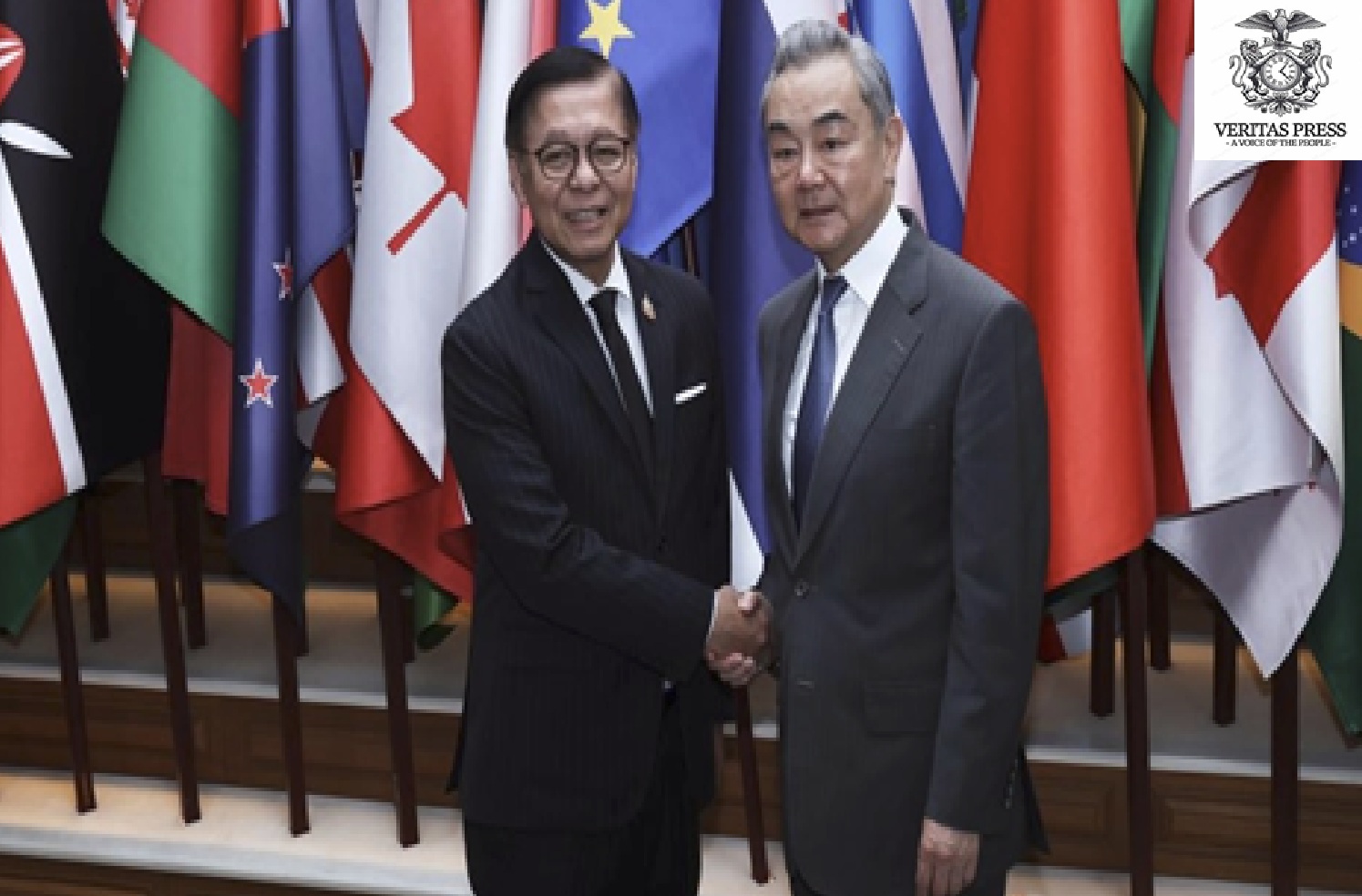
This was not merely a celebration of the 50th anniversary of diplomatic ties, which had been lavishly commemorated just months earlier with a historic state visit to Beijing by King Maha Vajiralongkorn. This visit was a working summit designed to consolidate a complex and at times contradictory agenda. Over two days, from April 24 to 25, Wang Yi and his counterpart, Deputy Prime Minister and Foreign Minister Sihasak Phuangketkeow, held the third meeting of their bilateral Consultation Mechanism. The agenda fused economic ambition, a crackdown on transnational crime, the mediation of a bloody border conflict with Cambodia, and the re-architecture of regional multilateralism under the banner of Lancang-Mekong Cooperation 2.0.
Yet, beneath the bonhomie of durian snacks and “family-like” rhetoric, the talks laid bare an uncomfortable reality. Bangkok is walking a tightrope. It is seeking to guarantee its economic future through Chinese investment and its security through Chinese cooperation, while simultaneously relying on Beijing to mediate a conflict where many Thais view China as leaning toward its all-weather ally, Cambodia. This is the fundamental friction in a relationship that is now more consequential than ever.
I. The Strategic Choreography: A Web Of Initiatives.
Wang Yi’s trip to Thailand was the central leg of a meticulously planned three-nation tour. He had arrived from Phnom Penh, where, alongside Chinese Defence Minister Dong Jun, he had inaugurated a groundbreaking “2+2” strategic dialogue with Cambodia, a mechanism previously reserved for only a handful of China’s closest partners. After leaving Bangkok, he was due in Myanmar. The sequence was deliberate: a powerful signal that Beijing’s interactions with its southern neighbours are no longer discrete bilateral affairs but are being woven into a single, integrated strategic fabric.
For Thailand, the centrepiece of this integration is the agreement to formulate a new “Joint Action Plan”, a five-year blueprint to align the country’s development strategy with China’s 15th Five-Year Plan. Crucially, the talks also served to formally endorse the new government of Prime Minister Anutin, who assumed office just months ago. Wang Yi publicly declared China’s support for the new administration, stating, “China is ready to continue to be a reliable strategic partner of Thailand, support the new Thai government in leading its people to follow a development path that suits its national conditions”. In an era of global turbulence, a phrase both sides repeated, this was the political bedrock Anutin needed.
II. The Economic Embrace: Evs, Durians, And A Stalled Railway.
The economic component of the talks blended potent symbolism with stubborn logistical realities. Prime Minister Anutin, who recently switched from a Rolls-Royce to a BYD for his daily commute, is repositioning Thailand as the region’s electric vehicle hub, a strategy that Chinese giants like BYD and Zeekr are already fueling with significant investments. Wang Yi confirmed China’s readiness to expand cooperation in “new energy, infrastructure construction, and agriculture”.
This economic logic faces significant headwinds. The flagship project meant to anchor regional connectivity, the Thai-Chinese high-speed railway, is mired in difficulties. The first phase from Bangkok to Nakhon Ratchasima has reached only 52.4% completion, a full 28.2% behind the planned schedule of approximately 80%. While Phase 2, a 357-kilometre extension to Nong Khai on the Lao border with an investment of 341.3 billion baht, was hoping to start bidding in 2026, the delays have cast a shadow over dreams of a seamless pan-Asian rail link.
Agricultural trade, often the populist heartbeat of the relationship, also featured prominently. Anutin served his guest durian and khao lam (sticky rice in bamboo), a friendly prelude to what government sources described as a push for “larger Chinese purchase orders” for Thai farm products. Yet the tone was not purely transactionally benign. Wang Yi explicitly linked economic goodwill to security performance by expressing “hope that Thailand will intensify its efforts to crack down on online gambling and telecommunications fraud, creating a favourable environment for bilateral relations”. The message was clear: market access is contingent upon progress on security.
III. Crossing The Line: From Rhetoric To Raids On Transnational Crime.
No issue more starkly illustrates the shift from diplomatic theatre to coercive reality than the war on scam syndicates. What began in January 2025 as a Chinese plea, Wang Yi then urged ASEAN envoys to act, citing the case of actor Wang Xing, who was lured across the Thai-Myanmar border and forced into a scam compound in Shwe Kokko. This case has become an existential test of Thai sovereignty over its borderlands.
By April 2026, the crackdown was yielding tangible results, driven by direct intelligence from the Chinese Embassy. Thai police, in a dawn raid on a luxury pool villa in Pattaya, arrested a 32-year-old man identified as a key figure in a network running 239 online gambling platforms with over 330,000 Chinese users and a staggering 13.18 billion baht ($410 million) turnover. In a significant development, Chinese authorities had urgently sought him, and he had allegedly attempted to evade arrest by altering his nationality and using a passport from the Caribbean nation of Saint Kitts and Nevis to enter Thailand. Concurrently, the Anti-Money Laundering Office froze assets linked to various fraud networks totalling over 20.39 billion baht ($635 million) in a matter of weeks. The scale of these operations confirms that the syndicates are not merely criminal enterprises; they are parallel financial systems capable of destabilising economies and corrupting institutions.
During the Bangkok meetings, Anutin pledged to “intensify” this crackdown. Yet, for China, the issue is far from resolved. In a parallel development that underscored the gravity of the crisis, the United States Department of Justice charged two Chinese nationals with managing the industrial-scale Shunda Park cyberscam compound in Myanmar, demonstrating that these networks are now the target of a new, more muscular international law enforcement convergence. When China’s top diplomat uses the joint communique to reiterate a demand to “completely eradicate gambling and fraud,” it reflects a profound concern that these illicit economies, if left unchecked, could pollute the entire foundation of legitimate bilateral cooperation.
IV. The Third Party In The Room: Mediating A Bloody Border War.
While the third Consultation Mechanism was the formal venue, the ghost in the Thai and Chinese foreign ministries was the border conflict with Cambodia. The 2025 clashes were devastating: two rounds of fighting, first in July and then a more brutal resurgence in December, killed over 100 people and displaced more than 650,000 civilians. By April 2026, over 80,000 remained displaced, and cross-border trade had collapsed by nearly 40% in the first quarter to approximately $700 million.
The war has fundamentally redrawn the geopolitical map of the Mekong subregion. When the United States, under President Donald Trump, sponsored the Kuala Lumpur Peace Accord in October 2025, there was a brief moment of hope before the December offensive shattered the truce. With Washington subsequently consumed by conflict with Iran, China stepped into the vacuum, hosting trilateral talks at Fuxian Lake in Yunnan that produced the five-point Fuxian Consensus on December 29, 2025. This was Beijing’s signature “quiet way”, a non-confrontational, step-by-step approach that contrasts sharply with Western sanctions-heavy diplomacy.
Kin Phea, director of the International Relations Institute at the Royal Academy of Cambodia, described this method in detail: “Chinese diplomacy does not normally apply pressure on the conflict parties; their way of facilitation is normally quiet, urging both sides to solve issues peacefully and on an accepted consensus. They have applied this technique to the intervention and resolution of other international conflicts”. Complementing this state-to-state approach, a Track II dialogue convened in Beijing from April 20-21, bringing together over 70 media figures, scholars, and humanitarian representatives from all three nations to “explore pathways to resolve the longstanding border conflict through peaceful initiatives rather than military means”.
In Bangkok, Wang Yi’s position was that of a gentle but persistent mediator. He expressed hope that both sides would “consolidate the ceasefire situation, resume bilateral contacts, and resolve border disputes as soon as possible”. Prime Minister Anutin and Foreign Minister Sihasak both publicly thanked China for its efforts. Yet, the bitter reality on the ground contradicts this diplomatic harmony. Thailand’s foreign minister had just weeks earlier declared that his country was “still not ready” for Joint Boundary Commission talks, prioritising internal procedures first. Crucially, Sihasak had categorically rejected Cambodian accusations of “occupation” in a February interview with France 24, insisting troops remain in their positions under the ceasefire while accusing Phnom Penh of continuous encroachment and of “internationalising the conflict”.
Cambodia’s perspective is starkly different. Cambodian Prime Minister Hun Manet publicly declared that “Cambodia will not accept illegal Thai occupation or forced border changes”. At the United Nations ECOSOC forum, Cambodian delegate H.E. Chou Heng framed the conflict’s toll in stark humanitarian terms: over 100 deaths, tens of thousands of displaced women and children, and dozens of closed schools and health facilities. “Sustainable peace and sustainable development are inseparable,” he stated, directly linking the conflict to Cambodia’s faltering progress on the Sustainable Development Goals.
A survey conducted by the ISEAS–Yusof Ishak Institute captured a deeper regional anxiety: while 38.9% of respondents acknowledged ASEAN had taken “active steps” to manage the conflict, a full 34.7% saw the organisation as “slow and ineffective”. This perception gap between elite diplomacy and regional confidence is precisely the space China is seeking to fill, positioning itself as the indispensable stabiliser in a neighbourhood where ASEAN’s consensus-based, non-interference principles appear increasingly ill-suited to acute crises.
V. The Bigger Picture: The LMC 2.0 And A Glimpse Of The Future
Following the formal meetings in Bangkok, the two foreign ministers decamped to the southern resort province of Krabi for an informal retreat on April 25. Here, against the backdrop of limestone cliffs and turquoise water, the agenda shifted to green economy, energy security, and the digital sector.
Crucially, they also agreed to “actively build an LMC 2.0,” upgrading a decade-old framework connecting China, Cambodia, Laos, Myanmar, Thailand, and Vietnam. This pivot is not cosmetic. It aims to deepen security cooperation through the “Safe Lancang-Mekong” joint operation, which has become a central mechanism for coordinating the anti-scam crackdown, economic integration through a potential new Lancang-Mekong Economic Development Belt, and the establishment of a permanent secretariat to institutionalise what has been a loose arrangement. For Beijing, this represents an effort to provide a China-centric institutional anchor for a region that is simultaneously managing the fallout from the Cambodia-Thailand war, Myanmar’s civil conflict, and the broader fragmentation of global supply chains.
Conclusion: A Partnership Built On A Razor’s Edge.
As Wang Yi’s plane departed for Naypyidaw, he left behind a partnership that is both deeper and more brittle than the official communiques suggest. Thailand has secured renewed pledges of Chinese investment, a committed mediator for its most dangerous border conflict, and a powerful partner in the war against the criminal networks that thrive in the region’s ungoverned spaces.
The price, however, is strategic autonomy. By relying on Beijing to manage its dispute with Cambodia, Bangkok has ceded a degree of diplomatic agency and must now calibrate its national security posture to avoid alienating its most important economic partner. Cambodia’s ambassador to the UN had just spent the week of Wang Yi’s visit reminding the world, as he saw it, of the cost of Thai aggression, while Thailand’s own foreign minister had been forced onto French television to deny charges of occupation.
The “new golden 50 years” has therefore opened with a paradox. The relationship has never been more multidimensional, yet it rests on a fundamental asymmetry. The durian and the diplomatic smiles, the joint patrols and the frozen bank accounts, and the quiet, behind-the-scenes mediation are all threads in a single, intricate tapestry. It is a partnership being woven not in the air-conditioned meeting rooms of Government House, but on a razor’s edge between dependence and sovereignty, and its durability will be tested not by the warmth of the next handshake, but by how it weathers the next crisis that spills across a contested border.
Source: Multiple News Agencies
Submissions:
For The Secure Submission Of Documentation, Testimonies, Or Exclusive Investigative Reports From Any Global Location, Please Utilise The Following Contact Details For Our Investigations Desk: enquiries@veritaspress.co.uk or editor@veritaspress.co.uk
Help Support Our Work:
Popular Information is powered by readers who believe that truth still matters. When just a few more people step up to support this work, it means more lies exposed, more corruption uncovered, and more accountability where it’s long overdue.
Help Protect Independent Journalism, Which Is Currently Under Attack.
If you believe journalism should serve the public, not the powerful, and you’re in a position to help, becoming a DONATOR or a PAID SUBSCRIBER truly makes a difference.
DONATION APPEAL: If You Found This Reporting Valuable, Please Consider Supporting Independent Journalism.
Help Support Our Work – We Know, We Know, We Know …
Seeing these messages is annoying. We know that. (Imagine what it’s like writing them … )
Your support fuels our fearless, truth-driven journalism. In unity, we endeavour to amplify marginalised voices and champion justice, irrespective of geographical location.
But it’s also extremely important. One of Veritas Press’s greatest assets is its reader-funded model.
1. Reader funding means we can cover what we like. We’re not beholden to the political whims of a billionaire owner. We are a small, independent and impartial organisation. No one can tell us what not to say or what not to report.
2. Reader funding means we don’t have to chase clicks and traffic. We’re not desperately seeking your attention for its own sake: we pursue the stories that our editorial team deems important and believe are worthy of your time.
3. Reader Funding: enables us to keep our website and other social media channels open, allowing as many people as possible to access quality journalism from around the world, particularly those in places where the free press is under threat.
We know not everyone can afford to pay for news, but if you’ve been meaning to support us, now’s the time.
Your donation goes a long way. It helps us:
Keep the lights on and sustain our day-to-day operations
Hire new, talented independent reporters
Launch real-time live debates, community-focused shows, and on-the-ground reporting
Cover the issues that matter most to our communities, in real time, with depth and integrity
We have plans to expand our work, but we can’t do it without your support. Every contribution, no matter the size, helps us stay independent and build a truly people-powered media platform.
If you believe in journalism that informs, empowers, and reflects the communities we serve, please donate today.
Kamran Faqir is a volunteer investigative journalist and writer committed to exposing hidden truths and amplifying underreported stories. Driven by social justice, he brings sharp insight and fearless truth-telling to independent journalism. NUJ registered.
SEATTLE, TEHRAN — The U.S. Department of Homeland Security (DHS) will allow Iran’s national football team to enter the country 48 hours before their critical World Cup match against Egypt on Friday, a modest concession in a tournament where Team Melli’s travel conditions have sparked claims of oppression and competitive disadvantage.