




Help support our mission, donate today and be the change. Every contribution goes directly toward driving real impact for the cause we believe in.
The Battle Of The Numbers: 50,000 Vs. 500,000.
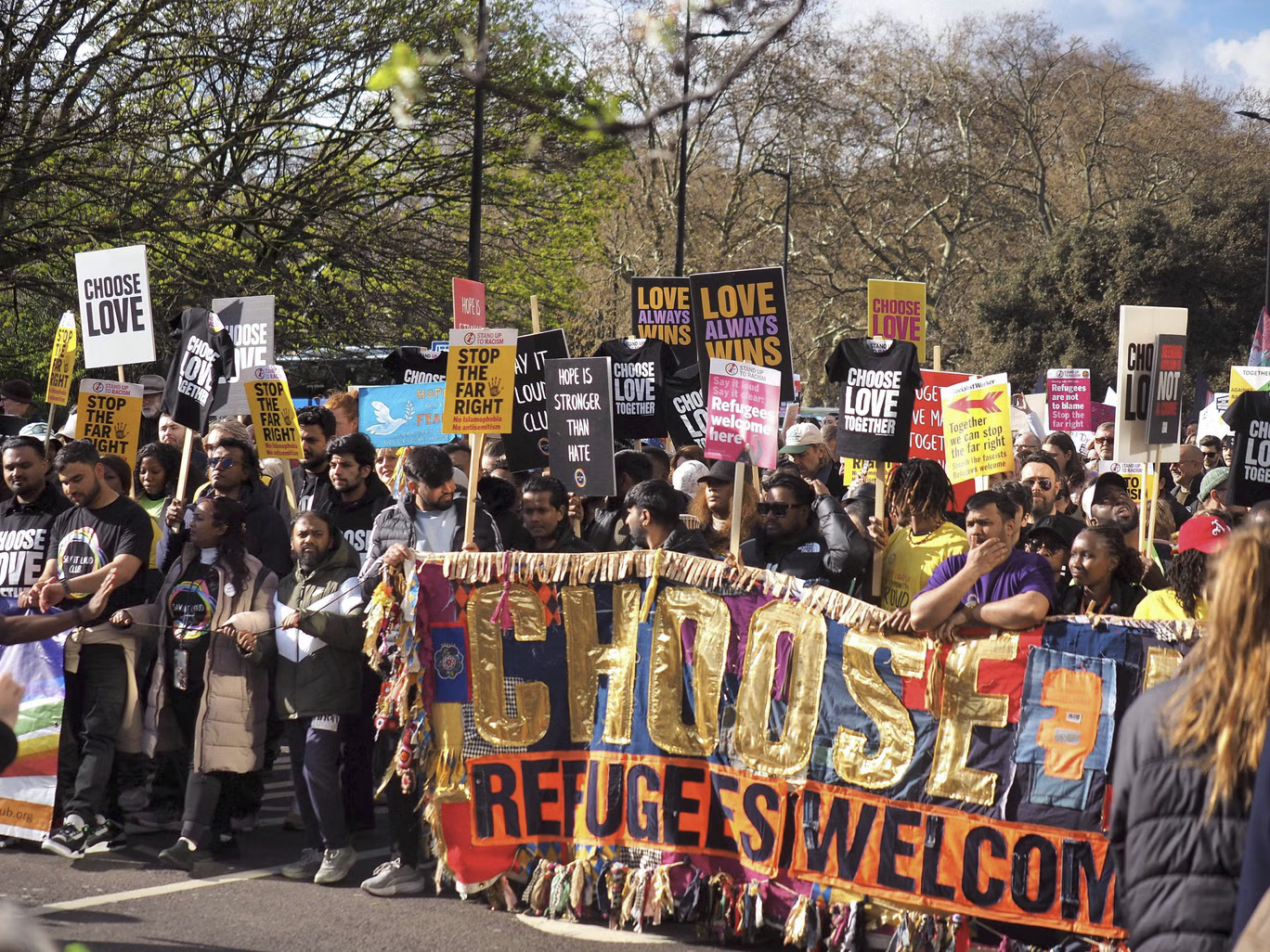
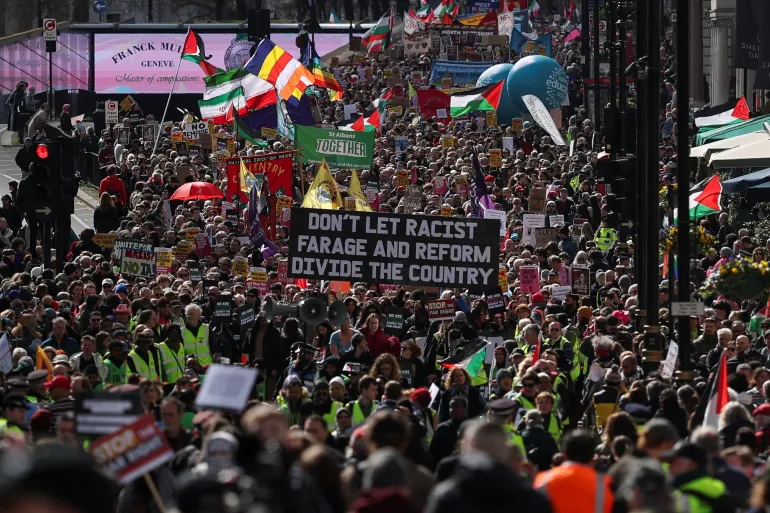
LONDON, UK – On a crisp Saturday in late March, central London became the stage for what organisers hailed as the largest anti-far-right demonstration in British history. The Together Alliance, a coalition of over 100 charities, campaign groups, and trade unions claiming to represent more than seven million people, brought tens of thousands, or perhaps hundreds of thousands, onto the streets from Park Lane to Trafalgar Square.
The discrepancy in crowd estimates tells its own story. “Our estimate is now that there are half a million people on this demonstration, the biggest demonstration ever against the far right,” declared Kevin Courtney, chairman of the Together Alliance coalition, addressing a sea of placards reading “No to racism, no to Trump” and “Refugees welcome”.
The Metropolitan Police, more conservatively, put the figure at approximately 50,000, though they conceded the numbers were difficult to gauge given how widely dispersed the crowds had become throughout central London.
This gap, an order of magnitude, reveals something fundamental about the nature of contemporary protest politics. For organisers, the claim of half a million was a rhetorical weapon, a psychological victory before the first chant had even faded. For the police, the lower estimate served operational and political purposes, downplaying both the scale of dissent and the logistical challenges of managing it. The truth, as is often the case, likely resides somewhere in between, but the dispute itself is the story.
The Shadow Of September: Remembering The Robinson Rally.
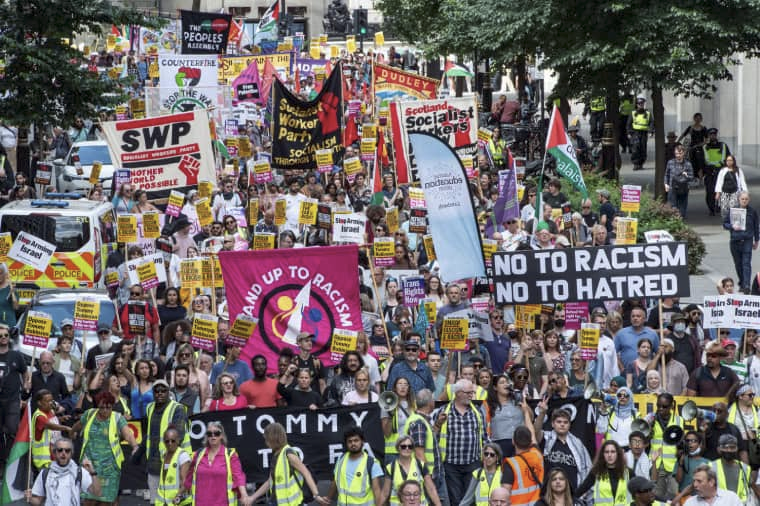
To understand why these streets are filled, one must look back six months. In September 2025, between 110,000 and 150,000 people gathered for Tommy Robinson’s “Unite the Kingdom” rally, the largest far-right mobilisation in modern British history. Tech billionaire Elon Musk addressed the crowd via video link, proclaiming the “destruction of Britain” due to “massive uncontrolled migration” and warning that “violence is coming” and “you either fight back or you die”.
The violence that day was not merely rhetorical. Twenty-six police officers were injured, four seriously, as bottles, flares, and other projectiles were hurled at police lines. Officers were kicked and punched while trying to prevent Robinson supporters from encircling counter-protesters. Nine people were arrested.
Prime Minister Sir Keir Starmer condemned the event, saying it had left people feeling “more scared than they were before.” But for many in the anti-racist movement, condemnation felt insufficient. The question that lingered through the autumn and winter was not whether the far right had mobilised; they clearly had, but whether the progressive opposition could match that energy.
Saturday’s march was the answer. “We believe that the majority of British people stand against the hatred and division and racism that was being encouraged at that demonstration,” said Sabby Dhalu, joint secretary of the Together Alliance and co-convenor of Stand Up To Racism, before the event.
A Coalition Of Conscience: The Who And Why.
The march brought together an extraordinary cross-section of British civil society. Trade unionists from the National Education Union, fire brigades union, and public service workers marched alongside faith groups, environmental activists, and community organisations. A group from Leicester Stand Up to Racism chanted “No borders, no nations, stop deportations!” while others carried signs reading “You cannot divide us”.
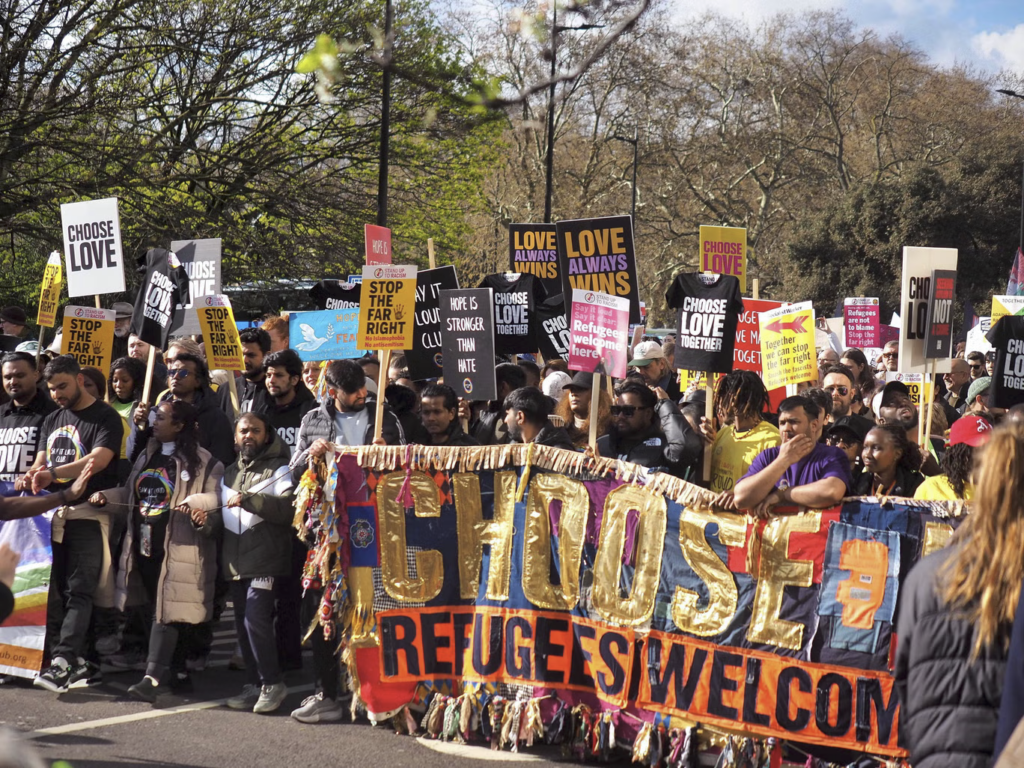
The celebrity contingent was substantial: actors Christopher Eccleston, David Harewood, Lenny Henry, Steve Coogan, and Maxine Peake; musicians Paloma Faith, Charlotte Church, Brian Eno, and Beverley Knight; comedian James Acaster. Onstage, performances from Self Esteem, Jessie Ware, Katy B, Joy Crookes, UB40, and Hot Chip provided the soundtrack.
But beneath the spectacle lay genuine anxiety. Steve Tribble, who travelled from Stroud with what he described as a “radical left-wing band” of musicians, articulated a sentiment shared by many: “I understand that populism is spreading all over the world and that people are trying to look for scapegoats; they’re angry. But we’re worried, that’s why we’re here”.
Emily Roth, a 23-year-old student, was more direct: “There’s a global toxic climate, and the UK is not fighting it. The government is obsessed with immigration, but that’s not our biggest problem”.
That last observation that the government itself has absorbed some of the far right’s framing is a tension running beneath the surface of the anti-racist movement, rarely acknowledged but impossible to ignore.
“Dressed As Big Oil”: The Environmental Dimension.
Among the more striking visual interventions was Woody, a protester in a grim reaper costume, who told the Guardian he had come “dressed as Big Oil.” His message was precise and provocative: “Big Oil are one of the major funders of Reform UK. We’re here to make that link that we need to cut the ties to fossil fuels”.
This intersection of environmental and anti-fascist politics, the linking of fossil fuel interests with the rise of the populist right, represents a strategic evolution. Woody, in his mid-50s, observed that he was hearing “people talking about left and right in a way that I haven’t heard since I was in school.” He stressed the importance of unity on the left: “It’s a numbers game in a way. This is really important to send a message”.
The Extinction Rebellion “red rebels”, figures with white-painted faces and red robes walking silently in the opposite direction, added a theatrical, almost haunting quality to the proceedings, drawing attention to the climate crisis amid the political sloganeering.
The Palestine Action Arrests: A Legal Minefield.
While the main march proceeded largely peacefully, a parallel drama unfolded outside New Scotland Yard, where 18 people were arrested for staging a protest in support of Palestine Action, a group proscribed as a terrorist organisation under the Terrorism Act 2000.
The arrests were the first under a revised Metropolitan Police policy announced just days earlier. In February, the High Court had ruled that the government’s ban on Palestine Action was unlawful, prompting the Met to pause arrests. But on March 26, the force reversed course, announcing that arrests would resume because the government’s appeal against the ruling would likely take several months.
Deputy Assistant Commissioner James Harman offered a blunt justification: “We must enforce the law as it is at the time, not as it might be at a future date. We must do that consistently and without fear or favour”.
The numbers are staggering: more than 2,700 people have been arrested for allegedly expressing support for Palestine Action since the group was banned. Those convicted face up to 14 years in prison. The trials of hundreds arrested since the High Court decision remain on hold while the legal battle continues.
The timing was delicate. The Met was simultaneously managing the main anti-far-right march, and the decision to resume Palestine Action arrests on the same day risked conflating two distinct protest movements in the public mind. Critics might argue that the force was choosing its battles and its targets, selectively.
The Counter-Protesters: Flags And Fractures.
No demonstration exists in a vacuum. A small group of counter-protesters appeared on Pall Mall, holding Israeli, American, and Iranian lion and sun flags, the latter a symbol of opposition to the current Iranian regime. Meanwhile, images on social media showed some on the main march carrying flags of the current Iranian regime, while journalist Paul Mason reported hearing “Zionists go home” chants from what he described as “far left antisemitic groups”.
These fissures within the broader progressive coalition are rarely highlighted in the celebratory coverage of large-scale demonstrations. Yet they matter. The presence of Iranian regime flags at an anti-far-right march, given the regime’s documented human rights abuses, its suppression of women’s rights, and its execution of protestors, raises uncomfortable questions about the consistency of the coalition’s stated values.
The Bishop of Croydon, Rosemarie Mallett, who addressed a church service before the demonstration, took a different tack. She stood with “all people of goodwill who seek to build diverse and inclusive communities” and said she and other Christians were “committed to building bridges rather than barriers and to living out Jesus’s command to love our neighbours”. Her remarks came against a backdrop of concern about the “use of Christian symbols” by far-right figures like Robinson, who in December led a carol concert claiming to “put the Christ back into Christmas.”
The Reform UK Counter-Strike: Farage Disrupted.
While the main march was winding down, a different kind of political theatre was unfolding in Croydon, where Nigel Farage was addressing a Reform UK rally. Two young activists from Green New Deal Rising, Alex, 30, and Kay, 23, interrupted his speech, shouting “Reform is not welcome here” to a chorus of boos as security moved in.
Alex, describing himself as “the son of a bricklayer and teaching assistant,” explained his motivation: “Nigel Farage claims to be on the side of working young people like me, but that is so far from the truth. Reform has consistently voted against workers’ rights, and their inhumane plans to deport our neighbours won’t improve the outlook for the next generation”.
The disruption was brief but symbolically potent: the same day that half a million (or 50,000) people marched against the far right in central London, a handful of activists managed to physically confront Farage himself in his own political space. Whether this represents a strategic model for future opposition or merely a photogenic stunt is a question the movement will have to answer.
The Numbers Game: What Does 500,000 (Or 50,000) Actually Achieve?
For all the energy and emotion on display, a more uncomfortable question lingers: what does a march actually accomplish?
The September Robinson rally, despite its violence and ugliness, demonstrated the far right’s capacity for mass mobilisation. It legitimised anti-immigrant rhetoric, provided a platform for figures like Musk to address a British audience directly, and created a sense of momentum that the anti-racist movement is still scrambling to counter.
But the March 2026 counter-march, whatever its true size, has its own limitations. The people who attended were, by and large, already converted. They were trade unionists, environmental activists, community organisers, the same networks that have powered progressive movements for decades. The challenge is not mobilising the base; it is expanding it.
Zack Polanski, the Green Party leader, addressed this tension directly in his speech: “Go back to your communities, to the community centres, to your trade unions, to your friends, to your neighbours. We must organise in our communities. Local elections are coming in just a few weeks “.
This was a recognition that marches, however large, are not an end in themselves. The real work happens in the months between demonstrations, in leafleting, door-knocking, community organising, and electoral politics. Polanski’s message was clear: don’t just march; vote. Don’t just chant; organise.
The Labour Question: Diane Abbott And The Shifting Centre.
The presence of Diane Abbott, now sitting as an independent after Labour withdrew the whip, was a reminder of the Labour Party’s own complicated relationship with anti-racist politics. Abbott, Britain’s first Black woman MP, told the cheering crowd that the turnout was “the largest anti-racist march that I have seen in my lifetime”.
But the absence of senior Labour leadership figures beyond Abbott and Dawn Butler was notable. While Labour officially opposes the far right, the party under Starmer has moved steadily rightward on immigration and cultural issues, adopting rhetoric and policies that would have been unthinkable under Jeremy Corbyn’s leadership.
Rose Batterfield, a retiree from central England, articulated this frustration: “I don’t really recognise Labour anymore. The idea that you can implement far-right ideas in order to stop the far right is nonsense”.
This is the progressive’s dilemma: in attempting to outflank the far right by adopting some of its premises, that immigration is a problem to be managed, that cultural identity requires defending, centrist parties risk legitimising the very framework they claim to oppose. The march was, in part, a rejection of that logic, an insistence that anti-racism requires not just opposition to the far right but a positive vision of multicultural democracy.
The Global Context: Trump, Iran, And The Transnational Far Right.
The march did not occur in isolation. It was part of a broader international moment, with simultaneous “No Kings” protests across the United States and Europe against President Donald Trump’s actions and the war in Iran. Billy Bragg, who performed at the London event, explicitly linked the two: “Like a blaring horn that never switches off, Donald Trump is a constant reminder of the cruel realities of the politics of division. We’re coming together on Saturday to encourage our fellow citizens to take a stand against this kind of politics being imported into the UK”.
The transnational nature of contemporary far-right politics, Musk addressing a London rally, Trump’s influence on British discourse, and the coordination between European far-right parties demand a transnational response. Yet the anti-racist movement remains largely national in its orientation, focused on domestic politics and local organising. Whether it can develop the internationalist infrastructure to match its opponents remains an open question.
The Road Ahead: Local Elections And Beyond.
The march took place less than six weeks before voters head to the polls for elections to the Scottish Parliament, the Welsh Senedd, and local councils across England. Reform UK, which has been leading in national polls for over a year, is predicted to perform strongly.
Robert Gadwick, 48, who travelled from Bath, expressed a common anxiety: “We’ve been there with Brexit, it’s all the same lies and yet some people decide to believe it. We need to speak the truth… voting for Reform is a vote for more chaos and more uncertainty”.
Sabby Dhalu struck a more confident note before the march, claiming that the size of the mobilisation had “intimidated the far-right” and that they were “not confident enough to stand against us”. But confidence can be fragile. The far right has not disappeared; it has merely postponed its next mobilisation. Robinson is reportedly planning a follow-up rally in mid-May.
Critique: The Limits Of Symbolic Politics.
For all its energy and good intentions, the Together Alliance march exposed certain limitations of the contemporary anti-racist movement.
First, the reliance on celebrity endorsements and musical performances, while effective at drawing crowds, can substitute for substantive political organising. A concert is not a strategy. A speech is not a policy.
Second, the coalition’s breadth, over 100 organisations, from trade unions to faith groups to environmental campaigns, is both its strength and its weakness. Holding together such a diverse coalition requires avoiding controversial positions, which often means avoiding the most difficult conversations about migration, borders, and economic redistribution.
Third, the movement has yet to develop an effective response to the far right’s dominance of digital spaces. While Robinson and Farage command millions of online followers, the anti-racist movement’s digital presence remains fragmented and reactive. A march, however large, reaches only those who are already in London; the far right’s propaganda reaches millions in their living rooms.
Finally, there is the question of political power. Marches do not elect governments. They do not pass legislation. They do not stop deportations. These require sustained, unglamorous, often frustrating engagement with the machinery of the state, the very machinery that many on the left view with deep suspicion.
Voices From The Ground.
The march’s power ultimately resided not in its headline speakers or celebrity attendees but in the thousands of ordinary people who made the journey.
Salvinder Dhillon captured the spirit: “What we have, they don’t have. We have the unity of the people, the fighting spirit of the people, and we’re going to win”.
UB40’s Jimmy Brown, speaking from the stage, offered a class-based analysis: “One thing that we’ve come to the conclusion of is that working people around the world have more in common with each other than they do with their elite, and the billionaire class. There are more of us than there are them”.
And Woody, the grim reaper of Big Oil, offered perhaps the most honest assessment of what the day meant: “It’s a numbers game in a way. This is really important to send a message. So I’m really excited about being here today and being part of a much bigger thing”.
Conclusion: Hope Is Not A Strategy.
The Together Alliance march was, by any measure, an impressive display of progressive mobilisation. Tens of thousands of people, whether 50,000 or 500,000, came together to declare that hatred and division would not go unanswered. They sang, they chanted, they carried signs, and they went home.
But hope is not a strategy. And in the weeks and months ahead, as local elections approach and the far right continues to organise, the question will not be whether Britain can fill its streets with protesters. The question will be whether those protesters can translate their energy into political power, at the ballot box, in their communities, and in the digital spaces where the battle for hearts and minds is increasingly fought.
“The tide is turning,” Zack Polanski told the crowd. But tides turn on their own schedule, indifferent to human wishes. The anti-racist movement cannot afford to wait for the tide. It must learn to swim against it.
None of this is inevitable. The far right does not possess some mystical advantage that guarantees its victory. What it possesses is energy, organisation, and a willingness to exploit fear and division, and these can be matched. Saturday’s march proved that. But marches are moments, not movements. The real test comes when the crowds disperse, when the hashtags fade, when the celebrities return to their studios. Will the millions who claim to oppose hatred translate their outrage into sustained action, into door-knocking, into difficult conversations with neighbours, into showing up at school board meetings and council chambers? Or will they wait, once again, for the next crisis to jolt them into temporary consciousness? Because here is the truth that no placard can soften: the far right must not win, otherwise dark times will be upon us, times when deportations become routine, when mosques and synagogues require armed guards, when journalists are jailed for reporting inconvenient truths, when the very idea of a multicultural Britain is relegated to a nostalgic memory. The choice, as always, belongs to those who still believe in choosing. Marching is not enough. But it is a start. What follows, what must follow, is everything else.
Source: Multiple News Agencies
Submissions:
For The Secure Submission Of Documentation, Testimonies, Or Exclusive Investigative Reports From Any Global Location, Please Utilise The Following Contact Details For Our Investigations Desk: enquiries@veritaspress.co.uk or editor@veritaspress.co.uk
Help Support Our Work:
Popular Information is powered by readers who believe that truth still matters. When just a few more people step up to support this work, it means more lies exposed, more corruption uncovered, and more accountability where it’s long overdue.
Help Protect Independent Journalism, Which Is Currently Under Attack.
If you believe journalism should serve the public, not the powerful, and you’re in a position to help, becoming a DONATOR or a PAID SUBSCRIBER truly makes a difference.
DONATION APPEAL: If You Found This Reporting Valuable, Please Consider Supporting Independent Journalism.
Help Support Our Work – We Know, We Know, We Know …
Seeing these messages is annoying. We know that. (Imagine what it’s like writing them … )
Your support fuels our fearless, truth-driven journalism. In unity, we endeavour to amplify marginalised voices and champion justice, irrespective of geographical location.
But it’s also extremely important. One of Veritas Press’s greatest assets is its reader-funded model.
1. Reader funding means we can cover what we like. We’re not beholden to the political whims of a billionaire owner. We are a small, independent and impartial organisation. No one can tell us what not to say or what not to report.
2. Reader funding means we don’t have to chase clicks and traffic. We’re not desperately seeking your attention for its own sake: we pursue the stories that our editorial team deems important and believe are worthy of your time.
3. Reader Funding: enables us to keep our website and other social media channels open, allowing as many people as possible to access quality journalism from around the world, particularly those in places where the free press is under threat.
We know not everyone can afford to pay for news, but if you’ve been meaning to support us, now’s the time.
Your donation goes a long way. It helps us:
- Keep the lights on and sustain our day-to-day operations
- Hire new, talented independent reporters
- Launch real-time live debates, community-focused shows, and on-the-ground reporting
- Cover the issues that matter most to our communities, in real time, with depth and integrity
We have plans to expand our work, but we can’t do it without your support. Every contribution, no matter the size, helps us stay independent and build a truly people-powered media platform.
If you believe in journalism that informs, empowers, and reflects the communities we serve, please donate today.
GENEVA — A United Nations fact-finding mission has concluded there are “reasonable grounds to believe”
Iran’s GDP is projected to contract by 5.4 to 6.1% in 2026, its worst performance
The Trump administration is preparing a $2.8 billion weapons package for Israel containing 40,000 2,000-pound
Film alleges mass civilian deaths are routinely built into military decisions amid Israel’s genocidal war
The Israeli rights group says violence, displacement, economic strangulation, and settlement expansion form part of

Houthi forces have captured the historic Red Sea port of Mocha and are advancing on
London’s historic sanctions against Israeli settlements mark a watershed moment in UK foreign policy, but
With 95% of Gaza’s population now wholly dependent on aid and more than 90% stripped
India calls for Kashmir and Ladakh to appear only on its official map after a
ISLAMABAD – In the high-stakes political theatre of Pakistan, the battleground has shifted from the