

Help support our mission, donate today and be the change. Every contribution goes directly toward driving real impact for the cause we believe in.
A Chilling Act Of Political Violence:
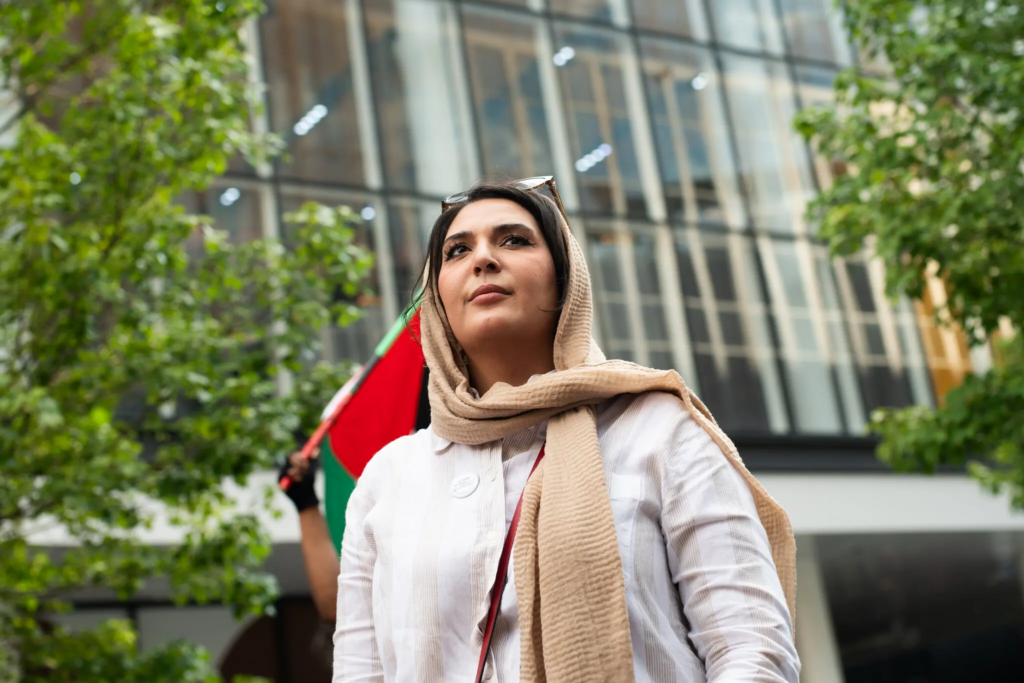
NEW YORK, US – On the night of March 26, 2026, Nerdeen Kiswani received a phone call that would confirm what her years of activism had taught her to fear. The FBI’s Joint Terrorism Task Force informed the 31-year-old Palestinian-American activist that law enforcement had just disrupted an imminent plot to assassinate her, a scheme involving a dozen Molotov cocktails, surveillance of her Brooklyn home, and a suspected perpetrator who allegedly planned to flee to Israel after carrying out the attack.
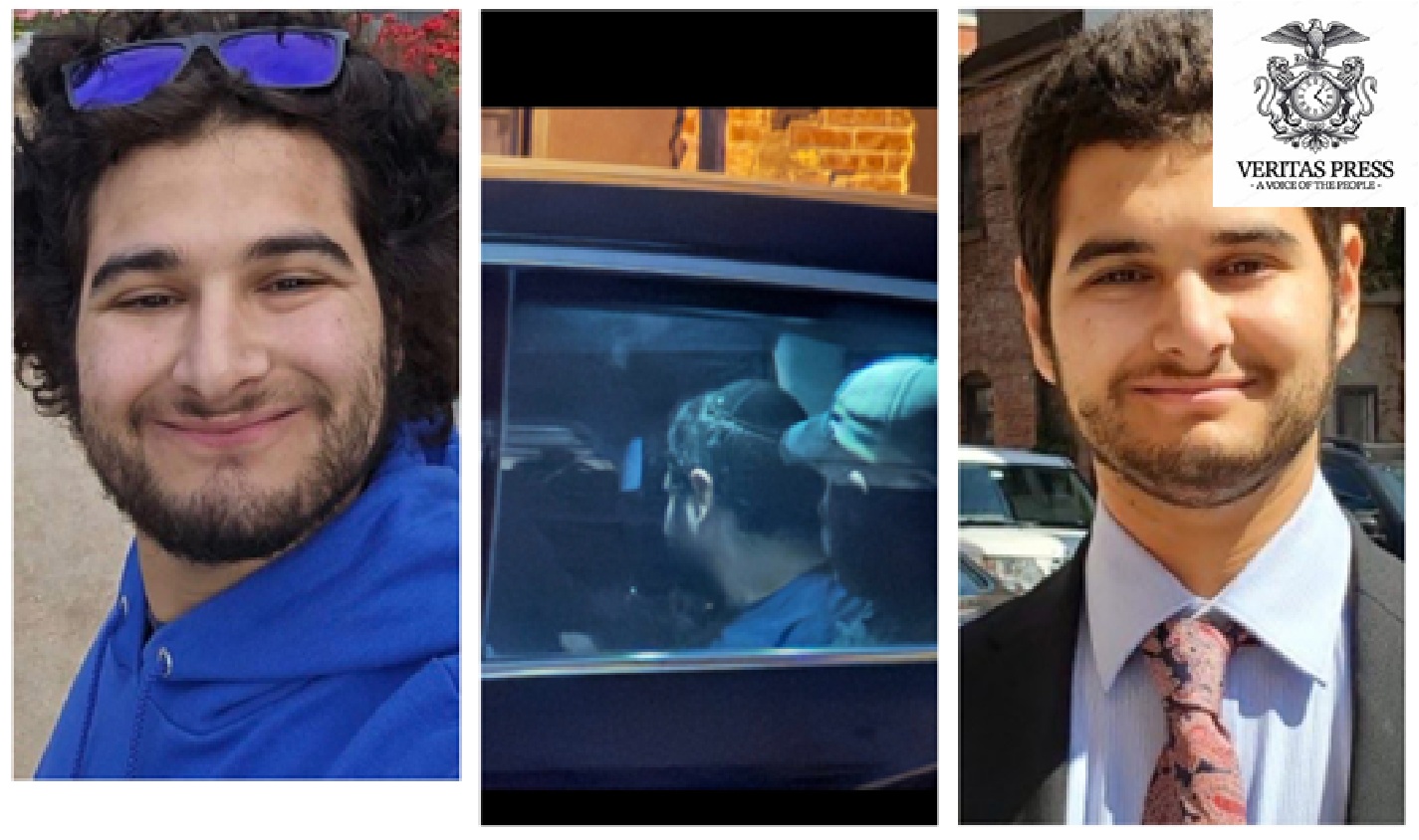
The arrest of Alexander Heifler, a 26-year-old machine learning engineer living in Hoboken, New Jersey, has exposed what New York City Mayor Zohran Mamdani described as “a chilling act of political violence” linked to an extremist offshoot of the Jewish Defence League (JDL), an organisation long designated by the FBI as a “known violent extremist organisation”. But beyond the immediate details of the foiled plot lies a deeper, more troubling narrative about the normalisation of political violence against pro-Palestinian voices in the United States, the resurgence of far-right extremist networks, and the complicity of public officials whose inflammatory rhetoric creates the conditions for such attacks.
This investigative analysis draws on court documents, law enforcement statements, activist testimony, and broader contextual reporting to examine not only what happened but how and why such plots are becoming increasingly common, and what this reveals about the state of political discourse, extremism, and accountability in America today.
Part I: The Plot Uncovered.
The Undercover Operation
The investigation that ultimately disrupted Heifler’s alleged plot began in January 2026, when an undercover detective from the NYPD’s Intelligence Division infiltrated a New York and New Jersey-based group chat used by the suspect. What unfolded over the following weeks reads like a counterterrorism case file from a bygone era of domestic extremism, except that the target was not a federal building or a symbolic monument, but the home of a 31-year-old activist and mother.
According to the criminal complaint filed in federal court, Heifler first discussed his intentions on a February video call with a group that included the undercover officer. He spoke of his interest in training for “self-defence” and wanting space where he could practice throwing Molotov cocktails. By the next day, the conversation had escalated significantly. In an in-person meeting, Heifler allegedly told the undercover officer: “We have [Kiswani’s] address. So it’s like that, that would be easier if you’d be more comfortable with that”.
The planning that followed was methodical. On March 4, Heifler and the undercover officer drove to Kiswani’s residence to “conduct surveillance”. During this reconnaissance, they discussed making a dozen Molotov cocktails, some to be thrown directly into Kiswani’s home, others to target vehicles parked outside. Heifler allegedly told the officer he planned to flee the country after carrying out the attack, initially aiming for late April before later pushing the timeline to mid-May.
The culmination came on March 26. Heifler met the undercover officer at his Hoboken apartment on Willow Avenue, where he had assembled components for the incendiary devices, including a large bottle of Everclear, a highly flammable grain alcohol. Together, they constructed eight Molotov cocktails. Shortly after, law enforcement executed a federal search warrant, recovering the devices along with other evidence. Heifler was taken into custody that evening.
The Suspect:
Alexander Heifler, 26, presents a profile that complicates easy categorisation. A graduate of Stevens Institute of Technology in Hoboken with a master’s degree in machine learning, he worked as a machine learning engineer for CVS Health. Online images show him attending events at Hadar HaTorah, a Brooklyn-based religious institution. In court, he appeared wearing a black yarmulke, swaying and fidgeting nervously as he was ordered held without bail.
But alongside this seemingly conventional biography, prosecutors allege, was a man who had aligned himself with a violent extremist organisation. An official briefed on the investigation told the Associated Press that Heifler identified as a member of the JDL 613 Brotherhood, a New Jersey-based group founded in 2024 that describes its members as “Jewish warriors” fighting back against rising antisemitism.
During his initial court appearance in Newark, Heifler was charged with two counts related to making and possessing destructive devices, each carrying a maximum penalty of ten years in prison. He did not enter a plea. His federal public defender did not immediately respond to requests for comment.
Part II: The JDL’s Dark Legacy And Modern Revival.
A History of Domestic Terrorism
To understand the significance of Heifler’s alleged affiliation, one must understand the Jewish Defence League’s long and bloody history. Founded in New York in 1968 by Meir Kahane, a Brooklyn-born militant who later moved to Israel, the JDL was designated by the FBI as a “known violent extremist organisation” following decades of documented terrorist activity.
The JDL’s operational history is inseparable from its ideology. Kahane preached a militant form of Jewish nationalism that advocated for the expulsion of Arabs from Israel and the occupied territories, and his followers carried this extremism into action. During the 1970s and 1980s, the group was linked to numerous bombings and attempted assassinations of Arab American political activists. In 2005, JDL members were convicted of plotting to bomb a Los Angeles mosque and the office of Representative Darrell Issa of California.
Perhaps most notoriously, the JDL’s influence extended to Israel, where Kahane founded the Kach party, later outlawed in Israel for inciting racism. In 1994, Baruch Goldstein, a Brooklyn-born JDL activist who had immigrated to Israel, entered the Ibrahimi Mosque (Cave of the Patriarchs) in Hebron during Ramadan and opened fire on worshippers, killing 29 people and wounding 125 before being beaten to death by survivors. Goldstein remains a hero to the Israeli far-right, with followers maintaining a shrine at his grave.
The JDL 613 Brotherhood:
The group Heifler allegedly joined, the JDL 613 Brotherhood, was formed in the New York area in late 2024, positioning itself as a revival of Kahane’s original organisation. Its website describes its membership as “Jewish warriors” and explicitly cites inspiration from the original JDL.
According to reports, the group is led by Yisrael Yaacob ben Avraham, a former Christian who converted to Judaism and adopted a new identity reflecting his ideological transformation. He presents himself as a devout Jew and a self-described “warrior” for the cause, promoting militant Kahanist ideology across social media and in online content.
What makes the JDL 613 Brotherhood particularly concerning to counterterrorism analysts is its blend of religious identity, political activism, and operational capacity. The group emerged at a time when far-right extremist networks have become increasingly sophisticated in using digital platforms to recruit, radicalise, and coordinate. As Mayor Mamdani noted in his statement, the case underscores how “an alarming rise in threats and violence across the country” has been accompanied by the resurgence of groups with explicit terrorist pedigrees.
Part III: A Broader Pattern Of Political Violence.
The Escalating Threat to Pro-Palestinian Voices
The plot against Kiswani did not emerge in a vacuum. It represents, as Mamdani and others have noted, part of a larger nationwide trend of escalating threats and violence targeting Palestinian human rights advocates.
Data support this assessment. The Council on American-Islamic Relations (CAIR), the nation’s largest Muslim civil rights organisation, recently released a report documenting 8,658 complaints of anti-Muslim and anti-Arab incidents in a single year, a 7.4% increase that marks the highest level since the organisation began tracking such data in 1996. The group’s statement on the Kiswani plot explicitly linked the case to this broader climate:
“This disturbing case underscores the growing climate of harassment, threats, and violence directed at those speaking out on Palestinian human rights and other social justice issues. Such actions not only endanger individuals but also threaten the fundamental freedoms of speech and civic engagement”.
Kiswani herself has been a frequent target of this hostility. In February, she filed a civil rights lawsuit against Betar U.S., a right-wing Jewish organisation, accusing it of using social media to put “bounties” on her head and harassing her with references to exploding pagers, an apparent allusion to Israel’s 2024 attack on Lebanon that used such devices to kill at least a dozen people and injure thousands.
The lawsuit drew attention to Betar’s pattern of targeting Kiswani, but the organisation’s response to news of the firebomb plot revealed the depth of the animosity. In an email to The New York Times, Betar spokesman Daniel Levy wrote: “We of course know nothing about this threat and have had zero contact with law enforcement on this issue. That said, Palestinians are a violent people”.
The Role Of Public Officials:
Perhaps more troubling than extremist group rhetoric is the role that elected officials have played in normalising hostility toward Palestinians and their advocates. In February 2026, just weeks before Heifler conducted surveillance on Kiswani’s home, Republican Congressman Randy Fine of Florida posted on social media: “If they force us to choose, the choice between dogs and Muslims is not a difficult one”.
The post was a response to a satirical comment Kiswani had made about dogs in the context of New York City sanitation issues, a joke she later clarified. But Fine’s response, which he doubled down on when criticised, drew immediate condemnation from CAIR and Democratic lawmakers. Yet Fine faced no formal censure, and the incident largely faded from public view.
Kiswani has explicitly linked such rhetoric to the violence she faces. In a social media post following the foiled plot, she wrote: “That hate against Palestinians has been bolstered by public officials, by Zionist organisations, who are never held accountable. This is the inevitable result of that”.
Mayor Mamdani, who himself was drawn into the controversy after Fine falsely claimed Kiswani was a “key Mamdani advisor,” has been careful to condemn the political violence without engaging in the culture war provocations that defined the Fine episode. But the broader pattern is clear: when elected officials dehumanise entire populations, they create a permission structure for extremist violence.
Part IV: “Within Our Lifetime” And The Politics Of Resistance.
The Organisation Under Fire
Nerdeen Kiswani co-founded Within Our Lifetime (WOL) as a grassroots organisation dedicated to Palestinian rights activism. Since the October 7 attacks and Israel’s subsequent war in Gaza, the group has become one of the most visible pro-Palestinian protest organisers in New York City, with demonstrations that have drawn hundreds of participants and, at times, led to mass arrests.
The group’s rhetoric has drawn fierce criticism. WOL’s calls to “abolish Zionism” and its expressed support for “all forms of struggle” have led pro-Israel organisations to accuse it of antisemitism. Kiswani has consistently rejected these accusations, arguing that her activism targets Israel as a political entity, not Judaism as a religion or Jews as a people.
A common chant at WOL protests is: “Judaism, yes, Zionism no! The state of Israel has got to go!” For many American Jews who view Zionism as intrinsic to their religious or ethnic identity, this distinction is unacceptable. The result has been a deepening polarisation in which each side sees the other as delegitimising their fundamental identity.
The Cost Of Speaking Out:
Kiswani’s profile has made her a target. In addition to the Betar lawsuit and now the firebomb plot, she has faced persistent online harassment, doxxing, and threats. In February 2024, Meta shut down Within Our Lifetime’s Instagram account, which had roughly 180,000 followers at the time, in a move the group said was part of a broader crackdown on pro-Palestinian voices.
In an interview following the foiled plot, Kiswani spoke to the psychological weight of living under constant threat. “I feel very blessed that they were able to thwart this,” she told the Associated Press, “but it’s something that is a constant possibility for people who speak up on behalf of Palestine”.
She added: “I will not stop speaking up for the people of Palestine”.
Part V: Counterterrorism Or Entrapment?
The Role of Undercover Operations
The NYPD’s handling of the Kiswani case has drawn praise from Mayor Mamdani and Police Commissioner Jessica Tisch, who called it evidence that the department’s counterterrorism apparatus is “a sophisticated apparatus built to detect danger early and prevent violence before it reaches our streets”.
But the operation also raises questions that civil liberties advocates have long raised about undercover policing. According to the criminal complaint, the undercover officer not only infiltrated Heifler’s group chat but also participated in planning the attack, including driving with him to surveil Kiswani’s home and helping assemble the Molotov cocktails.
Such tactics have historically been controversial. During the post-9/11 era, FBI and NYPD operations targeting Muslim communities frequently involved undercover agents who played active roles in developing plots, leading to accusations of entrapment. Critics argue that such operations can create crimes that would not otherwise have occurred, targeting vulnerable individuals susceptible to suggestion.
Al Jazeera’s reporting on the case noted: “US law enforcement agencies have previously faced criticism for using undercover agents to help plan attacks with suspects, only to foil them and claim credit for preventing them. Those methods, which some rights advocates argue amount to illegal entrapment, often targeted Muslim communities during the post-9/11 period”.
In this case, the investigation began with the NYPD proactively seeking out extremist group chats. While the threat to Kiswani was clearly real, Heifler had her address, had conducted surveillance, and had assembled the components for firebombs, the line between monitoring extremism and facilitating it remains contested.
Heifler’s defence has not yet been publicly articulated. His federal public defender has not commented on the case, and it remains to be seen whether entrapment arguments will be raised.
Part VI: The International Dimension.
The Israel Connection
One of the most striking details to emerge from the investigation is Heifler’s alleged plan to flee to Israel after carrying out the attack. According to Mayor Mamdani, the suspect “reportedly planned to flee to Israel after carrying out the terrorist attack”.
This detail, mentioned in multiple news reports, points to a transnational dimension of far-right Jewish extremism that has long concerned counterterrorism officials. The JDL’s founder, Meir Kahane, moved to Israel, where his Kach party achieved parliamentary representation before being banned. Today, Kahanist ideology is represented in the Israeli Knesset by the Otzmah Yehudit (Jewish Power) party, led by Itamar Ben-Gvir, who currently serves as Israel’s National Security Minister.
The ideological and operational links between American far-right Jewish extremists and their Israeli counterparts have been documented for decades. In the 1994 Hebron massacre, Baruch Goldstein had immigrated from Brooklyn to the West Bank settlement of Kiryat Arba, where he became a leader of the local JDL chapter. His attack was carried out with weapons from the Israeli military service, and he was buried with full honours by supporters who subsequently turned his grave into a pilgrimage site.
The prospect of an American extremist fleeing to Israel after attacking a Palestinian activist in New York is not merely speculative; it reflects a longstanding pattern in which Israel has been viewed by such extremists as a safe haven.
Parallel Moral Degradation
The plot against Kiswani also invites comparison with trends within Israeli society itself. In recent months, Israeli far-right leaders have made statements that would have been unthinkable in mainstream discourse just a few years ago. Yitzhak Kroizer, a member of the Otzmah Yehudit party, said in March 2026: “I stand behind IDF soldiers in every situation. Even if the collateral damage is children or women, it does not matter to me. In Jenin, there are no innocent civilians. In Jenin, there are no innocent children”.
His comments followed the killing of an entire Palestinian family by Israeli undercover forces near the village of Tammun on March 15. Waed Bani Ohde, her husband Ali, and two of their young children, Othman, 7, and Mohammed, 5, were killed when forces opened fire on their car. Two sons survived. The army claims the car accelerated toward forces; Palestinian witnesses say no warning was given before the attack.
No senior Israeli official apologised for the shooting. No official conceded that killing two children might warrant something beyond a routine internal review. Instead, the cabinet convened to legalise 30 illegal settlement outposts, including some in Area A, which is supposed to be under full Palestinian control.
As one analyst noted in a recent Guardian report: “No Israeli citizen has been prosecuted for a killing in the West Bank since 2020, despite a radical uptick in violence; settlers and police have already killed 10 Palestinian civilians this month alone”.
The moral framework articulated by Kroizer, that there are no innocent children in Jenin, that collateral damage “does not matter”, is not limited to fringe figures. It is the logical extension of a political culture that has increasingly normalised the dehumanisation of Palestinians. And it is the same ideological foundation upon which plots like Heifler’s are built.
Part VII: Responses And Repercussions.
Official Condemnations
The foiled plot has drawn condemnation from across the political spectrum, though with notable differences in emphasis. Mayor Mamdani’s statement was the most comprehensive, explicitly naming the JDL’s terrorist designation and warning of “escalating political violence against pro-Palestine voices”.
Gov. Kathy Hochul praised law enforcement on social media, saying: “No one should be targeted or live in fear of violence for expressing their beliefs”. Police Commissioner Tisch credited the undercover officer who infiltrated Heifler’s group chat, though she did not identify the officer by name.
The U.S. Attorney for New Jersey, Robert Frazer, attended Heifler’s court hearing and thanked “law enforcement partners for this work in identifying and removing this potential threat”.
Hoboken Mayor Emily B. Jabbour issued a statement assuring residents there was “no danger to residents and no ongoing threat”.
Activist and Organisational Responses
Kiswani herself has been measured but defiant. In addition to her public statements thanking law enforcement and vowing to continue her activism, she used the moment to highlight the broader climate of impunity she believes enables such violence. “For months, Zionist organisations like Betar and political figures such as Randy Fine have encouraged violence against my family and me,” she wrote.
CAIR’s joint statement with its New York chapter went further, calling for accountability beyond the immediate perpetrator:
“We urge a full and transparent investigation, appropriate prosecution of those responsible, and continued vigilance by law enforcement to protect all communities from hate-driven violence. Public officials and community leaders must also speak out clearly and consistently against rhetoric that can incite violence and discrimination”.
The organisation also noted that its civil rights report documented “an ongoing pattern of Islamophobia impacting communities across the country”.
The Silence Of Pro-Israel Organisations
Notably, mainstream pro-Israel organisations have been slow to respond to the plot. While groups like the Anti-Defamation League have historically condemned violence from all sides, there has been no coordinated campaign to repudiate the JDL 613 Brotherhood or to acknowledge the role that inflammatory rhetoric may play in inspiring such attacks.
This silence is conspicuous. When pro-Palestinian activists have engaged in what is perceived as antisemitic rhetoric, mainstream Jewish organisations have been swift and vocal in their condemnations. But when the violence flows in the opposite direction, when a Jewish extremist plots to firebomb a Palestinian activist’s home with her infant son inside, the response has been muted.
The contrast illuminates a double standard that many Palestinian activists have long alleged: that their lives and safety are treated as less worthy of concern, that threats against them are not taken as seriously as threats against Jewish Americans.
Conclusion: Solidarity And The Future.
The foiled plot against Nerdeen Kiswani is both a victory for law enforcement and a warning about the trajectory of American political life. That the NYPD and FBI were able to disrupt the attack before it occurred is a testament to the importance of counterterrorism resources and undercover operations. But that such a plot could be planned in the first place, by a highly educated professional, in the open, over weeks of discussion, speaks to a normalisation of political violence that should alarm all Americans.
Mayor Mamdani concluded his statement with a call for solidarity: “Our city must meet hate with solidarity, and meet fear with an unshakable commitment to justice and to one another”. It is a noble sentiment, but one that requires more than words. It requires a consistent commitment to protecting all communities from political violence, regardless of the target. It requires holding accountable not only the perpetrators of such violence, but also the public officials and organisations whose rhetoric enables it.
For Kiswani, the immediate crisis has passed. But the conditions that produced it remain. The surveillance of her home, the stockpiling of Molotov cocktails, the flight plan to Israel, these are not the actions of a lone wolf, but of an individual embedded in a network with a history and an ideology.
She will continue to speak out. In her own words: “I will not stop speaking up for the people of Palestine”. The question facing the rest of American society is whether it will stand with her against those who would silence her with fire.
Source: Multiple News Agencies
Submissions:
For The Secure Submission Of Documentation, Testimonies, Or Exclusive Investigative Reports From Any Global Location, Please Utilise The Following Contact Details For Our Investigations Desk: enquiries@veritaspress.co.uk or editor@veritaspress.co.uk
Help Support Our Work:
Popular Information is powered by readers who believe that truth still matters. When just a few more people step up to support this work, it means more lies exposed, more corruption uncovered, and more accountability where it’s long overdue.
Help Protect Independent Journalism, Which Is Currently Under Attack.
If you believe journalism should serve the public, not the powerful, and you’re in a position to help, becoming a DONATOR or a PAID SUBSCRIBER truly makes a difference.
DONATION APPEAL: If You Found This Reporting Valuable, Please Consider Supporting Independent Journalism.
Help Support Our Work – We Know, We Know, We Know …
Seeing these messages is annoying. We know that. (Imagine what it’s like writing them … )
Your support fuels our fearless, truth-driven journalism. In unity, we endeavour to amplify marginalised voices and champion justice, irrespective of geographical location.
But it’s also extremely important. One of Veritas Press’s greatest assets is its reader-funded model.
1. Reader funding means we can cover what we like. We’re not beholden to the political whims of a billionaire owner. We are a small, independent and impartial organisation. No one can tell us what not to say or what not to report.
2. Reader funding means we don’t have to chase clicks and traffic. We’re not desperately seeking your attention for its own sake: we pursue the stories that our editorial team deems important and believe are worthy of your time.
3. Reader Funding: enables us to keep our website and other social media channels open, allowing as many people as possible to access quality journalism from around the world, particularly those in places where the free press is under threat.
We know not everyone can afford to pay for news, but if you’ve been meaning to support us, now’s the time.
Your donation goes a long way. It helps us:
- Keep the lights on and sustain our day-to-day operations
- Hire new, talented independent reporters
- Launch real-time live debates, community-focused shows, and on-the-ground reporting
- Cover the issues that matter most to our communities, in real time, with depth and integrity
We have plans to expand our work, but we can’t do it without your support. Every contribution, no matter the size, helps us stay independent and build a truly people-powered media platform.
If you believe in journalism that informs, empowers, and reflects the communities we serve, please donate today.
GENEVA — A United Nations fact-finding mission has concluded there are “reasonable grounds to believe”
Iran’s GDP is projected to contract by 5.4 to 6.1% in 2026, its worst performance
The Trump administration is preparing a $2.8 billion weapons package for Israel containing 40,000 2,000-pound
Film alleges mass civilian deaths are routinely built into military decisions amid Israel’s genocidal war
The Israeli rights group says violence, displacement, economic strangulation, and settlement expansion form part of

Houthi forces have captured the historic Red Sea port of Mocha and are advancing on
London’s historic sanctions against Israeli settlements mark a watershed moment in UK foreign policy, but
With 95% of Gaza’s population now wholly dependent on aid and more than 90% stripped
India calls for Kashmir and Ladakh to appear only on its official map after a
ISLAMABAD – In the high-stakes political theatre of Pakistan, the battleground has shifted from the