



Help support our mission, donate today and be the change. Every contribution goes directly toward driving real impact for the cause we believe in.
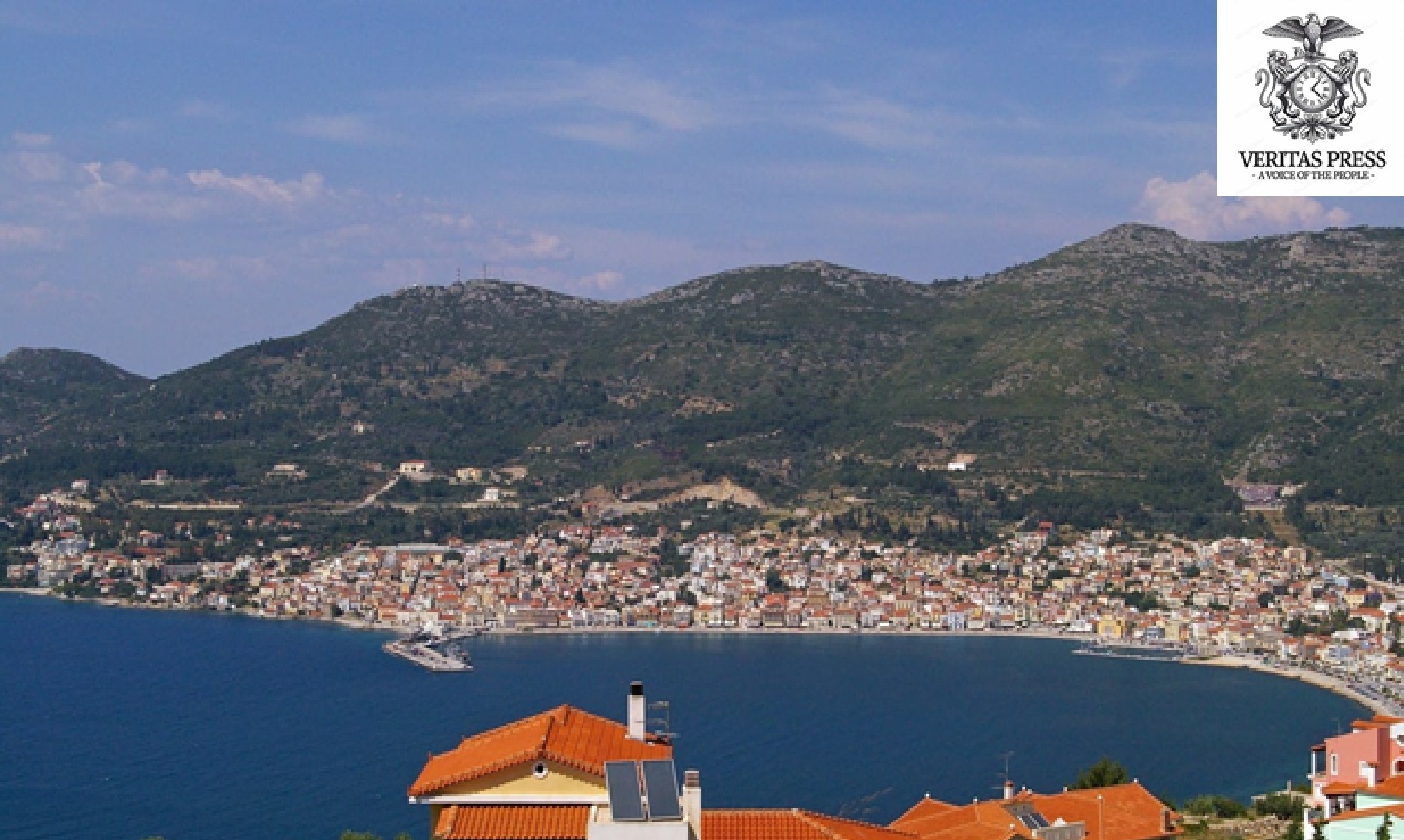
GREEK ISLANDS – A controversial proposal by Israeli politician Avri Steiner to purchase Greek islands as a wartime “safe haven” has sparked criticism, not only for its apparent impracticality, but for what analysts say it reveals about Israel’s evolving strategic doctrine: one that increasingly links security to territorial expansion, sovereignty, and aggressive control beyond its borders.
The suggestion, floated during a board meeting of Himnuta, a subsidiary of the Jewish National Fund (JNF), comes amid escalating regional tensions involving Iran, Hezbollah, and a rapidly militarising Eastern Mediterranean.
But beyond its framing as emergency planning, the proposal has ignited deeper concerns: that it reflects a continuity of expansionist logic, now projected outward from Palestine into Europe itself.
“Another Iron Dome”: Security Doctrine Or Strategic Panic?
Steiner, a representative of Blue and White, framed the proposal as a humanitarian contingency plan:
“This is an idea that arose following publications that missiles could hit Israeli territory… What do we do in a scenario threatening a large population?”
Referencing Iran’s missile capabilities and lessons from the Second Lebanon War, he proposed leasing or purchasing uninhabited Greek islands as an evacuation zone, which he described as “another Iron Dome.”
Yet his remarks went further, suggesting a pathway to sovereignty:
“It would be possible to create a framework with the Greek government to later transfer sovereignty.”
That statement transformed the proposal from contingency planning into a question of territorial acquisition.
The plan was rejected by Himnuta’s board, with one member reportedly calling it “surreal.” But within Israel’s political sphere, reactions have revealed deeper divisions.
Israeli Political Reactions: Between Dismissal And Strategic Anxiety.
While no formal government policy has emerged, reactions from Israeli political figures and commentators reflect a mix of embarrassment, concern, and underlying anxiety.
A senior official within the orbit of Benjamin Netanyahu’s coalition, speaking anonymously to Israeli media, dismissed the proposal as:
“Detached from reality and diplomatically irresponsible.”
However, opposition figures linked to security debates framed it differently. A former Knesset member aligned with centrist blocs told journalists:
“The idea itself may be unrealistic, but the fear behind it is real. Israelis are asking what happens if missile defence systems are overwhelmed.”
Some security analysts close to Israeli military circles have also pointed to growing concern over multi-front conflict scenarios involving Iran, Hezbollah, and regional actors.
At the same time, left-wing Israeli commentators were more critical. Writing in the Hebrew press, one analyst argued:
“Instead of addressing the political roots of insecurity, we are imagining exporting the problem geographically.”
The debate has thus exposed a widening gap between military-driven security thinking and political reality.
From Annexation To “Privatised Sovereignty”:
For critics, the proposal cannot be separated from Israel’s long-standing annexation policies in the occupied Palestinian territories.
For decades, Israeli strategy has followed a pattern:
- Establish control
- Expand settlements
- Normalise governance
- Seek legal recognition
This model underpins ongoing annexation efforts in the West Bank, widely deemed illegal under international law.
Steiner’s proposal introduces a variation: acquiring land through purchase, then pursuing sovereignty.
A European legal scholar explained:
“This is annexation logic in contractual form. It bypasses military occupation but retains the same end goal, sovereign control.”
A Palestinian analyst in Ramallah said:
“This reflects a mindset where land, any land, is treated as a solution to insecurity.”
International Law: The UN Position On Territorial Acquisition.
Under international law, the acquisition of territory is tightly regulated.
The United Nations Charter explicitly prohibits the acquisition of territory by force, a principle reinforced by multiple UN Security Council resolutions, including UN Security Council Resolution 242, which affirms the “inadmissibility of the acquisition of territory by war.”
While Steiner’s proposal is framed as a consensual purchase, legal experts stress that sovereignty transfer raises complex issues:
- The territorial integrity of states cannot be undermined without full legal and constitutional processes
- EU law would apply in the case of Greek territory
- Any transfer could set controversial international precedents
The International Court of Justice has repeatedly affirmed, including in its advisory opinions on the occupied Palestinian territory, that unilateral annexation or territorial acquisition outside lawful frameworks violates international law.
A UN-affiliated legal expert commented:
“Even when framed as voluntary, transferring sovereignty over populated or strategic territory raises serious legal and ethical concerns. It risks normalising territorial transactions in a way the post-World War II legal order sought to prevent.”
Greece, Europe, And A Legal Red Line:
For Greece, any such proposal would cross a fundamental boundary.
Greek territory is part of the European Union, meaning sovereignty cannot be treated as a negotiable asset.
A former Greek diplomat stated:
“There is no scenario in which sovereignty over Greek islands is transferred. This is not a commercial matter; it is constitutional and geopolitical.”
The contradiction for Europe remains stark. While EU states oppose Israeli annexation in Palestine, they continue to deepen security cooperation with Israel in the Mediterranean.
A Brussels-based analyst noted:
“Europe cannot defend international law selectively. The principle either holds universally, or it erodes everywhere.”
Cyprus: Strategic Depth Without Formal Annexation.
If the Greek island proposal represents a hypothetical future, Cyprus illustrates how influence can precede sovereignty.
Over the past decade, Cyprus has been integrated into Israel’s strategic environment:
- Israeli military exercises
- Intelligence cooperation involving Mossad
- Western naval deployments
- Use of British sovereign bases
A local journalist observed:
“Cyprus has become part of regional military architecture without any formal declaration.”
Iranian officials have warned the island could become a target, highlighting the risks of such integration.
Greek Islands And A New Security Axis:
The proposal also coincides with plans for a joint Israel-Greece-Cyprus rapid-response force operating across key points such as Rhodes and Karpathos.
Officials describe the initiative as necessary for protecting energy infrastructure and ensuring rapid response capabilities.
But critics argue it reflects a broader shift toward regional militarisation and strategic encirclement, particularly in relation to tensions with Turkey.
Local Anxiety And Regional Blowback:
The arrival of Israeli civilians in Cyprus during heightened tensions has triggered mixed reactions.
A civil society activist in Nicosia said:
“We are being turned into a buffer zone for conflicts we did not create.”
Such concerns underscore a broader warning: transforming islands into “safe havens” risks making them targets.
A Region Becoming A Battlefield-In-Waiting:
From Gaza to Lebanon, from Cyprus to the Aegean, civilian and military spaces are increasingly intertwined.
What is presented as contingency planning is becoming part of a larger transformation, one in which geography itself is militarised.
As one Israeli commentator warned:
“If safety requires more land, then safety will always remain out of reach.”
Conclusion: The Geography Of Insecurity.
Strip away the language of “humanitarian evacuation” and “temporary refuge,” and what remains is something far more revealing: a political imagination in which insecurity is not resolved, but displaced, onto new territory, new populations, and new frontiers.
The proposal by Avri Steiner may never materialise. But its significance lies in what it reveals.
It reflects a strategic doctrine in which:
- Territory is seen as a solution to insecurity
- Sovereignty becomes negotiable
- Expansion extends beyond traditional boundaries
From the annexation of Palestine to strategic integration in Cyprus, and now to hypothetical acquisitions in Greece, a consistent logic emerges, one that reimagines geography itself as a tool for managing fear.
And in a region already defined by conflict, that logic raises a fundamental question:
If security depends on expanding control over land, can it ever truly be achieved, or does it merely reproduce the very insecurity it claims to solve?
The proposal may never advance beyond speculation. But it exposes a deeper structural pattern that has long defined Israeli statecraft, from the occupied Palestinian territories to the wider region: when confronted with crisis, the response is not to dismantle the conditions producing insecurity, but to expand the spatial boundaries within which that insecurity is managed.
This is the paradox at the heart of the doctrine.
For decades, territorial expansion, whether through settlement construction, annexation policies, or strategic control, has been justified as a means of achieving security. Yet each expansion has produced new fault lines, new confrontations, and new cycles of instability. The logic now appears to be evolving, not retreating: from occupying land, to integrating foreign territory, to even imagining sovereignty itself as something transferable, purchasable, and exportable.
Under international law, as articulated by the United Nations and affirmed in rulings of the International Court of Justice, territory is not meant to function as an instrument of power politics, whether seized by force or reconfigured through coercive or unequal arrangements. That principle was designed to prevent precisely this: a world in which stronger states redraw geography to manage their fears.
And yet, that boundary is now being tested, not through tanks crossing borders, but through proposals that recast expansion as pragmatism and sovereignty as negotiation.
What makes this moment particularly dangerous is not the feasibility of the plan, but its normalisation of a new idea: that in an era of advanced warfare and regional volatility, the answer lies in acquiring more land, somewhere else.
But geography does not absorb conflict. It transmits it.
Cyprus offers a clear warning. Once marketed as a neutral bridge between regions, it is now entangled in overlapping military architectures, its proximity transforming it from refuge into a potential target. The same would hold true for any “safe haven” built on the premise of strategic alignment rather than genuine neutrality.
As one regional analyst put it:
“You cannot outsource insecurity. You can only relocate its consequences.”
The deeper issue, then, is not about Greek islands. It is about a worldview in which security is pursued through spatial control rather than political resolution, a worldview that risks turning every new territory into the next frontier of conflict.
Because if safety depends on expanding the map, the map will never be large enough.
And in that endless search for strategic depth, what is ultimately revealed is not strength, but a system trapped in its own logic, forever chasing security across an ever-expanding geography of fear.
If security depends on expanding control over land, where does it end?
Source: Multiple News Agencies
Submissions:
For The Secure Submission Of Documentation, Testimonies, Or Exclusive Investigative Reports From Any Global Location, Please Utilise The Following Contact Details For Our Investigations Desk: enquiries@veritaspress.co.uk or editor@veritaspress.co.uk
Help Support Our Work:
Popular Information is powered by readers who believe that truth still matters. When just a few more people step up to support this work, it means more lies exposed, more corruption uncovered, and more accountability where it’s long overdue.
Help Protect Independent Journalism, Which Is Currently Under Attack.
If you believe journalism should serve the public, not the powerful, and you’re in a position to help, becoming a DONATOR or a PAID SUBSCRIBER truly makes a difference.
DONATION APPEAL: If You Found This Reporting Valuable, Please Consider Supporting Independent Journalism.
Help Support Our Work – We Know, We Know, We Know …
Seeing these messages is annoying. We know that. (Imagine what it’s like writing them … )
Your support fuels our fearless, truth-driven journalism. In unity, we endeavour to amplify marginalised voices and champion justice, irrespective of geographical location.
But it’s also extremely important. One of Veritas Press’s greatest assets is its reader-funded model.
1. Reader funding means we can cover what we like. We’re not beholden to the political whims of a billionaire owner. We are a small, independent and impartial organisation. No one can tell us what not to say or what not to report.
2. Reader funding means we don’t have to chase clicks and traffic. We’re not desperately seeking your attention for its own sake: we pursue the stories that our editorial team deems important and believe are worthy of your time.
3. Reader Funding: enables us to keep our website and other social media channels open, allowing as many people as possible to access quality journalism from around the world, particularly those in places where the free press is under threat.
We know not everyone can afford to pay for news, but if you’ve been meaning to support us, now’s the time.
Your donation goes a long way. It helps us:
- Keep the lights on and sustain our day-to-day operations
- Hire new, talented independent reporters
- Launch real-time live debates, community-focused shows, and on-the-ground reporting
- Cover the issues that matter most to our communities, in real time, with depth and integrity
We have plans to expand our work, but we can’t do it without your support. Every contribution, no matter the size, helps us stay independent and build a truly people-powered media platform.
If you believe in journalism that informs, empowers, and reflects the communities we serve, please donate today.
GENEVA — A United Nations fact-finding mission has concluded there are “reasonable grounds to believe”
Iran’s GDP is projected to contract by 5.4 to 6.1% in 2026, its worst performance
The Trump administration is preparing a $2.8 billion weapons package for Israel containing 40,000 2,000-pound

Film alleges mass civilian deaths are routinely built into military decisions amid Israel’s genocidal war
The Israeli rights group says violence, displacement, economic strangulation, and settlement expansion form part of

Houthi forces have captured the historic Red Sea port of Mocha and are advancing on
London’s historic sanctions against Israeli settlements mark a watershed moment in UK foreign policy, but
With 95% of Gaza’s population now wholly dependent on aid and more than 90% stripped
India calls for Kashmir and Ladakh to appear only on its official map after a
ISLAMABAD – In the high-stakes political theatre of Pakistan, the battleground has shifted from the