







Help support our mission, donate today and be the change. Every contribution goes directly toward driving real impact for the cause we believe in.
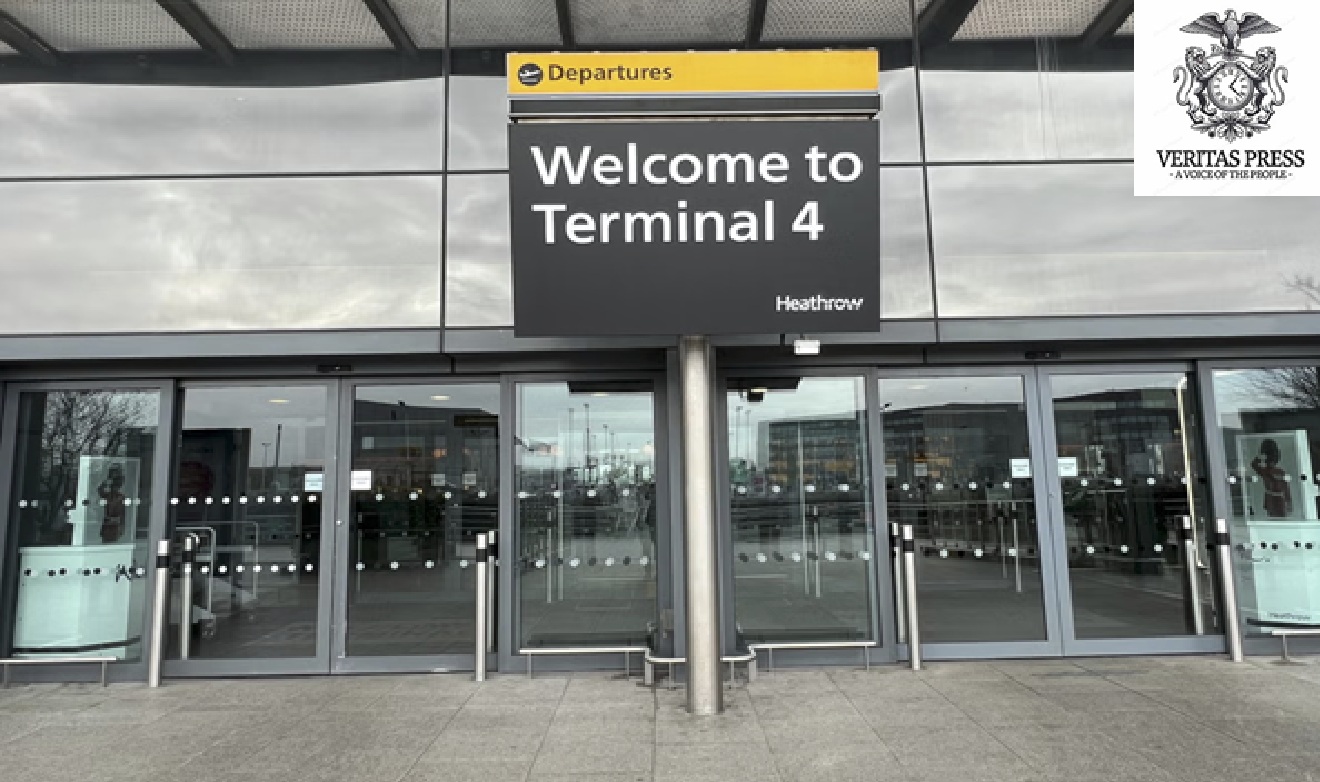
LONDON, UK – London’s busiest airport is confronting a striking symbol of how war in the Middle East is rippling through global transport and trade. At Heathrow Airport, the normally bustling Heathrow Terminal 4, a hub for flights to the Gulf, has become eerily quiet following the escalation of the 2026 Israel–Iran War.
Airlines across the region have grounded flights, rerouted aircraft, and cut services amid missile threats, airspace closures and security fears. The result: tens of thousands of disrupted journeys worldwide and a visible collapse in traffic through Heathrow’s Middle Eastern corridor.
A catering worker inside the terminal summed up the scene bluntly when asked how busy the airport now feels compared with normal days.
“If a normal day is 100… right now? Ten.”
Industry analysts say the deserted check-in desks and shuttered cafés reflect a deeper structural vulnerability in the global aviation system, one heavily dependent on Gulf hubs that are now caught in the middle of a widening regional conflict.
According to travel industry analysis, Terminal 4 has lost roughly one-third of its passengers since U.S.-Israeli strikes on Iran on 28 February triggered a wave of aviation disruption. Around 9,000 passengers a day are now missing from the terminal’s usual traffic flows.
The drop is primarily due to cancellations and schedule cuts by Gulf and Middle Eastern carriers, including:
- Qatar Airways
- Etihad Airways
- Gulf Air
- Kuwait Airways
- El Al
Terminal 4 has historically served as Heathrow’s primary Middle East gateway, with heavy traffic to hubs including Hamad International Airport, Zayed International Airport, and Kuwait International Airport.
Under normal conditions, passengers could choose from seven daily flights to Doha, four to Abu Dhabi, and multiple wide-body services to Bahrain and Kuwait.
Now departure boards frequently show gaps of more than 90 minutes with no flights at all, something aviation experts say would have been “unthinkable” at Heathrow before the crisis.
A Heathrow spokesperson downplayed the scale of the decline but acknowledged disruption is continuing as airlines “review operations in response to the situation in the Middle East.”
War Reaches Global Aviation Corridors:
The quiet at Heathrow is part of a much wider shock to global air travel.
Missile and drone threats across the Gulf have forced repeated airspace closures in Iran, Iraq and parts of the Arabian Peninsula, prompting airlines to cancel or reroute flights.
Earlier this week, the United Arab Emirates temporarily closed its airspace after drone and missile alerts, forcing carriers to delay or suspend flights.
The impact has been dramatic:
- Hundreds of flights cancelled across Gulf hubs
- detours adding hours to long-haul journeys
- spikes in fuel costs and airfares
- cargo delays affecting medical supplies and goods
In Doha alone, 566 flights were cancelled or heavily delayed in a single day, leaving passengers stranded and forcing airlines to run emergency repatriation flights.
One aviation executive described the crisis as “one of the most severe operational challenges in modern aviation history.”
Travel industry analyst Alex Macheras told European media the situation reveals the fragility of the global aviation network.
“The entire Europe-Asia travel system depends heavily on Gulf super-hubs. When those hubs are threatened by conflict, the shockwaves are felt instantly across the world’s airports.”
Passengers Stranded, Scams Rising:
Behind the statistics are thousands of travellers caught in uncertainty.
Passengers attempting to reach destinations via the Gulf have faced repeated cancellations and rerouting. Airlines have urged travellers not to even go to the airport unless they have confirmed seats.
Consumer groups say the confusion has also triggered a surge in fraud.
Banks and regulators have warned that scammers are impersonating airline support accounts online, targeting passengers desperate for refunds or rebooking information.
Chris Ainsley, head of fraud risk management at Santander UK, warned:
“Fraudsters exploit moments of chaos. People looking for help with cancelled flights are particularly vulnerable.”
Heathrow Businesses Fear A Repeat Of The Pandemic:
Inside Terminal 4, the drop in passengers is already hitting airport businesses.
Retail staff and café workers report drastically lower sales as footfall collapses. During the COVID-19 pandemic, the terminal was closed entirely for two years, leaving workers furloughed and shops shuttered.
Some airport employees now fear a repeat scenario if the Middle East war drags on.
A duty-free worker told reporters:
“We’ve seen this before during COVID. When the flights disappear, everything else disappears too.”
Heathrow management insists closing the terminal again is not under consideration, but acknowledged the situation could worsen if cancellations continue.
British Airways Reshapes Strategy As Gulf Disruption Spreads:
While Gulf airlines struggle with instability, European carriers are repositioning their networks.
The UK’s flag carrier British Airways has extended cancellations to several Middle Eastern destinations, including Amman, Bahrain, Dubai and Tel Aviv, until at least late May because of regional security concerns.
At the same time, the airline is expanding long-haul routes elsewhere.
New services include:
- London–Melbourne via Kuala Lumpur (from 2027)
- Colombo in Sri Lanka (winter 2026 season)
- additional flights to Delhi, Tokyo, Cape Town, and Caribbean destinations.
Neil Chernoff, the airline’s chief planning and strategy officer, said the expansion reflects changing demand patterns.
“We’re delighted to announce sizeable growth to our flying schedule… These changes represent a significant investment in our long-haul leisure network.”
But aviation analysts note the move is also a strategic hedge against a shrinking Gulf corridor.
The chief executive of Lufthansa, Carsten Spohr, warned that the conflict could permanently alter the balance of global aviation.
“The dominance of Gulf carriers on Asia routes may diminish because their hubs are now exposed to geopolitical risks,” he said.
A Geopolitical Choke Point For Global Travel:
Experts say the crisis exposes how global aviation has become increasingly constrained by geopolitical conflict.
Major air corridors are already restricted due to:
- The closure of Russian airspace to Western airlines since the Ukraine war
- Ongoing instability in parts of the Middle East
- Military conflicts are forcing airlines to avoid large sections of airspace
With fewer safe routes available, aircraft must follow longer detours, increasing costs and travel times.
One aviation consultant described the emerging situation bluntly:
“The world’s airspace map is shrinking. The more conflicts there are, the fewer corridors remain.”
The Uncertain Future Of Heathrow’s Middle East Gateway:
For now, Heathrow Terminal 4 stands as an unusually visible barometer of a war unfolding thousands of miles away.
Rows of unused check-in desks and half-empty departure halls illustrate how quickly geopolitical conflict can ripple through the global economy, from oil markets to tourism and aviation.
If the Iran war continues or expands across the Gulf region, analysts warn the impact could extend far beyond one London terminal.
The aviation system that connects Europe, Asia and Australia, built around the Gulf’s mega-hubs, may face its most profound restructuring since the COVID-19 pandemic.
And in Heathrow’s quiet Terminal 4, that transformation has already begun.
Source: Multiple News Agencies
Submissions:
For The Secure Submission Of Documentation, Testimonies, Or Exclusive Investigative Reports From Any Global Location, Please Utilise The Following Contact Details For Our Investigations Desk: enquiries@veritaspress.co.uk or editor@veritaspress.co.uk
Help Support Our Work:
Popular Information is powered by readers who believe that truth still matters. When just a few more people step up to support this work, it means more lies exposed, more corruption uncovered, and more accountability where it’s long overdue.
Help Protect Independent Journalism, Which Is Currently Under Attack.
If you believe journalism should serve the public, not the powerful, and you’re in a position to help, becoming a DONATOR or a PAID SUBSCRIBER truly makes a difference.
DONATION APPEAL: If You Found This Reporting Valuable, Please Consider Supporting Independent Journalism.
Help Support Our Work – We Know, We Know, We Know …
Seeing these messages is annoying. We know that. (Imagine what it’s like writing them … )
Your support fuels our fearless, truth-driven journalism. In unity, we endeavour to amplify marginalised voices and champion justice, irrespective of geographical location.
But it’s also extremely important. One of Veritas Press’s greatest assets is its reader-funded model.
1. Reader funding means we can cover what we like. We’re not beholden to the political whims of a billionaire owner. We are a small, independent and impartial organisation. No one can tell us what not to say or what not to report.
2. Reader funding means we don’t have to chase clicks and traffic. We’re not desperately seeking your attention for its own sake: we pursue the stories that our editorial team deems important and believe are worthy of your time.
3. Reader Funding: enables us to keep our website and other social media channels open, allowing as many people as possible to access quality journalism from around the world, particularly those in places where the free press is under threat.
We know not everyone can afford to pay for news, but if you’ve been meaning to support us, now’s the time.
Your donation goes a long way. It helps us:
- Keep the lights on and sustain our day-to-day operations
- Hire new, talented independent reporters
- Launch real-time live debates, community-focused shows, and on-the-ground reporting
- Cover the issues that matter most to our communities, in real time, with depth and integrity
We have plans to expand our work, but we can’t do it without your support. Every contribution, no matter the size, helps us stay independent and build a truly people-powered media platform.
If you believe in journalism that informs, empowers, and reflects the communities we serve, please donate today.
The Trump administration is preparing a $2.8 billion weapons package for Israel containing 40,000 2,000-pound

Film alleges mass civilian deaths are routinely built into military decisions amid Israel’s genocidal war
The Israeli rights group says violence, displacement, economic strangulation, and settlement expansion form part of

Houthi forces have captured the historic Red Sea port of Mocha and are advancing on
London’s historic sanctions against Israeli settlements mark a watershed moment in UK foreign policy, but
With 95% of Gaza’s population now wholly dependent on aid and more than 90% stripped
India calls for Kashmir and Ladakh to appear only on its official map after a
ISLAMABAD – In the high-stakes political theatre of Pakistan, the battleground has shifted from the
Francesca Albanese says third states have an ICJ-mandated obligation to end Israel’s occupation. But with
As Israeli jets bomb a Syrian air base over alleged Turkish deployment plans, Ankara, Washington