Kamran Faqir is a volunteer investigative journalist and writer committed to exposing hidden truths and amplifying underreported stories. Driven by social justice, he brings sharp insight and fearless truth-telling to independent journalism. NUJ registered.
Article Date Published:
Article Date Modified:
21 minutes
Views:429
Listen to this article
Help support our mission, donate today and be the change. Every contribution goes directly toward driving real impact for the cause we believe in.
TIRANA, ALBANIA — The tear gas has barely cleared from Skanderbeg Square, but the acrid smell still clings to the air, mingling with the salt breeze that drifts in from the Adriatic. For the fifth consecutive day, tens of thousands of Albanians have filled the boulevards of the capital, transforming the heart of Tirana into a tableau of rage, defiance, and an almost desperate hope. What began as a local stand against a luxury resort has metastasised into a nationwide insurrection against an entire political order. They call it the “Flamingo Revolution,” named for the elegant pink birds whose last pristine European sanctuary now stands on the brink of destruction.
The trigger is a stretch of coastline 130 kilometres south of here: the Vjosa-Narta Protected Landscape, a shimmering lagoon system of dunes, salt marshes, and pine forests that hosts over 200 species of birds, including nesting flamingos. It is one of the Mediterranean’s last intact coastal ecosystems. It is also the site of a proposed $4 billion luxury tourism development, backed by foreign investors including Jared Kushner, the son-in-law of former U.S. President Donald Trump, and his wife, Ivanka Trump. The project, championed by Prime Minister Edi Rama’s government, would transform the sleepy villages of Zvërnec and Pishë-Poro-Nartë into a playground for billionaires, complete with marinas, villas, and airstrips, all behind walls that locals say will sever them forever from land their families have fished, farmed, and foraged for centuries.
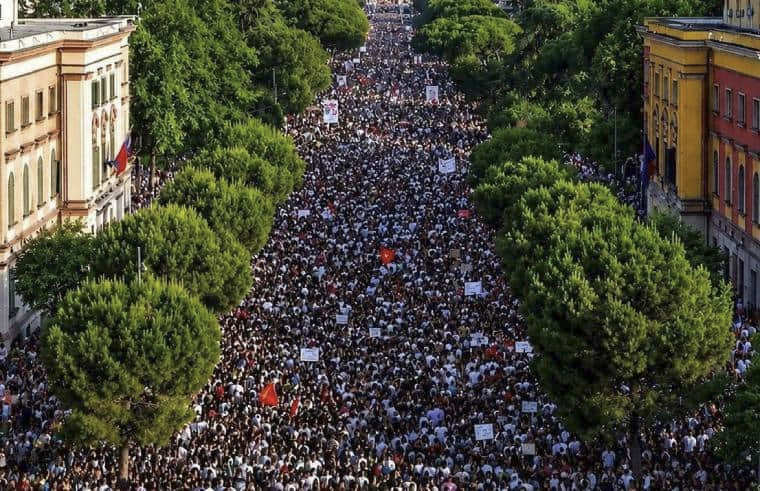
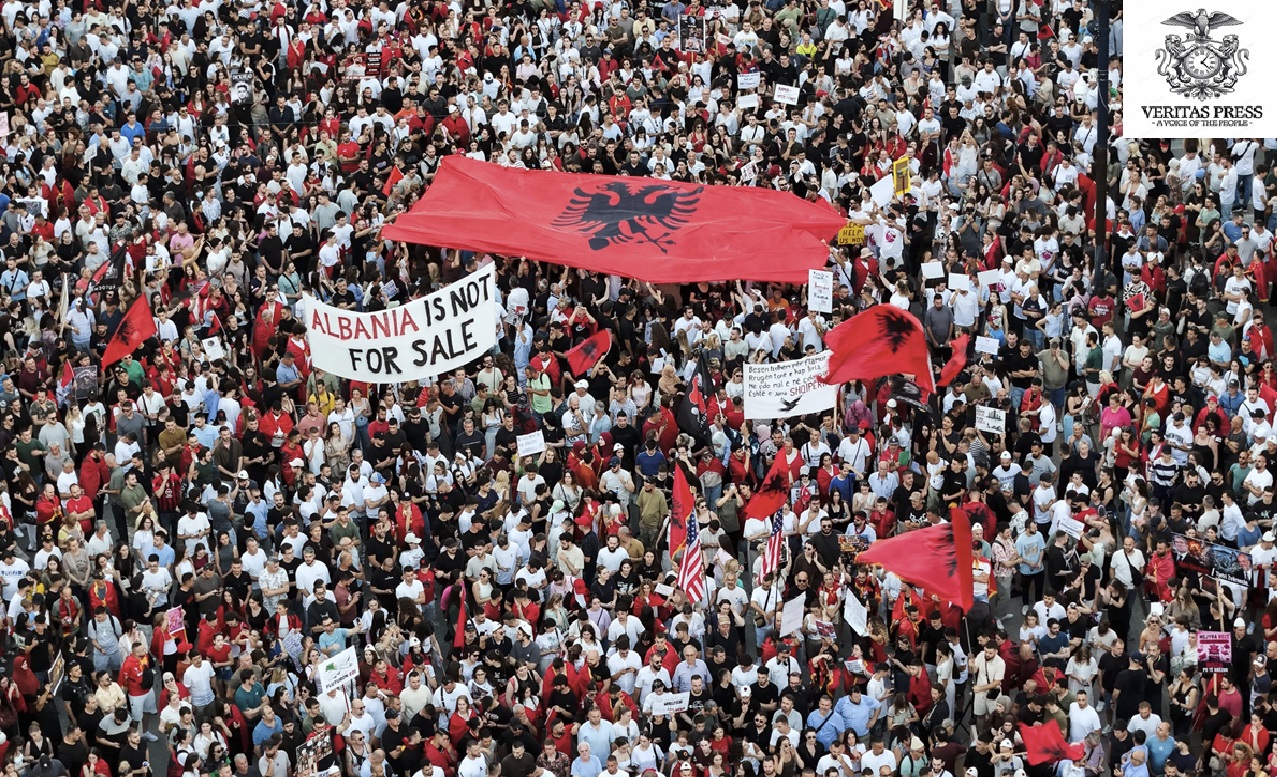
Hundreds of thousands on the streets of Tirana, the capital of Albania
But the Flamingo Revolution is about far more than a single real estate deal. It is the detonation point for decades of accumulated fury: at breathtaking corruption, at an authoritarian turn in Albanian governance, at a neoliberal economic model that has sold off the country’s patrimony to oligarchs and foreign speculators, and at a political class that protesters say has betrayed the very idea of a public good. After four days of escalating street battles, the question hanging over the Adriatic is not whether the Rama government will fall, but how much force it will use to stay upright, and what remains of Albania’s democratic experiment.
‘We Were Peaceful Until They Dragged Us Away’
To understand the revolt, one must travel to the narrow causeway that leads to the island monastery of Zvërnec. Here, among the cypress trees and the Byzantine-era stone, local residents and environmental activists erected a small encampment in late May. They were ordinary people: fishermen, smallholders, pensioners, students. “My grandfather is buried in the pine forest,” said Elira Hoxhaj, a 54-year-old teacher from the nearby village of Nartë. “We have baptisms there, weddings, we gather wild asparagus and medicinal herbs. This land is not empty. It lives, and we live with it.”
On May 30, that symbiosis was shattered. According to multiple eyewitness accounts, private security guards employed by a company linked to the development forcibly removed protesters from the site. Videos verified by BIRN Albania and shared widely on social media show a young man being dragged by his collar across the dirt while uniformed police look on without intervening. “They treated us like animals,” said Besnik Gjini, a fisherman whose nets were allegedly confiscated. “The police were there to protect the investors, not the citizens.”
The violence in Zvërnec was the spark. Within 48 hours, calls for protest had spread from environmental NGOs and the left-wing Lëvizja BASHKË (Together Movement) to trade unions (despite their co-optation), student associations, and ordinary citizens organising via TikTok and Telegram. On June 2, the first mass demonstration in Tirana drew an estimated 30,000 people. By June 4, the crowds had swelled beyond even organisers’ expectations, over 150,000, according to independent monitors, with parallel rallies erupting in Vlora, Durrës, and among the Albanian diaspora in London, Berlin, and Milan.
“What started as a battle to protect a specific natural area gradually transformed into a broader form of resistance against the way public assets and territory have been managed,” said Ariela Zeneli, a prominent activist and member of Lëvizja BASHKË, in an interview with Socialist Worker’s Tomáš Tengely-Evans. “Protesters see it as part of a broader system where the interests of the domestic oligarchy and foreign capital are intertwined to the detriment of the public interest.”
From Flamingos To Molotovs: The Violence Escalates.
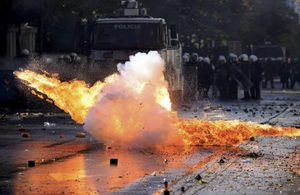
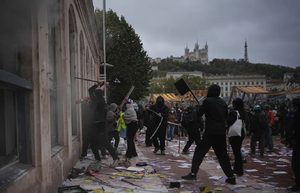
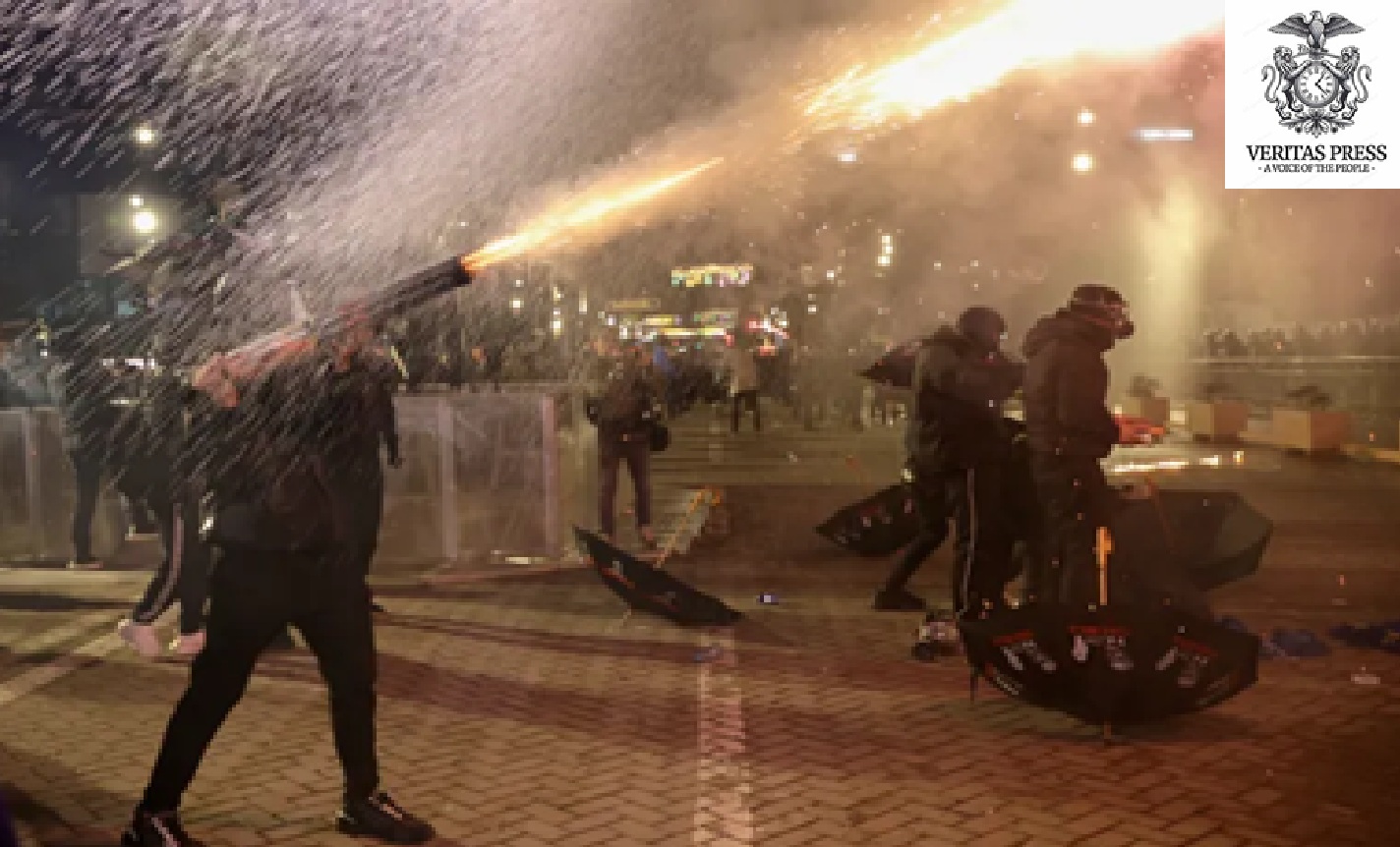
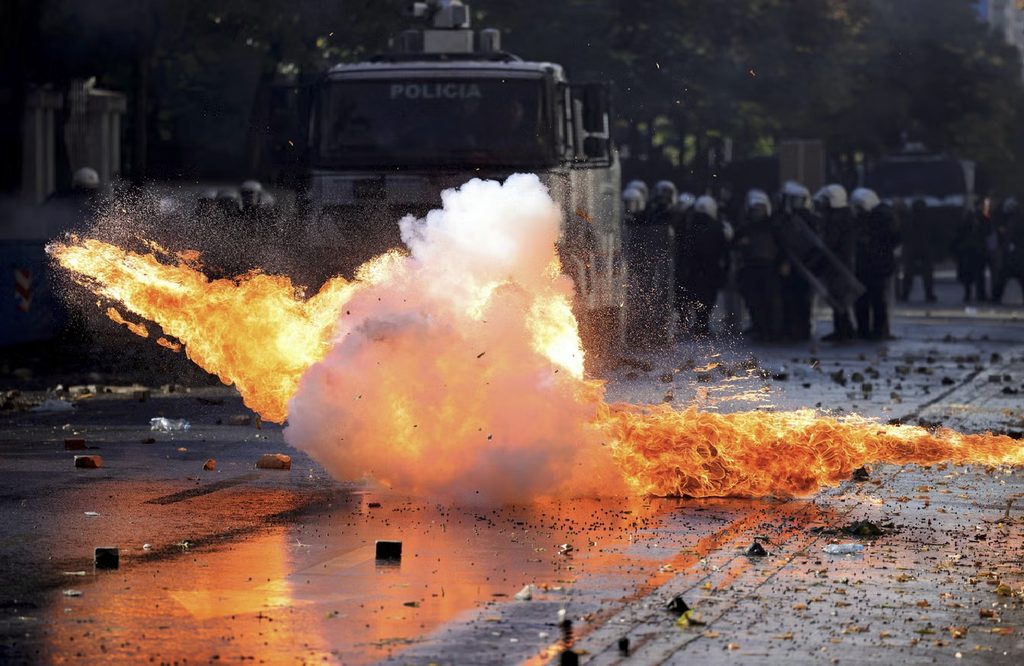
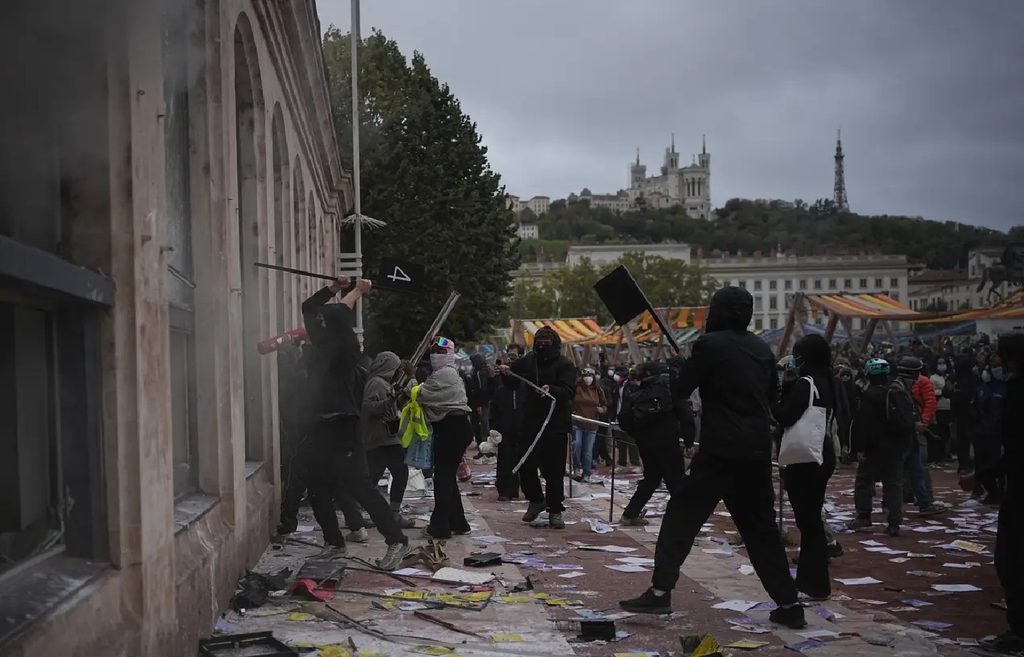
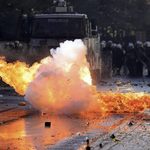
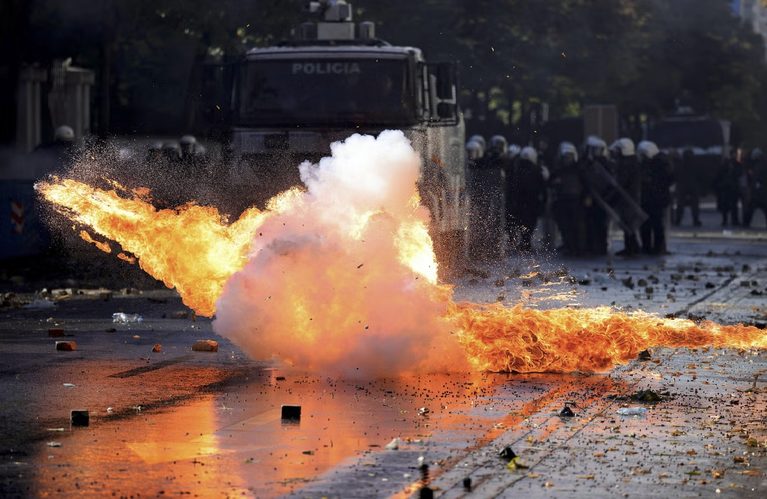
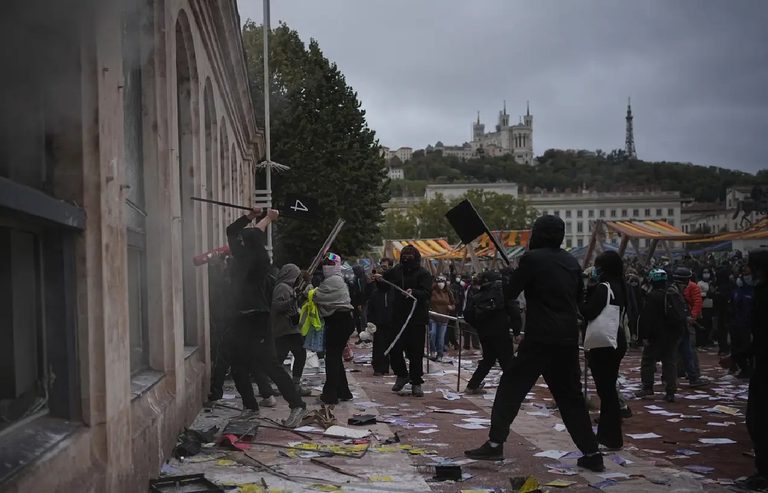
By Friday, June 5, the protests had turned violent. Marchers, many with faces wrapped in keffiyehs or Albanian flags, converged on the prime minister’s modernist office block on Dëshmorët e Kombit Boulevard. They hurled Molotov cocktails and fireworks at the building, shattering ground-floor windows. Anti-riot police responded with volleys of tear gas and high-pressure water cannons, the blue-tinted water mixing with the blood of those struck by rubber bullets. The clashes raged for two hours around the nearby parliament building, as a journalist from Agence France-Presse witnessed firsthand.
“Rama, ik!” the crowd chanted, “Rama, go away!”, punctuated by cries of “Rama në burg!” (Rama in jail) and “Shqipëria nuk shitet!” (Albania is not for sale). Demonstrators carried banners in multiple languages, a message aimed as much at Brussels and Washington as at the domed chamber of the Assembly. One read: “Kushner, Trump, Rama: Hands Off Our Land.” Another, in English: “Eco-Cide Is Genocide.”
Police said approximately 30 people were arrested. The opposition Democratic Party, which has struggled to position itself, claimed 40 of its supporters were detained. Interior Minister Albana Kociu issued a terse statement condemning “acts of vandalism” and calling the attack on police “a crime.” The United States Embassy, in a cautiously worded release, urged “all parties to exercise restraint and respect the rule of law,” but pointedly did not mention the Kushner-Trump investment.
On the ground, the protesters’ anger was anything but restrained. “Rama sold our coastline to the man who ethnically cleansed Palestinians and recognised Jerusalem as Israel’s capital,” shouted Arben, 29, a sociology student who declined to give his surname for fear of police reprisal. “This is a Zionist-colonialist project, just like in Gaza. They want to push us out and build walls. But we will tear them down.”
The conflation of the Albanian land struggle with Palestinian liberation has become a potent, if controversial, motif within the movement. Images of flamingos have been spliced with watermelon emojis; graffiti on the walls of the University of Tirana reads: “From the River to the Sea, From Zvërnec to Nartë.” While some analysts warn that this narrative risks alienating Western diplomatic support, for many young Albanians, who came of age watching Israel’s war on Gaza, it is a visceral lens through which to understand global power and dispossession.
“Kushner is not just any investor,” Zeneli told Socialist Worker. “He represents the intersection of American political dynasty and capital interests that have no accountability. The Trump family’s history of land grabs, of using political connections to override local rights, is exactly what we face here. The government treats him like a king, but for us, he is an occupier and a Zionist-coloniser.”
The Strategic Investors Law: A Decade Of Dispossession.
To comprehend how a protected landscape could be handed over to a foreign developer, one must examine the legal architecture quietly erected by Rama’s Socialist Party over the past decade. Central to this is the controversial Strategic Investors Law, which grants special status and fast-tracked approvals to projects deemed to be of national economic interest. Critics charge that the law has been systematically weaponised to transfer public land and resources to a narrow clique of oligarchs and politically connected foreigners, bypassing environmental assessments, parliamentary oversight, and the rights of local communities.
“Property during this decade has been taken from ordinary people and given to oligarchs through this law,” Zeneli explained. “It’s a form of legalised theft.” The Vjosa-Narta development, still officially in the “draft decision” phase according to government statements, would permit accommodation facilities, agritourism, camping sites, renewable energy installations, and fish farming centres. With the National Territorial Council’s approval, it could expand to include urban zones, highways, and marinas, a transformation that ecologists say would destroy the delicate hydrological balance of the lagoon and the breeding grounds of the flamingo, Dalmatian pelican, and loggerhead sea turtle.
The government’s messaging has been contradictory. Rama, in a series of Facebook Live broadcasts this week, alternately claimed the project would bring “4 billion euros of investment” and that “there is still no final project.” “The prime minister goes live every day with a new approach,” said Zeneli. “It is clear he is afraid. He has called for negotiations, but the call from the protests is clear: ‘Resign!’”
The indignation is compounded by a deep sense of political betrayal. The main opposition Democratic Party, led by veteran politician Sali Berisha, himself a former prime minister and president, has been conspicuously absent from a clear stance against the development. Berisha, who addressed a parallel rally on June 5, trained his fire on Rama’s corruption but avoided any pledge to cancel the Kushner project. “We will save Albania from Edi Rama, who has plunged the country into poverty and corruption,” Berisha thundered. “Even if they go behind the sun, we will find them and punish them with the full force of the law.”
But for the flamingo revolutionaries, this is hollow rhetoric. “Rama in prison, Berisha in prison,” they chant, a call echoed across social media. “It shows that the dissatisfaction is not only directed at the current government, but at the entire political establishment of the last 35 years,” said Zeneli. “The Democratic Party has not taken a clear stance against the project. This has led protesters to present the conflict not only as a clash with a party, but with a broader system.”
Corruption And The Balluku Affair:
The legitimacy crisis deepens with the ongoing corruption scandal enveloping Deputy Prime Minister Belinda Balluku. In December 2025, a special prosecution unit indicted Balluku, a close Rama associate and the powerful infrastructure minister, on charges related to a multi-million-euro kickback scheme in road construction contracts. Balluku was suspended, but the investigation has cast a long shadow over the government’s claims of reform. Several other former ministers from Rama’s cabinets have also been targeted in anti-corruption probes, reinforcing a public perception that the Socialist Party has institutionalised graft.
The protests on Friday, June 5, deliberately placed the Balluku case at their centre, with demonstrators demanding “accountability” and an end to impunity. The march to parliament was as much about the rule of law as about the flamingos. “We are governed by a mafia,” said Dritan, a 44-year-old former construction worker who said he was owed three months’ wages by a now-defunct subcontractor on a public-private partnership hospital. “They steal from us and then sell what remains to foreigners. This is not a government. It is a criminal enterprise.”
The V-Dem Institute, a respected Swedish research body, has classified Rama’s Albania as an “electoral autocracy,” a system in which formal democratic institutions exist but are controlled by the ruling party to the extent that the rule of law and civil liberties are hollowed out. This analysis, cited by activists, has gained new traction as international media descend on Tirana. “There is political pluralism, but there is no rule of law,” Zeneli summarised. “There are institutions, but they are controlled by the party in power.”
A Nation Of Emigrants, A Revolt Of Those Who Stayed:
Beneath the immediate demands, cancel the Zvërnec project, resign, jail the corrupt, lies a deeper sorrow. Albania is haemorrhaging its youth. Since the fall of communism in 1991, the country has lost over a third of its population to emigration, a demographic catastrophe that has emptied rural villages and left the country with a median age pushing 40. Those who remain often speak of a pervasive sense of hopelessness, of a political class that has monetised the nation’s future for its own enrichment while telling young people that their only option is a one-way ticket to Germany or Britain.
“The flamingo, for us, is a symbol of something that still chooses to stay,” said Redi Muçi, the first member of parliament elected from Lëvizja BASHKË in the 2025 parliamentary elections. In an interview at a smoke-filled café near Tirana’s pyramid, Muçi, a former university lecturer, linked the environmental struggle to a broader political project. “Lëvizja BASHKË was founded on the idea of the ‘red robin’, a small bird that does not migrate, that stays to sing in the frost. That is the choice we are demanding our society make: to stay, to resist, to build something here.”
Muçi’s party, which emerged from a decade of grassroots activism among miners, oil workers, students, and feminists, has become a crucial organising node in the protests, though he insists the movement is far broader than any single organisation. “This is a civic uprising, not a party one. The youth are leading; they have no memory of the old left-right divides. They see only a system that has failed them.”
Indeed, the generational character of the Flamingo Revolution is striking. On the streets, the faces are overwhelmingly young, adorned with surgical masks and phone cameras held aloft to livestream police abuses to the world. They dance to traditional iso-polyphony remixed with techno beats, a soundtrack of defiance that echoes through the canyons of Tirana’s communist-era apartment blocks. Yet their elders join too, women in headscarves and men with weather-beaten faces who remember the pyramid schemes of the 1990s, the 1997 civil war, and the long season of disappointment.
The Regional Echo: Yugoslavia, Kosovo, And The Spectre Of Unrest.
Observers of Balkan history cannot fail to notice the resonance. The fires of Tirana burn in a region still marked by the violent dissolution of Yugoslavia and the unresolved status of Kosovo. The 2023 Kosovo riots, the simmering Republika Srpska secessionism, and the student-led mass protests in Serbia that toppled a government in the early 2000s, all these provide a template and a warning.
Albania has its own particular revolutionary genealogy. The country was the most isolated Stalinist dictatorship in Europe under Enver Hoxha until 1985. The subsequent transition was catastrophic: the 1997 collapse of pyramid saving schemes led to a nationwide armed insurrection in which some 2,000 people were killed, and military depots were looted, putting some 550,000 Kalashnikovs into circulation. The trauma of that anarchy has long been invoked by the political elite as a disciplining tool: “Do you want another ’97?” Yet today’s protesters, many born after that dark year, are no longer cowed by the memory.
“Our anger is not chaotic,” said Mirela Ruko, a municipal councillor in Tirana for Lëvizja BASHKË. “We have studied the movements in Serbia, in Bosnia, the student revolts in Greece. We know that sustainable change requires organisation, not just Molotovs. But the people are pushed to the edge. What do you expect when the government sends water cannons against your grandmother?”
The regional dimension is inescapable in another sense: the Kushner project is part of a broader pattern of Gulf and American luxury investment in the Balkan coastline, from the Porto Montenegro marina for superyachts to the sprawling resorts of the Albanian Riviera. These enclaves create pockets of extreme wealth guarded by private security, while local populations are priced out and disconnected from ancestral lands. The United Arab Emirates, Israel, and Western investment funds have been snapping up prime coastal real estate, often with opaque legal arrangements and minimal environmental oversight. In Montenegro, similar protests in 2024 over a resort development on the Lustica peninsula were suppressed with mass arrests.
“The Balkan coast is the new frontier of global capital,” said Dr. Flora Krasniqi, an environmental sociologist at the University of Prishtina, reached by phone. “What we are witnessing is a new form of enclosure, the privatisation of the commons on a scale not seen since the fall of the Ottoman Empire. And it is generating its own antithesis: a transnational, youth-led movement that connects climate justice, anti-corruption, and decolonisation.”
The Diaspora Rises: Protests Go Global.
As the week unfolded, the Flamingo Revolution leapt national borders. On Saturday, June 6, over 2,000 Albanian diaspora members and solidarity activists gathered outside the Albanian Embassy in London’s St. James’s Square, chanting and waving the double-headed eagle flag alongside banners reading “Stop the Land Grab.” Similar actions took place in Rome, Berlin, Thessaloniki, and New York, where demonstrators in Times Square projected images of flamingos and the Narta lagoon onto the Reuters building.
“We left Albania because we had no future, but we will not stand by while the last beautiful places are destroyed for the fantasy of a Trump paradise,” said Liridon, a 35-year-old IT worker who travelled from Luton to the London protest. “This is our homeland, even if we cannot live there. Kushner and Rama are carving it up like a carcass.”
The diaspora, which sends home remittances exceeding $1.5 billion annually, a lifeline for many families, has an underappreciated political weight. Its members were radicalised by the Zvërnec video, shared widely on WhatsApp and Instagram. Diaspora organisations are now raising funds for the legal defence of those arrested and lobbying EU parliamentarians to scrutinise the Rama government’s environmental record as part of Albania’s ongoing accession negotiations.
The European Union, which aims to bring Albania into the bloc by 2030, has maintained a calibrated silence. An EU Commission spokesperson issued a statement expressing “concern” over “reports of violence” and stressing “the importance of independent environmental impact assessments and respect for the rule of law.” Privately, diplomats worry that Rama, once celebrated as a reformer, is becoming a liability.
‘They Are Afraid Because We Are Many’
Back in Tirana, the rhythm of protest has become almost liturgical. Each evening, demonstrators gather at the statue of Skanderbeg, the medieval national hero, before processing down the Martyrs of the Nation Boulevard. The police presence is massive, yet the mood shifts hourly: at dusk, a carnival of resistance with music and speeches; by midnight, a cat-and-mouse of barricades and charges down the side streets.
On the morning of June 7, state television broadcast images of Rama convening an emergency cabinet meeting. The prime minister, looking visibly shaken, proposed a “national dialogue” to “review” the Zvërnec project. But he stopped far short of cancellation, and his call for “negotiations” was met with scorn on the streets. “He wants to talk because we have made it impossible for him to ignore us,” said Arlind Qori, the leader of Lëvizja BASHKË, at a press conference. “But the only negotiation we will accept is the annulment of the Strategic Investment status and a full public inquiry into how this deal was made. And Rama’s resignation.”
Political analysts are scrambling to map the fallout. The Socialist Party still holds a comfortable parliamentary majority, but its internal cohesion is fraying. One senior Socialist MP, speaking on condition of anonymity, told Reuters that “the prime minister has underestimated the generational fury. This is no longer about a lagoon, it’s about everything.” The opposition remains fragmented and compromised by its own legacies of corruption, but the protests have created a new political space that traditional parties cannot easily co-opt.
The radical left is attempting to fill that space. Lëvizja BASHKË, with its hybrid identity as both a parliamentary party and a social movement, is gaining adherents daily. Its model, inspired partly by Podemos in Spain and the Zapatistas, of “walking at two speeds”, building community power while contesting elections, is now being stress-tested in revolutionary conditions. “We don’t just want to replace one set of thieves with another,” said Muçi. “We want to rebuild the relationship between citizen and state, to enshrine the commons in law, to guarantee that the Flamingo never has to protest again.”
What The Flamingo Means:
The Vjosa-Narta lagoon is not merely a biodiversity hotspot. It is a bellwether for the planet. The Adriatic coast is on the front line of climate breakdown: rising seas, salinisation of aquifers, and extreme heat are already reshaping life for coastal communities. The decision to bulldoze a protected area for luxury tourism, at a time when scientists are pleading for ecosystem-based adaptation, encapsulates a civilizational madness. The flamingo, with its delicate pink plumage and dependence on shallow, undisturbed waters, becomes a proxy for all that is vulnerable and beautiful in a world on fire.
“When we defend the flamingo, we defend our own right to exist,” said Elira Hoxhaj, back in Nartë, standing on the dusty road that leads to the now-guarded pine forest. “We are not against development. We are against the lie that our land is empty and our lives are worthless. They want us to disappear. But we are still here.”
As the sun sets over the lagoon, a small group of activists maintains a vigil near the monastery. The water shimmers with the last light, and in the distance, the unmistakable silhouette of a flamingo rises, beats its wings, and flies toward the open sea. In Tirana, the crowd roars once more.
For The Secure Submission Of Documentation, Testimonies, Or Exclusive Investigative Reports From Any Global Location, Please Utilise The Following Contact Details For Our Investigations Desk: enquiries@veritaspress.co.uk or editor@veritaspress.co.uk
Help Support Our Work:
Popular Information is powered by readers who believe that truth still matters. When just a few more people step up to support this work, it means more lies exposed, more corruption uncovered, and more accountability where it’s long overdue.
Help Protect Independent Journalism, Which Is Currently Under Attack.
If you believe journalism should serve the public, not the powerful, and you’re in a position to help, becoming a DONATOR or a PAID SUBSCRIBER truly makes a difference.
DONATION APPEAL: If You Found This Reporting Valuable, Please Consider Supporting Independent Journalism.
Help Support Our Work – We Know, We Know, We Know …
Seeing these messages is annoying. We know that. (Imagine what it’s like writing them … )
Your support fuels our fearless, truth-driven journalism. In unity, we endeavour to amplify marginalised voices and champion justice, irrespective of geographical location.
But it’s also extremely important. One of Veritas Press’s greatest assets is its reader-funded model.
1. Reader funding means we can cover what we like. We’re not beholden to the political whims of a billionaire owner. We are a small, independent and impartial organisation. No one can tell us what not to say or what not to report.
2. Reader funding means we don’t have to chase clicks and traffic. We’re not desperately seeking your attention for its own sake: we pursue the stories that our editorial team deems important and believe are worthy of your time.
3. Reader Funding: enables us to keep our website and other social media channels open, allowing as many people as possible to access quality journalism from around the world, particularly those in places where the free press is under threat.
We know not everyone can afford to pay for news, but if you’ve been meaning to support us, now’s the time.
Your donation goes a long way. It helps us:
Keep the lights on and sustain our day-to-day operations
Hire new, talented independent reporters
Launch real-time live debates, community-focused shows, and on-the-ground reporting
Cover the issues that matter most to our communities, in real time, with depth and integrity
We have plans to expand our work, but we can’t do it without your support. Every contribution, no matter the size, helps us stay independent and build a truly people-powered media platform.
If you believe in journalism that informs, empowers, and reflects the communities we serve, please donate today.
Kamran Faqir is a volunteer investigative journalist and writer committed to exposing hidden truths and amplifying underreported stories. Driven by social justice, he brings sharp insight and fearless truth-telling to independent journalism. NUJ registered.
SEATTLE, TEHRAN — The U.S. Department of Homeland Security (DHS) will allow Iran’s national football team to enter the country 48 hours before their critical World Cup match against Egypt on Friday, a modest concession in a tournament where Team Melli’s travel conditions have sparked claims of oppression and competitive disadvantage.