Kamran Faqir is a volunteer investigative journalist and writer committed to exposing hidden truths and amplifying underreported stories. Driven by social justice, he brings sharp insight and fearless truth-telling to independent journalism. NUJ registered.
Press Release: Veritas Press C.I.C.
Author: Kamran Faqir
Article Date Published: 27 Oct 2025 at 14:52 GMT
Category: Middle-East | Palestine-Gaza-West Bank | Two Palestinians Killed
Source(s): Veritas Press C.I.C. | Multi News Agencies
Business Ads
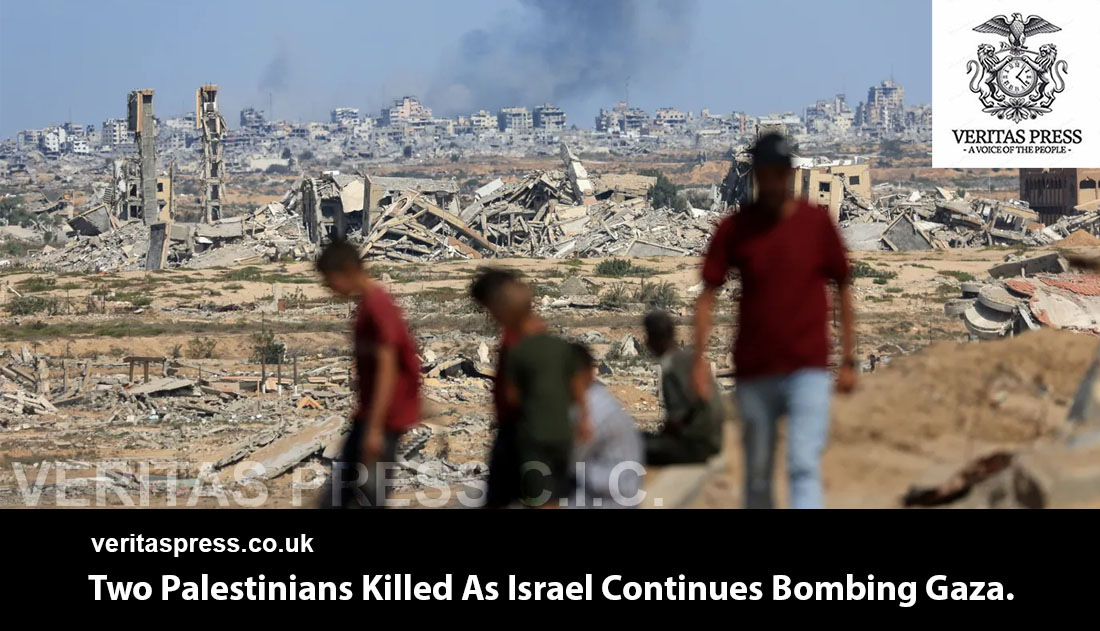
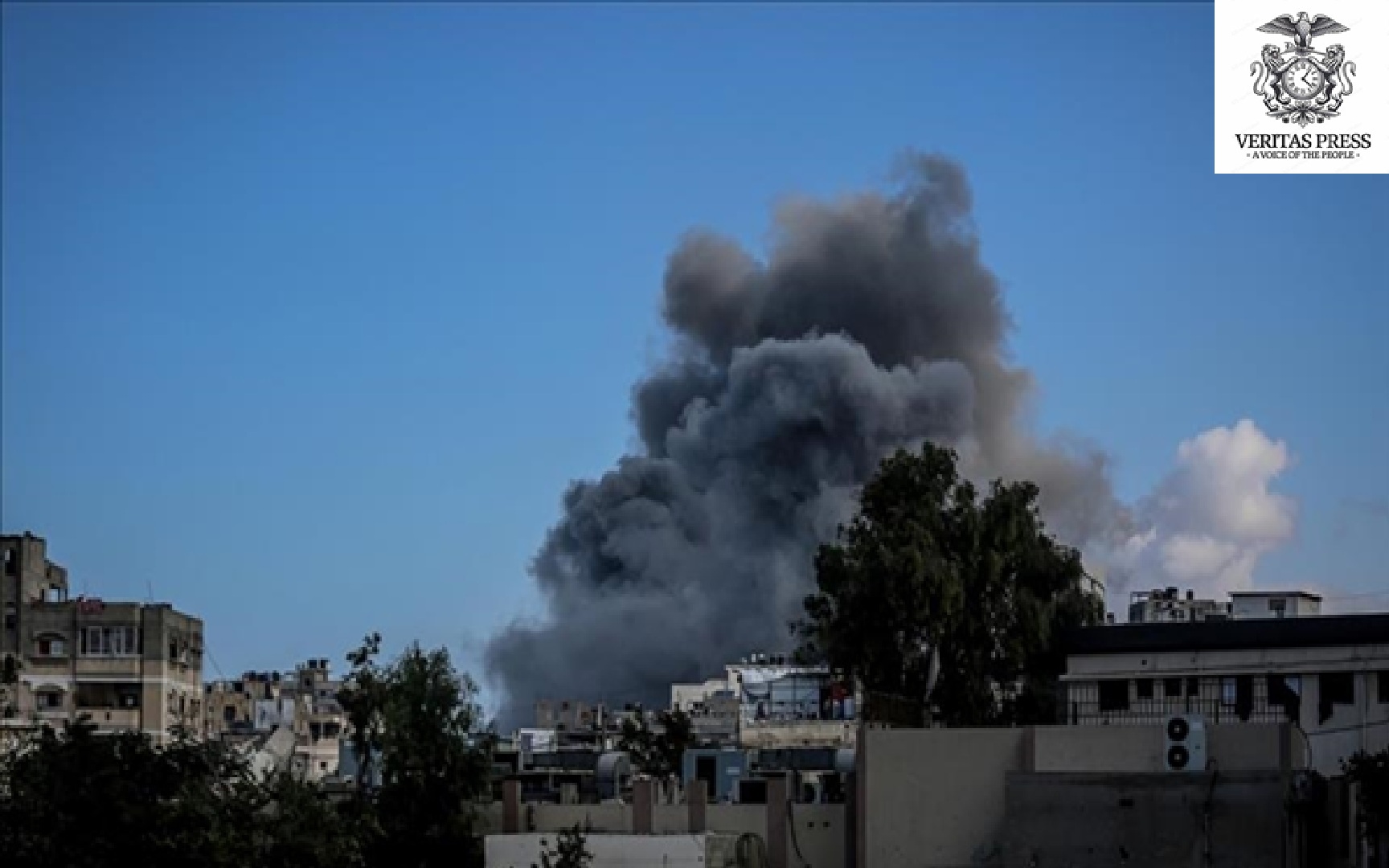
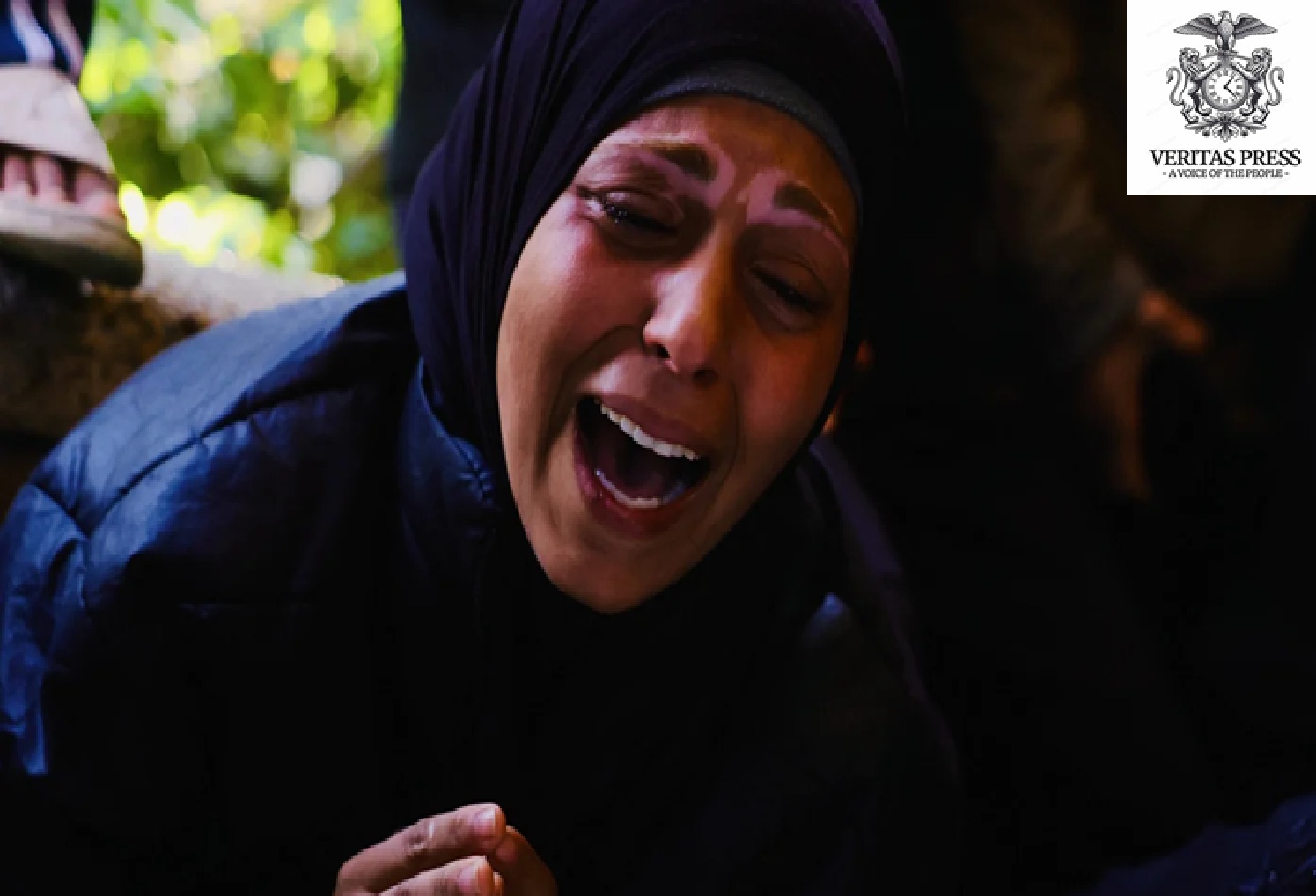
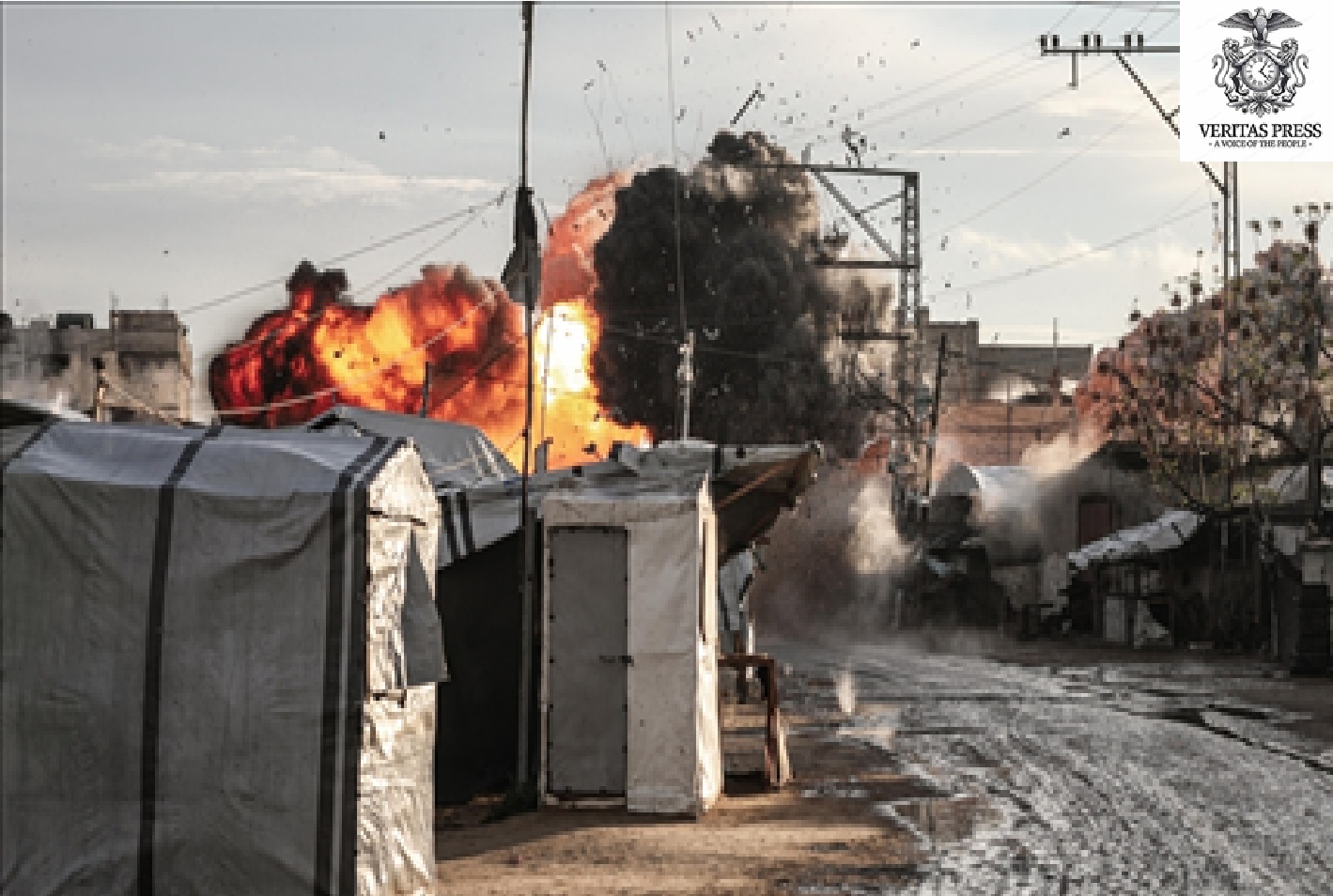
On Monday morning, an Israeli drone struck Abasan al-Kabira, east of Khan Yunis, killing two Palestinians who, according to local hospitals and civil defence teams, had returned to inspect the ruins of their homes. The Nasser Medical Complex confirmed the fatalities; local media identified one of the dead as Farid Hassan Qdeih, 45. Residents and witnesses described missiles fired at people picking through rubble and at displaced person camps near Sheja’iyya, while Israeli forces simultaneously shelled eastern Khan Yunis and fired from naval vessels off Rafah’s coast. These incidents are not isolated misfires but part of a documented pattern of strikes and shoot-outs that have continued since the ceasefire was announced on 10–11 October 2025.
What Happened, On The Ground And On Record:
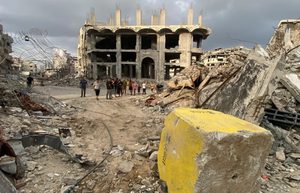
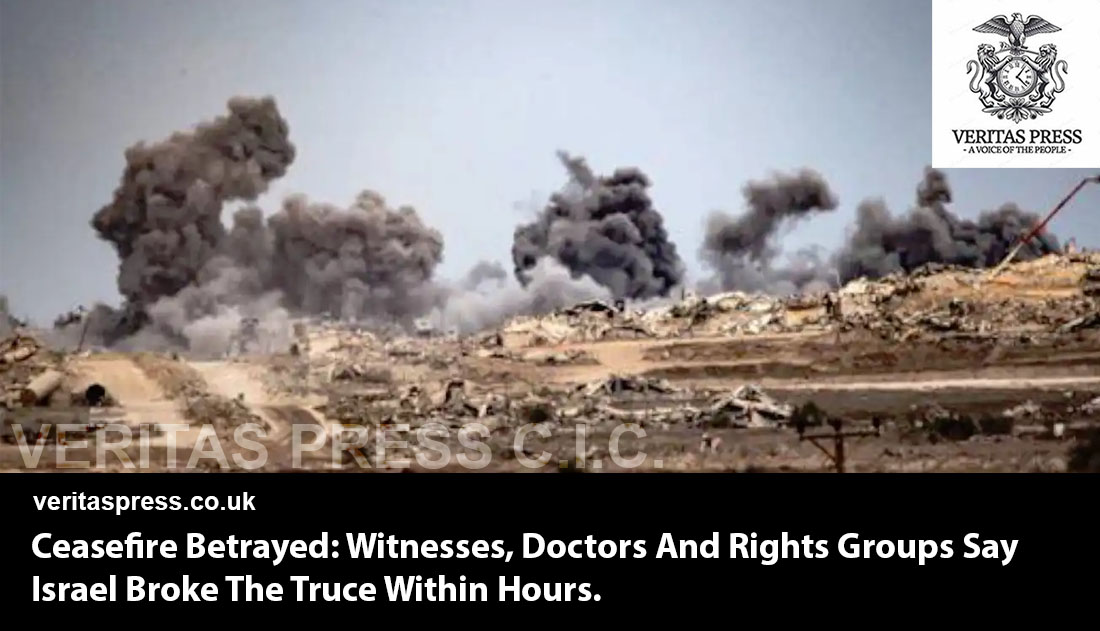
Medical and civil defence sources in Gaza say roughly 93 Palestinians have died and several hundred have been wounded in continuing strikes since the ceasefire, and health authorities place the cumulative death toll since 7 October 2023 at more than 100,000. Rescue teams continue to recover bodies from deep under collapsed buildings; whole neighbourhoods remain littered with unexploded ordnance and inaccessible remains. Local reporting and live coverage from Al Jazeera show people returning to the rubble only to be hit, often while conducting the human, laborious task of identifying bodies and salvaging belongings.
This reporting raises two immediate lines of inquiry for investigators: (1) whether forces firing on civilians returning to damaged homes knew those people were civilians, and (2) whether such strikes were isolated errors or reflect a broader operating procedure of interdiction and intimidation. Eyewitness accounts collected by field reporters, people saying they were “inspecting our destroyed home when the strike hit”, are consistent across multiple sites and dates.
Official Rationale Vs. Operational Practice:
Israel’s leadership frames its continuing strikes as defensive or retaliatory. Prime Minister Benjamin Netanyahu made plain that Israel intends to remain the final arbiter of Gaza’s security, including which foreign security contingents may enter under any multinational arrangement, telling his cabinet: “We are in control of our security … Israel will determine which forces are unacceptable to us.” That insistence has both political and operational consequences: it gives Israel the latitude to declare particular operations necessary on national-security grounds, while limiting impartial third-party oversight of those operations.
Yet that official posture collides with evidence on the ground. Video and witness reporting, and repeated complaints by Gaza medical staff and civil defence, show strikes on civilians in areas where no visible armed confrontation was occurring. Human Rights Watch and Amnesty International have warned that a ceasefire without independent monitoring, unfettered aid access and accountability mechanisms is insufficient to protect civilians. HRW said the ceasefire “is no substitute for action on aid and justice”; Amnesty has repeatedly framed short-term pauses as insufficient without substantive changes to occupation, blockade and impunity.
Eyewitnesses, Civil Defenders And Journalists: A Chorus Of The Same Facts.
Field reporters and local organisations paint a consistent picture. Al Jazeera’s live reporting from Khan Yunis documented people returning to their homes and being struck; its correspondents described unexploded ordnance, bodies recovered from rubble, and rescue crews unable to reach certain sites because of ongoing strikes. Local health workers in Nasser Hospital and civil defence teams say they are regularly receiving bodies pulled from rubble, sometimes many days after initial strikes, and that continued attack patterns impede retrieval and identification.
Journalists on the ground have also recorded footage of drones following and striking vehicles or groups that appear to be civilians, footage that raises questions about target identification protocols and whether proper positive identification of combatants was obtained before lethal strikes. Independent monitors have repeatedly called for access to that footage and for transparent after-action accounting.
Patterns Of Conduct That Demand Legal Scrutiny:
Three patterns emerging from the public record should be subject to immediate independent investigation:
Strikes on people returning to their homes or on rescue and salvage operations. Repeated reporting shows civilians were targeted while surveying rubble or recovering bodies, actions that are by definition humanitarian and civilian. If confirmed, such strikes can amount to unlawful attacks under international humanitarian law.
Use of remote, stand-off weapons (drones, precision missiles) in dense civilian areas without apparent precautions. The operational record suggests either inadequate precautions to avoid civilian harm or, more alarmingly, indifference to it, both legally and morally problematic.
Control of monitoring and aid access as leverage. Israel’s insistence on determining which foreign forces are “acceptable” and continued restrictions on crossings and convoys create structural conditions that enable impunity: if inspections and third-party monitors are excluded, there is no credible independent verification of whether rules of engagement were lawful. Human rights groups and the ICJ’s recent rulings and commentary have underscored that obstruction of aid and failure to allow UN access violate obligations to protect civilians.
Voices Demanding Accountability, Activists, Rights Groups And Analysts:
Human rights organisations and analysts have been blunt. Human Rights Watch warned that the ceasefire “is no substitute for action on aid and justice,” urging that any truce must be accompanied by independent monitoring and enforcement mechanisms. Amnesty International has framed the crisis in Gaza in terms of longer-term structural violence, calling for the ceasefire to be a pathway to ending occupation policies and to accountability for alleged international crimes. International analysts at Chatham House and other think-tanks have likewise argued that a ceasefire lacking real inspection and enforcement is a pause, not a settlement.
Families of hostages and many Israeli officials insist on strictures that further complicate impartial oversight. Hostage families have publicly demanded guarantees that remain non-negotiable for them, and Israel has used those demands to justify continued constraints on Rafah and aid routes. The result is a political equilibrium where civilians in Gaza are left paying the price for the bargaining chips of others.
Who Benefits From The ‘Fragile’ Truce?
At a minimum, the fragility of the truce preserves Israel’s ability to claim military and political control over Gaza’s immediate future: who may enter, what aid is permitted, and the conditions under which reconstruction and political negotiation proceed. Strategically, maintaining a low-intensity coercive posture allows Israel to keep territorial and security leverage while avoiding the immediate political costs of a full redeployment or meaningful concessions. Practically, it leaves humanitarian organisations scrambling to get aid in under hazardous, politically contingent terms. Human rights organisations note that without independent enforcement mechanisms, such arrangements routinely calcify into de facto control without accountability.
Evidence gaps, and why they matter for accountability:
There are obvious and urgent evidence gaps that investigators must close:
Access to strike footage and targeting intelligence. Where video exists of drones following vehicles or people who appear to be civilians, that footage must be preserved and independently assessed. Media outlets have published snippets; investigators need chain-of-custody access.
Timelines and after-action reports from the Israeli military. Public claims of targeting militants must be matched to a public record showing positive identification, warnings given (if any), and battle damage assessments. Without those, lethal strikes in civilian contexts remain unexplained.
Independent medical and forensic documentation. Hospitals and civil defence in Gaza report bodies recovered from under rubble; independent forensic teams should be allowed to examine remains to determine cause and weapon type. International bodies, OCHA, WHO, and the ICRC, have roles here but need unfettered access.
What Investigators And The International Community Must Do, A Short Checklist:
Demand immediate, independent investigations into strikes where civilians were present and where rescue or recovery operations were hit. These investigations must be able to subpoena military logs and video. (HRW/Amnesty/ICJ guidance cited.)
Insist on neutral monitors for the ceasefire. If Israel continues to insist on vetting foreign contingents, the international community must press for UN or impartial guarantors with full access and enforcement capability.
Enforce humanitarian obligations immediately. The ICJ and rights groups have demanded that Israel allow unhindered aid; donors and UN agencies should condition assistance on demonstrable delivery and protection protocols.
Preserve and vet audiovisual evidence. Media-published footage must be collected under an impartial chain of custody for forensic review.
Conclusion, Beyond Denunciation To Institutional Remedies.
The killings in Abasan al-Kabira are not incidental casualties of a confused battlefield; they fit into a broader operational and political pattern, a ceasefire whose rules are negotiable in practice, where control of access and surveillance sits with one party, leaving civilians exposed. The persistence of strikes on civilians returning to their homes, coupled with restrictions on independent monitoring and the continuing politicisation of aid, turns temporary pauses into protracted punishment.
These repeated breaches reveal more than a military failure to restrain fire; they expose what rights groups and UN investigators describe as a deliberate strategy of domination, forced displacement, and systematic erasure. Human-rights monitors, including Amnesty International, Human Rights Watch, and B’Tselem, have warned that Israel’s conduct in Gaza, defined by mass bombardment, blockade, and the destruction of civilian infrastructure, constitutes collective punishment and an operation of ethnic cleansing in practice, as entire communities are being uprooted and confined to shrinking, militarised zones.
UN Special Rapporteur Francesca Albanese has repeatedly warned that Israel’s actions show “a systematic attempt to make Gaza uninhabitable, an operation of ethnic cleansing conducted under the cover of security rhetoric.” In her latest report to the Human Rights Council, she described the emergence of “kill zones” and “displacement corridors” designed to forcibly remove Palestinians and permanently alter Gaza’s demographic and territorial character.
Satellite imagery and field data collected by the UN Office for the Coordination of Humanitarian Affairs (OCHA) and the Euro-Med Human Rights Monitor show vast swathes of northern and eastern Gaza flattened and fenced, converted into military “security belts”, and divided by “yellow lines”, areas emptied of civilians, where any movement is treated as a threat. Survivors and local journalists report that Palestinian communities have been dispossessed of their land through displacement, and when they return to inspect or rebuild their homes, they are being forced into makeshift encampments that lie within or adjacent to these active kill zones, under the guise of security and military necessity.
“These aren’t accidental killings; they are part of an organised geography of control,” said Omar Shakir, Israel and Palestine Director at Human Rights Watch. “Israel has created zones where civilians cannot live, move, or rebuild. This is systematic erasure, the displacement and confinement of a people within deadly boundaries.”
The remedy, as human-rights experts and legal scholars argue, is not more rhetoric or unenforced resolutions. It is an independent investigation, impartial monitoring with enforcement authority, unimpeded humanitarian corridors, and credible judicial mechanisms capable of determining whether Israel’s ongoing attacks, displacement policies, and land appropriation constitute war crimes, crimes against humanity, or, as multiple UN experts have suggested, acts of ethnic cleansing and persecution.
Until such mechanisms are empowered and enforced, every “ceasefire” will remain a fragile façade, and more families will bury the victims of returns that became death sentences. As one aid worker in Khan Yunis told Middle East Eye: “They are told it’s safe to go home, but home is gone, and those who try to find it are being killed for trying.”
What emerges from Abasan al-Kabira and beyond is not the end of war but its transformation, from bombardment to bureaucratised erasure. The creation of kill zones, demolition corridors, and encampments for displaced Palestinians is not security policy; it is the architecture of systematic erasure and ethnic cleansing, concealed within ceasefire management. Without accountability and international enforcement, this will not be peace; it will be a continuing war of removal, one that redraws Gaza’s map by eliminating those who live upon it.
The Global Struggle For Accountability:
While the bombardment and dispossession continue, international legal machinery is beginning, however haltingly, to respond. The International Criminal Court (ICC) has kept open its investigation into crimes committed in the occupied Palestinian territory since 2014, now expanded it to include Gaza since October 2023. This process could, in principle, cover the drone strikes on returning civilians, the creation of kill zones, and the mass displacement policies described above.
At the International Court of Justice (ICJ), a case brought by several states in April 2025 accuses Israel of breaching its obligations as an occupying power by weaponising humanitarian aid access. The hearings, focused on Israel’s blockade of Gaza, could set a legal precedent over the duty to “allow and facilitate” life-saving assistance under international law.
Meanwhile, the UN Human Rights Council’s Independent Commission of Inquiry, in its September 2025 legal analysis, concluded that Israel’s actions in Gaza “fulfil several acts under the Genocide Convention,” including deliberate killing, starvation, and the infliction of conditions of life designed to bring about physical destruction. This landmark finding has intensified calls for ICC prosecutors to expand their charges to include genocide.
In the absence of immediate enforcement, civil society has mobilised. The Gaza Tribunal, a people’s tribunal convening its final session in Istanbul in October 2025, has already declared Israel guilty of genocide and apartheid, providing a powerful moral record and an archive of survivor testimony. At the same time, the UN-sponsored Geneva Hearings earlier this year collected evidence of torture, starvation, and abuse of Palestinian detainees, feeding directly into ongoing UN and ICC investigations.
Together, these parallel efforts, from The Hague to Geneva, from the UN system to grassroots tribunals, represent a fragile yet growing architecture of accountability. Whether it can overcome political obstruction, notably the repeated US vetoes at the Security Council, will determine if international law still has force in the face of systematic erasure in Gaza.
Until that test is met, Gaza’s landscape will remain both a graveyard and a courtroom, a place where the ruins of homes, camps, and communities stand as living indictments of a global order that has so far refused to act.
BelowAre Five Key International Legal Proceedings Currently Underway Against Israel (or recently completed):
1. ICJ Hearings on Israel’s Humanitarian Blockade of Gaza
In April 2025, the International Court of Justice (ICJ) held public hearings on accusations that Israel is violating its obligations as an occupying power by blocking humanitarian aid into Gaza, part of a case brought by Norway and other states.
The arguments focus on whether Israel must “allow and facilitate” relief operations under the Hague Regulations and Fourth Geneva Convention. While ICJ rulings are advisory in many respects, its judgments carry strong legal and reputational weight. The outcome may help frame future legal arguments about the use of aid as leverage or weaponisation.
2. ICC Decision on Israel’s Objections and Ongoing Warrant Applications
In April 2025, the ICC Appeals Chamber ordered a lower panel to revisit Israel’s objections to jurisdiction over arrest warrants sought against Israeli leaders, including Netanyahu and Gallant.
Additionally, ICC judges secretly ordered that any future arrest warrant applications in the Palestine case must be kept confidential, limiting public announcements.
These developments affect what the ICC can reveal, how the process is framed publicly, and how evidence is shielded or exposed, factors that influence how accountability is pursued, perceived, or resisted.
3. UNHRC Independent Commission Report Declaring Evidence of Genocide
On 16 September 2025, the UN Human Rights Council’s Independent International Commission of Inquiry released a landmark 72-page Legal Analysis concluding that Israel is committing acts that fulfill multiple articles of the 1948 Genocide Convention in Gaza, including murder, infliction of conditions of life calculated to bring about destruction, and measures intended to prevent births, and calling for adding genocide charges to ICC warrants.
That report is among the strongest institutional findings to date, giving civil society and legal advocates a powerful baseline to push for investigations and expansion of charges.
4.Gaza Tribunal / People’s Tribunal in Istanbul (October 2025)
The Gaza Tribunal, a civil society initiative founded in 2024, is convening its final public session in Istanbul in October 2025. It will produce a “Jury of Conscience” judgment, issuing moral and legal findings on Israel’s conduct, including accusations of genocide, apartheid, and systematic erasure.
At its most recent session, it has already declared Israel to be perpetrating genocide in the enclave and called for accountability from states and international bodies.
While this is not a state court, the tribunal serves as an accountability archive, a public pressure tool, and a record of testimony, especially useful when formal institutions stall.
5. UN-sponsored Geneva Hearings on Palestinian Allegations of Abuse in Israeli Custody
In early 2025, the UN Human Rights Council’s Commission of Inquiry conducted hearings in Geneva where Palestinian survivors testified to physical abuse, sexual violence, starvation, and degrading treatment while in Israeli detention during the Gaza conflict.
Those testimonies are expected to feed into ICC or other tribunal prosecutions, especially in command responsibility or patterns of abuse. The commission is expected to publish findings with recommendations.
Kamran Faqir is a volunteer investigative journalist and writer committed to exposing hidden truths and amplifying underreported stories. Driven by social justice, he brings sharp insight and fearless truth-telling to independent journalism. NUJ registered.
SEATTLE, TEHRAN — The U.S. Department of Homeland Security (DHS) will allow Iran’s national football team to enter the country 48 hours before their critical World Cup match against Egypt on Friday, a modest concession in a tournament where Team Melli’s travel conditions have sparked claims of oppression and competitive disadvantage.