Kamran Faqir is a volunteer investigative journalist and writer committed to exposing hidden truths and amplifying underreported stories. Driven by social justice, he brings sharp insight and fearless truth-telling to independent journalism. NUJ registered.
Press Release: Veritas Press C.I.C.
Author: Kamran Faqir
Article Date Published: 30 Oct 2025 at 12:29 GMT
Category: USA | Politics | Trump Orders Resumption Of U.S. Nuclear Testing
Source(s): Veritas Press C.I.C. | Multi News Agencies
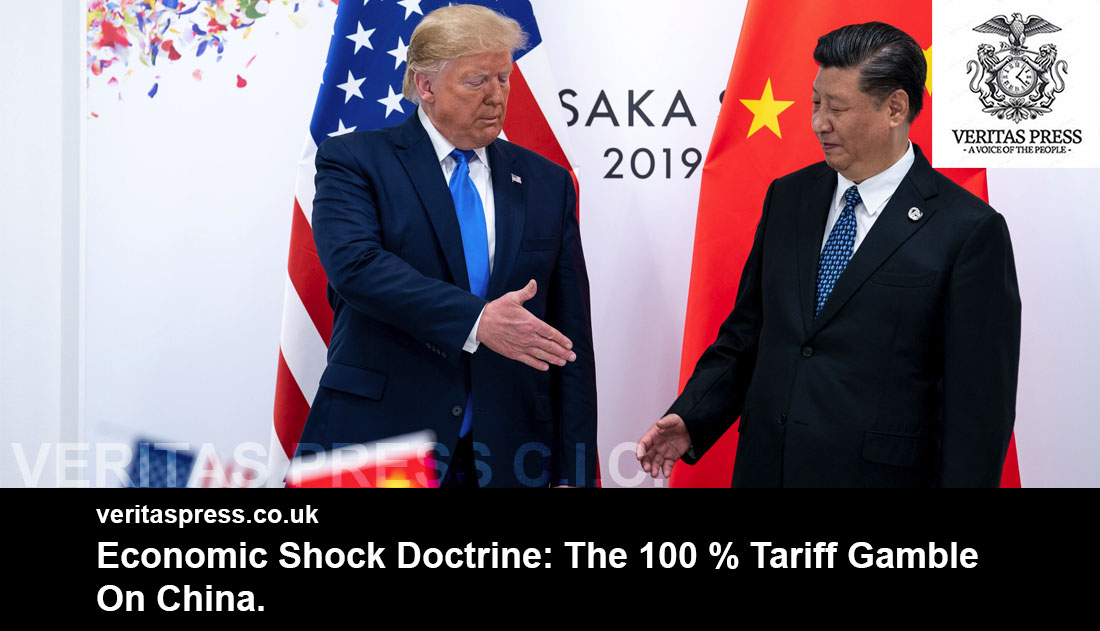
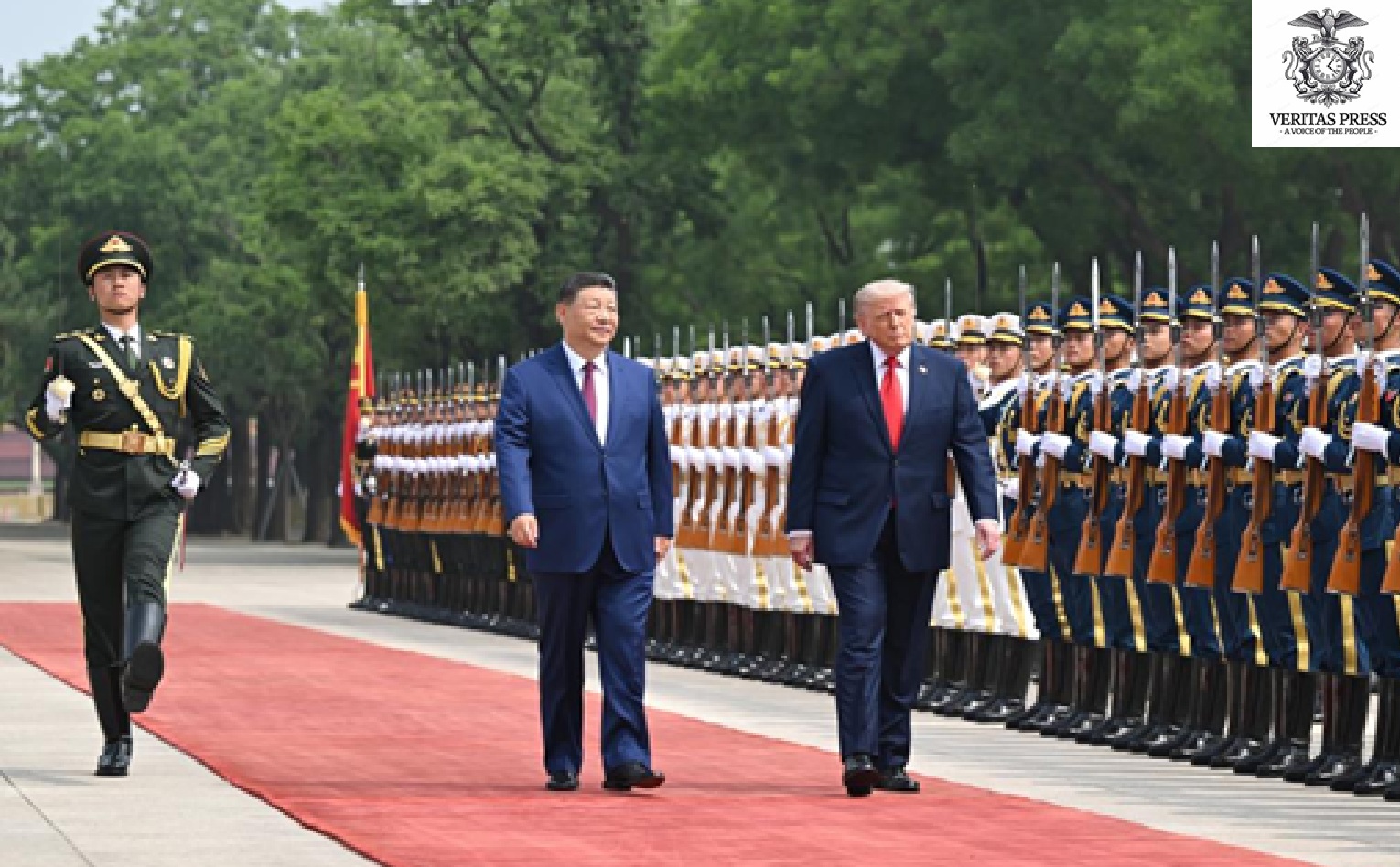
WASHINGTON, USA, Oct. 30 — In a dramatic pivot, U.S. President Donald Trump announced via Truth Social that he has instructed the Pentagon to immediately resume testing U.S. nuclear weapons, breaking a 33-year moratorium. The announcement came mere moments before his summit with Chinese President Xi Jinping in Busan, signalling a sudden escalation in the nuclear posture of the United States.
Trump justified the decision by citing the rapid nuclear modernisation of Russia and China:
“Because of other countries’ testing programs, I have instructed the Department of War to start testing our Nuclear Weapons on an equal basis. That process will begin immediately.”
He also touted the size and modernisation of the U.S. arsenal, claiming Washington holds the world’s largest stockpile and warning that China “will be even within 5 years.”
Yet, even as he called for parity with rivals, Trump added a rhetorical caveat: he would welcome denuclearisation, and claimed the U.S. arsenal was “well locked up.”
Why This Decision Matters And Why It’s Ambiguous:
At the heart of the controversy is ambiguity: Trump did not specify whether he meant explosive nuclear testing (i.e. underground detonations) or flight tests/system tests of nuclear-capable delivery platforms.
If he means explosive testing, that would require reactivating or constructing underground test facilities (e.g., at the Nevada National Security Site), which have not been used since 1992.
If he means flight tests, it might refer to putting warheads or delivery systems through new stress tests or missile launches, something more routine and less politically explosive (though still significant in signalling).
In practice, experts observe that the U.S. today relies heavily on subcritical tests, simulations, and modelling to validate its warhead designs without detonation. Resuming full-blown nuclear explosions would represent a dramatic policy reversal.
It is expected that, even preparing for explosive tests, the U.S. would need at least 36 months to refurbish or validate containment structures and safety protocols.
Critics have warned that such a move would undermine the global non-proliferation architecture, provoke reciprocal testing, and destabilise decades of arms control norms.
Russia’s Poseidon Torpedo And Broader Nuclear Escalation:
Trump’s decision comes amid intensified nuclear signalling by Russia. On Oct. 29, President Putin announced that Russia had successfully tested the Poseidon, a nuclear-powered underwater drone/torpedo system, capable of generating radioactive “tsunamis” against coastal targets.
The Poseidon is said to travel long distances autonomously under nuclear propulsion, bypass defences, and deliver a nuclear warhead. Analysts estimate its range to be ~10,000 km and speed ~185 km/h, though many technical details remain opaque.
Moscow portrays Poseidon as a counter to U.S. missile defences, an asymmetric threat targeting coastlines and naval bases.
Importantly, Russia has also recently tested its Burevestnik (nuclear-powered cruise missile) and announced large-scale nuclear drills.
These moves, combined with Trump’s announcement, suggest a renewed tripolar nuclear arms competition, with high-stakes signalling and grave risks of miscalculation.
China’s Rapid Stockpile Expansion And Strategic Pressure:
China, long viewed as the rising power in nuclear affairs, has massively expanded its arsenal over the past five years. According to the Centre for Strategic and International Studies (CSIS), China’s nuclear warhead count grew from an estimated 300 in 2020 to about 600 in 2025.
CSIS and U.S. military assessments project that China may cross the 1,000-warhead threshold by 2030.
In its September Victory Day parade, China displayed several strategic systems that analysts said could reach the U.S. mainland.
From Washington’s perspective, this aggressive growth forces a recalibration: either to deter China’s future parity or to risk being outmatched.
Domestic And Global Backlash:
The reactions were swift and largely negative:
Congressional pushback: Representative Dina Titus (D‑Nevada) pledged legislation to block testing.
Arms control voices: Daryl Kimball, head of the Arms Control Association, vigorously criticised the order, calling it “misinformed and out of touch.” He warned that the move could break the Nuclear Non-Proliferation Treaty (NPT) regime and spark retaliatory testing.
Strategic consequences: Observers note that even without explosive testing, the signal itself may provoke Russia, China, and other states to respond openly, undermining decades of tacit restraint.
Global condemnation: China’s Foreign Ministry urged the U.S. to “honour its commitment to the moratorium,” calling the decision a destabilising move.
Russian counter‑signals: A senior Russian lawmaker warned that the decision marks a new era of unpredictability and confrontation.
Proponents of the suspension point to the need for empirical data, modernisation of warheads, and maintaining credible deterrence. Critics emphasise the risks: a breakdown in nuclear norms, cascading arms races, environmental and safety hazards, and the political fallout of abandoning decades of U.S. restraint.
Historical Context: Why Testing Ceased, And What Breaking It Means.
From Trinity to the Moratorium
The first U.S. nuclear detonation, the Trinity test, occurred in 1945, heralding the atomic age.
Between 1945 and the 1990s, the U.S., Soviet Union (later Russia), China, Britain, France, and others carried out thousands of tests, many atmospheric or underground, often with devastating environmental and human health consequences.
In 1992, under President George H. W. Bush, the U.S. declared a moratorium on nuclear explosive testing, which subsequent administrations, including Bill Clinton, George W. Bush, Obama, and Biden, upheld—though the U.S. never ratified the Comprehensive Nuclear-Test-Ban Treaty (CTBT).
Meanwhile, Russia ratified the CTBT in 2000, though it later withdrew, while China also ratified but has not conducted tests since 1996.
The moratorium became a central pillar of post–Cold War nuclear restraint, serving as a tacit compact: nuclear states would forego full detonations in exchange for global stability, verification regimes, and non-proliferation norms.
Breaking the Compact: Ramifications Ahead.
Resuming explosive testing would deliver powerful political signalling: Washington is announcing it is ready to re-enter the most extreme forms of nuclear competition.
It would erode U.S. moral standing on arms control: Many non-nuclear states would see this as vindication of proliferation arguments (i.e. why shouldn’t they test too?).
Retaliatory tests: Russia, China or others may feel justified to resume full detonations. The cycle could spiral.
Verification & arms control treaties: The CTBT, now in limbo, could collapse entirely. Bilateral arms control (e.g. future U.S.–Russia treaties) would face a profound strain.
Technical & safety challenges: Reopening dormant test sites, revalidating containment, environmental assessments, and safety for local communities are each complex, time-consuming, and politically fraught.
Escalation risk: In a crisis, ambiguous tests could be misinterpreted as a prelude to use. The fog around whether a test is conventional, subcritical, or explosive raises the risk of miscalculation.
Why Now? Reading The Strategic Calculus:
Why did Trump choose this moment? Several converging pressures seem to be at work:
Perceived Loss of U.S. Nuclear Edge With China accelerating its build-up and Russia innovating delivery systems (e.g. Poseidon, Burevestnik), some in Washington argue the U.S. could lose deterrence credibility if it fails to keep pace.
Political Messaging and Domestic Audiences For Trump, who has repeatedly emphasised strength, military posture, and rivalrous competition with China and Russia, this move reinforces his brand: asserting dominance and rejecting restraint.
Leverage in Diplomatic Negotiations The announcement came just before the Xi summit, perhaps to gain leverage or reset strategic dynamics.
Deterrence Signalling in an Unstable Era With war raging in Ukraine, rising crises across multiple theatres, and shifts in missile defence architectures, Trump may calculate that overt nuclear signalling is needed to re-establish deterrence credibility.
But each of those justifications carries risk: credibly regenerating nuclear test capacity is expensive and slow. Moreover, the first blowback might come diplomatically and politically before any strategic gain is realised.
Potential Scenarios Ahead:
Given the opaque announcement and politically contested terrain, several paths lie ahead:
Trump may pursue enhanced flight or system-level tests without full detonations, offering some bolstered confidence in warhead systems while avoiding the worst political consequences. But even that would provoke backlash and risk misperception.
Scenario 2: Full Explosive Testing (Underground)
In a more dramatic break, the U.S. may reopen underground test chambers and conduct low-yield (or higher-yield) detonations, restarting full-scale nuclear testing. This would have major global consequences.
Scenario 3: Political Blowback and Reversal
Mounting pressure from Congress, U.S. allies, arms control communities, and international censure could force a tempering or rollback of the directive, even if the initial announcement stands as rhetorical posturing.
Scenario 4: Spiral of Reciprocal Testing
Once one major power breaks the restraint, others may feel compelled to reciprocate, leading to a cascade of nuclear testing and a new arms race.
Scenario 5: Recommitment to Arms Control (with Preconditions)
Trump is known to rhetorically embrace “denuclearisation”; there is a possibility he will use resumed testing as leverage in future arms control talks, requiring Russia and China to join. But whether trust and verification are possible again is an open question.
Interpreting The Minuteman III (And The Symbolism Of Inaction):
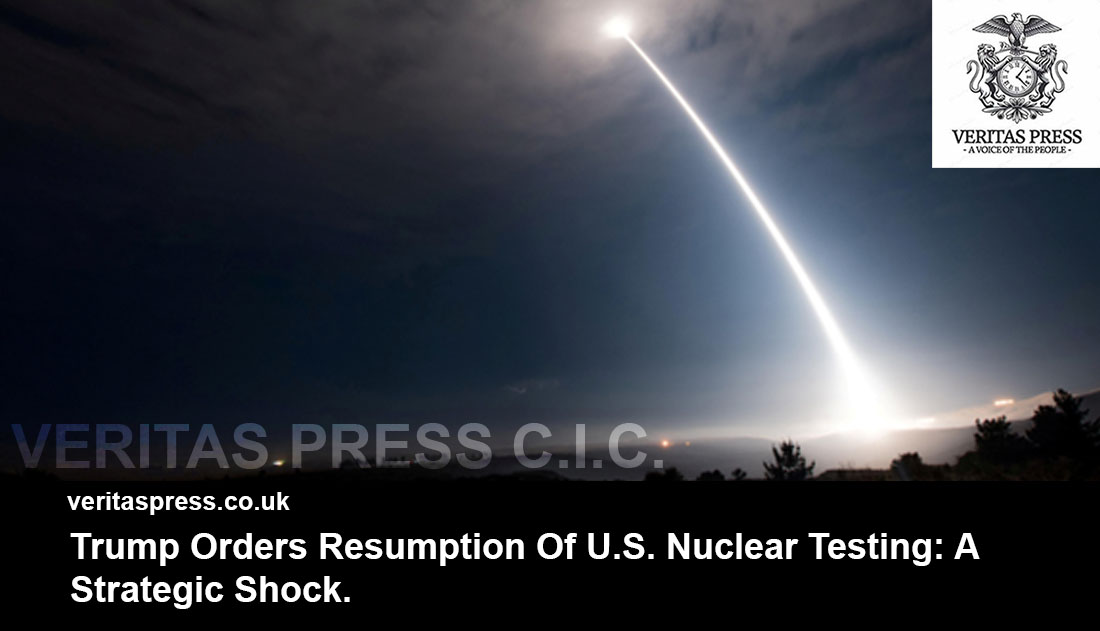
The Minuteman III ICBM, a stalwart of U.S. land-based deterrence, stands as a symbolic contrast: a powerful nuclear delivery vehicle whose warhead has not been explosively tested in decades. Instead, its performance is validated via modelling, subcritical experiments, and historical empirical confidence.
Resuming explosive testing would mark a return to technocratic validation through “blast data”, a sign that the U.S. no longer trusts simulations alone. It would signal that America is willing to re-engage in naked nuclear experimentation rather than rely on sophistication or restraint.
Conclusion: A Return To Nuclear Reckoning.
President Trump’s directive to restart U.S. nuclear testing marks one of the most consequential shifts in American strategic posture in decades. Whether it is symbolic, selective, or substantive, the move shatters long-standing restraints and reopens the possibility of a new nuclear spiral among the great powers.
The international system now faces a test: will the global non-proliferation and arms control architecture survive this rupture? Or will we be propelled back into a Cold War–era brinksmanship, and possibly much worse? As the world watches, Washington must now chart whether this was a strategic reset or a reckless gamble.
Kamran Faqir is a volunteer investigative journalist and writer committed to exposing hidden truths and amplifying underreported stories. Driven by social justice, he brings sharp insight and fearless truth-telling to independent journalism. NUJ registered.
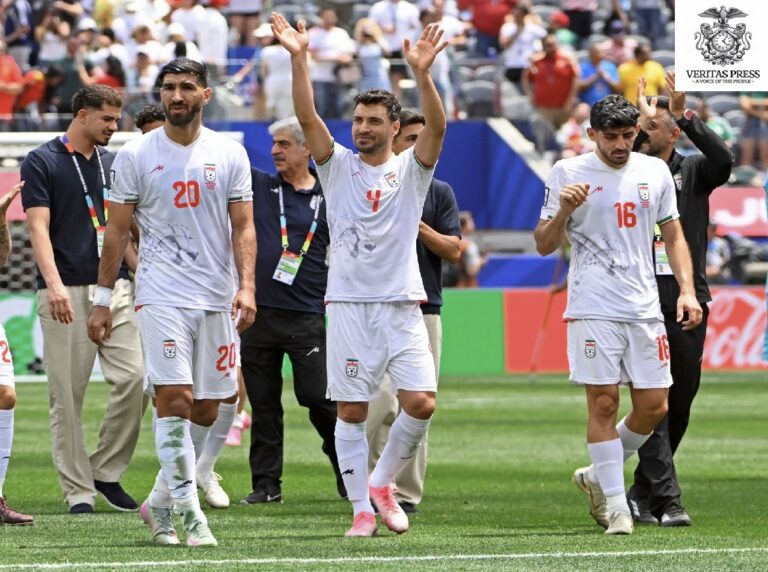
SEATTLE, TEHRAN — The U.S. Department of Homeland Security (DHS) will allow Iran’s national football team to enter the country 48 hours before their critical World Cup match against Egypt on Friday, a modest concession in a tournament where Team Melli’s travel conditions have sparked claims of oppression and competitive disadvantage.