










Press Release: Veritas Press C.I.C.
Author: Kamran Faqir
Article Date Published: 29 Oct 2025 at 13:35 GMT
Category: UK | Politics-NHS | England’s Hospices Are Dying
Source(s): Veritas Press C.I.C. | Multi News Agencies
Website: www.veritaspress.co.uk

Business Ads

“This sector isn’t broken by chance. It’s being broken by neglect.” — a hospice nurse, speaking on condition of anonymity.
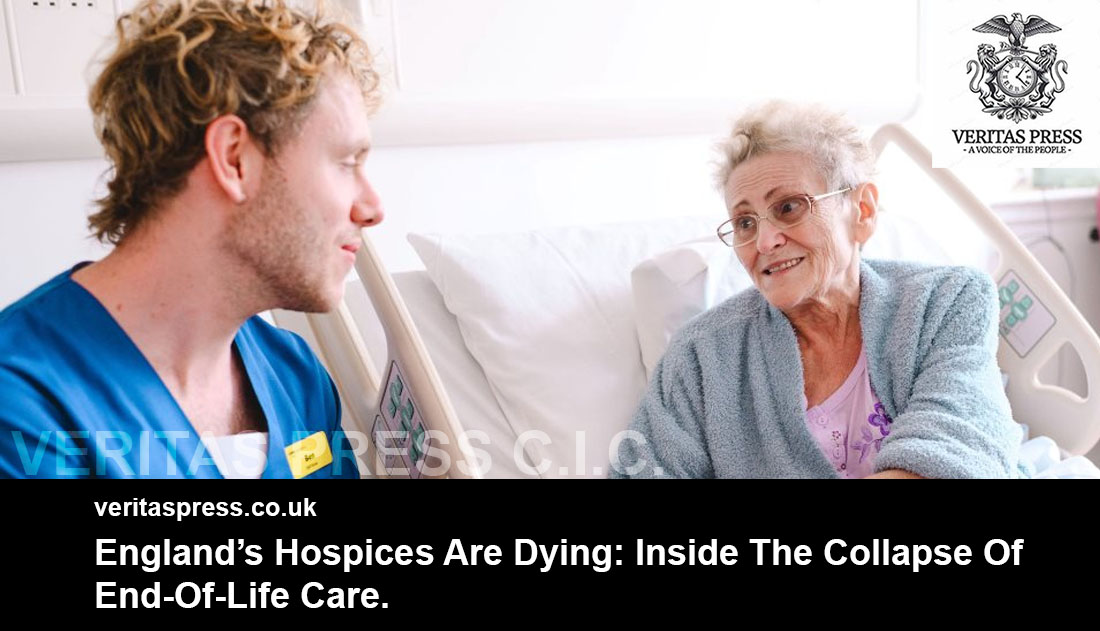
Across England, the places meant to offer peace and dignity in death are themselves dying. Hospices, long hailed as the backbone of compassionate end-of-life care, are closing beds, laying off staff, and turning away patients. The crisis, described by one sector leader as “unpalatable,” has deepened into what campaigners now call a moral failure of the state.
A report by the National Audit Office (NAO) this month laid bare what those on the frontlines have known for years: the independent hospice model is collapsing under financial strain while demand continues to soar.
Beds Lost, Staff Gone, Patients Waiting:
Hospice UK, the sector’s national charity, estimates that by the end of 2024, nearly 300 inpatient beds in England, roughly 14% of capacity, had been closed or taken out of use due to funding shortfalls.
“The timing couldn’t be worse,” said Toby Porter, chief executive of Hospice UK. “When hospices cut services, patients are pushed back into the NHS, ultimately costing the taxpayer more.”
Hospices support around 300,000 people a year across the UK, but rising costs, inflation, and pay pressures have pushed many to the brink. The sector collectively faces a £77 million deficit, according to Hospice UK.
At Birmingham Hospice, the largest in the West Midlands, a £2.4 million shortfall forced the organisation to cut 45 full-time roles, around 14% of its workforce, and reduce inpatient capacity from 24 to 16 beds.
“The prospect of having to make highly skilled end-of-life clinicians and support staff redundant is totally unpalatable,” said Simon Fuller, its chief executive.
Hospices from Manchester to Kent have reported similar retrenchments. In West Sussex, St Catherine’s Hospice was forced to mothball beds and reduce helpline hours, with one manager admitting that “thresholds for admission have risen.”
The Postcode Lottery Of Dying:
The cuts are not just numbers; they decide where and how people die.
“We are part of the NHS, part of social care, and a fundamental part of that framework,” said Rachel McMillan, chief executive of St Ann’s Hospice in Manchester. “But what we need now is action. End-of-life care in communities is being cut back right when demand is rising.”
At St Ann’s, ward manager Louise Pinney said she now keeps a waiting list for hospice admission, something she once thought impossible.
“We shouldn’t have one. If people need us, they need us straight away.”
Families increasingly report being told no beds are available, with loved ones dying instead in overstretched hospital wards, contrary to their wishes.
“For every patient we look after, there are others we can’t,” said Giles Tomsett, chief executive of St Catherine’s Hospice.
The result is a “postcode lottery of dying well,” where geography and income determine the quality of one’s final days.
A System Designed To Fail:
Behind the crisis lies an outdated, fragmented funding model that experts say was doomed to break.
Unlike NHS hospitals, most hospices are charitable organisations, with only around 30% of income coming from the state. The rest is raised through donations, retail shops, and fundraising, all vulnerable to economic downturns.
“The hospice funding model is simply not fit for purpose,” warned the All-Party Parliamentary Group on Hospice and End-of-Life Care in a January 2024 report.
The Department of Health and Social Care (DHSC) and NHS England, the NAO found, do not even know what proportion of end-of-life care is provided by independent hospices. That ignorance, critics say, reflects a deeper neglect of planning and accountability.
“We’ve been ringing the alarm for some time,” said Porter. “Yet too many hospices are still struggling to cope with the rising cost of providing essential care.”
Pay Pressures And Inflation Push Hospices Over The Edge:
Hospices also face a paradox. When the government approved a 5.5% NHS pay rise last year, a long-overdue victory for health workers, hospices were left without matching funding to pay their own staff competitively.
“Keeping pace with NHS pay rises will likely cost the hospice sector around £66 million,” said Porter. “But hospices are already in a precarious position.”
Payroll costs rose by 11% last year alone, according to a report in the Evening Standard, even before accounting for soaring energy bills and supply inflation.
Without sustainable public funding, hospices now compete directly with the NHS for the same pool of palliative-care nurses and doctors, and are losing.
“We Are Failing the Dying”:
For those on the frontlines, the human cost is devastating.
A hospice nurse in Surrey told The Guardian she now cares for up to twice as many patients as a few years ago:
“We are running on goodwill. Staff are burning out, and patients are waiting to die in places that were never meant for dying.”
A bereaved daughter in Liverpool described being told her father’s preferred hospice bed was no longer available:
“We were told there was a waiting list. He died in the hospital three days later, surrounded by machines. It broke us.”
Campaigners say such cases reveal a system that no longer guarantees dignity at the end of life.
“This is not a funding blip,” said Dr Katherine Sleeman, professor of palliative medicine at King’s College London. “This is a structural collapse. We are failing the dying, quietly, and bureaucratically.”
Government Pledges And Hollow Headlines:
In response to growing outrage, the government announced £100 million to upgrade hospice facilities and £80 million for children’s hospices.
But hospice leaders warn this is capital funding, for buildings and refurbishments, not operational support to keep services running.
“It’s good headline money,” said one hospice executive, “but it doesn’t keep nurses in post or beds open.”
Hospice UK and MPs from multiple parties have called for multi-year funding contracts, aligned with NHS commissioning cycles, rather than annual ad-hoc grants.
Until that happens, hospices say they cannot plan long-term staffing or meet rising needs.
The Cost Of Inaction:
Analysts warn that cuts to hospice care will backfire economically. Without hospice beds, dying patients are admitted to hospitals, a vastly more expensive and less appropriate setting.
According to Hospice UK estimates, investing in palliative care saves the NHS money by reducing emergency admissions and freeing hospital beds. Yet successive governments have treated hospice funding as optional charity work, not core healthcare.
“Hospices are the canary in the coal mine of the NHS,” said health economist Dr Anita Charlesworth. “When hospices fail, hospitals feel it, and so do families.”
A Crisis Of Decency:
The hospice movement began as a moral project, that every person deserves dignity and compassion in death. That moral foundation, staff say, is now being eroded by austerity and indifference.
“When the state allows a sector that supports the dying to rely on bake sales and charity shops, it tells us everything about our priorities,” said a hospice doctor in Bristol. “We are building new hospitals, but closing the places where people actually die.”
If the government fails to act, experts warn, the crisis will deepen as the post-war baby-boomer generation ages and mortality rises.
Already, hospices are warning they will be unable to meet demand by the end of the decade.
The Final Indignity:
Dying well should not depend on luck, geography, or fundraising capacity. Yet that is precisely what England’s hospice system has become.
“It’s not just a policy failure,” said Rachel McMillan of St Ann’s Hospice. “It’s a test of who we are as a society.”
Unless urgent reforms are made, guaranteeing long-term public funding, equitable access, and proper workforce support, England’s hospice sector may not survive the next five years.
And when the places built to care for the dying die first, the loss will not just be institutional. It will be deeply human.
Tags:
TOP STORIES


ISLAM EXPLAINED: The Farewell Sermon Of The Prophet Muhammad’s (SAW).


IRAN-US: US Fighter Jet Shot Down Over Iran – Escalation, Secrecy, And The Expanding Risks Of War.


IRAN: Wave 92 And The War Without End: How A “Decisive Strike” Became A Regional Conflict Defined By Attrition, Narrative, And Escalation


UK: Starmer’s Own Adviser Turns The Screw – The Political, Economic And Human Cost Of The Iran War.


UK: The Price Of Conflict – How The War In Iran Is Driving A Global Food Crisis.


US: Liftoff! NASA Launches Astronauts On Historic Artemis II Moon Mission.


UK: Labour’s Education Betrayal: Schools Collapse Under Pressure As Teachers Abandon The Party That Promised Change.

US: A War Without End: The Political Illusion Of Trump’s “Victory” In Iran.

WEST BANK: Israel’s Death Penalty Law, The West Bank General Strike, And The Legal Architecture Of Apartheid.

US: The Great Abandonment: Trump’s Iran Strategy Leaves Allies Adrift In A Sea Of Chaos. “Have The Courage, Go To The Strait And Just Take The Oil”

IRAN: Operation True Promise 4, Wave 88 – A Strategic Escalation In The Gulf.
ISRAEL: The Death Penalty Law: Israel’s Descent Into Legal Apartheid.