

Press Release: Veritas Press C.I.C.
Author: Kamran Faqir
Article Date Published: 24 Oct 2025 at 18:05 GMT
Category: South Asia | India | Charged For Saying ‘I Love Muhammad’
Source(s): Veritas Press C.I.C. | Multi News Agencies

Business Ads

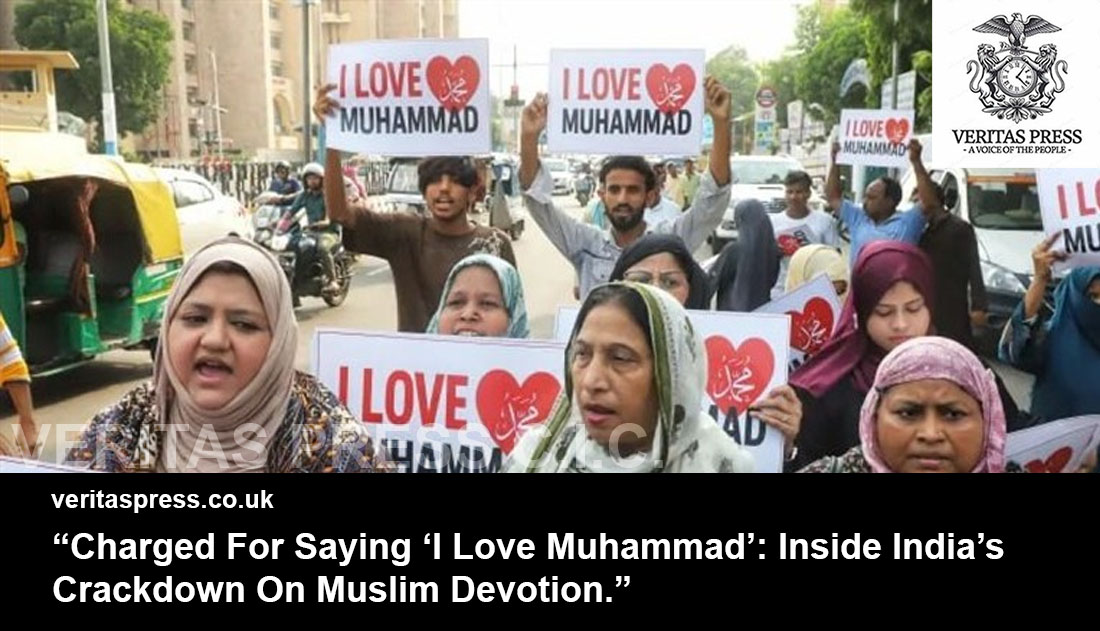
BAREILLY / KANPUR / NEW DELHI – OCTOBER 2025 – When a small group of residents in Syed Nagar, Kanpur, hung a glowing sign reading “I Love Muhammad” on September 4, few could have predicted it would spark a nationwide policing campaign. Within weeks, hundreds were arrested, shops were sealed, homes demolished, and internet services suspended across multiple districts in Uttar Pradesh and beyond.
Authorities say they acted to prevent communal tension. But human rights defenders, local residents, and independent journalists argue the slogan, an expression of religious love, has been criminalised as part of a growing campaign to suppress Muslim identity in India’s heartland.
A Devotional Banner Turned Criminal Case:
The first “I Love Muhammad” sign went up during Milad-un-Nabi, celebrating the Prophet Muhammad’s birthday. Local Hindutva activists filed a complaint, claiming the banner “provoked” communal sentiment. Police swiftly removed it and registered an FIR (First Information Report) against several Muslim residents for “promoting enmity” and “disturbing public order.”
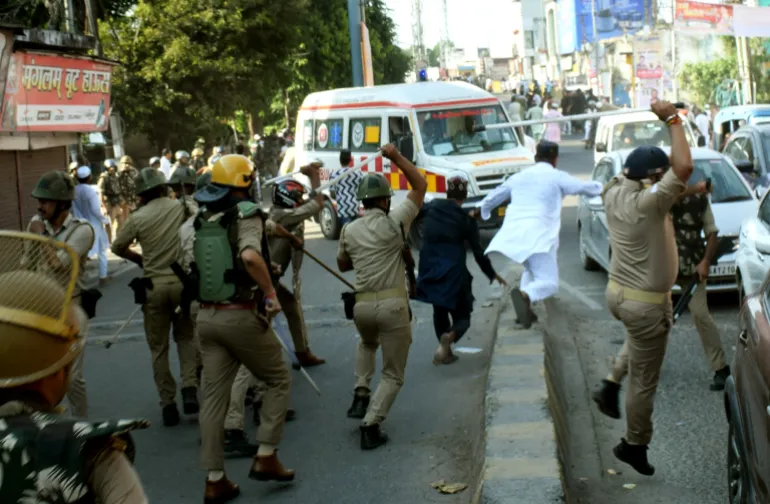
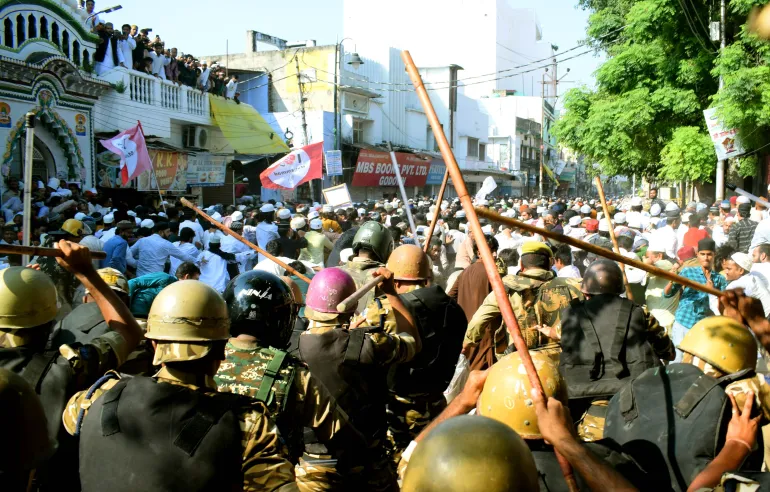
That local dispute in Kanpur soon spiralled. When cleric Maulana Tauqeer Raza Khan announced a protest in Bareilly on September 21 against what he called “an attack on Muslim faith,” authorities denied permission. Thousands still gathered after Friday prayers. Police responded with baton charges, tear gas, and mass arrests. Internet access was cut for two days across the Bareilly district.
“They came without warning,” said Naseer Ahmed, a 42-year-old shopkeeper in Bareilly’s Pehalwaan Market. “They sealed our shops and took our sons. All we did was say we love our Prophet.”
A Pattern Of Repression:
A fact-finding report released on October 10 by the Association for Protection of Civil Rights (APCR) documented what it called “a nationwide criminalisation of Muslim religious expression.” The report lists thousands of FIRs, mass detentions, and demolitions in Uttar Pradesh, Madhya Pradesh, and Rajasthan.
“The state has treated a slogan expressing love for the Prophet as a criminal act,” said Mohammad Shoaib, APCR’s executive director. “This is not about law and order, it’s about sending a message of fear.”
According to the APCR report, authorities routinely used broad public-order laws, such as those on “rioting” or “promoting enmity”, to arrest participants, even where no violence occurred. In many cases, entire markets or homes belonging to accused persons were demolished within days, often without prior notice.
Bulldozers As Punishment:
The Bareilly District Magistrate, Avinash Singh, defended the crackdown, telling NDTV that no protest was authorised and that the administration “acted to prevent communal violence.” The Senior Superintendent of Police (SSP), Anurag Arya, claimed “external elements” had instigated the unrest.
But eyewitnesses say the demolitions targeted innocent families.
“We were not given any notice. They just came and broke everything,” said Sajida Begum, whose tailoring shop in Bareilly’s Old City was sealed after her husband was named in an FIR. “Now my children have nothing to eat.”
Photographs verified by Scroll in and The Wire show bulldozers razing structures within 48 hours of protests. In one instance, local officials even posed for cameras beside the wreckage, an image that quickly spread on social media with the caption: “Bulldozer Justice.”
Human rights lawyer Zia Jillani, representing several detainees, told reporters that most accused are “daily-wage workers and small traders who cannot afford prolonged legal battles.”
“The punishment isn’t just legal, it’s economic,” he said. “They’re destroying livelihoods to silence dissent.”
A Political Spectacle:
Chief Minister Yogi Adityanath, known for his hardline rhetoric, described the Bareilly clashes as a “well-orchestrated attempt to disturb peace” and defended the demolitions as a necessary deterrence. At a rally in Gorakhpur, he reportedly said “some denting-painting is required” to maintain order, remarks that rights groups say legitimise collective punishment.
Analysts believe the “I Love Muhammad” campaign fits into a broader pattern of state-backed intimidation targeting Muslim identity under the guise of maintaining order.
“Bulldozers have become political theatre,” said Nilanjan Mukhopadhyay, a journalist and author on Hindu nationalism. “It’s about signalling dominance, showing that even devotion can be policed if it comes from the wrong community.”
Legal and Constitutional Questions:
India’s Constitution guarantees freedom of religion and expression under Articles 25 and 19. No law criminalises saying “I Love Muhammad.” Yet authorities have justified arrests under vague sections of the penal code relating to “promoting enmity” or “hurting religious sentiments.”
“This is a textbook example of disproportionate state action,” said Amnesty International India in a statement. “The use of public-order laws and bulldozer demolitions without due process amounts to collective punishment and violates basic rights.”
The Uttar Pradesh Human Rights Commission has since ordered an inquiry into alleged violations in Bareilly after petitions from local activists pointed to illegal demolitions and detentions of minors.
‘They Want Us to Be Afraid’
On the ground, fear has spread faster than faith.
In Bareilly’s Islamia Ground, where the protests began, residents now avoid speaking on record. Internet shutdowns have crippled small businesses reliant on online payments. Many families have fled temporarily to nearby towns.
“They want us to be afraid to even say the Prophet’s name,” said a local imam, who asked not to be named. “If ‘I Love Muhammad’ is a crime, what else is left for us to love?”
A Coordinated Crackdown?
Rights groups argue the speed and uniformity of the crackdown suggest coordination across multiple BJP-ruled states. APCR investigators found similar tactics, rapid FIRs, internet suspensions, and demolitions, repeated in Kanpur, Bareilly, Bhopal, Indore, and Jaipur within days.
“It appears to follow a shared playbook,” said Kavita Krishnan, a Delhi-based activist. “Police in different states acted almost identically, which indicates political direction rather than spontaneous law enforcement.”
The Bharatiya Janata Party (BJP) denies any political interference, insisting that “law and order is a state matter.” But political analysts say the crackdown carries electoral symbolism in the run-up to key state elections.
“Portraying Muslims as potential disruptors helps consolidate a majority vote,” said political scientist Hilal Ahmed. “The message is clear: assertive Muslim identity will be punished, and majoritarian control will be rewarded.”
Human Cost And Aftermath:
Weeks after the protests, Bareilly’s Pehalwaan Market remains sealed. Piles of debris lie where homes once stood. Children play near the rubble, watched by police patrols.
APCR estimates at least 2,000 people remain under investigation, while dozens face long-term detention. Many families report they still have not received copies of the FIRs against them, a violation of due process.
“This isn’t Law And Order; It’s Social Engineering,” said Aakar Patel, former head of Amnesty India. “The state is teaching citizens that piety, protest, and poverty can all be punished.”
Conclusion: Criminalising Faith And The Politics Of Fear.
The “I Love Muhammad” crackdown in Uttar Pradesh is not merely a local policing action; it is a systematic campaign to suppress Muslim identity under the guise of law and order. Authorities framed peaceful devotional expression as a “threat to public harmony,” yet independent investigations, eyewitness accounts, and media coverage show no evidence of violence. The only unrest arose from state intervention itself, baton charges, mass arrests, bulldozing of homes, and internet shutdowns.
The BJP’s argument is riddled with fallacies. By claiming that saying “I love Muhammad” is provocative, the state inverts victimhood, treating minority devotion as the danger while ignoring the intolerance of Hindu-majoritarian groups. Legal experts note that this selective enforcement violates the principle of equality before the law and turns constitutionally protected freedoms into discretionary privileges.
“They preemptively criminalise faith by asserting that others might react violently,” said lawyer Mihir Desai. “This rewards intolerance and punishes identity.”
This pattern mirrors tactics observed in other ethno-religious conflicts, notably Israel’s control over Palestinians. Analysts and human rights observers note several parallels:
- Collective punishment: Like Israeli authorities’ demolition of Palestinian homes as retaliation for protests or militant activity, Uttar Pradesh has bulldozed Muslim-owned homes and shops without due process, sending a message of deterrence through fear.
- Targeted suppression of public expression: Just as Palestinians are restricted from public demonstrations or symbols asserting national or religious identity, Indian Muslims expressing devotion are treated as provocateurs.
- Information control and intimidation: Internet shutdowns and selective media narratives echo Israel’s control over information during unrest, shaping perceptions while limiting coordination or public dissent.
“The methods are eerily similar: control through fear, policing visibility, and criminalising basic cultural and religious expression,” said Nilanjan Mukhopadhyay, journalist and author on communal politics. “It’s about maintaining dominance by turning everyday life into a zone of surveillance and threat.”
In Bareilly and Kanpur, these strategies have real human costs: thousands of Muslims face FIRs and arrests, shops are sealed, homes destroyed, and families plunged into economic precarity. Children are growing up under constant surveillance, fearful of expressing even devotion to their faith.
Political analysts argue this is not law enforcement but political theatre. The BJP’s actions ahead of state elections consolidate a narrative of Muslim “otherness,” portraying visible Islamic identity as inherently threatening, echoing global tactics where dominant states seek to suppress minority assertion.
“This isn’t about slogans, it’s about policing existence,” said journalist Rana Ayyub. “When saying ‘I love Muhammad’ becomes a crime, what remains of freedom of conscience, faith, or identity?”
International human rights bodies have flagged similar tactics in both contexts, highlighting how fear, intimidation, and legal overreach are used to undermine minority rights under the pretext of public order. India’s secular constitution and international human rights obligations, including Article 18 of the ICCPR on freedom of religion, are at risk of systematic erosion if such practices continue.
Ultimately, the Uttar Pradesh crackdown is a blueprint of authoritarian control masquerading as law and order. By criminalising devotion, deploying bulldozers as political theatre, and restricting communication, the state not only punishes individuals but signals that Muslim identity itself is suspect. The parallels with Israeli tactics underscore a global pattern: controlling minorities through fear, surveillance, and selective application of law.
As human rights lawyer Vrinda Grover put it:
“This is not just policing dissent; it is a strategy of domination. Criminalising faith to enforce compliance is how authoritarian states, whether in India or elsewhere, normalise fear as governance.”
In Uttar Pradesh today, loving the Prophet Muhammad has become a political act fraught with danger, a chilling reminder that religious freedom and secularism are under siege, not just locally, but as part of a wider pattern of state-backed intimidation globally.
The crackdown on Muslims for simply expressing love for the Prophet Muhammad is not an isolated incident of law enforcement overreach; it is part of a larger, systemic Islamophobia embedded in politics, policy, and public discourse. From selective enforcement of laws to economic and social intimidation, these measures signal that Muslim identity itself is suspect, and that everyday acts of devotion are framed as threats. Activists warn that such campaigns normalise prejudice, making discrimination socially and legally acceptable. “This is Islamophobia codified through governance,” said Sumaiya Rana, human rights activist and daughter of Urdu poet Munawwar Rana. “It is no longer just hate speech on the street; it is the state teaching citizens that being Muslim in public is punishable.” By criminalising faith, bulldozing homes, and silencing dissent, the authorities are not just policing public order; they are perpetuating a climate of fear that reinforces anti-Muslim bias across India.
If expressing love for one’s faith can now be treated as a crime, what does that mean for the future of religious freedom, secularism, and equality for Muslims in India?
Tags:
TOP STORIES


IRAN-US: Beyond The Ballistic: Iran’s “Wave 62” And The Unfolding New West Asian Order.

UK: Heathrow’s “Ghost Terminal”: Iran War Empties London’s Middle East Gateway As Aviation Faces Geopolitical Shock.
IRAN-SRI LANKA: Beyond The Waves Of Retribution: The Sinking Of The IRIS Dena And The Unravelling Of Maritime Order.
IRAN-ISRAEL: Iranian Missiles Strike Near Netanyahu’s Office As Regional War Intensifies.


UK: The Return Of The Ration Book – Is Britain Prepared For The Coming Fuel Shock?

USA-Israel: Global Oil Lifeline Under Siege: Europe Resists Trump’s Pressure As Strait Of Hormuz Crisis Exposes Fractures In Western Alliance.
GAZA: Beyond The Truce: Israeli Massacres Continue In Gaza, 16 Palestinians Killed In 24 Hours, Israel Undermines Ceasefire As Death Toll Surpasses 72,000.
IRAN-ISRAEL: Beyond The Ballistic – Inside The 55th Wave Of ‘True Promise 4’ As Iran Redefines Asymmetric Warfare.
IRAN: Night Of Escalation: Iran’s 53rd Strike Wave And Hezbollah’s Entry Signal A Widening Regional War.

CANADA: 4,500 Rally For Palestine In Toronto As Ford’s Attempt To Stop Al-Quds Day March Backfires.

IRAN/IRAQ: The Lanaz Pretext: Investigating The “False Flag” Narrative Amidst The Expanding US-Israel Campaign Against Iran.
IRAN: The Hunt For Netanyahu: Inside The 52 Waves Of Iran’s ‘True Promise’ And The IRGC’s Vow To Pursue The ‘Child-Killer’, Israeli Leader.