Kamran Faqir is a volunteer investigative journalist and writer committed to exposing hidden truths and amplifying underreported stories. Driven by social justice, he brings sharp insight and fearless truth-telling to independent journalism. NUJ registered.
Press Release: Veritas Press C.I.C.
Author: Kamran Faqir
Article Date Published: 28 Oct 2025 at 16:30 GMT
Category: UK | Politics | A Band-Aid On A Broken System
Source(s): Veritas Press C.I.C. | Multi News Agencies
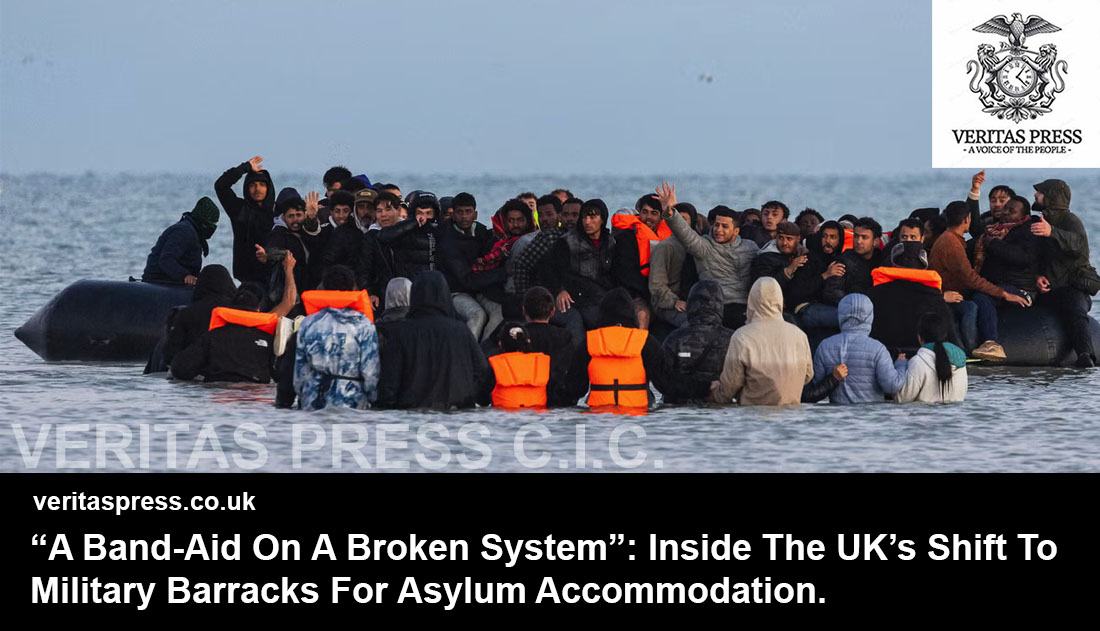
The decision by the Home Office to house roughly 900 male asylum seekers in two military sites, Cameron Barracks in Inverness (≈ 300) and Crowborough Training Camp in East Sussex (≈ 600), marks a bold pivot in the government’s asylum accommodation strategy. Officials say the move is necessary amid soaring hotel costs and rising public disquiet, yet refugee organisations, local councils, and human-rights experts warn that in replacing “hotels” with “barracks,” the government risks trading one crisis for another.
The Context: Hotel Rooms, Sky-High Costs And Mounting Political Pressure.
As of June 2025, about 32,000 asylum seekers were still housed in hotels, down from a peak of over 56,000 in 2023, but still increasing year-on-year by ~2,500. In parallel, the Home Office’s projected accommodation contract costs for 2019-29 jumped from £4.5 billion to £15.3 billion.
A parliamentary committee described the hotel-based policy as “failed, chaotic and expensive”, accusing ministers of squandering billions. Yet, despite the scale of the crisis, this new plan to shift to barracks appears driven less by cost-control than by optics: a determination to show the public the asylum system is under control. As Downing Street phrased it, “communities don’t want asylum seekers housed in hotels, and neither does the government.”
The New Sites: Reenacting Past Patterns.
Both Cameron Barracks and Crowborough Training Camp previously accommodated Afghan evacuees under the 2021 Kabul withdrawal scheme. Their reuse as emergency asylum accommodation signals an ongoing recycling of military infrastructure rather than investment in sustainable housing. Officials say the first cohort will move in “by the end of next month” with a stay of up to 12 months, while the MoD works with the Home Office to map out additional disused sites and modular “pop-up” units.
Yet this is not uncharted territory. NGO and inspectorate reports show that previous use of barracks such as Napier Barracks and Penally Camp were plagued by overcrowding, inadequate services and a sense of institutionalisation.
Voices From The Field: Civil-Society, Local Government And The Asylum Sector.
“The Government’s decision to expand the use of military barracks … is a pointlessly cruel and costly move that will do nothing to deter those seeking safety in the UK.”— Médecins Sans Frontières (UK) Migration Operations Manager Jacob Burns.
“The plans… to house 10,000 people seeking asylum on military sites are fanciful, too expensive and too logistically difficult.” — Refugee Council Chief Executive Enver Solomon.
“How much evidence does the government need that camps are bad for people’s health and wellbeing? … We’ve had Napier, Penally and Wethersfield, and hunger strikes, protests and attempted suicides have been a regular occurrence at all of them.” — Care4Calais CEO Steve Smith.
Local government voices are equally uneasy. In the Highlands, the Highland Council issued a strong statement:
“Our main concern is the impact this proposal will have on community cohesion given the scale of the proposals as they currently stand. Inverness is a relatively small community, but the potential impact locally … appears not to have been taken into consideration by the UK government.”
Legal, Human Rights And Welfare Red Flags.
Numerous reports raise substantial red flags:
In 2021, the High Court found that Napier Barracks provided “inadequate accommodation for asylum seekers” and that the Home Office’s selection process was “flawed and unlawful”.
A briefing by the British Red Cross found that residents of military-site asylum accommodation reported dorm-style rooms, minimal privacy, delayed medical access, and serious mental-health deterioration.
An internal Equality Impact Assessment revealed that the decision to house asylum seekers in military sites partially rested on concern that better accommodation would “undermine public confidence in the system”.
This highlights a foundational tension: the government’s statutory duty under section 95 and section 4 of the Immigration & Asylum Act 1999 to provide suitable accommodation collides with a political logic driven by optics and public-confidence metrics.
Costs, Logistics And The Veneer Of “Proof Of Concept”:
While official rhetoric emphasises cost-saving, the nuanced reality is starkly different. The Defence Minister, Luke Pollard, admitted “in some cases… those bases may be a different cost to hotels.” Observers point out that large-site conversions carry hidden costs: refurbishments, security infrastructure, transport logistics (especially in rural/remote sites), and heightened wrap-around services (mental-health, legal support, safeguarding). A parliamentary committee explicitly warned that large-site barracks may cost more than hotels.
Officials describe the two sites as “proof of concept.” However, the ambition, potentially up to 10,000 people on military or industrial sites, risks institutionalising large-camp accommodation rather than dispersing asylum seekers into communities with support and integration pathways.
Community And Integration Implications:
The stated goal is to remove asylum seekers from hotels (often in populated areas) and move them either into dispersal accommodation or military sites. But critics argue that barracks replicate the isolation of hotels, and may worsen it.
Remote sites may hinder access to jobs, language classes, mental-health services, legal advice and community networks.
Large concentrations of asylum seekers create a quasi-camp effect, undermining integration, fueling protests, and placing strain on local services.
Local authorities report being sidelined in decision-making. The Highland Council has demanded full details of how community cohesion will be protected.
Political Calculus And Narrative Over Substance:
Why press ahead with costly barracks? The answer lies largely in optics and electoral politics. The government seems more driven by public perception (“we are doing something”) than by durable solutions. As one Home Office spokesperson put it:
“The public is very clear it does not want asylum seekers housed in hotels, and neither does the government.”
Yet this focus on confidence masks the deeper dysfunction: the asylum system remains backlogged, housing remains inadequate, and the migration drivers (conflict, climate, economy) remain unresolved. The Barracks strategy risks being structural theatre: big-scale, visible, but perhaps ineffective.
Conclusion: Barracks Over Hotels, A Test Of Policy, Not Protection.
As the Home Office moves to convert Cameron Barracks in Inverness and Crowborough Training Camp in East Sussex to house nearly 900 asylum seekers, the shift from hotels to military sites is more than a change of venue. It is a litmus test for how the UK treats people seeking safety: as individuals with rights, or as a policy burden to manage. The choice of military sites, oversized cohorts, and modular units suggests the latter.
Preliminary financial assessments indicate that converting a single military-site bed could cost £35,000–£42,000 in setup expenses alone, with annual per-person costs exceeding £24,000, similar to, or potentially higher than, hotel accommodations. Local councils and refugee organisations have repeatedly requested full cost breakdowns from the Home Office, yet these remain unpublished. Firms such as Mears Group, Mitie, and Serco are understood to be managing refurbishments, with internal contracts setting minimal standards for privacy, mental health spaces, and fire safety, raising questions about whether these sites can genuinely provide humane conditions.
This is not an abstract concern. Mental-health data from previous military-site conversions, Napier, Penally, and RAF Wethersfield, reveal high rates of trauma, depression, and suicidality among asylum seekers. Médecins Sans Frontières’ teams report that the “prison-like” surveillance and isolation at Wethersfield caused “widespread psychological distress.” Legal challenges against past barracks, some still active, argue that inadequate conditions violate Article 3 of the European Convention on Human Rights. Experts warn that unless robust standards are enforced, new sites could repeat the same failures.
Local communities are bracing for impact. Highland Council has repeatedly flagged that Inverness’s health, housing, and welfare services are already stretched to capacity, while East Sussex residents describe consultations as perfunctory at best. MPs, including Angus MacDonald, question locating a barracks within the city centre, emphasising that the government promised secure, discreet sites, not facilities embedded in high-footfall areas.
Alternatives exist. NGOs advocate for community-based dispersal and small-scale modular units integrated with local services, safer, cheaper, and more supportive of integration. Yet the Home Office appears reluctant to adopt these options, prioritising “public confidence” and optics over evidence. Without investment in community housing, robust legal processes, and meaningful integration pathways, barracks risk replicating the costly failures of the hotel era, but with amplified moral and social consequences.
The unanswered question remains: is this new model genuinely about improving asylum outcomes, or is it primarily a performance, designed to appear decisive while sidestepping long-term solutions? As it stands, the barracks strategy offers a cautionary tale of short-term containment at the expense of human dignity, legal compliance, and fiscal transparency. The UK government’s approach will not only define the fate of the thousands housed in these facilities but will also signal whether Britain treats asylum seekers as human beings or merely as a policy problem to be managed.
Cost And Impact Analysis: Military Sites Vs Hotels Vs Community-Based Dispersal.
Accommodation Type
Estimated Setup Cost per Bed
Ongoing Annual Cost per Person
Mental Health / Trauma Risk
Legal Risk
Community Integration
Military Barracks (Cameron, Crowborough, RAF Wethersfield)
£35,000–£42,000
£24,000+
High, prior sites reported PTSD, depression, suicidality, and social isolation.
High, active legal challenges cite Article 3 violations
Moderate, better facilities, but overcrowding & uncertainty still cause stress.
Moderate, fewer precedent cases, but hotels criticised as inhumane in Parliamentary reports
Moderate, better access to local services, but often in unsuitable locations
Community-Based Dispersal / Modular Units
£15,000–£25,000 (modular unit)
£15,000–£20,000
Low, stable environment, better access to mental health and social networks
Low, legal compliance is easier if facilities meet standards
High integration into communities, schools, healthcare, and employment opportunities
Notes:
Costs include site conversion, utilities, staffing, and security, based on internal government estimates and NGO analyses.
Mental health outcomes are drawn from published studies and reports by MSF, Refugee Council, and Public Health England from previous barracks-based housing.
Legal risk considers ongoing and past judicial reviews, including Napier and Penally, with expert commentary from immigration barrister Colin Yeo.
Community integration scores are qualitative, based on NGO reports and local council consultations.
Timeline Of Precedent And Risk Factors:
Year
Site / Policy
Key Issues / Findings
2015
Napier Barracks
Overcrowding, poor sanitation, and hunger strikes; judicial review found inadequate conditions for vulnerable people.
2019
Penally Camp
Overcrowding & isolation led to protests, hunger strikes, and suicidality; police and NGO reports highlight failure to provide mental health support.
2021
RAF Wethersfield
Afghan evacuees housed; MSF documented high levels of PTSD and depression; prison-like surveillance exacerbated trauma.
2023
Hotel System Peak
56,000 asylum seekers in hotels; Commons Home Affairs Committee calls system “chaotic and expensive”; £4.5bn–£15.3bn projected costs (2019–2029).
2025
Barracks Conversion Announced
900 asylum seekers to Cameron & Crowborough; Home Office cites “public confidence” as key driver; NGOs warn against repeating barracks trauma; costs projected higher than hotels.
Visual reinforcement for the investigation is provided by this table-and-timeline format.
Costs are not lower for barracks.
Human and legal risks are amplified, based on clear precedent.
Community integration suffers, making barracks a short-term fix rather than a sustainable solution.
Kamran Faqir is a volunteer investigative journalist and writer committed to exposing hidden truths and amplifying underreported stories. Driven by social justice, he brings sharp insight and fearless truth-telling to independent journalism. NUJ registered.
SEATTLE, TEHRAN — The U.S. Department of Homeland Security (DHS) will allow Iran’s national football team to enter the country 48 hours before their critical World Cup match against Egypt on Friday, a modest concession in a tournament where Team Melli’s travel conditions have sparked claims of oppression and competitive disadvantage.