

Title: Why Pakistan’s War With India Triggered A Boom In Arms Sales And Defence Ties.
Press Release: Veritas Press C.I.C.
Author: Kamran Faqir
Article Date Published: 17 Jan 2026 at 10:35 GMT
Category: South Asia | Pakistan | Why Pakistan’s War With India Triggered A Boom In Arms Sales And Defence Ties
Source(s): Veritas Press C.I.C. | Multi News Agencies
Website: www.veritaspress.co.uk

Business Ads

When Pakistani and Indian fighter jets clashed for four days in May 2025, the immediate outcome on the battlefield remained contested. But far from South Asia’s skies, the encounter produced an unexpected and far-reaching consequence: it turbocharged Pakistan’s defence export ambitions and repositioned Islamabad as an emerging arms supplier across the Middle East, Africa and beyond.
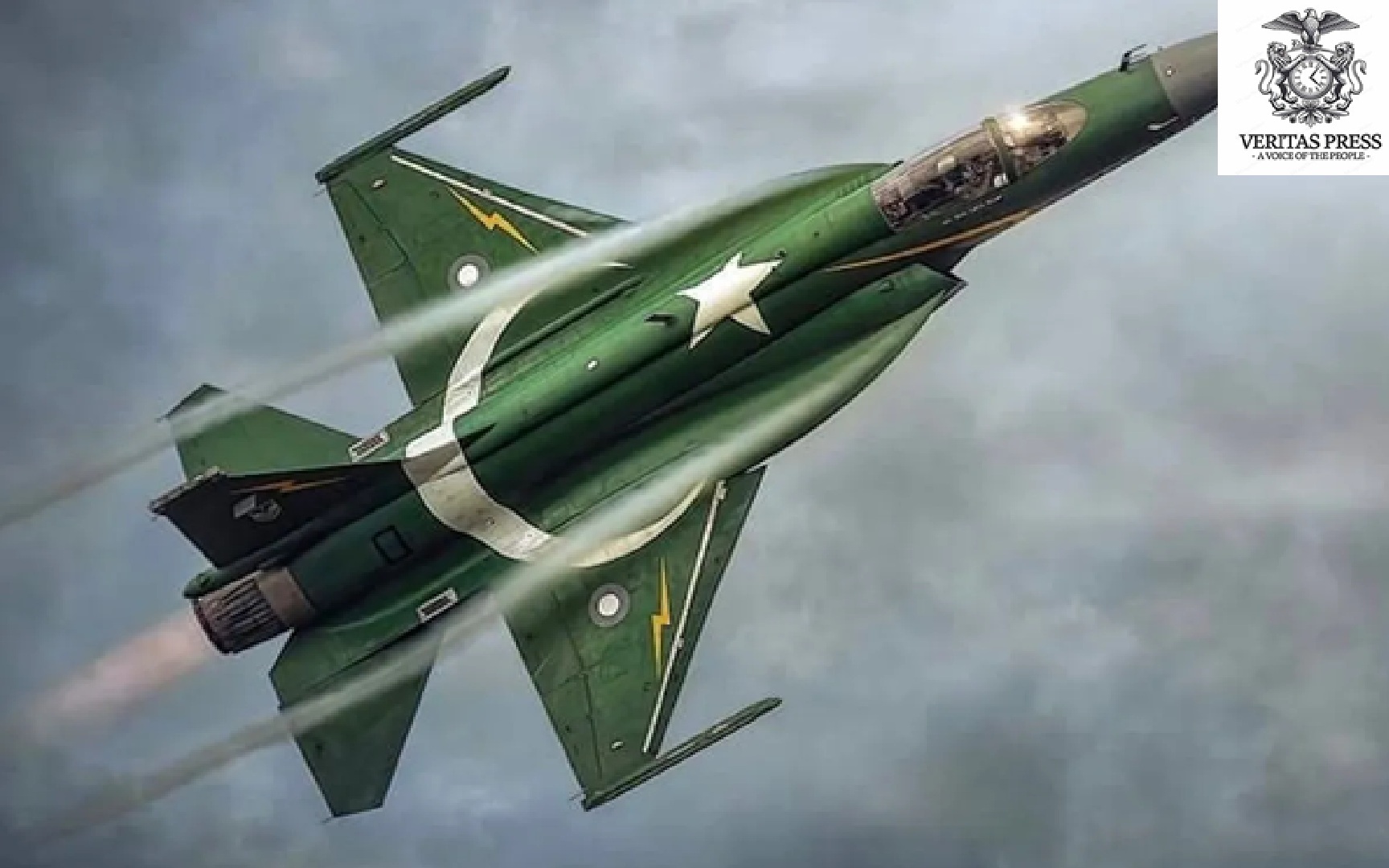
At the centre of this push is the JF-17 Thunder, Pakistan’s domestically assembled multi-role fighter jet, now being marketed not merely as an affordable alternative to Western aircraft, but as a combat-tested platform forged in high-intensity conflict.
Pakistani officials and regional analysts say Islamabad is seeking to convert battlefield claims and shifting geopolitical alignments into diplomatic and commercial leverage, an effort that could mark the most significant transformation of Pakistan’s defence-industrial profile in decades.
The JF-17’s Moment:
Jointly developed by Pakistan Aeronautical Complex (PAC) and China’s Chengdu Aircraft Corporation, the JF-17 Thunder Block III is a single-engine, fourth-generation fighter designed to meet the needs of air forces constrained by cost, logistics and political restrictions.
Long promoted as a budget-friendly platform for smaller militaries, the aircraft is now being recast as a frontline fighter capable of operating in contested airspace.
That rebranding effort gained momentum after the May 2025 air confrontation with India, the most serious exchange between the two nuclear-armed rivals in decades. Pakistani officials cite the episode as a real-world demonstration of the Pakistan Air Force’s (PAF) integrated combat capabilities, including data-linking, electronic warfare and pilot training.
Although the precise balance of losses remains disputed, Islamabad has seized on one symbolic claim: that Pakistani aircraft downed at least one of India’s French-made Rafale fighters. New Delhi has neither confirmed nor denied the assertion, but in the arms trade, perception can be as powerful as proof.
“Pakistan struggled for years to move the JF-17 beyond its image as a ‘cheap’ option,” said Muhammad Shoaib, assistant professor at Quaid-i-Azam University in Islamabad. “The May clash changed that narrative. The JF-17 is no longer just a budget option, but a battle-tested one.”
Shoaib added that the aircraft’s appeal is amplified by the absence of political vetoes and end-use restrictions that typically accompany US and European arms exports.
Combat As Credentials:
The export drive has been reinforced by an unlikely external endorsement: US President Donald Trump, who repeatedly praised Pakistan’s aviation performance while claiming credit for brokering the ceasefire, a claim India flatly rejects.
Such rhetoric is highly unusual in US-Pakistan relations, long defined by mistrust and transactional cooperation. But for Pakistani defence marketers, it has become a powerful talking point.
Still, some analysts argue the interest stems less from the aircraft itself than from the perceived professionalism of the PAF.
“Countries are impressed by the Pakistan Air Force’s performance, training and combat learning from the May conflict,” said Abdul Basit, senior associate fellow at Singapore’s S Rajaratnam School of International Studies. “That credibility spills over into demand for the JF-17.”
Africa As A Proving Ground:
Pakistan has already exported the JF-17 to Azerbaijan, Myanmar and Nigeria, while Indonesia, Bangladesh and Iraq are exploring defence cooperation. But it is Africa where Islamabad’s strategy is yielding its most consequential results.
In Sudan, Pakistani officials told Reuters that negotiations are advanced on a defence package worth around $1.5 billion, including JF-17 Block III fighters, K-8 aircraft and more than 200 drones. The deal would strengthen the Sudanese army, backed by Saudi Arabia and Turkey, in its war against the UAE-supported Rapid Support Forces.
Libya represents an even sharper inflexion point.
In December, Pakistan’s army chief, Field Marshal General Asim Munir, travelled to Benghazi to meet General Khalifa Haftar, commander of the Libyan National Army (LNA). The visit reportedly culminated in a defence agreement exceeding $4 billion, the largest arms export deal in Pakistan’s history, covering JF-17s, Super Mushshak trainers and naval and ground systems.
Although arms transfers to Libya remain politically sensitive under UN embargo frameworks, Haftar described the agreement as the start of a “new phase of strategic military cooperation”. A Forbes analysis suggested that a dozen JF-17s would give the LNA a “game-changing advantage” over the UN-recognised government in Tripoli.
“These deals embed Pakistan deeply into African security calculations,” said a Western defence official based in Islamabad. “They also place Islamabad squarely in the competitive space between Gulf powers, China, Turkey and increasingly Russia.”
Saudi Arabia’s Recalibration:
Perhaps the most striking shift is unfolding in Pakistan’s relationship with Saudi Arabia.
Islamabad and Riyadh have signed a Strategic Mutual Defence Agreement committing both states to treat an attack on one as an attack on both, a dramatic departure from past security arrangements. Talks are now focused on operationalising that pact through defence procurement.
Reuters reported that both sides are discussing converting $2 billion of Saudi sovereign loans into an order for JF-17 fighter jets. While Pakistan’s foreign ministry says it is “unaware” of a formal deal, Pakistan’s air chief has held high-level meetings in Riyadh, fuelling speculation of serious intent.
“Saudi Arabia does not need the JF-17 tactically,” said Pakistani defence analyst Ayesha Siddiqa. “This is essentially about supporting Pakistan and building a strategic hedge.”
That hedge reflects Saudi Arabia’s declining confidence in the US-led security architecture following the muted American response to the 2019 Houthi attacks, the withdrawal of US missile defences in 2021, and the scaling back of support for the Yemen war.
Pakistan, nuclear-armed, militarily professional and deeply embedded with China, is increasingly viewed as a complementary pillar of Saudi security. Turkish officials have reportedly held advanced talks about joining this emerging framework, underscoring a broader regional recalibration.
The China Factor:
Behind every JF-17 export discussion stands China.
Nearly half the aircraft’s components, including critical avionics and radar systems, are Chinese-made. Any export requires Beijing’s approval, a reality Pakistani officials openly acknowledge.
“China will be a party to any agreement we enter into with third countries,” Defence Production Minister Raza Hayat Hiraj told BBC Urdu.
Analysts say this dependency is both a constraint and an advantage. Beijing retains decisive influence over production scaling, but many countries prefer acquiring Chinese technology via a Pakistani intermediary to avoid diplomatic friction with the West.
“Pakistan acts as a buffer,” Shoaib said. “States want Chinese hardware without triggering Western backlash.”
Economics, Ambition And Limits:
For Pakistan, the stakes are existential.
The country is under its 24th IMF programme, following a $7 billion bailout in 2023. Defence exports are now being framed as a pathway toward economic sovereignty. Defence Minister Khawaja Asif has even claimed that arms exports could one day free Pakistan from IMF dependence, a bold assertion analysts view with scepticism.
Even so, the numbers are striking. Projected defence export orders could reach $13 billion, more than 80 percent of Pakistan’s foreign exchange reserves and roughly 3.7 percent of GDP.
Yet capacity constraints loom large.
“France produces about 25 Rafales a year,” Basit noted. “How can Pakistan manufacture far more JF-17s if multiple orders materialise?”
He warned that export enthusiasm must not undermine Pakistan’s own force readiness, especially as India expands its Rafale fleet.
A Structural Break From The Past:
Historically, Pakistan’s defence exports were marginal. In 2024, arms and ammunition exports totalled just $22.4 million, according to UN Comtrade data.
Today’s pipeline, spanning fighter jets, drones, trainers, armoured vehicles, naval systems and munitions, marks a qualitative break. Indigenous platforms have matured, institutional capacity has expanded, and defence exports are now embedded within state-to-state strategic partnerships.
Pakistan’s defence ecosystem, led by PAC, Heavy Industries Taxila, Pakistan Ordnance Factories and Karachi Shipyard, is increasingly geared for sustained production. Analysts expect a gradual shift toward a mixed public-private model, with private firms entering as subcontractors before expanding into systems integration, software and lifecycle support.
The real value lies beyond initial sales. Maintenance, training, upgrades and spare parts generate recurring revenue streams lasting decades, offering durable foreign exchange inflows rather than one-off windfalls.
Defence Exports As Geoeconomic Statecraft:
Pakistan’s defence export surge reflects a rare convergence of geopolitical timing, industrial maturity and macroeconomic necessity.
What began as a contested air clash with India has evolved into a broader exercise in geoeconomic statecraft, leveraging military credibility into diplomatic influence, industrial upgrading and economic diversification.
The opportunity is real, but conditional. Execution, transparency, production scalability and diplomatic alignment, particularly with China, will determine whether Pakistan can convert this opening into a lasting transformation.
If it succeeds, defence exports could reshape not only Pakistan’s economy, but its strategic position across Asia, Africa and the Middle East, turning a moment of conflict into a durable instrument of power.