



Title: ‘We Do Not Want To Be Americans’: Greenlanders Reject Trump’s Annexation Threats.
Press Release: Veritas Press C.I.C.
Author: Kamran Faqir
Article Date Published: 13 Jan 2026 at 13:20 GMT
Category: Americas | Politics | ‘We Do Not Want to Be Americans’: Greenlanders Reject Trump’s Annexation Threats.
Source(s): Veritas Press C.I.C. | Multi News Agencies
Website: www.veritaspress.co.uk

Business Ads


Greenland’s political leaders and ordinary citizens are pushing back against US President Donald Trump’s renewed drive to acquire the Arctic island, warning that Washington’s pressure risks replacing one colonial power with another, and shattering the post-war rules-based order.
A Nation Under Sudden Siege:
In Copenhagen, the corridors of Denmark’s parliament have become a revolving door of foreign media. International camera crews shuffle in and out of a modest office belonging to Aaja Chemnitz, one of Greenland’s two representatives in the Danish Folketing. Interviews are tightly scheduled, assistants negotiating time in multiple languages as journalists queue for comment.
The frenzy reflects the gravity of the moment. Greenland, a self-governing Inuit-majority territory of just under 57,000 people, has been thrust into the centre of a geopolitical storm after US President Donald Trump once again declared his intent to acquire the island, refusing to rule out the use of military force.
“Greenland is not for sale, and Greenland will never be for sale,” Chemnitz, a senior figure in the Inuit Ataqatigiit (IA) party, says bluntly. “People seem to think they can buy the Greenlandic soul. But our identity, our language and our culture are not commodities.”
Her colleague, Aki-Matilda Hoegh-Dam of the Naleraq party, describes a population rattled by threats few imagined would ever be voiced by a NATO ally. “It has been a very turbulent time,” she says. “We feel cornered, and that is making many people deeply anxious.”
Both MPs now divide their time between Nuuk and Copenhagen, shuttling between crisis meetings and press briefings as Greenland’s future is debated in capitals far from its ice-covered shores.
“All Greenlandic parties agree on one thing,” Hoegh-Dam adds. “We do not want to be Americans, and we do not want to be Danes either. We want to be Greenlanders. We already have one coloniser. We do not need a new one.”
Trump’s Return To Arctic Expansionism:
Trump’s fixation on Greenland is not new. During his first term in 2019, he floated the idea of buying the island, prompting Denmark’s prime minister to dismiss the proposal as “absurd” and triggering the cancellation of a state visit.
What has changed is the tone, and the stakes.
Since December, Trump has repeatedly revived the proposal, framing Greenland as a US “national security necessity” and warning that Washington may act “the easy way or the hard way” to secure it. In recent remarks, he emphasised that “ownership”, not merely military access, is the goal.
The rhetoric has alarmed officials in Nuuk and Copenhagen alike. While Greenland enjoys extensive home rule under a 2009 agreement, Denmark retains control over defence and foreign policy, placing the island squarely in the middle of an escalating US–Danish diplomatic crisis.
Hans Engell, a former Danish defence minister, describes the situation in stark terms. “This is the worst foreign relations crisis for the Danish kingdom since World War II,” he says. “Even at the height of the Cold War, I cannot recall a comparable confrontation with the United States.”
Denmark’s foreign ministry has since confirmed that Copenhagen and Nuuk jointly requested urgent talks with US Secretary of State Marco Rubio, a meeting widely seen as a potential turning point.
‘We are not merchandise’
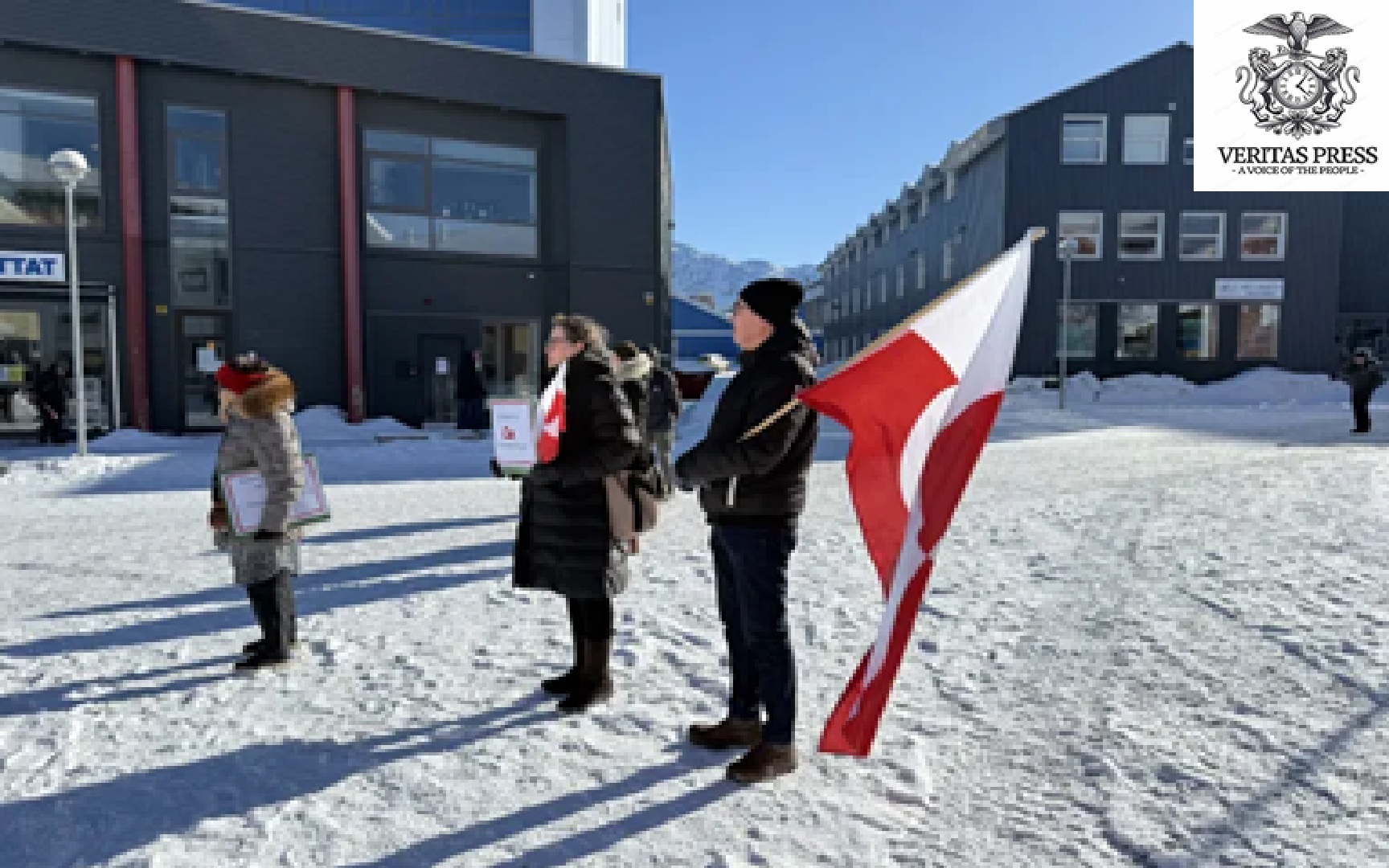
In Nuuk, the capital of Greenland, anxiety has given way to anger.
By the harbour, fishing trawlers bob in dark Arctic waters as snow settles on the docks. “I have never seen any Russians or Chinese here,” says Helte Johannsen, a fisherman who has worked Greenland’s coastline for nearly four decades, dismissing Trump’s claims that foreign powers are swarming Greenlandic waters. “I don’t think Trump knows anything about Greenland.”
Further along the quay, Josef Iyberth unloads freshly caught cod. In his spare time, he hunts seals and reindeer, but laughs bitterly at the idea of resisting a military takeover. “Our guns are not for people,” he says.
For many, Trump’s language cuts deeper than geopolitics. “They are treating us like merchandise in a shop,” says Per Berthelsen, a Greenlandic MP and former foreign minister. “I have difficulty seeing the difference between how the US is acting toward Greenland and how Russia behaves when it wants to expand its territory.”
The comparison, unthinkable just years ago, is now openly voiced by Greenlandic politicians.
Culture Under Threat:
Beyond sovereignty, Greenlanders fear what annexation would mean for Inuit culture, already scarred by centuries of colonial rule.
In a small workshop in Nuuk, seamstress Maja Overgaard scrapes a wet sealskin, preparing it for months of labour before it becomes winter boots. She says Trump’s threats have sparked conversations she never expected to have, including whether her family should flee to Denmark if the US takes control.
“I don’t want to live in an American empire,” she says quietly.
Others point to Alaska as a cautionary tale. Sofie Amondsen, who crafts traditional Inuit jewellery from seal intestines, has spent time in Indigenous communities across Alaska and Canada. “In Alaska, many were forbidden to speak their language,” she says. “Their grandparents were punished for it. I don’t want that future for us.”
Hunters travelling Greenland’s remote eastern coasts, Amondsen adds, have already begun encountering the material traces of rising militarisation, spent cartridges and signs of expanded exercises.
“We are just healing from Danish colonisation,” she says. “Now this fear has opened old wounds.”
Independence, but on Greenland’s terms
Ironically, Trump’s pressure has not dampened Greenlandic aspirations for independence from Denmark, but it has sharpened fears of exchanging one overlord for another.
All five parties represented in Greenland’s parliament, the Inatsisartut, support eventual independence, a right explicitly recognised under the 2009 self-rule agreement. But they remain divided over timing.
The governing coalition urges caution, citing economic dependence on Denmark and unresolved structural challenges. The opposition Naleraq party argues for a faster break, accusing Copenhagen of weaponising fear of the US to delay decolonisation.
Still, unity has emerged in response to Washington.
In an unprecedented joint statement, all five parties rejected Trump’s threats outright. “We do not want to be Americans. We do not want to be Danes. We want to be Greenlanders,” the statement declared, insisting that Greenland’s future “must be decided by its people, without pressure or interference.”
The parties also announced plans to bring forward a parliamentary debate to safeguard Greenlanders’ rights amid mounting external pressure.
Empire In The Arctic: A Return To Colonial Logic.
For many Greenlanders, Trump’s rhetoric does not merely signal an aggressive bargaining strategy; it reflects a deeper revival of imperial thinking in which territory, resources and peoples are reduced to strategic assets.
At the heart of Washington’s interest lies not only geography but extraction. Beneath Greenland’s melting ice are vast reserves of rare earth minerals, uranium, oil and gas, resources increasingly vital to high-tech industries, weapons systems and the global energy transition. As climate change accelerates Arctic ice loss, Greenland is being recast by powerful states not as a homeland, but as a frontier: newly accessible, newly profitable and newly militarisable.
This is what critics describe as climate imperialism, the exploitation of climate breakdown to expand military reach and extract resources from Indigenous lands under the banner of security and economic necessity. Trump’s framing of Greenland as indispensable to US national security mirrors long-standing colonial justifications used to seize Indigenous territories worldwide: strategic chokepoints, resource scarcity, and civilisational superiority.
Militarisation is central to this vision. Greenland already hosts the US-run Pituffik Space Base (formerly Thule Air Base), a critical node in America’s missile early-warning and space surveillance network. Trump’s insistence that existing arrangements are “not enough” signals an ambition to transform Greenland into a far more heavily militarised Arctic outpost, regardless of local consent. Hunters and residents in remote regions report increased military exercises and debris, tangible reminders that great-power competition is encroaching on everyday life.
Greenland’s colonial history sharpens these fears. Denmark’s 300-year rule involved forced relocations, racial hierarchies, language suppression and social engineering, including the now-documented campaign that subjected thousands of Inuit women and girls to non-consensual contraceptive implants. While Greenland has gained extensive self-rule, decolonisation remains incomplete, and trust in external powers is fragile.
Against this backdrop, Trump’s talk of “buying” Greenland is widely seen not as diplomacy but as a continuation of colonial extraction logic, swapping one imperial centre for another. Comparisons drawn by Greenlandic politicians between Washington’s posture and Russia’s territorial expansionism, once taboo within NATO, now circulate openly.
Greenlanders point to Alaska as a warning. Under US rule, many Indigenous Iñupiat communities have experienced linguistic erosion, cultural loss and persistent poverty despite decades of resource extraction. “They were forbidden to speak their language,” says seamstress Sofie Amondsen. “We still have ours.”
The risk, Greenlanders warn, is that independence, long sought as an escape from Danish colonialism, could be hijacked by American domination, turning sovereignty into a façade beneath foreign bases, extractive contracts and strategic control.
Law, Sovereignty And The Collapse Of The Rules-Based Order:
Trump’s threats also raise profound legal questions that strike at the foundations of international law, and have prompted unusually blunt warnings from scholars of imperialism, Indigenous rights and security studies.
“The idea that a powerful state can openly discuss acquiring another people’s territory, by purchase or by force, belongs to a pre-1945 world,” said Alfred de Zayas, former UN independent expert on international order. “It violates the UN Charter, the prohibition on territorial acquisition by force, and the right of peoples to self-determination. To normalise this rhetoric is to normalise imperialism itself.”
The UN Charter explicitly prohibits the acquisition of territory by force and enshrines the right of all peoples to self-determination. Greenland’s political status is not a legal grey zone: under the 2009 Self-Government Act, Greenlanders are recognised as a distinct people with the right to independence should they choose it. Any attempt to coerce, purchase or seize the territory without their freely expressed consent would constitute a clear breach of international law.
For Sigrid Kaag, a scholar of Arctic governance at the University of Oslo, the danger lies in how quickly exceptionalism is invoked. “Security language has always been the handmaiden of empire,” she said. “Once a territory is framed as strategically indispensable, the rights of its inhabitants are treated as secondary. Greenland fits this pattern almost perfectly.”
Legal experts also stress that the language of “purchase” itself is deceptive. “International law does not permit the sale of a people,” said Michael Lynk, former UN special rapporteur on human rights. “Those doctrines were abandoned precisely because they enabled colonial transfers of territory without consent. Reviving them now would be a regression of historic proportions.”
Denmark’s prime minister has warned that a US military takeover of Greenland would spell the end of NATO, underscoring the unprecedented nature of a threat by one alliance member against another’s territory. Such an act would not only breach the UN Charter but unravel the credibility of collective security itself.
For Greenlanders, the implications are existential. “If the law does not protect small nations from coercion,” Lynk added, “then the rules-based order becomes a slogan, not a reality.”
NATO On The Line:
The crisis is reverberating across Europe. Danish Prime Minister Mette Frederiksen has warned that any US military action against Greenland would effectively mark the end of NATO, an extraordinary statement reflecting the depth of alarm in Copenhagen.
Even in Washington, senior officials have been forced to soften the rhetoric. Rubio told Congress last week that the administration prioritises “purchase” over force, a reassurance that has done little to calm fears in Nuuk.
Greenlandic editor-in-chief Masaana Egede describes the mood as deeply unsettled. “It is frightening to be subjected to this kind of pressure,” he says. “Especially when it comes from a president who does not follow normal diplomatic rules.”
Trump’s approach, critics argue, reflects a broader shift toward coercive, transactional foreign policy, what some commentators have dubbed a revival of 19th-century imperial logic.
The ‘Donroe Doctrine’: Empire By Coercion.
Observers increasingly describe Trump’s approach as a revival of what commentators have dubbed the “Donroe Doctrine”, a throwback foreign policy that fuses the 19th-century Monroe Doctrine with Donald Trump’s transactional, coercive worldview.
Under this doctrine, the distinction between diplomacy, economic pressure and outright force is deliberately blurred. Sovereignty becomes conditional, tolerated only so long as it aligns with US strategic and commercial interests. Territory is framed as negotiable, resources as spoils, and international law as an inconvenience rather than a constraint.
Trump’s threats toward Greenland echo this logic with striking clarity. The island is presented not as a society with political rights but as a strategic asset to be secured, whether through purchase, pressure or force. The language mirrors Washington’s posture elsewhere: intervention in Venezuela framed around oil and “order”, threats against Panama’s canal, coercion of smaller states through sanctions, and open support for territorial expansion by allies so long as it serves US interests.
Critics argue that Greenland fits squarely into this emerging pattern. As Arctic ice retreats and global competition intensifies, the island is recast as a prize in a zero-sum struggle, a space where power dictates outcome, and consent is secondary. The fact that Greenland is Indigenous, sparsely populated and strategically located makes it especially vulnerable to this imperial calculus.
For Greenlanders, the danger is not only annexation but normalisation: the gradual acceptance that great powers may openly threaten smaller peoples in pursuit of security and profit. In that sense, Greenland is not an exception but a warning, a signal that the post-Cold War illusion of a stable, rules-based order is giving way to something far older and far harsher.
A Pivotal Moment:
Greenland now stands at a crossroads, confronting internal challenges tied to economic dependency and social reform, while facing an unprecedented external threat from the world’s most powerful military.
“There are two dangers,” Chemnitz says as another journalist waits outside her office door. “One is internal, our own structural problems. The other is external, and it is coming from the United States right now.”
As the door closes and the next interview begins, the message from Greenland remains strikingly consistent, from politicians in Copenhagen to hunters in Nuuk:
Greenland is not for sale. And its people will not quietly accept a new empire in place of the old.
Conclusion: A Pivotal Moment, And A Warning.
What is unfolding around Greenland is no longer a diplomatic misunderstanding or an eccentric fixation of a single president. It is an exposure of how fragile Indigenous self-determination remains when confronted by raw power, and how quickly the language of empire can be rehabilitated when strategic interests are at stake.
Trump’s threats have stripped away the polite fiction that the post-war order reliably protects small nations. In its place stands a harsher reality: that sovereignty is increasingly conditional, enforced not by law but by leverage, military, economic and political. Greenland is being treated not as a people with rights, but as a strategic object whose value rises as ice melts, minerals surface and great-power rivalry intensifies.
For Greenlanders, this moment collapses centuries of colonial history into the present. Danish rule extracted labour, land and bodies under the guise of civilisation; American interest now invokes security, technology and climate transition to justify control. The rhetoric has changed. The logic has not.
The danger is not only annexation. It is precedent. If a NATO superpower can openly threaten to acquire another people’s territory, by purchase or force, without immediate, unified consequences, then the prohibition on territorial conquest becomes optional. International law becomes aspirational. And Indigenous peoples, once again, become negotiable.
This is why Greenland matters far beyond the Arctic. The island has become a litmus test for whether decolonisation is reversible; whether climate breakdown will be used to justify new rounds of extraction and militarisation; and whether empire, long declared dead, is simply adapting to a warming world.
Greenlanders have responded with unusual clarity. Across party lines, across debates over independence, they have rejected both American coercion and Danish paternalism. “We do not want to be Americans. We do not want to be Danes. We want to be Greenlanders,” their leaders declared, not as a slogan, but as a demand rooted in law, history and survival.
Whether that demand is respected will determine more than Greenland’s future. It will reveal whether the international system still recognises people over power or whether the age of empire, rebranded and unapologetic, has truly returned.
Observers in Greenland draw uneasy parallels to other territories where powerful states have pursued strategic annexation under the guise of security and legitimacy. Palestinian leaders and analysts point to Israeli settlement expansion and control over land as a stark analogue: strategic interests and territorial control justified by historical claims, security concerns, and international inaction. Just as in Greenland, the local population’s self-determination and cultural integrity are treated as negotiable, subordinated to the designs of a more powerful actor. This comparison reinforces the broader warning: without robust international enforcement of law and rights, small nations and Indigenous peoples everywhere remain vulnerable to a new age of annexation, whether in the Arctic or the Middle East or globally.