
Press Release: Veritas Press C.I.C.
Author: Kamran Faqir
Article Date Published: 09 Nov 2025 at 11:40 GMT
Category: Middle-East | Palestine-Gaza-West Bank | We Are Being Pushed Off The Land
Source(s): Veritas Press C.I.C. | Multi News Agencies
Website: www.veritaspress.co.uk

Business Ads

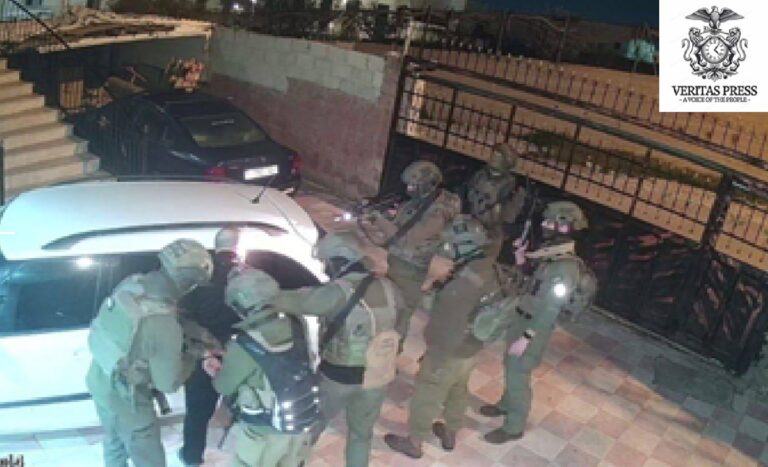
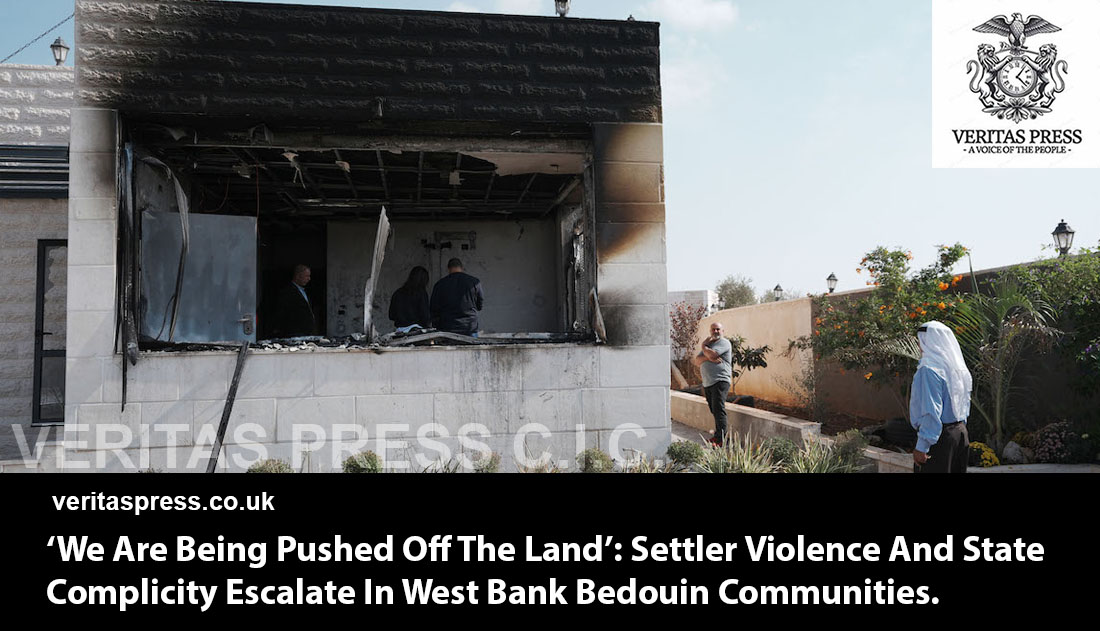
November 2025 | West Bank – Israeli settlers armed with sticks, guns, and stones attacked two Palestinian Bedouin communities near East Jerusalem and Hebron on Sunday, leaving at least eight people injured, homes torched, and farmland destroyed.
The assaults on the Al-Arara encampment north of East Jerusalem and the village of Umm al-Khair in the South Hebron Hills mark the latest in a surge of settler violence that Palestinians, human rights groups, and analysts describe as part of a broader, state-enabled campaign to drive Indigenous communities from their land.
“I really do not understand what this damned hatred is,” said a resident of Umm al-Khair. “Why are people being fought by cutting off their water? Isn’t it enough to demolish our homes?” — Palestinian villager, Umm al-Khair (International Solidarity Movement)
‘They Came With Guns And Fire’:
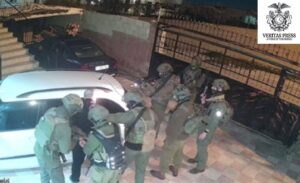
Eyewitnesses told WAFA and Al-Baidar Organisation for the Defence of Bedouin Rights that dozens of settlers, some masked, stormed Al-Arara under Israeli army protection, attacking residents and setting fire to container homes.
“Armed settlers, under the protection of Israeli occupation forces, stormed the gathering, raided homes and assaulted the residents,” said Hassan Mleihat, Al-Baidar’s general coordinator. “At least five were injured, and several shelters burned.”
Hours later, settlers and soldiers attacked Umm al-Khair, assaulting farmers, uprooting 150 olive trees, and damaging fences. According to Rateb al-Jabour, coordinator of the Popular Committees against the Wall and Settlements, “the joint forces assaulted farmers and their families, leaving several bruised and in shock.”
Violence As Policy, Not Exception:
These incidents are not isolated, rights monitors say, but form part of an expanding system of coercive control. In both the South Hebron Hills and Bedouin communities around East Jerusalem, settlers and soldiers routinely coordinate assaults, demolitions, and access restrictions to render Palestinian life untenable.
“During one incursion, a settler fired live rounds into the air while soldiers pepper-sprayed women and blocked ambulances,” said local activist Samira Hathaleen. “They wanted to show us we have no protection.”
The attacks have intensified amid what locals call a “silent transfer” of Palestinian Bedouin communities from Area C, the 60 per cent of the West Bank under full Israeli control, to make room for expanding settlements and military zones.
A recent Le Monde investigation described how settlers “operate under army escort, seizing grazing land and erecting illegal outposts with impunity,” while Palestinians are denied basic permits to build or farm.
Legal Framework For Dispossession:
Under Israeli law, Palestinians in Area C must apply for building permits from the military-civil administration, requests that are almost uniformly denied. Yet settlers build freely, often with ministerial approval.
In Umm al-Khair, Israeli authorities issued mass demolition orders in August, even as settlers erected a new outpost nearby. The UN Office of the High Commissioner for Human Rights (OHCHR) warned that “these measures, coupled with unpunished settler violence, create a coercive environment that may amount to forcible transfer.”
“For years, Israeli authorities have subjected Umm al-Khair residents to discriminatory land regulations,” the UN said. “Recent outposts and repeated attacks represent an intensification of annexation efforts.”
Even Israel’s far-right ministers have been open about their goals. A cabinet member told a settler meeting in September,
“As long as this government continues, we’re living in a miracle. We need to do as much as possible, especially in the South Hebron Hills.”
Impunity And Double Standards:
When settlers attack, arrests are rare and prosecutions almost nonexistent. After a settler shot and killed Palestinian activist Awdah Hathaleen in July, Israeli police released the suspect to house arrest after three days. No formal indictment has been filed.
Meanwhile, Palestinians in the same area face demolitions and detention for unpermitted construction or alleged “disturbances.”
“The impunity extends to unchecked settler violence,” said an OHCHR spokesperson. “It signals that Palestinians’ lives and property are unprotected under occupation law.”
Locals say this double standard has become the occupation’s most powerful weapon: it erases the line between civilian crime and state enforcement.
“There were so many women on the ground, struggling to breathe,” recalled journalist Basel Adra after witnessing a settler attack. “Soldiers were there, watching.”
A War On Livelihoods:
The attacks target more than people; they aim to destroy the means of survival.
In the Jordan Valley, settlers recently stole over 1,500 sheep from Palestinian herders, according to Reuters (Mar. 2025). Olive trees, water pipes, and makeshift homes are also regular targets.
“The olive grove, the sheep, the water well, these are our lives,” said a Bedouin shepherd from Al-Arara. “When they destroy them, they destroy us.”
The United Nations reports that more than 1,000 Palestinians have been displaced in 2025 due to settler violence and demolition orders, the highest figure in a decade.
International Law And Global Silence:
The International Court of Justice reaffirmed in July 2024 that Israel’s settlement enterprise violates international law and that the transfer of Israeli civilians into occupied territory constitutes a war crime. Yet no sanctions or enforcement mechanisms have followed.
The lack of accountability, analysts say, has emboldened the expansionist project.
“Settler violence is not a failure of law, it is the law,” said legal analyst Dr. Michael Lynk, former UN Special Rapporteur on the situation of human rights in the Palestinian territories. “It operates within a framework of de facto annexation, where the state’s non-action is its approval.”
‘We Will Not Leave’
Despite the violence, villagers insist on staying. In Umm al-Khair, a mural painted on a demolished wall reads, “We will not leave, even if the world turns away.”
“They cut our water, they burn our homes, but this is still our land,” said 60-year-old herder Abu Bashar. “We will not move like our grandparents in 1948.”
For Palestinians across the West Bank, such attacks are no longer seen as random outbreaks of extremism but as the frontline of a coordinated campaign of displacement, one unfolding with the tacit, and often explicit, support of the state.
Conclusion: Settler Violence As State Policy — A Regime Of Impunity And International Lawlessness.
What is unfolding across the West Bank, from the Bedouin encampments of Al-Arara north of Jerusalem to the village of Umm al-Khair in Hebron, is not random chaos nor the excess of rogue militias. It is the visible machinery of a state-sanctioned campaign of colonisation, a hybrid war of displacement that merges private settler terror with official military power.
From Al-Arara to Umm al-Khair, settlers act not as rogue actors but as foot soldiers of a broader project, one that merges private violence with public policy. Backed by ministerial decrees, military escorts, and judicial silence, these attacks form a continuum of state violence designed to fragment Palestinian geography and extinguish Palestinian life.
Systematic Legal Violations:
Under international law, Israel’s conduct in the occupied West Bank constitutes a series of grave breaches of the Fourth Geneva Convention, the Rome Statute of the International Criminal Court (ICC), and numerous UN Security Council and General Assembly resolutions affirming the illegality of settlement expansion and annexation.
1. Forcible Transfer and Ethnic Displacement
The United Nations Office of the High Commissioner for Human Rights (OHCHR) and humanitarian agencies have documented repeated cases of forced displacement in the South Hebron Hills, Jordan Valley, and central West Bank. These acts violate Article 49 of the Fourth Geneva Convention, which explicitly prohibits the forcible transfer of protected persons from occupied territories.
“These attacks are meant to make life unliveable,” said Francesca Albanese, UN Special Rapporteur on the occupied Palestinian territories. “That coercive environment, a combination of fear, humiliation, and economic strangulation, amounts to forcible transfer under international law.”
2. Settlement Expansion and Population Transfer
The continued construction, retroactive legalisation, and militarised protection of settlements, policies directly advanced by ministers Itamar Ben-Gvir and Bezalel Smotrich, constitute a violation of Article 49(6) of the Geneva Convention and Article 8(2)(b)(viii) of the Rome Statute. The International Court of Justice (ICJ) reaffirmed in its 2024 advisory opinion that these settlements are illegal and must be dismantled.
3. Collective Punishment and Property Destruction
Demolitions of Palestinian homes, burning of crops, confiscation of water tanks, and destruction of humanitarian shelters all breach Articles 33 and 53 of the Fourth Geneva Convention. These acts are not isolated abuses but systematic policies.
“This dual system of violence, settlers attack, soldiers protect, has turned the law upside down,” said Hagai El-Ad of B’Tselem. “It’s not the rule of law here; it’s the rule of the settler.”
4. Failure to Protect Civilians
As the occupying power, Israel has a binding duty to ensure the safety of the civilian population under Article 27 of the Geneva Convention. Yet documented incidents, including verified footage by CNN and Reuters, show IDF soldiers standing idle, or even participating, as settlers assault Palestinians and torch their property.
“The army’s non-intervention is not neglect, it’s policy,” said Dror Etkes of Kerem Navot. “It is the silent partner in the violence.”
5. Apartheid and Systematic Discrimination
Human Rights Watch, Amnesty International, and Yesh Din all affirm that Israel’s dual legal regime, civilian law for settlers, military law for Palestinians, meets the international legal definition of apartheid under the 1973 Apartheid Convention and Article 7(2)(h) of the Rome Statute.
“Settler violence is not an aberration of apartheid, it is its enforcement arm,” said Heba Morayef, Amnesty’s Regional Director for the Middle East and North Africa.
The Machinery Of Erasure:
The evidence is clear: settler violence is not an uncontrolled symptom but a state-managed strategy. The IDF’s presence during assaults, the Civil Administration’s denial of building permits, and the judiciary’s systemic bias against Palestinians together constitute a unified apparatus of dispossession.
From Al-Arara to Umm al-Khair, every torch set to a tent, every bullet fired at a shepherd, every olive grove razed is part of a calculated effort to make Palestinian existence untenable.
International bodies continue to issue condemnations, yet without enforcement, the message remains the same: Palestinian lives are disposable, their presence negotiable. Western governments, by arming and financing Israel while ignoring the ICJ’s rulings, are not neutral observers but complicit enablers of a regime of impunity.
“Settler violence is the smoke; the occupation is the fire,” said Palestinian analyst Diana Buttu. “Israel wants to make Palestinians disappear from the map, not overnight, but inch by inch, village by village.”
Until that impunity is broken, the burning of a Bedouin tent will remain more than a local crime; it will stand as a symbol of an occupation that has turned dispossession into governance. The destruction of Al-Arara and Umm al-Khair is not an aberration but a blueprint for erasure, sustained by silence and shielded by diplomacy.
“We are not leaving,” said Umm al-Khair elder Fatima al-Hathaleen, standing beside the ashes of her home. “They want us to vanish like ghosts. But we are still here. The land remembers us, even if the world has forgotten.”
Legal Accountability: Paths To Justice And Enforcement.
Despite mounting evidence, accountability remains elusive, yet international law provides multiple mechanisms to address Israel’s ongoing violations.
- International Criminal Court (ICC)
The ICC Prosecutor has jurisdiction over the occupied Palestinian territories following Palestine’s accession to the Rome Statute in 2015.
Potential Charges Include:
- Forcible transfer (Article 8(2)(a)(vii))
- Unlawful population transfer and settlement construction (Article 8(2)(b)(viii))
- Destruction and appropriation of property (Article 8(2)(a)(iv))
- Persecution and apartheid as crimes against humanity (Article 7(1)(h) and 7(1)(j))
The ICC’s ongoing preliminary examination could progress to formal indictments against Israeli political and military officials responsible for the policy of settlements and displacement.
2. International Court of Justice (ICJ)
The ICJ’s 2024 advisory opinion reaffirmed that the occupation and settlement enterprise are illegal. Under Articles 41 and 94 of the UN Charter, states are obliged to ensure compliance. The UN General Assembly can now invoke Article 96 to seek enforcement measures or refer Israel’s noncompliance to the Security Council.
3. United Nations Human Rights Council (UNHRC)
The UNHRC’s Commission of Inquiry on the Occupied Palestinian Territory has already recommended targeted sanctions, arms embargoes, and asset freezes for individuals and entities complicit in settlement construction and settler violence. These measures could be expanded through coordinated action among EU member states and other signatories to the Geneva Conventions.
4. Universal Jurisdiction and Domestic Courts
Several European states, including Spain, Belgium, and South Africa, recognise universal jurisdiction for war crimes and crimes against humanity. This opens potential pathways for national prosecutions of Israeli officials or settler leaders responsible for grave breaches of international law.
5. Arms Embargoes and Economic Sanctions
Article 1 of the Geneva Conventions obliges all signatories to “ensure respect” for the conventions. States continuing military cooperation or trade with Israeli settlements are in violation of this obligation. A coordinated arms embargo, suspension of settlement-linked trade, and divestment from companies complicit in construction or surveillance infrastructure could serve as immediate enforcement tools.
The Unfinished Reckoning:
The violence in Al-Arara and Umm al-Khair is not only a humanitarian crisis; it is a legal emergency. Every act of arson, eviction, and assault left unpunished erodes the foundations of international law itself.
If the ICC and the ICJ fail to enforce their own statutes, and if states continue to shield Israel from accountability, then the Geneva Conventions risk becoming dead letters, instruments honoured only in rhetoric.
Breaking this cycle of impunity requires more than condemnation. It demands enforcement: prosecutions, sanctions, and the political will to treat Palestinian lives as equal before the law.
Until then, the West Bank will remain a landscape of sanctioned illegality, a place where occupation has become governance, and justice remains exiled alongside the people it was meant to protect.