



Title: US Stock Market Crashes Today: Why Dow, S&P 500 And Nasdaq Are Down As Microsoft, Tesla And Meta Trigger Tech Rout.
Press Release: Veritas Press C.I.C.
Author: Kamran Faqir
Article Date Published: 30 Jan 2026 at 13:30 GMT
Category: Americas | Politics-Economy | US Stock Market Crashes Today: Why Dow, S&P 500 And Nasdaq Are Down As Microsoft, Tesla And Meta Trigger Tech Rout.
Source(s): Veritas Press C.I.C. | Multi News Agencies
Website: www.veritaspress.co.uk

Business Ads

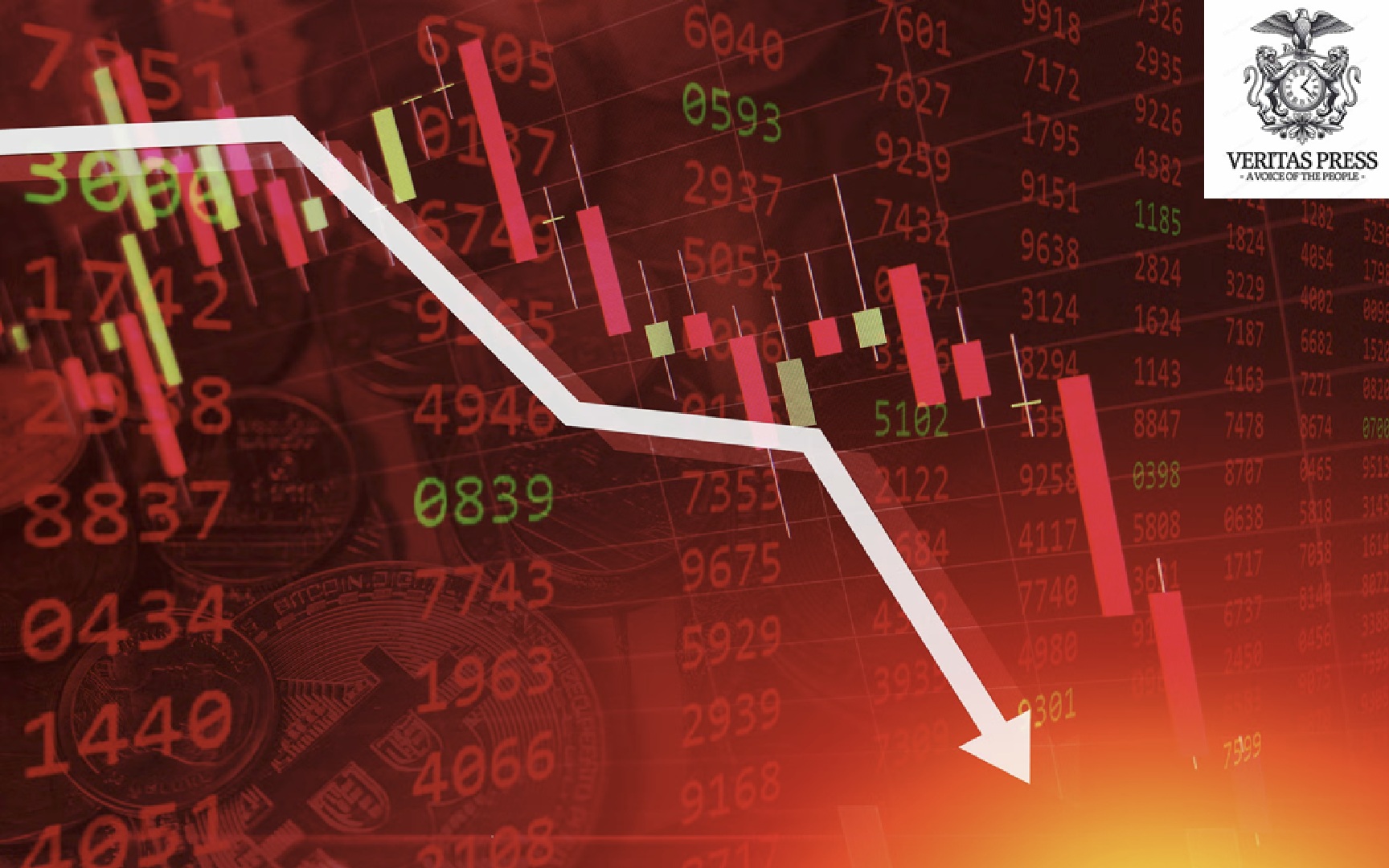
NEW YORK — The US stock market suffered a sharp and destabilising selloff on Thursday as a violent reversal in megacap technology stocks collided with escalating geopolitical tensions and growing fears that the Western financial system is far more fragile than headline indices suggest.
By mid-morning, all three major indices were deep in the red. The Nasdaq Composite plunged 2.21%, shedding more than 527 points to 23,330.21, while the S&P 500 fell 1.21% to 6,893.47. The Dow Jones Industrial Average slid 0.55% to 48,746.33.
What initially appeared to be an earnings-driven pullback quickly morphed into something more unsettling: a broad reassessment of risk in a market increasingly vulnerable to shocks — economic, political, and geopolitical.
Microsoft’s Collapse Sparks A Tech-Led Rout:
At the epicentre of Thursday’s turmoil was Microsoft (MSFT), whose shares cratered more than 11%, erasing roughly $250 billion in market value in a single session and marking one of its worst trading days since the COVID crash of 2020.
The selloff came despite Microsoft beating profit and revenue expectations, underscoring how unforgiving markets have become. Investors focused instead on ballooning AI-related capital expenditures, slowing growth in Azure cloud revenues, and uncertainty over when massive AI investments will translate into sustainable profits.
For a stock priced for near-perfect execution, even modest cracks triggered a brutal repricing. Given Microsoft’s outsized weight in major indices, the decline alone dragged the Nasdaq and S&P 500 sharply lower.
The weakness spread rapidly across megacap technology.
Meta, Tesla And Nvidia: Earnings No Longer Enough.
Meta Platforms (META) initially surged after reporting strong revenue guidance and reaffirming plans to spend up to $135 billion on AI and data-centre infrastructure this year. Shares jumped as much as 8–10% before enthusiasm cooled, as investors questioned whether unprecedented capital spending across Big Tech is compressing future returns rather than enhancing them.
Tesla (TSLA) fell between 1.5% and 3%, even after posting an earnings beat. The decline reflected deeper concerns over the company’s first-ever annual revenue contraction, weakening EV demand, and CEO Elon Musk’s strategic pivot toward robotics and autonomous systems.
Even Nvidia (NVDA), long treated as the market’s most resilient AI bellwether, traded lower, a signal that investors are beginning to rotate out of crowded AI trades after a historic rally.
The message from markets was unmistakable: strong earnings alone are no longer enough. Investors now want proof that growth justifies valuations built on cheap capital and endless expansion.
Geopolitics Ignite A Flight To Safety, And Volatility:
While earnings triggered the initial selloff, geopolitics intensified it.
Investor sentiment deteriorated sharply after President Donald Trump warned that Iran must quickly agree to a nuclear deal or face potential US military strikes. The remarks reignited fears of a broader US–Israel–Iran conflict, particularly around the Strait of Hormuz, through which roughly 20% of global oil supply flows.
Oil markets reacted immediately. Brent crude jumped more than 2–3%, flirting with the $70 per barrel level, reinforced by data showing a surprise 2.3 million-barrel drop in US crude inventories. Rising energy prices revived inflation fears just as markets had been hoping for interest rate cuts later this year.
At the same time, investors rushed into perceived safe havens.
Gold Whiplash Reveals Market Stress:
Gold surged to a fresh record above $5,500 an ounce, briefly approaching $5,600, as fear swept through markets. But the rally quickly turned violent. By the afternoon, gold had plunged nearly 9%, wiping an estimated $3.4 trillion from the value of above-ground gold. Silver collapsed nearly 12% from record highs.
Analysts warned that extreme volatility, thinning liquidity and forced liquidation were overwhelming even traditional safe havens.
Rather than acting as a stabilising refuge, gold became another casualty of market stress, a troubling signal of how fragile liquidity has become during periods of heightened uncertainty.
Fed Holds Rates Steady As Policy Uncertainty Grows:
Adding to the unease, the Federal Reserve held interest rates steady at 3.5%–3.75% at its first policy meeting of 2026. While the pause was expected, markets reacted to the uncertainty surrounding what comes next.
Fed Chair Jerome Powell warned that inflation risks remain persistent, particularly with energy prices rising again. Futures markets still price in two quarter-point rate cuts later this year, but confidence in near-term easing is fading.
Compounding the uncertainty is Powell’s expected departure in May, with President Trump set to name a new Fed chair. Investors fear political pressure could reshape monetary policy at precisely the wrong moment, undermining credibility as inflation risks resurface.
Is The US Market Entering A Danger Zone?
Thursday’s selloff has reignited a deeper and increasingly uncomfortable debate: whether US markets are entering a systemic danger zone, rather than experiencing a routine correction.
Critics point to a volatile combination of stretched equity valuations, political instability, geopolitical brinkmanship, and record-high debt levels. The concentration of gains in a handful of megacap stocks has further amplified fragility, meaning shocks now propagate rapidly across indices.
Some analysts have cautiously raised the possibility that extreme instability, triggered by war, financial stress or a sudden liquidity freeze, could one day force extraordinary measures, including temporary market halts. While such scenarios remain unlikely, the fact that they are even being discussed reflects the depth of investor unease.
What A US-Israel–Iran War Would Mean For Markets And The Global Economy:
Markets are now acutely sensitive to any escalation between Washington/Tel-Aviv and Tehran, and for good reason. Analysts warn that a US–Israel–Iran war would not remain a regional conflict but would send shockwaves through the global economy.
Oil prices could surge toward $150–$200 per barrel if trade routes through the Persian Gulf are disrupted. Shipping costs could jump by 50% as insurers withdraw coverage and vessels reroute. Global stock markets would likely crash amid panic selling, while inflation would spike worldwide.
Interest rate cuts would be delayed or abandoned. Global GDP growth could stall or reverse.
Major oil importers such as India and China would be hit hardest, but Western economies would not escape the fallout. Supply chains for fertilisers, petrochemicals, food and industrial inputs would face renewed disruption, feeding directly into higher consumer prices.
Why War Could Push The West Toward Depression:
Crucially, this shock would hit at a moment when the US and Europe are already financially overstretched. High interest rates, heavy debt burdens, fragile banking systems and slowing growth leave little room for error.
A war-driven oil shock would reignite inflation just as economies weaken, trapping central banks. Cutting rates would worsen inflation; holding rates high would deepen the recession. That combination is historically associated not with mild downturns, but with deep, prolonged depressions.
Stock market crashes, collapsing confidence, forced asset liquidations and tightening credit would reinforce the downturn. Gold, after initial spikes, could plunge amid liquidity stress. Oil would remain elevated, ensuring inflation persists even as demand collapses.
Conclusion: This Is Not Volatility, It Is Structural Failure.
What unfolded on Wall Street this week was not a market “correction,” nor a temporary reaction to earnings disappointment or geopolitical noise. It was a stress fracture, one that exposed how brittle the Western financial system has become after years of distortion, leverage, and political denial.
The violent collapse in Microsoft, the whiplash in gold, and the sudden repricing of oil were not isolated events. They were symptoms of a market structure that has been inflated by cheap money, speculative excess, and the illusion that risk can be permanently deferred. Artificial intelligence became the latest narrative used to justify extreme valuations, even as capital spending ballooned, margins narrowed, and real economic growth lagged behind asset prices.
When that narrative cracked, even slightly, the reaction was brutal.
Yet the greater danger lies beyond technology stocks. The United States and Europe are entering this period with record debt, fragile banks, overstretched consumers, hollowed-out industrial bases, and political systems increasingly incapable of coordinated response. Central banks are boxed in, having exhausted their credibility through years of emergency interventions. Governments, meanwhile, remain dependent on financial markets they claim to regulate but clearly no longer control.
Against this backdrop, the prospect of a US–Israel-led war with Iran is not just a geopolitical risk, it is a potential economic detonator. A conflict centred on the Strait of Hormuz would weaponise energy, disrupt global trade arteries, and reignite inflation across the West at precisely the moment economies are slowing. Oil prices would surge. Supply chains would fracture. Central banks would be paralysed.
And markets would not “adjust.” They would break.
Equities would collapse under the weight of repriced risk. Bond markets would strain as governments borrow into crisis. Gold, falsely assumed to be a stable refuge, would become a liquidity source for forced selling, amplifying volatility rather than absorbing it. The result would not be a clean reset, but a disorderly unwinding of a financial system built on perpetual growth assumptions that no longer hold.
History shows that depressions are not caused by a single shock. They emerge when multiple failures converge: financial excess, policy paralysis, geopolitical conflict, and collapsing confidence. All of those conditions are now present.
What makes this moment particularly dangerous is that markets are still being reassured rather than restructured. Policymakers continue to frame systemic fragility as temporary turbulence. Financial institutions continue to price assets as though central banks retain unlimited power. And political leaders continue to escalate global tensions without accounting for the economic consequences.
The events of this week suggest that those assumptions are no longer credible.
This was not a warning flare fired into calm skies. It was a tremor from a system already under strain, one that may not withstand the next shock. If war, inflation and financial instability collide, the question may no longer be whether markets fall, but whether the Western economic order as currently constructed can survive the fall at all.
What investors witnessed was not the end of a rally.

When Lieutenant Colonel Ebrahim Zolfaqari, spokesman for Iran’s Khatam al-Anbiya Central Headquarters, issued a warning

The historic Christian presence in Palestine, dating back to the earliest centuries of Christianity, is

JERUSALEM – For the first time since the aftermath of the Six-Day War, the courtyards

TEHRAN – As the sun rose on Eid al-Fitr, a day meant for celebration and

HUNGARY – As Benjamin Netanyahu prepares to travel to Hungary this weekend, a mounting legal

LONDON — In the polished corridors of 10 Downing Street, the language remains meticulously calibrated:
On March 20, 2026, the Pentagon quietly announced what amounts to a fundamental restructuring of

WASHINGTON / ISLAMABAD — A fresh warning by US Director of National Intelligence Tulsi Gabbard