






Press Release: Veritas Press C.I.C.
Author: Kamran Faqir
Article Date Published: 09 Nov 2025 at 13:59 GMT
Category: UK | Politics-Economy | UK Welfare Overhaul Sparks Crisis
Source(s): Veritas Press C.I.C. | Multi News Agencies
Website: www.veritaspress.co.uk

Business Ads

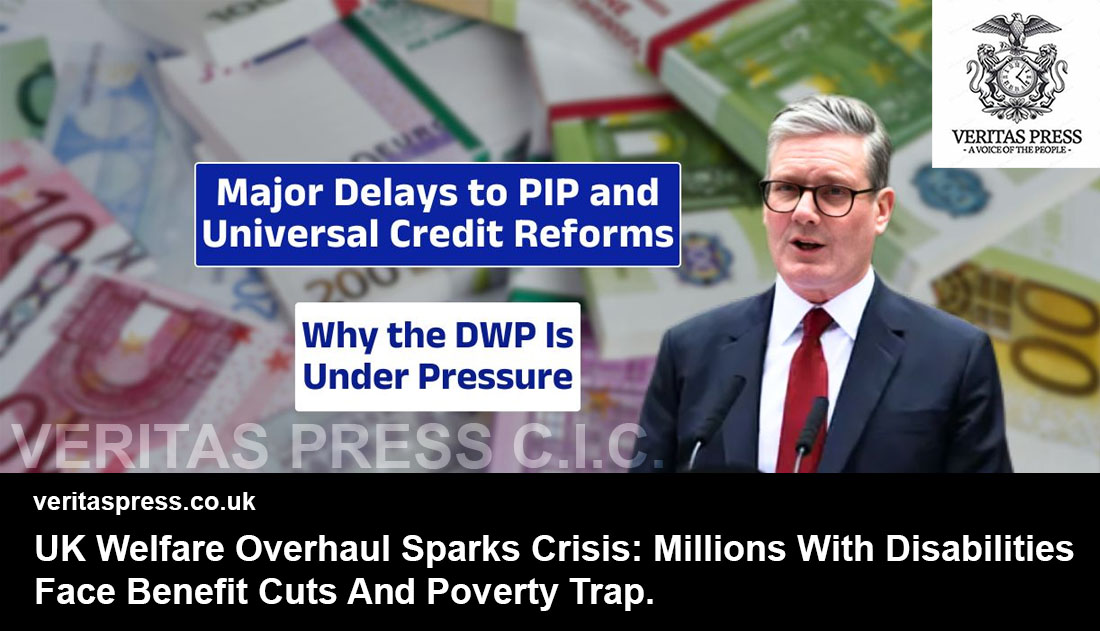
The UK government’s proposed changes to Universal Credit (UC) and Personal Independence Payment (PIP) have sparked a storm of criticism from campaigners, think tanks, and affected citizens, who warn that millions of people with long-term health conditions could see their incomes slashed and their access to essential support drastically curtailed.
The Department for Work and Pensions (DWP) plans to withdraw or reduce health-linked elements of UC and PIP for those with “milder” conditions, while excluding only claimants meeting strict “severe conditions” criteria. Critics say these reforms risk locking millions into dependency, pushing thousands into poverty, and straining public services.
Cuts, “Resets,” and the Human Cost
According to the Centre for Social Justice (CSJ), the government’s decision to rule out identifying savings in the Timms Review will sharply increase welfare spending, leaving a projected £27.2 billion cost to taxpayers by 2030. CSJ estimates this will amount to £700 per taxpayer per year.
The proposals would see UC Health and PIP removed from around 1.1 million people with milder anxiety, depression, or ADHD, with remaining awards “reset” to £103 per week. The think tank argues that at least £1 billion of the savings should be reinvested in NHS Talking Therapies, social prescribing, and employment support programs.
“Everyone can see the system is failing. Abandoning proper welfare reform while costs surge is a political choice with a £27 billion bill attached. Even worse, a lost generation will be stuck on benefits with no route back to work or independence,” said Joe Shalam, Policy Director at the CSJ.
The DWP also plans to introduce a Future Workforce Credit, an incentive for employers to hire young people not in education, employment, or training (NEETs), funded by removing the UC health element for under-22s. Officials estimate 120,000 young people could enter employment, with £765 million in net savings from tax and welfare reductions.
Severe Conditions Criteria: Who Is Protected?
The government has outlined three criteria for the Severe Conditions Criteria (SCC) group, which shields claimants from cuts:
- The condition persistently affects the claimant’s functionality.
- It is expected to be lifelong.
- A National Health Service (NHS) professional must have diagnosed it.
Conditions that fluctuate or are potentially remediable by treatment, or diagnosed privately, are excluded. Those meeting all three requirements will be considered to have a severe, lifelong health disorder and will be exempt from routine reassessment.
“A range of MPs have been raising serious concerns about the plans. But the publication of today’s Universal Credit and Personal Independence Payment Bill shows that the government is just not listening,” said Anela Anwar, CEO of Z2K.
“Instead of making any concessions, it is pushing ahead with plans that will see people with the highest support needs, including double amputees, stroke survivors, and people with psychosis, lose up to a third of their income,” she added.
Growing Caseloads And Rising Stakes:
PIP and UC claimants are already at record levels. The DWP reports nearly 9 million Universal Credit claimants, with the PIP caseload at 3.8 million, expected to exceed 4.6 million by 2030. Claims for anxiety and depression have more than tripled since 2019.
Combined with UC, PIP can provide up to £1,149 a month for single claimants over 25, a lifeline for those with health conditions affecting daily living and mobility.
“The government is asking MPs to vote on legislation without being given the whole picture. Ministers still can’t say how many of those who will lose thousands of pounds a year they expect to find work,” said Iain Porter, Senior Policy Adviser at the Joseph Rowntree Foundation.
Experts warn that slashing benefits for those with “milder” conditions could increase poverty, strain the NHS, and push people into crisis, undermining the very savings the government seeks.
Voices From The Ground:
“As someone long-term disabled, it scares me what the government are planning to do to these benefits. My home is small, and I can’t afford to lose support for my treatment,” said Janine Allen, 56, from Padstow.
Charities are sounding the alarm. Scope warns that hundreds of thousands of families could lose income, with disability households already facing average shortfalls of £1,010 per month compared to non-disabled households.
“It’s a political choice to try fixing the public finances by cutting the incomes of disabled people,” said Sarah Hughes, CEO of Mind.
Cracks In The Reform Narrative:
- Savings Are Overstated: Independent analysis suggests cuts may exceed £7.5–9 billion a year by 2030, far higher than the government estimate.
- Weak Evidence for Work Activation: Removing benefits before sufficient employment support risks pushing people into poverty.
- Middle-Condition Claimants Invisible: Many with episodic or “moderate” conditions may fall through the gaps.
- Political Volatility: Reforms face rebellion within government and among MPs, highlighting tension between cost-saving and welfare rights.
- Hidden Costs Elsewhere: Reduced benefits may transfer costs to the NHS, social care, housing, and local authorities.
“There has been no proper assessment of the poverty impact, which may increase costs elsewhere, including further strain on the NHS,” warned Iain Porter.
A Call For Scrutiny:
As the legislation advances, campaigners, analysts, and MPs are calling for full transparency on impact projections, poverty implications, and employment outcomes. Many argue that the welfare system is being restructured at the expense of the most vulnerable, raising questions of legality, ethics, and public accountability.
“Hundreds of thousands of people are trapped in a welfare system that does not work for them,” said CSJ. “Some of the savings must be invested in a radical expansion of NHS Talking Therapies and back-to-work help. The stakes are human lives, dignity, and a social contract that is being rewritten without full public debate.”
Conclusion: A System On The Brink.
The government’s welfare overhaul is not merely a technical adjustment of benefits; it is a radical restructuring of the social safety net that risks leaving millions of vulnerable people exposed to poverty, exclusion, and deteriorating health. By cutting the UC health element and narrowing PIP eligibility, ministers are effectively redistributing hardship onto those least able to absorb it, while touting speculative savings that independent analysis suggests are likely overstated.
What emerges is a stark picture of policy driven by fiscal optics rather than human reality. The CSJ warns of a “lost generation” trapped on benefits, while charities and campaigners describe households being forced into impossible choices, between paying for essential treatment, housing, or daily living costs. Experts highlight that the government’s own modelling fails to account for indirect costs: increased demand on the NHS, social care, housing, and local authority services, which could easily swallow any projected savings.
From a political perspective, the reforms reveal a government choosing ideological austerity over evidence-based support, despite widespread criticism from MPs, think tanks, and public advocacy groups. By shielding only those with severe, lifelong conditions, the policy risks creating a two-tier system where millions with episodic, moderate, or treatable conditions are left in limbo, unprotected and financially insecure.
Ultimately, this is a human rights issue as much as a fiscal one. Cutting support from people with disabilities, mental health conditions, or chronic illness undermines dignity, autonomy, and social inclusion. As campaigners and analysts have repeatedly warned, the reforms may achieve short-term headline savings but at the cost of long-term social, economic, and ethical harm. The welfare system is meant to protect society’s most vulnerable, but unless these proposals are urgently reassessed, it risks betraying that fundamental responsibility.
The question now is not whether the reforms will save money, but how much human suffering the government is willing to accept in pursuit of it.