




Original Article Date Published:
Article Date Modified:
Help support our mission, donate today and be the change. Every contribution goes directly toward driving real impact for the cause we believe in.
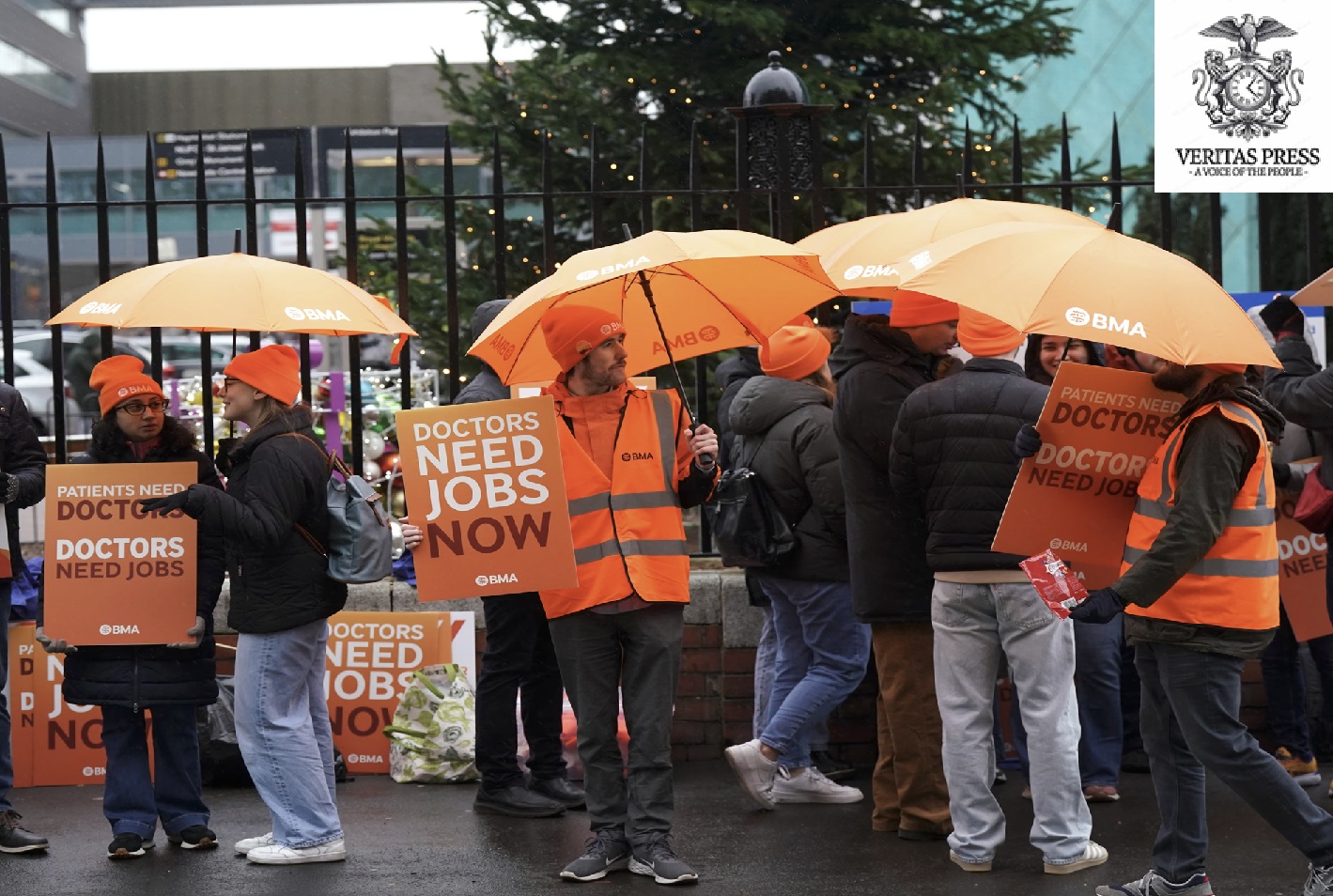
It begins with a late-night email from Downing Street and ends with two picket lines on the same London street, both belonging to the same union. The British Medical Association is about to launch its fifteenth all-out strike since 2023, a six-day walkout by resident doctors demanding “full pay restoration”. But while its members man the barricades, hundreds of the BMA’s own staff will be standing on a separate picket line, accusing their employer of the very “hypocrisy” the union rails against in Whitehall. This is the story of how a labour movement demanding fair pay is quietly tearing itself apart.
The Fractured NHS Family:
The raw numbers tell a story of profound inequality. On 1 April 2026, more than 1.4 million NHS workers on Agenda for Change contracts, nurses, healthcare assistants, porters, paramedics and midwives received a consolidated pay rise of 3.3%, a figure the government proudly noted was above the Office for Budget Responsibility’s forecast inflation of 2.2%. Doctors, meanwhile, secured 3.5% through the DDRB process, a differential that has ignited fury across the NHS workforce.
The response from UNISON, the UK’s largest union, was scathing. Helga Pile, UNISON head of health, said: “Many health staff will question why colleagues working alongside them have, once again, got a higher pay rise for no apparent reason. Ministers can’t keep deferring to archaic pay review body processes that keep valuing some parts of the NHS workforce more highly than others, year after year”.
But the BMA’s demand for “full pay restoration” to 2008 levels, the equivalent of a 26% pay rise, has gone even further. In pursuit of this, the union rejected a government offer that would have given resident doctors an average basic pay rise of 4.9% for 2026/27, taking their total increase over four years to 35.2%. The deal also included up to 4,500 additional speciality training posts and reimbursement of costly Royal College exam fees. It was, in the government’s words, a “generous deal”. And it was rejected without being put to a member vote.
Behind closed doors, other unions are seething. “The deals we have been able to present to our members are becoming a much tougher sell,” one senior union figure told The Guardian in late March. Another source said the BMA’s leadership by resident doctors rather than professional negotiators had made talks “chaotic”, adding: “I think it stops from taking any kind of pragmatic approach”. A third union source acknowledged “undoubtedly resentment” among non-doctor unions, coupled with a sense that the government “always seemed more willing to listen to the doctors”.
The Ultimate Irony: BMA Staff On Strike.
Just as the BMA prepares to lead its members out, its own workforce is walking the picket line. The GMB union, which represents over 75% of BMA staff, has secured a 96% vote in favour of industrial action on an 80% turnout. Staff say their pay has been eroded by between 13% and 16.5% in real terms since 2012. The BMA’s latest offer to its employees? Just 2.75%, plus £1,000 for lower-paid workers, enhanced paternity leave and three extra days of annual leave. The GMB is demanding 6.5% for all grades plus an additional consolidated £1,000 for lower pay grades.
The symbolism is impossible to ignore. The BMA’s chief executive, Rachel Podolak, insisted the offer was “at the very limit of keeping that recovery on track to give the BMA a sound financial footing for the future”. But for Ursula Fuller, a BMA senior elections officer and GMB executive member standing on the picket line outside BMA House in Tavistock Square, the explanation rings hollow.
“The morale of staff at the doctors’ union is absolutely rock bottom at the moment. Staff are really angry and really upset. They work incredibly hard fighting for doctors and, you know, the kind of hypocrisy, it just really kind of feels a bit of a slap in the face to be offered something below inflation,” Fuller told the Press Association. “It’s another below-inflation pay rise at a time when inflation is extremely high, and everyone’s costs are going up. The cost of living is so high, especially in London”.
GMB senior organiser Gavin Davies was even more pointed: “BMA staff have tirelessly supported resident doctors in their fight for improved pay. Now it’s their turn to demand a fair pay deal”.
The BMA’s own statement to The Guardian attempted to draw a distinction: “Doctors have seen their pay fall by more than a fifth since 2008–09… We cannot speak for other unions’ strategies or why they think it is their role to justify an inadequate government pay award to their members”. But as Fuller observed, the situation on 7 April will be surreal: “It’s going to be a strange situation. They’ll be on their picket line, and we’ll be on our picket line. Undoubtedly, it will affect their strike, because they rely on staff to help support with their pickets as well”.
Negotiations In Bad Faith?
The breakdown of talks between the BMA and the Department of Health and Social Care has been acrimonious. The government accepted the DDRB’s recommendation of a 3.5% headline pay award on 25 March, but had also been negotiating a broader package of reforms since January. The BMA’s resident doctors committee, led by Dr Jack Fletcher, walked away from the table, accusing ministers of “shifting the goalposts”.
The response from Wes Streeting was withering. In a letter to Dr Fletcher on 2 April, the Health Secretary wrote: “If members of your committee cannot reach an agreed position among themselves, it is hard to see how the government will be able to reach an agreement with your committee. The government’s offer is on the table. The BMA has chosen to reject it and put the NHS through another round of unnecessary and damaging strike action”. He added: “The BMA seems to be labouring under the delusion that you can reject the deal, but claim the benefits of the offer”.
Writing exclusively for The Independent on 2 April, Streeting went further: “After months of detailed negotiations, collaboration, and compromise, the government has put forward a fair, deliverable, and serious offer on both jobs and pay. The BMA’s choice to rush to strike action means cancelled appointments, delayed care, and additional strain on colleagues who will be asked to pick up the pieces”.
Prime Minister Sir Keir Starmer gave the union a 48-hour ultimatum on 30 March: call off the strike or lose the offer of 1,000 additional training posts for this year. The BMA refused. The posts were withdrawn. Dr Fletcher called the decision “extremely disappointing” and accused the government of using “the development of the doctors of the future” as a pawn.
Streeting’s frustration is palpable. He told the House of Commons that if the BMA missed the 2 April deadline, minimising disruption from the strike would “consume the money set aside for this deal”. The government is now “planning on the basis of a prolonged conflict” in Iran, he added, warning that a future offer will not be better.
The ‘Absurd’ Deal:
The government has consistently framed its offer as extraordinary. Streeting claims that since his appointment, resident doctors have received a 28.9% pay rise, the highest in the entire public sector. The rejected deal would have seen newly qualified doctors in their first year (FY1) receive a 6.2% rise, with basic pay reaching £41,226, almost £12,000 higher than in 2022/23. For the most experienced resident doctors, basic pay would have increased to £77,348, and could top £100,000 with additional hours.
But the BMA uses a different measure of inflation, the Retail Price Index (RPI), to calculate its members’ losses. RPI is typically higher than the Consumer Prices Index, and the BMA argues it is appropriate because the government uses RPI when adding interest to student loans. On that basis, the union says doctors’ pay remains a fifth lower than in 2008 in real terms.
The debate over which inflation measure to use has become a proxy war over competing narratives. The government accuses the BMA of “recklessly” walking away from a deal that would have transformed working lives; the BMA accuses the government of using misleading figures to “wildly overstate the case”. Both sides claim the moral high ground. Neither is listening.
Patient Impact And The Cost Of Conflict:
The human cost of this impasse is mounting. NHS Providers chief executive Julian Hartley said the series of strikes had already cost the NHS £1 billion, money that could have been spent on patient care. Each major strike now costs up to £300 million. The six-day walkout beginning at 7 am on Tuesday, 7 April, is expected to cost more than £250 million in overtime payments and lost activity.
For patients, the disruption is deeply personal. Hospital trusts across England are urging patients to attend appointments unless contacted, but the NHS has warned that cancellations may come with little notice. In a statement, one trust said: “We will only reschedule appointments where necessary and will rebook immediately, where possible. Unfortunately, these strikes will have an impact upon planned and routine care”.
Sir Keir Starmer did not mince words: “It is a reckless decision. And doing so without even giving resident doctors themselves the chance to vote on it makes it even worse. Because the truth is this: no one benefits from rejecting this deal”.
The Broader Labour Movement Responds:
The BMA’s stance has not gone unchallenged within the wider labour movement. Fourteen unions representing NHS workers, including Unison, GMB, Unite, and the Royal College of Nursing, have written to Wes Streeting demanding significant extra funding for pay restructure talks. But they have also made clear their anger at the government’s “imposed” 3.3% award for Agenda for Change staff, which they say represents a real-terms pay cut.
In a letter earlier this month, unions including Unison, GMB and the RCN stated that the NHS workforce crisis “will continue to grow” if the government does not improve upon its “inadequate” 3.3% pay rise. They criticised the government for “using this process that gives staff and their unions no say in the matter”.
Helga Pile summed up the mood: “Staff on Agenda for Change contracts will see their latest award swamped by inflation almost as soon as it kicks in next week. Reforms to the broken pay structure in the NHS can’t come soon enough”.
A House Divided:
As the picket lines form on 7 April, the contradictions will be on full display. Outside hospitals, resident doctors will argue that only “full pay restoration” can reverse years of erosion and stem the exodus of medics from the NHS. Outside BMA House, the union’s own staff will argue that they too deserve a fair pay rise, and that their employer is guilty of the very hypocrisy it condemns in government.
The BMA insists it is doing its job: fighting for its members. But in a health service where doctors and nurses work side by side, where porters and physiotherapists share the same wards, where midwives and consultants deliver babies together, the optics are disastrous. The government, meanwhile, has weaponised the pay differential to divide and rule, presenting the BMA as intransigent and unreasonable while quietly imposing a lower award on the majority of the workforce.
The tragedy is that both sides may have a point. Doctors have indeed seen their pay eroded in real terms over two decades. But so have nurses, paramedics, and healthcare assistants. The BMA’s decision to hold out for “full restoration” while other unions accept a 3.3% award has created a rift that may take years to heal. And with the government now planning for a “prolonged conflict” and withdrawing training posts, the only certain outcome is more cancelled operations, more delayed care, and more bitterness across a health service already stretched to breaking point.
As one senior union figure put it to The Guardian: “You need to zoom out sometimes, and I don’t think they can see the bigger picture”. On the morning of 7 April, with two picket lines on the same London street, that picture will be impossible to ignore.
Source: Multiple News Agencies
Submissions:
For The Secure Submission Of Documentation, Testimonies, Or Exclusive Investigative Reports From Any Global Location, Please Utilise The Following Contact Details For Our Investigations Desk: enquiries@veritaspress.co.uk or editor@veritaspress.co.uk
Help Support Our Work:
Popular Information is powered by readers who believe that truth still matters. When just a few more people step up to support this work, it means more lies exposed, more corruption uncovered, and more accountability where it’s long overdue.
Help Protect Independent Journalism, Which Is Currently Under Attack.
If you believe journalism should serve the public, not the powerful, and you’re in a position to help, becoming a DONATOR or a PAID SUBSCRIBER truly makes a difference.
DONATION APPEAL: If You Found This Reporting Valuable, Please Consider Supporting Independent Journalism.
Help Support Our Work – We Know, We Know, We Know …
Seeing these messages is annoying. We know that. (Imagine what it’s like writing them … )
Your support fuels our fearless, truth-driven journalism. In unity, we endeavour to amplify marginalised voices and champion justice, irrespective of geographical location.
But it’s also extremely important. One of Veritas Press’s greatest assets is its reader-funded model.
1. Reader funding means we can cover what we like. We’re not beholden to the political whims of a billionaire owner. We are a small, independent and impartial organisation. No one can tell us what not to say or what not to report.
2. Reader funding means we don’t have to chase clicks and traffic. We’re not desperately seeking your attention for its own sake: we pursue the stories that our editorial team deems important and believe are worthy of your time.
3. Reader Funding: enables us to keep our website and other social media channels open, allowing as many people as possible to access quality journalism from around the world, particularly those in places where the free press is under threat.
We know not everyone can afford to pay for news, but if you’ve been meaning to support us, now’s the time.
Your donation goes a long way. It helps us:
- Keep the lights on and sustain our day-to-day operations
- Hire new, talented independent reporters
- Launch real-time live debates, community-focused shows, and on-the-ground reporting
- Cover the issues that matter most to our communities, in real time, with depth and integrity
We have plans to expand our work, but we can’t do it without your support. Every contribution, no matter the size, helps us stay independent and build a truly people-powered media platform.
If you believe in journalism that informs, empowers, and reflects the communities we serve, please donate today.
The raw numbers tell a story of profound inequality. On 1 April 2026, more than

What began on February 28, 2026, as a coordinated US-Israeli campaign to decapitate Iran’s military

The idea of a “freedom flotilla” carries a ghost in its hold: the 2010 Mavi

Original Article Date Published: Article Date Modified: Help support our mission, donate today and be

Original Article Date Published: Article Date Modified: Help support our mission, donate today and be

A United States fighter jet has been shot down over Iran, marking a dangerous and

On February 28, the United States and Israel launched coordinated strikes on Iran, reported by

LONDON, UK – Just weeks after being appointed as the government’s “Cost of Living Champion”,

On February 28, 2026, the first wave of U.S.-Israeli pre-emptive strikes hit Iranian military and

USA, NASA – Spurred by American ingenuity, astronauts on NASA’s Artemis II mission are in