







Original Article Date Published:
Article Date Modified:
Help support our mission—donate today and be the change. Every contribution goes directly toward driving real impact for the cause we believe in.
The Political Dam Breaks:
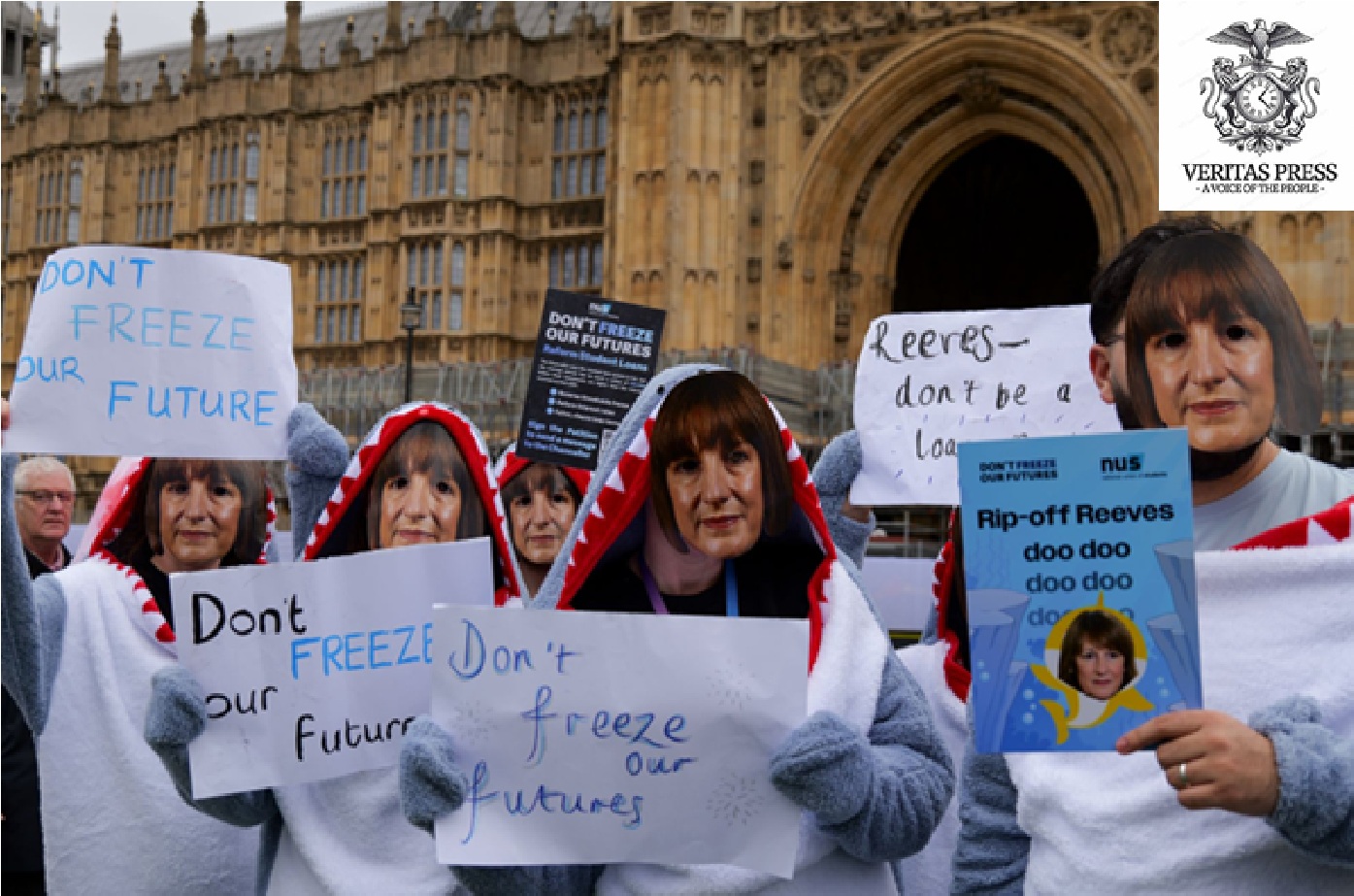
In an extraordinary parliamentary intervention that has sent shockwaves through Westminster, a coalition of Labour backbenchers has turned on their own government, condemning the student loan system in England and Wales as an “outrageous scam” against graduates. The revolt, which saw more than 20 Labour MPs speak during a Westminster Hall debate, represents a significant political headache for Keir Starmer’s administration and a deeper crisis of legitimacy for a financing model critics say has trapped millions in spiralling, unpayable debt.
The metaphor that captured the moment came from Liberal Democrat MP Josh Babarinde, who invoked the Eagles’ classic Hotel California to describe the predicament of Plan 2 loan holders: “They can check out, graduate, but they can never leave.”
At the heart of the controversy is Chancellor Rachel Reeves’ November 2024 decision to freeze the salary repayment threshold for three years from April 2027, a move condemned by consumer finance expert Martin Lewis as a “unilateral breach of contract.”
But beyond the political row lies a larger question: what kind of higher education system does Britain want for the next generation?
A System Under Strain:
Plan 2 loans, introduced in 2012 alongside the tripling of tuition fees, were presented as progressive and income-contingent. Graduates would repay 9% of earnings above a threshold; any remaining balance would be written off after 30 years.
In practice, interest rates of RPI plus up to 3% mean balances often grow faster than repayments. The Institute for Fiscal Studies estimates that around 70% of borrowers will never fully repay. For many, the loan functions less as a traditional debt and more as a 30-year surtax, but one accompanied by a visible, psychologically burdensome balance that compounds over time.
The threshold freeze intensifies that burden. As wages rise, more income becomes liable for repayment. While ministers argue the average additional cost is modest, critics insist the core issue is retrospective rule-changing.
The Deeper Structural Question:
The immediate political storm obscures a more profound structural flaw: Britain’s shift from grants to loans transformed higher education from a public investment into an individualised liability.
For decades, maintenance grants ensured that students from low- and middle-income families could attend university without incurring life-shaping debt. The abolition of those grants, replaced almost entirely by loans, reframed education as a personal financial gamble rather than a collective national strategy.
Yet the UK economy is entering an era in which technological sophistication, advanced research, artificial intelligence, green engineering, biomedical science, and digital infrastructure will sit at the centre of national development. Human capital, intellectual and technical, will define productivity growth.
In that context, constraining access to higher education through fear of debt may prove economically self-defeating.
Reinstating Grants: An Investment, Not A Subsidy.
One emerging argument, increasingly voiced by Labour backbenchers and education economists, is that for future cohorts the government should reintroduce maintenance grants in place of, or alongside, reduced reliance on loans.
The logic is straightforward:
- Access: Students from lower-income backgrounds are disproportionately debt-averse. Grants remove a psychological and financial barrier to entry.
- Mobility: If higher education remains central to high-skill employment, equitable access becomes essential to social mobility.
- Productivity: A more educated workforce supports innovation, entrepreneurship, and long-term GDP growth.
- Fiscal return: Graduates typically pay more in income tax over their lifetimes. Grants can therefore function as long-term public investment rather than simple expenditure.
In knowledge-driven economies, underinvestment in education risks stagnation. Countries that subsidise tertiary education often justify it not as charity, but as infrastructure, as essential to economic resilience as transport or energy networks.
If Britain wants to compete in sectors where technological and intellectual capability sit at the epicentre of development, expanding, not financially deterring, participation becomes a strategic imperative.
The Economic Multiplier:
Reintroducing grants would not merely reduce student anxiety; it could also have measurable macroeconomic effects. Graduates entering the workforce without heavy debt burdens are:
- More likely to form households earlier.
- More capable of entering the housing market.
- More willing to start businesses.
- More mobile geographically.
Debt overhang can suppress consumption and risk-taking. Removing or reducing it may stimulate economic dynamism.
Moreover, if access widens for talented students who would otherwise opt out, the national talent pool expands. In sectors such as AI, engineering, medicine, climate science and advanced manufacturing, the marginal productivity of skilled workers is high. A single additional innovator can generate disproportionate returns.
Intergenerational Fairness And The Social Contract:
Critics argue that grants shift costs onto taxpayers who did not attend university. But the counterargument is that higher education benefits society broadly, through medical advances, technological development, public services, and tax contributions.
The Plan 2 crisis illustrates what happens when policy design emphasises fiscal accounting over the social contract. Retrospective changes erode trust. Compounding interest undermines perceived fairness.
Reintroducing grants for future students would signal a reset, a recognition that higher education is not solely a private commodity but a shared national investment.
Conclusion: Beyond The Debt Trap.
The student loans controversy is about more than repayment thresholds and interest rates. It is about whether Britain views education as a public good or a personal liability.
The Plan 2 generation feels trapped in a “Hotel California” of debt. Reform may alleviate their burden. But the deeper challenge is preventing the next cohort from entering the same structure.
Reinstating maintenance grants, even partially, would not solve every fiscal constraint. But it would reframe higher education as infrastructure for a technologically and intellectually advanced economy.
If future prosperity depends on human capital, then access to that capital cannot be governed primarily by fear of lifelong debt.
The door that must be unlocked is not only for today’s graduates, but for tomorrow’s students.
For The Secure Submission Of Documentation, Testimonies, Or Exclusive Investigative Reports From Any Global Location, Please Utilise The Following Contact Details For Our Investigations Desk: enquiries@veritaspress.co.uk or editor@veritaspress.co.uk
Popular Information is powered by readers who believe that truth still matters. When just a few more people step up to support this work, it means more lies exposed, more corruption uncovered, and more accountability where it’s long overdue.
If you believe journalism should serve the public, not the powerful, and you’re in a position to help, becoming a DONATOR or a PAID SUBSCRIBER truly makes a difference.
DONATION APPEAL: If You Found This Reporting Valuable, Please Consider Supporting Independent Journalism.
Help Support Our Work – We Know, We Know, We Know …
Seeing these messages is annoying. We know that. (Imagine what it’s like writing them … )
Your support fuels our fearless, truth-driven journalism. In unity, we endeavour to amplify marginalised voices and champion justice, irrespective of geographical location.
But it’s also extremely important. One of Veritas Press’s greatest assets is its reader-funded model.
1. Reader funding means we can cover what we like. We’re not beholden to the political whims of a billionaire owner. We are a small, independent and impartial organisation. No one can tell us what not to say or what not to report.
2. Reader funding means we don’t have to chase clicks and traffic. We’re not desperately seeking your attention for its own sake: we pursue the stories that our editorial team deems important and believe are worthy of your time.
3. Reader Funding: enables us to keep our website and other social media channels open, allowing as many people as possible to access quality journalism from around the world, particularly those in places where the free press is under threat.
We know not everyone can afford to pay for news, but if you’ve been meaning to support us, now’s the time.
Your donation goes a long way. It helps us:
- Keep the lights on and sustain our day-to-day operations
- Hire new, talented independent reporters
- Launch real-time live debates, community-focused shows, and on-the-ground reporting
- Cover the issues that matter most to our communities, in real time, with depth and integrity
We have plans to expand our work, but we can’t do it without your support. Every contribution, no matter the size, helps us stay independent and build a truly people-powered media platform. If you believe in journalism that informs, empowers, and reflects the communities we serve, please donate today.

In what press freedom watchdogs are calling a historic collapse of civilian protection, 2025 has
In an extraordinary parliamentary intervention that has sent shockwaves through Westminster, a coalition of Labour

GREATER MANCHESTER, UK – On the evening of February 24, prayers at Manchester Central Mosque,
WEST BANK, Date: February 25, 2026 – The occupied West Bank is witnessing a dramatic

NEW DELHI/KASHMIR -As Narendra Modi makes his second official visit to Israel starting February 25,

WASHINGTON/TEHRAN, Feb 25, 2026- For the second time in a week, Tehran has levelled an

US – In a move that has simultaneously energised moderate pro-Israel advocates and drawn sharp

GAZA – A comprehensive investigation has concluded that the deaths of 39 Palestinians, including 22
As Indian Prime Minister Narendra Modi prepares to land in Tel Aviv on February 25
In the complex tapestry of Middle Eastern geopolitics, cartography is often the sharpest weapon. In