

Original Article Date Published:
Article Date Modified:
Help support our mission, donate today and be the change. Every contribution goes directly toward driving real impact for the cause we believe in.
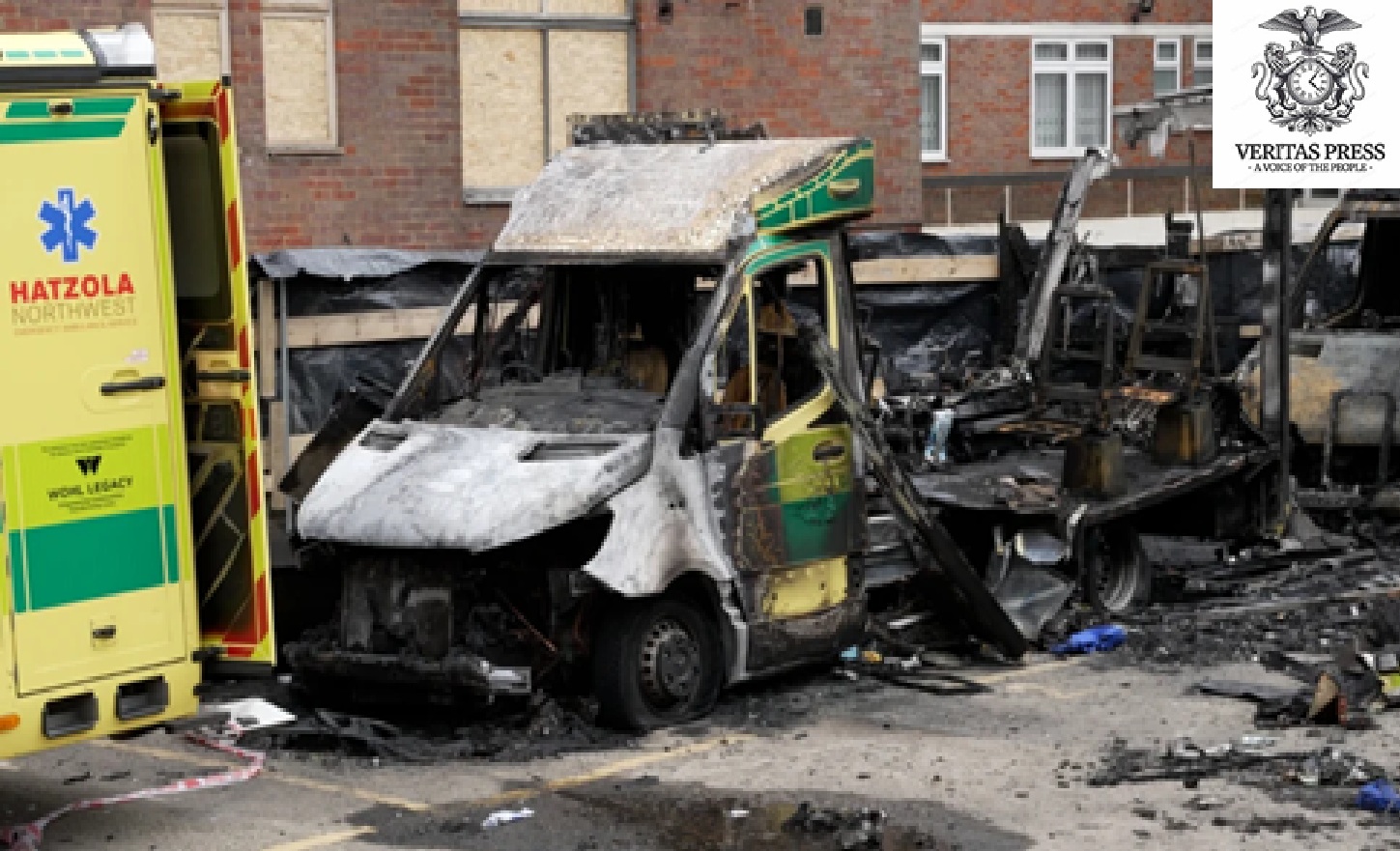
LONDON, UK – In the early hours of Monday morning, a quiet street in Golders Green became the epicentre of a national crisis. Four ambulances belonging to Hatzola, a Jewish volunteer service, were set ablaze outside a synagogue. The attack, featuring hooded figures pouring accelerant before fleeing, triggered the full machinery of the British state. Within hours, Prime Minister Keir Starmer had issued a condemnation, calling it a “deeply shocking antisemitic arson attack”. The Home Office promised replacements by the next morning. Counter-terrorism police took charge. The national solidarity script was flawless.
But by midday, the script had torn. When an Al Jazeera news crew arrived to cover the aftermath, they were surrounded by a hostile crowd from the same community that had just been promised the nation’s sympathy. Shouted at to “go back to Qatar,” branded as “terrorists,” and subjected to animal slurs, “donkey,” “dog”, the journalists were ultimately forced to abandon their reporting.
In the space of twelve hours, Golders Green did not just witness two incidents of hate; it laid bare the operational mechanics of British racism: a system where Jewish fear is immediately legible and actionable, while Arab and Muslim fear is dismissed as a complication, and where press freedom depends entirely on who is holding the camera.
The Crime And The ‘Breakthrough’:
The arson attack itself remains a grave concern. As of Wednesday, the Metropolitan Police have arrested two men, aged 47 and 45, on suspicion of arson with intent to endanger life. Commander Helen Flanagan, head of Counter Terrorism Policing London, described the arrests as an “important breakthrough,” though she conceded that CCTV footage suggests at least three people were involved, indicating the investigation remains active.
A group calling itself Harakat Ashab al-Yamin al-Islamiya (HAYI), which translates to “The Islamic Movement of the People of the Right Hand,” has claimed responsibility. The group, which security monitoring services say is aligned with Iran, has also claimed similar attacks in Belgium and the Netherlands. While British authorities are treating the arson as an antisemitic hate crime, they are still probing the authenticity of the Iranian link, urging caution against premature attribution.
Yet, even as these arrests were made, the political and media class continued to grapple with the second incident, the one they didn’t have a script for.
The Harassment: ‘Go Back To Qatar’.
Videos circulating online show the exact moment the national consensus fractured. An Al Jazeera reporter, standing his ground, tells a hostile crowd: “You don’t decide when I stay or when I leave”. He shouldn’t have had to say it. Police officers at the scene can be heard trying to explain that the journalists are “reporting the news” and cannot be removed.
It didn’t matter. The men in the crowd, having just absorbed the language of victimhood, weaponised it instantly.
“We feel threatened by Al Jazeera being here,” one man insisted, despite the fact that he and his cohort were the ones doing the shouting and surrounding. “The reporting is going to go to potential terrorists. That’s why we don’t want to see that on our streets”.
The slurs that followed, “Get out of here, you donkey, you dog”, stripped away any remaining pretence of “community tension”. This was not a nuanced debate about editorial bias; it was racist thuggery. As one commentator noted, the scene demonstrated how “the aggressor claims fear” and “the surrounding crowd claims threat” to borrow official authority and decide which journalists are allowed to work.
Fiona O’Brien, Director for Europe and Central Asia at the Committee to Protect Journalists, told The New Arab: “No one should have to put up with being shouted at or intimidated for doing their job, and police officers witnessing such harassment should respond appropriately, to ensure that news crews are able to continue reporting safely and freely”.
The Hierarchy Of Racism:
The asymmetry in coverage is not an accident; it is a reflection of a deeply entrenched hierarchy. The arson attack was immediately handed to Counter Terrorism Policing, condemned by the Prime Minister, and received government funding for replacements. Meanwhile, the harassment of the Al Jazeera crew was treated by much of the mainstream media as a mere “side-detail”, a tense “altercation” rather than a hate crime.
Martin Abrams, a Jewish Green Party councillor, was one of the few public figures to call out the double standard explicitly. “The ambulance arson was absolutely shocking,” he wrote on X, “but that attack in no way justifies members of the Jewish community there harassing and abusing journalists trying to do their jobs.”
The contrast in political will is stark. If a Jewish Chronicle crew had been surrounded and called dogs in Whitechapel by a Muslim mob, the reaction would have been immediate and overwhelming. There would be emergency panels, demands for community leaders to answer, and sweeping condemnations from the highest offices. Instead, the Al Jazeera incident was met with public mumbling and a reluctance to use plain language about what was done to them.
Keir Starmer’s Selective Spine:
Prime Minister Keir Starmer has positioned himself as the enforcer of moral standards, particularly on antisemitism. His swift condemnation of the ambulance attack was necessary and proper. But his silence, or delayed, measured response, regarding the assault on Arab journalists speaks to a political calculation.
Starmer has become the symbol of Britain’s selective spine. He finds his moral certainty quickly where establishment consensus is present, but when the politics get dangerous, when the abusers are a community, the establishment is culturally more comfortable sheltering, and he retreats into “lawyerly little pauses”.
This is not merely a failure of leadership; it is an endorsement of a hierarchy. It tells Arab and Muslim Britons that their fear, their dehumanisation, and their safety are secondary.
The Importation Of War Politics:
To understand the venom directed at Al Jazeera, one must look beyond Golders Green to Tel Aviv. Israel banned Al Jazeera in May 2024, shutting its offices and branding the network a security threat. Benjamin Netanyahu’s government has repeatedly treated the channel, renowned for its relentless coverage of Gaza, as an enemy entity.
When a crowd in London chants “Al Jazeera off our streets,” they are not voicing a local grievance about community relations. They are importing a foreign government’s war policy onto British soil. As the user narrative rightly pointed out, “you are looking at war politics crossing borders and taking local form.”
Key Updates & Developments:
- Arrests Made: Two men (47 and 45) arrested on suspicion of arson with intent to endanger life. A third suspect is still being sought.
- Investigation Status: Counter-terrorism police are leading the probe. The claim by the Iran-aligned group HAYI is being investigated but not yet confirmed.
- Government Response: Four replacement ambulances were provided by the government the morning after the attack. Increased armed patrols have been promised for Jewish communities ahead of Passover.
- Press Freedom Concerns: The Committee to Protect Journalists and other watchdogs have condemned the harassment of the Al Jazeera crew, calling for police to guarantee the safety of reporters.
Conclusion: A Street Scene Caught On Camera.
Golders Green has provided a clean demonstration of how Britain’s moral machinery works. One hate crime was treated with urgency, while the other, perpetrated by those who had just been anointed as presumptive victims, was minimised.
As the hunt continues for the third suspect in the ambulance arson, the Metropolitan Police must also confront the implications of the harassment video. If journalists are allowed to be hounded out of a neighbourhood simply because a crowd deems their presence “threatening,” then the principle of press freedom in the UK is already dead.
For now, the footage remains. It shows a police officer trying to reason with a mob, a journalist refusing to back down, and a system failing to apply the same rules to everyone.
“Britain can still name racism quickly enough when the victim fits the approved template,” the analysis concluded. “When the target is an Arab journalist and the abusers are people the system is more used to sheltering… the double standard is no longer a suspicion but a street scene in London caught on camera.”
Source: Multiple News Agencies
Submissions:
For The Secure Submission Of Documentation, Testimonies, Or Exclusive Investigative Reports From Any Global Location, Please Utilise The Following Contact Details For Our Investigations Desk: enquiries@veritaspress.co.uk or editor@veritaspress.co.uk
Help Support Our Work:
Popular Information is powered by readers who believe that truth still matters. When just a few more people step up to support this work, it means more lies exposed, more corruption uncovered, and more accountability where it’s long overdue.
Help Protect Independent Journalism, Which Is Currently Under Attack.
If you believe journalism should serve the public, not the powerful, and you’re in a position to help, becoming a DONATOR or a PAID SUBSCRIBER truly makes a difference.
DONATION APPEAL: If You Found This Reporting Valuable, Please Consider Supporting Independent Journalism.
Help Support Our Work – We Know, We Know, We Know …
Seeing these messages is annoying. We know that. (Imagine what it’s like writing them … )
Your support fuels our fearless, truth-driven journalism. In unity, we endeavour to amplify marginalised voices and champion justice, irrespective of geographical location.
But it’s also extremely important. One of Veritas Press’s greatest assets is its reader-funded model.
1. Reader funding means we can cover what we like. We’re not beholden to the political whims of a billionaire owner. We are a small, independent and impartial organisation. No one can tell us what not to say or what not to report.
2. Reader funding means we don’t have to chase clicks and traffic. We’re not desperately seeking your attention for its own sake: we pursue the stories that our editorial team deems important and believe are worthy of your time.
3. Reader Funding: enables us to keep our website and other social media channels open, allowing as many people as possible to access quality journalism from around the world, particularly those in places where the free press is under threat.
We know not everyone can afford to pay for news, but if you’ve been meaning to support us, now’s the time.
Your donation goes a long way. It helps us:
- Keep the lights on and sustain our day-to-day operations
- Hire new, talented independent reporters
- Launch real-time live debates, community-focused shows, and on-the-ground reporting
- Cover the issues that matter most to our communities, in real time, with depth and integrity
We have plans to expand our work, but we can’t do it without your support. Every contribution, no matter the size, helps us stay independent and build a truly people-powered media platform.
If you believe in journalism that informs, empowers, and reflects the communities we serve, please donate today.
GREEK ISLANDS – A controversial proposal by Israeli politician Avri Steiner to purchase Greek islands
TEHRAN, IRAN – In the early hours of Thursday, the Islamic Revolutionary Guard Corps (IRGC)
LONDON, UK – In the early hours of Monday morning, a quiet street in Golders
SEOUL / TEHRAN — In a packed press conference at the Iranian Embassy in Seoul’s
Pakistan’s imprisoned former prime minister Imran Khan has issued one of his most forceful denunciations
At the Rubaya mining complex in eastern Democratic Republic of Congo, the hillside known as
On the 25th day of a conflict that has already rewritten the geopolitical map of
On the outskirts of Nabatieh, where the Mediterranean breezes once carried the scent of olive
On December 27, 2024, Israeli occupation forces raided Kamal Adwan Hospital in northern Gaza, one

Senior officials within the US military have drawn up contingency plans for a potential ground