





Original Article Date Published:
Article Date Modified:
Help support our mission, donate today and be the change. Every contribution goes directly toward driving real impact for the cause we believe in.
A Seismic Shift In British Politics:
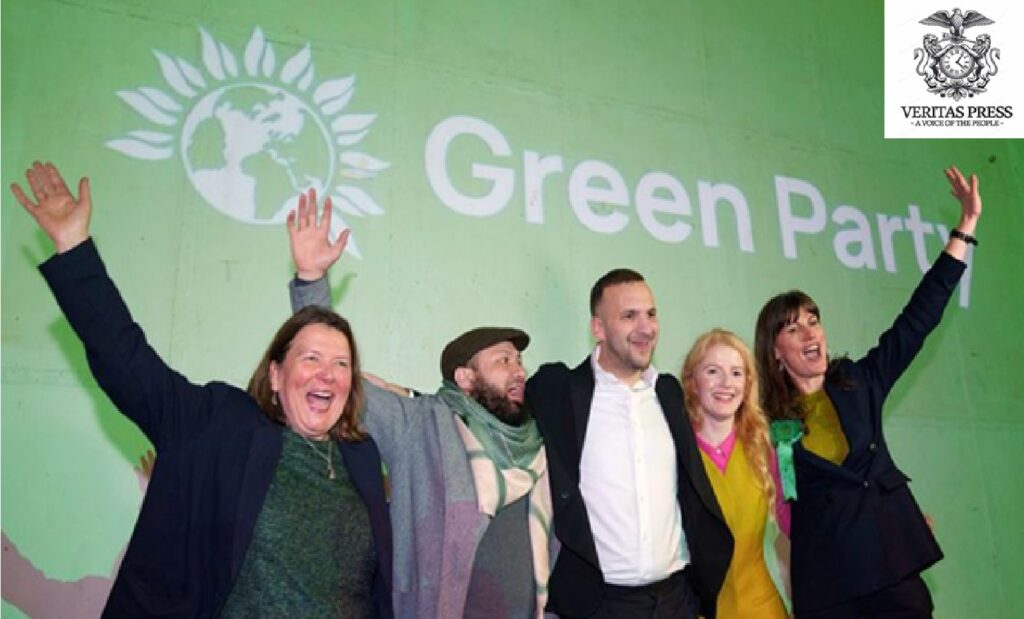
GORTON AND DENTON, UK – At 4:30 am on February 27th, 2026, Hannah Spencer stood before a sparse crowd at Manchester Central Convention Complex and apologised to her plumbing customers. “I think I might have to cancel the work that you had booked in, because I’m heading to parliament,” she said, visibly overwhelmed by the history she had just made.
The 34-year-old plumber and plasterer had done what no Green Party candidate had ever done before: win a Westminster by-election. In doing so, she overturned a 13,413 Labour majority, pushed Reform UK into second place, and relegated the governing party to third in what had been one of its safest seats. The last time this area of Manchester elected someone other than a Labour MP, George V was on the throne, and Stanley Baldwin was prime minister. It was 1931.
But beyond the historical milestone, the Gorton and Denton result represents something far more menacing for Keir Starmer’s Labour Party: proof that the progressive coalition the party has taken for granted for generations is not merely fracturing, it is actively realigning behind a rival force on the left. As polling expert Sir John Curtice observed, this was the first time in a by-election contest that neither Labour nor the Conservatives occupied one of the top two positions. The duopoly that has defined post-war British politics has never looked weaker.
The Anatomy Of An Upset: By The Numbers.
The scale of Labour’s defeat is difficult to overstate. In the 2024 general election, Andrew Gwynne had secured 50.7% of the vote in the newly created constituency. Just eighteen months later, Labour’s candidate Angeliki Stogia attracted merely 25.4%, a collapse of 25.3 percentage points that ranks among the party’s heaviest by-election defeats this century.
The Greens, meanwhile, surged from 13.2% to 40.7%, a 27.5-point swing that gave Spencer a comfortable majority of 4,402 over Reform’s Matt Goodwin. Reform more than doubled its vote share to 28.7%, while the Conservatives were virtually erased, polling just 1.9% and losing their deposit, their worst ever by-election result. The Liberal Democrats fared little better with 1.8%.
Turnout, remarkably, held steady at 47.6%, barely below the 47.8% recorded in 2024. This was not a case of apathetic Labour voters staying home; they turned out, but they voted for someone else.
Hannah Spencer: The Plumber Who Plugged Labour’s Leak.
Spencer’s journey to parliament is itself an indictment of the political class she now joins. A Bolton native who left school at sixteen, she trained as a plumber before launching her own business, Hannah’s Household Plumbing, in 2015. During the by-election campaign, she continued attending classes to qualify as a plasterer, a course she passed with distinction.
“I didn’t grow up wanting to be a politician,” she told supporters in her victory speech. “I’m a plumber. And two weeks ago, during all this, I also qualified as a plasterer. Because even in chaos, even under pressure… I get things done”.
Her political awakening came not through environmental activism, the traditional gateway to Green politics, but through rage at the inequalities exposed by the pandemic. “So angry at the gap between the super-rich and all the rest of us getting bigger,” she explained of her decision to join the Greens in 2022. She was elected as a Trafford councillor the following year and finished fifth in the 2024 Greater Manchester mayoral election.
Unlike the caricature of Green politicians as middle-class environmentalists, Spencer speaks the language of working-class grievance. “Working hard used to get you something. It got you a house. A nice life. Holidays,” she said. “But now, working hard? What does that get you? The people who work hard but can’t put food on the table. Can’t get their kids’ school uniforms. Can’t put their heating on”.
This message resonated across the constituency’s stark internal divides. Gorton and Denton is, as political scientist Rob Ford notes, “a tale of two Manchesters on opposite edges of Labour’s unravelling electoral coalition”. One side is home to university students and graduates, with a population that is 40% Muslim. The other is 83% white, with many residents in low-paying jobs. Relative child poverty in parts of the constituency is twice the national average.
Spencer’s achievement was to bridge that divide. “Whilst our communities may sometimes be labelled in different ways, the thing everyone seems to have underestimated here is how similar we all actually are,” she said. “How we have common ground. How we get along, how we stand up for each other”.
The Muslim Vote: Labour’s Reckoning.
If Spencer’s working-class credentials won her support in Denton’s white communities, her position on Gaza unlocked something far more consequential in Longsight and the constituency’s other diverse wards. The shift of Muslim voters from Labour to the Greens was not merely significant; it was decisive.
Labour has long relied on Muslim voters. Shortly before the 2024 election, polling by Savanta found nearly two-thirds of the UK’s nearly 4 million Muslims intended to vote Labour. But anger at the party’s stance on Gaza has festered, exacerbated by what many Muslim voters perceive as a hostile approach to immigration under Home Secretary Shabana Mahmood.
“Lots of people were angry at Shabana and our approach to immigration in general,” one Labour MP told the Guardian. “Several people said these rules would not have allowed their parents to make their lives here”.
The Greens exploited this discontent with surgical precision. They produced campaign materials in Urdu featuring Keir Starmer shaking hands with Narendra Modi, the Hindu nationalist Indian prime minister who is a deeply polarising figure for many voters of Pakistani heritage. Spencer appeared on leaflets dressed in a keffiyeh, urging voters to “make Labour pay”.
Labour’s response was to accuse the Greens of “whipping up hatred” and playing “sectarian politics.” In a letter to Labour MPs, Starmer wrote: “Their divisive, sectarian politics is a sign that the Greens are not the harmless environmentalists they pretend to be”.
But privately, Labour figures admit the Greens simply out-organised them. “The Greens were doing a lot of stuff with the mosques, persuading people there they were best placed to defeat Reform,” one Labour source conceded. “When progressive voters were looking for a party to coalesce around, persuading the networks in the Muslim community that you were the party best placed to win made a huge difference”.
The endorsement of George Galloway, the firebrand former MP with his own history of targeting Muslim voters, only reinforced the perception that the Greens had captured a coalition Labour had allowed to slip through its fingers.
The ‘Family Voting’ Controversy And Accusations Of Sectarianism:
As the scale of the Greens’ victory became clear, Reform UK and the Conservatives launched a coordinated attack on the result’s legitimacy.
Election observers from Democracy Volunteers claimed they had witnessed “concerningly high levels” of family voting, an illegal practice where one person accompanies another into the polling booth with the intention of influencing their vote. The group reported observing potential family voting in 15 of the 22 polling stations they visited, affecting 12% of voters observed. In one polling station alone, they recorded nine cases.
John Ault, the group’s director, said: “We rarely issue a report on the night of an election, but the data we have collected today on family voting, when compared to other recent by-elections, is extremely high”.
Nigel Farage seized on the report with characteristic hyperbole. In a social media video, he claimed the by-election was “a victory for sectarian voting and cheating,” raising “serious questions about the integrity of the democratic process in predominantly Muslim areas”. He linked the result to the overnight vandalism of Winston Churchill’s statue in Westminster, which had been defaced with the words “Zionist” and “Globalise the Intifada”, a connection that appeared designed to conflate Muslim voting patterns with anti-British sentiment.
Matt Goodwin, Reform’s defeated candidate, went further, warning of “a dangerous Muslim sectarianism” and claiming there was “one general election left to save Britain”.
The acting returning officer for Manchester City Council strongly disputed the allegations, stating that polling station staff were trained to look for undue influence and that “no such issues” had been reported during polling hours. “If Democracy Volunteers were so concerned about alleged issues, they could and should have raised them with us during polling hours so that immediate action could be taken,” a spokesperson said.
Green Party leader Zack Polanski said that if wrongdoing had occurred, there should be an investigation, but pointed to the council’s statement. Labour’s chair Anna Turley called the reports “extremely worrying and concerning” while awaiting evidence.
British Muslim leaders responded with fury to what they saw as an attempt to delegitimise their community’s democratic participation. Wajid Akhter, secretary general of the Muslim Council of Britain, condemned the “gutter rhetoric” from “a desperate political class not willing to give ordinary British voters the dignity they deserve”. Shaista Gohir of the Muslim Women’s Network UK added: “Muslims have every right to vote for the party that listens to them and is most aligned with their issues, just as many voters now seem to be aligned with the Reform party”.
Kemi Badenoch, the Conservative leader, offered her own interpretation, arguing that Labour had created “the monster of harvesting Muslim community bloc votes” and that “yesterday that monster came back to bite them”. The irony of a Conservative leader complaining about targeted campaigning while her own party has spent years courting specific demographic groups appeared lost on her.
The Burnham Question: A ‘Catastrophic Error’.
In the aftermath of defeat, attention turned to a decision that now appears inexplicable: Keir Starmer’s personal intervention to block Andy Burnham from standing as Labour’s candidate.
The Greater Manchester mayor, who remains genuinely popular in the region, had been mooted as a potential candidate who might have held the seat. Instead, Labour selected Angeliki Stogia, a councillor who struggled to match Burnham’s name recognition or personal appeal.
Mainstream, a Labour faction backed by Burnham and a group of MPs including Clive Efford, Paula Barker, and Clive Lewis, issued a blistering statement: “This loss was avoidable. Angeliki, members and our party staff worked tirelessly, but our leader and sections of the NEC blocked the one candidate who could have won it for us. That decision now looks like a catastrophic error”.
The group called for “an immediate and fundamental reset”, language that falls just short of demanding Starmer’s resignation but leaves little to the imagination.
When asked whether she would have won against Burnham, Spencer offered a careful but pointed response: “If [Burnham had stood], it would have been a very different contest. But he didn’t, and I did, and the people of Gorton and Denton made their choice”.
Labour’s Internal Reckoning: The McSweeney Strategy In Tatters.
The defeat has exposed deep fissures within Labour about the party’s entire electoral strategy. For months, Morgan McSweeney, Starmer’s chief of staff and chief strategist, had pursued an approach built around winning back “hero voters”: older, more socially conservative residents of Red Wall constituencies who had defected to Reform. This meant neglecting, even insulting, progressive voters in the assumption that they would have nowhere else to go.
“At some point you reach a tipping point where Labour’s most traditional voters realise they can depart the party en masse and still keep out Reform,” one Labour source warned. “That’s the real danger for us at the next election”.
That tipping point appears to have arrived in Gorton and Denton. Angela Rayner, the former deputy leader, called the result a “wake-up call” and urged the party to be “braver”, code, in Westminster terms, for moving left. One senior figure on Labour’s soft left was blunter: “This must be the end of the McSweeney strategy of alienating our own voters”.
The unions, never fully reconciled to Starmer’s leadership, piled in. Sharon Graham of Unite demanded Labour “stop listening to your rich mates and start listening to everyday people”. Steve Wright of the Fire Brigades Union said the party’s “us versus Reform” strategy is in tatters.
Douglas Alexander, the Scottish secretary, offered the government’s most candid assessment: “We need to move further and faster in delivering the change that people want to see. Given the depth of frustration that voters feel about the challenges they continue to face”.
Even Lucy Powell, the deputy leader, effectively conceded the Greens had outflanked Labour on the anti-Reform message. “The Greens have managed to win that argument that they were best placed to do that,” she told Sky News as counting continued.
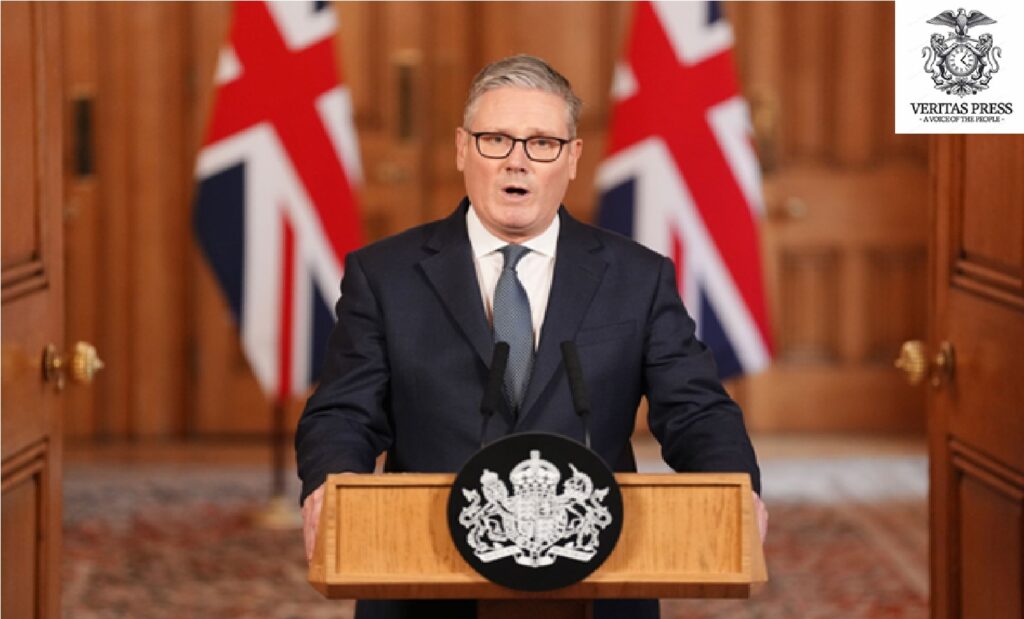
Starmer himself looked shell-shocked as he addressed the cameras on Friday. He reiterated his commitment to “fight against extremes in politics” on both left and right, a formulation that treats the Greens and Reform as equivalent threats. But the numbers tell a different story: Reform took 28.7% of the vote, the Greens 40.7%. The greater threat to Labour, at least in this corner of Manchester, came from the left, not the right.
The Polanski Project: From Environmentalists To Populists.
The Gorton and Denton result is also a personal triumph for Zack Polanski, the Green Party leader, who has repositioned the party with a more populist, left-wing appeal. Under his leadership, the Greens have moved away from being “just” a climate party to focus on cost-of-living pressures, housing, and public services.
“If we see a swing like this at the next general election, there will be a tidal wave of new Green MPs,” Polanski declared. “When I was elected leader of the Greens, I said we were here to replace Labour, and I meant it”.
The party has professionalised its operations, developed a more visible media presence, and learned to target its messaging with precision. The Urdu-language videos, the targeted leaflets, and the cultivation of community networks all reflect a party that no longer relies on the generosity of larger rivals but actively competes for every vote.
Polanski’s position outside the Commons, where he sits in the London Assembly, gives him strategic flexibility. He can delegate parliamentary scrutiny to the party’s four (now five) MPs while maintaining a broader media presence focused on the government’s performance. It is a division of labour that has served the SNP well and now appears to be working for the Greens.
Reform’s Mixed Night: Doubling Support But Falling Short.
For Reform UK, the result defies easy characterisation. Matt Goodwin more than doubled the party’s vote share to 28.7%, a performance that would have been celebrated as a breakthrough in almost any other context. In second place, Reform can credibly claim to have established itself as the main challenger on the right, with the Conservatives reduced to an embarrassing fourth.
But Reform had hoped to win. And in losing to the Greens, the party handed Labour a political gift: proof that voting Green can keep Reform out. “People everywhere will now know that voting Green is the way to defeat Reform,” Polanski said.
Farage’s response was to attack the integrity of the result itself, a strategy that echoes Donald Trump’s approach to electoral defeat and carries similar risks. By suggesting the election was stolen through “sectarian voting and cheating,” Farage risks alienating the very voters he needs to attract: those who want their votes to count in a fair system.
Reform chair David Bull was more restrained, insisting the party was not challenging the result’s legitimacy. But the damage was done. For a party that campaigns on restoring democratic accountability, appearing to reject democratic outcomes when they don’t go your way is a dangerous inconsistency.
The Conservatives: Erased.
If Labour’s defeat was humiliating, the Conservative performance was existential. With 1.9% of the vote, just 547 votes more than the Official Monster Raving Loony Party’s candidate, Sir Oink A-Lot—the party that governed the country until 2024 has been reduced to an electoral irrelevance in large swathes of the country.
The Conservative spokesperson’s claim that Starmer has “killed the Labour Party” rang hollow from a party that has lost its deposit in two consecutive by-elections. Kemi Badenoch’s attempt to blame Labour for creating the “monster” of the Muslim community voting looked less like political analysis than a desperate thrashing.
The Historical Context: Breaking A Century Of Labour Dominance.
The Irish News provided essential context for understanding the scale of the upset. The Gorton area of Manchester had returned Labour MPs continuously since 1935. Its roll call of representatives includes William Wedgwood Benn, father of Tony Benn and grandfather of current Northern Ireland Secretary Hilary Benn, and Sir Gerald Kaufman, who held the seat for 34 years until his death in 2017.
The new constituency of Gorton and Denton, created in 2024, had been won by Labour with a majority of 13,413, just outside the party’s top 50 biggest wins in that election. Its loss now ranks as the sixth-largest Labour majority overturned at a by-election since the Second World War.
The only larger Labour majorities to fall include Runcorn and Helsby, which Reform took in 2024, and Ashfield in 1977, which fell to the Conservatives during the depths of Jim Callaghan’s winter of discontent. History suggests governments lose by-elections. But they do not typically lose them to parties that barely registered in the same seats eighteen months earlier.
What It Means: The End Of The Two-Party System?
The most significant implication of Gorton and Denton is the confirmation that British politics has fundamentally realigned. The two-party system that has structured electoral competition for a century is giving way to a multi-party contest in which both Labour and the Conservatives face existential threats from insurgent rivals.
On the right, Reform is systematically dismantling the Conservative vote. On the left, the Greens are doing the same to Labour. The difference, and it is a crucial one, is that Reform and the Greens are not merely splitting votes; they are actively replacing the established parties as the primary vehicles for their respective constituencies.
Henry Zeffman, the BBC’s chief political correspondent, captured the dynamic: “Labour politicians have over the past year or so become comfortable with the idea that Reform UK could usurp the Conservatives as the main force on the right of British politics. Now they are confronted with the niggling possibility that something similar could be happening on their side of the political spectrum too”.
Ben Lowry, writing in the Belfast News Letter, offered a sobering assessment from a unionist perspective: “The main conclusion that I have deduced from it is how divided the United Kingdom is now.” He noted that the combined left-wing vote in Gorton and Denton (24,344) easily surpassed the combined right-wing vote (11,284), even with significant voter movement between blocs. “The left-wing vote easily prevailed,” he concluded.
But Lowry’s deeper point was about the unrepresentative nature of the electoral system itself. The first-past-the-post system, which progressives defended in the 2011 AV referendum, is now producing grotesquely distorted outcomes. In 2024, the Greens and Reform together received six million votes but just nine MPs. “Such unrepresentative outcomes are increasing the bitterness,” Lowry warned, “and making it ever more likely that we lurch left, then right, etc for the foreseeable future”.
The Path Forward: Starmer’s Nightmare.
For Keir Starmer, the political mathematics are brutal. Labour now faces organised competition on two fronts: Reform to the right, the Greens to the left. The strategy of squeezing Reform by adopting its language on immigration and culture wars has not only failed to win back defectors, but it has also alienated the progressive voters Labour needs to hold seats like Gorton and Denton.
“The squeeze that broke the Conservatives at the last general election, Reform to the right and Labour/the Lib Dems to the left, now threatens to sink Labour too,” one analysis noted.
The immediate question is whether Starmer can survive until the next general election. One Labour MP told the BBC simply: “Time to go”. Another said Starmer’s departure was now “inevitable,” though the timing remained uncertain.
Even those who stop short of demanding resignation acknowledge the scale of the crisis. The Weekend reported that Angela Rayner “leads new threat” to the prime minister, with MPs warning “it’s terminal”. The Daily Telegraph noted that Shabana Mahmood will urge the government to press ahead with migration crackdowns despite the result, a signal that the leadership intends to double down rather than pivot.
But doubling down carries its own risks. If Labour continues to alienate progressive voters while failing to win back Reform defectors, it risks being squeezed into irrelevance. The French experience offers a cautionary tale: when progressives are asked to compromise in the centre for fear of something worse, many simply abstain or turn to alternatives. In Gorton and Denton, they turned to the Greens.
Conclusion: The Hope And The Warning.
Hannah Spencer ended her victory speech with a message to Layla, a young girl she had met during the campaign. “I promised you I would try to improve the world you are growing up in. I told you I am not perfect, but that I always try my best. I always try and do the right thing”.
It was a moment of genuine human connection in a political culture increasingly defined by cynicism and division. Spencer’s appeal, to common ground, to mutual respect, to the idea that communities can heal rather than fracture, offered something Labour has conspicuously failed to provide.
But her victory also carries a warning. The coalition that elected her is fragile, held together by shared opposition to Reform and shared disappointment in Labour. Whether it can survive the transition from protest to governance, from opposition to responsibility, remains to be tested.
For Labour, the lesson of Gorton and Denton is brutal but clear: voters who feel taken for granted will eventually find somewhere else to go. The party that took Muslim voters for granted, that took working-class voters for granted, that took progressive voters for granted, has discovered that loyalty is not infinite. It can be earned, and it can be lost.
The question now is whether Keir Starmer’s Labour can learn that lesson before more seats fall. The next test comes in May, when local elections across the country will reveal whether Gorton and Denton was an aberration or the shape of things to come. If it were the latter, the political earthquake felt in Manchester on February 27th would be merely the first tremor of a much larger upheaval.
As Spencer herself put it: “Something exciting is happening, and I invite you to be part of it. Come and join the Green Party so we can spread hope and win everywhere else across the country too”.
For Labour, that is not a threat. It is a challenge. Whether the party can meet it will determine not just its own fate, but the shape of British politics for a generation.
Submission:
For The Secure Submission Of Documentation, Testimonies, Or Exclusive Investigative Reports From Any Global Location, Please Utilise The Following Contact Details For Our Investigations Desk: enquiries@veritaspress.co.uk or editor@veritaspress.co.uk
Help Support Our Work:
Popular Information is powered by readers who believe that truth still matters. When just a few more people step up to support this work, it means more lies exposed, more corruption uncovered, and more accountability where it’s long overdue.
If you believe journalism should serve the public, not the powerful, and you’re in a position to help, becoming a DONATOR or a PAID SUBSCRIBER truly makes a difference.
DONATION APPEAL: If You Found This Reporting Valuable, Please Consider Supporting Independent Journalism.
Help Support Our Work – We Know, We Know, We Know …
Seeing these messages is annoying. We know that. (Imagine what it’s like writing them … )
Your support fuels our fearless, truth-driven journalism. In unity, we endeavour to amplify marginalised voices and champion justice, irrespective of geographical location.
But it’s also extremely important. One of Veritas Press’s greatest assets is its reader-funded model.
1. Reader funding means we can cover what we like. We’re not beholden to the political whims of a billionaire owner. We are a small, independent and impartial organisation. No one can tell us what not to say or what not to report.
2. Reader funding means we don’t have to chase clicks and traffic. We’re not desperately seeking your attention for its own sake: we pursue the stories that our editorial team deems important and believe are worthy of your time.
3. Reader Funding: enables us to keep our website and other social media channels open, allowing as many people as possible to access quality journalism from around the world, particularly those in places where the free press is under threat.
We know not everyone can afford to pay for news, but if you’ve been meaning to support us, now’s the time.
Your donation goes a long way. It helps us:
- Keep the lights on and sustain our day-to-day operations
- Hire new, talented independent reporters
- Launch real-time live debates, community-focused shows, and on-the-ground reporting
- Cover the issues that matter most to our communities, in real time, with depth and integrity
We have plans to expand our work, but we can’t do it without your support. Every contribution, no matter the size, helps us stay independent and build a truly people-powered media platform.
If you believe in journalism that informs, empowers, and reflects the communities we serve, please donate today.
In the early hours of Saturday morning, the Middle East lurched into a new and

MINAB, IRAN — In the quiet coastal town of Minab, along the strategic Strait of
GORTON AND DENTON, UK – At 4:30 am on February 27th, 2026, Hannah Spencer stood

IRAN/US/ISRAEL – In the early hours of February 28, 2026, residents of Tehran awoke to

ISLAMABAD/KABUL – The thunder of Pakistani warplanes over the capitals of two nations at dawn
A Muslim community centre adjacent to a mosque in Worcester was firebombed in the early

GAZA CITY — In the predawn stillness of the 27th day of Ramadan, the sound

JERUSALEM / WASHINGTON — The skies over the Middle East have become a barometer of

US/IRAN – In a significant escalation of American military posture in the Middle East, the
ISLAMABAD, PAKISTAN – The political temperature in Pakistan, already simmering after years of instability, has