

Original Article Date Published:
Article Date Modified:
Help support our mission, donate today and be the change. Every contribution goes directly toward driving real impact for the cause we believe in.
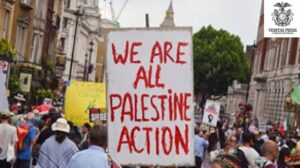
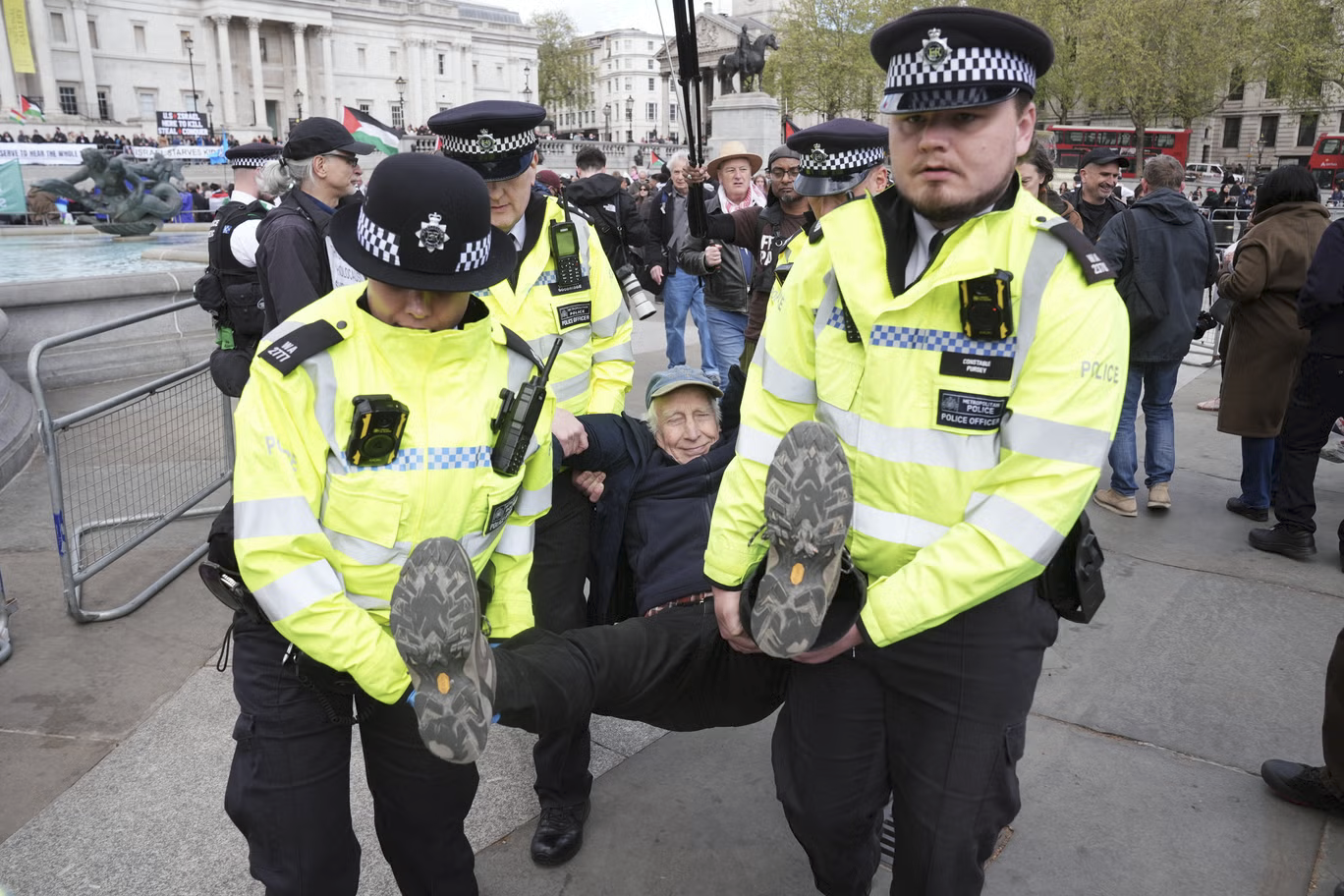
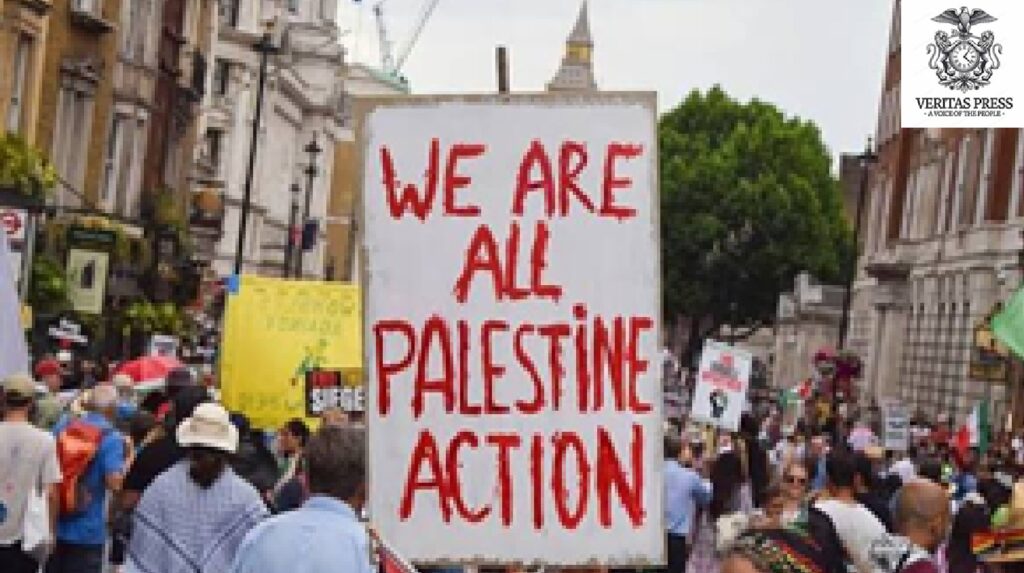
LONDON, UK – This wasn’t just another protest. On a Saturday afternoon in London’s Trafalgar Square, a silent vigil of over 500 people, ranging from an 87-year-old to a musician from Massive Attack, was systematically dismantled by a massive police operation. Their crime? Holding up a piece of card. The arrests, for showing support for the proscribed group Palestine Action, have exposed a deep and escalating crisis at the heart of British democracy, laying bare the government’s determination to use anti-terror laws to crush legitimate dissent, all in defiance of the High Court.
The Legal Labyrinth: From Ban To Mass Arrests
The scene on April 11, 2026, was the culmination of a legal and political firestorm. Organised by the group Defend Our Juries, the “Everyone Day” protest was a direct challenge to the government’s decision in July 2025 to proscribe Palestine Action under the Terrorism Act 2000.
- The Government’s Case: The ban was implemented after members of the group caused £7 million in damage by entering an RAF base and spray-painting aircraft. Home Secretary Shabana Mahmood defended it as the result of a “rigorous and evidence-based decision-making process,” putting Palestine Action in the same legal category as groups like ISIS and al-Qaeda.
- The High Court’s Rebuke: This decision was dealt a significant blow in February 2026, when the High Court ruled the proscription was “disproportionate and unlawful”. The court found that while Palestine Action engaged in criminality, its activities had not reached the level, scale, or persistence to warrant being defined as terrorism.
Crucially, the government appealed the ruling and, despite the High Court’s finding, the ban remains in effect pending that appeal, which is scheduled for April 28-29, 2026. This legal limbo is the powder keg that ignited the events of April 11.
A “Troubling Disregard For The Rule Of Law”: Policing In A Legal Vacuum
The Metropolitan Police’s response has been a case study in confusion and perceived overreach, with a dramatic policy U-turn that critics have described as authoritarian. Following the High Court ruling, the Met sensibly announced it would pause arrests under the Terrorism Act for expressing support for Palestine Action, stating it would instead gather evidence for potential future prosecutions.
However, in a move that has stunned legal observers and activists alike, the Met reversed this position in late March, announcing it would resume arrests. This reversal, which occurred while the High Court’s ruling was still the law of the land, set the stage for the mass arrests in Trafalgar Square.
The numbers are staggering:
- 523 people were arrested on April 11 alone, with ages ranging from 18 to 87.
- This brings the total number of arrests for supporting Palestine Action since the ban to nearly 3,000.
- Many are repeat offenders, including a woman who told the BBC she had been arrested 10 times before for the same act.
The optics were deliberately dramatic, with police carrying away elderly protesters on crutches and even a disabled, blind man. “This is not policing, this is the state criminalising dissent,” Amnesty International UK declared in a searing condemnation. The organisation accused the Met of returning to a “failed policy, mass arrests of people holding pieces of card”.
Voices From The Square: Defiance In The Face Of Arrest
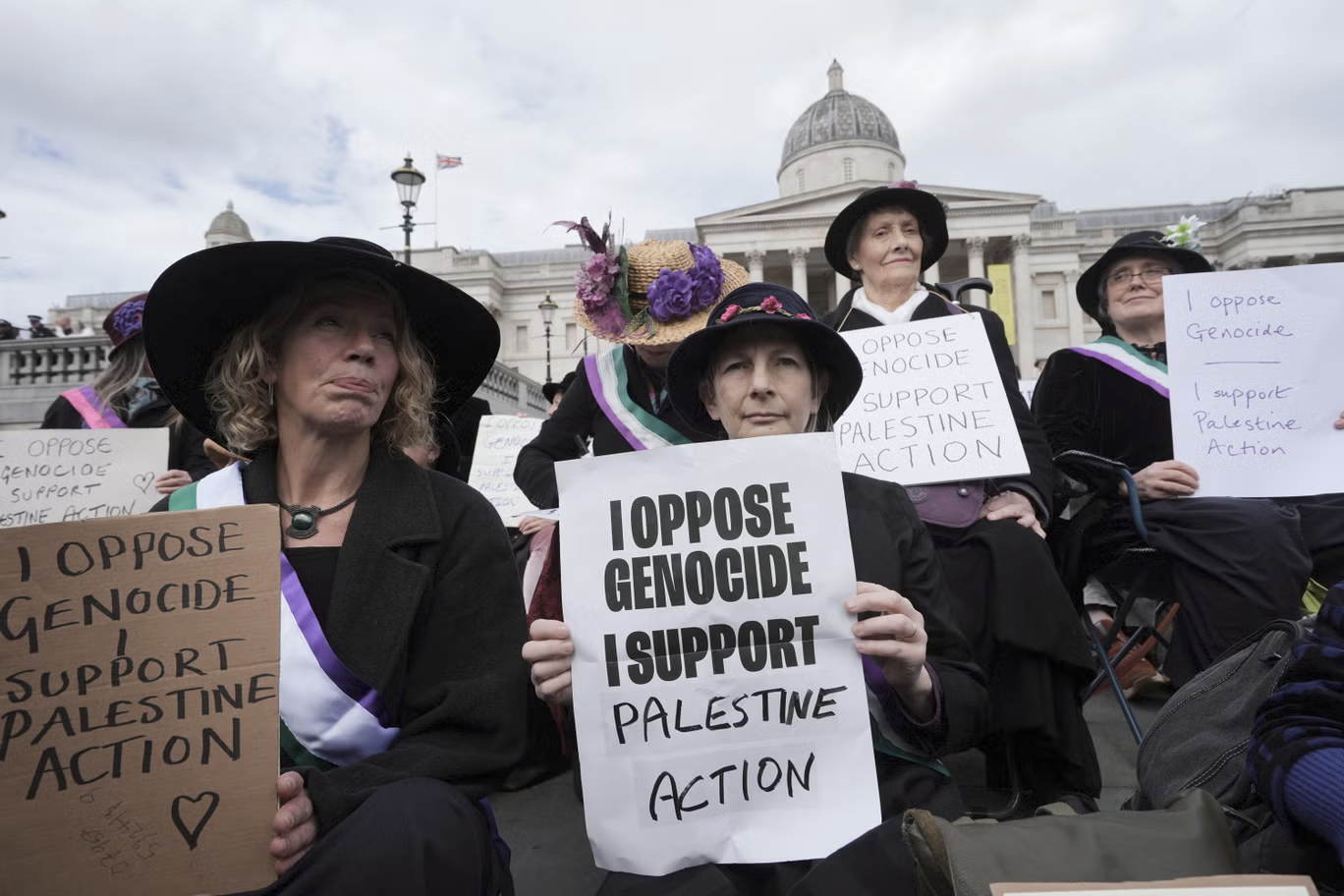
The protest was a sea of peaceful defiance. Hundreds sat on camping chairs and on the ground, holding identical signs that read: “I oppose genocide. I support Palestine Action”. Among the most prominent voices was Robert Del Naja, the musician from Massive Attack. Before his arrest, he told the Press Association that he had weighed the potential damage to his career but felt compelled to act: “I think that the actions of Palestine Action were highly patriotic, because they were pretty much protecting our country from getting involved in serious war crimes, and breaking international law. How much more patriotic can you be than that?”
Others echoed the sentiment that the moral imperative superseded the legal threat. “It’s important that we all continue to oppose genocide … The government might flip-flop in their legal argument, but the morals of these people (here) do not change,” said Freya, a 28-year-old environmental manager. For Denis MacDermot, 73, who had been arrested before, there was no hesitation: “I’m a supporter of these great people”.
The Unspoken Context: UK Complicity And Elbit Systems
To understand the government’s fixation on silencing Palestine Action, one must look at what the group actually does. Unlike the broad, symbolic marches that have become common in London, Palestine Action is a direct-action group founded in 2020. Its primary target is the Israeli defence giant Elbit Systems, which has numerous factories across the UK.
These facilities produce components for weapons, including Hermes drones, which human rights groups say have been used in Gaza. As Le Monde diplomatique notes, these drones are “trialled against Palestinians, then marketed to the rest of the world as ‘combat-proven’”. The group’s tactics include occupying factory roofs, smashing windows, and using “lawful excuse” defences in court, arguing their actions prevent the greater crime of genocide.
The UK government’s own relationship with Israel’s arms trade is deeply conflicted. While it suspended 30 out of 350 arms export licences in September 2024, citing a “clear risk” of violations of international law, it maintained the “F-35 carve-out” that allows components for the warplanes to continue flowing. This selective approach, critics argue, is precisely what fuels the moral outrage of groups like Palestine Action and their supporters.
The Campaign For Justice: Hunger Strikes And Jury Rights
The mass arrests have not occurred in a vacuum; they are the latest act in a broader, more desperate struggle. Former Palestine Action-affiliated prisoners have engaged in gruelling hunger strikes. Kamran Ahmed starved for over 60 days, and Qesser Zuhrah for 48, to protest their detention conditions and the proscription.
At the heart of the campaign is Defend Our Juries (DOJ), a group that argues the ban is part of a wider assault on the justice system itself. DOJ has written to the Met Commissioner warning of the legal repercussions of the arrests. Their spokesperson described the situation as “truly surreal,” stating, “An already absurdly authoritarian measure has now descended even further into farce ahead of the Court of Appeal hearing this month”. The group’s broader aim is to highlight what they see as a fundamental hypocrisy: “It is clear that the Metropolitan Police has adopted a policy of a) refusing to investigate crimes under the ICCA relating to the acts of the government of Israel; and b) suppressing public expression of opposition to such crimes”.
Looking Ahead: A Nation At A Crossroads
As the dust settles on Trafalgar Square, the 523 arrested individuals face an uncertain future. While a judge has put all related trials on hold pending the outcome of the appeal, the government’s determination to press ahead is clear. Home Secretary Mahmood has stated her intention to “fight this judgment in the Court of Appeal”.
The April 28-29 hearing will be more than a legal debate; it will be a defining moment for civil liberties in the UK. The outcome will determine whether the state can continue to use the most draconian laws on its books to silence a group whose primary aim is to halt the export of weapons used in a conflict where over 71,000 people have been killed, according to Palestinian health officials.
The questions raised are profound and uncomfortable. What does it say about a democracy that arrests a pensioner for holding a sign? What does it say about a government that prioritises the suppression of protest over the investigation of potential war crimes? In Trafalgar Square, the police may have cleared the square, but the movement they sought to quash has only grown. The silent defiance of 523 individuals has spoken louder than any siren or baton charge. The British public, and the world, are watching.
Source: Multiple News Agencies
Submissions:
For The Secure Submission Of Documentation, Testimonies, Or Exclusive Investigative Reports From Any Global Location, Please Utilise The Following Contact Details For Our Investigations Desk: enquiries@veritaspress.co.uk or editor@veritaspress.co.uk
Help Support Our Work:
Popular Information is powered by readers who believe that truth still matters. When just a few more people step up to support this work, it means more lies exposed, more corruption uncovered, and more accountability where it’s long overdue.
Help Protect Independent Journalism, Which Is Currently Under Attack.
If you believe journalism should serve the public, not the powerful, and you’re in a position to help, becoming a DONATOR or a PAID SUBSCRIBER truly makes a difference.
DONATION APPEAL: If You Found This Reporting Valuable, Please Consider Supporting Independent Journalism.
Help Support Our Work – We Know, We Know, We Know …
Seeing these messages is annoying. We know that. (Imagine what it’s like writing them … )
Your support fuels our fearless, truth-driven journalism. In unity, we endeavour to amplify marginalised voices and champion justice, irrespective of geographical location.
But it’s also extremely important. One of Veritas Press’s greatest assets is its reader-funded model.
1. Reader funding means we can cover what we like. We’re not beholden to the political whims of a billionaire owner. We are a small, independent and impartial organisation. No one can tell us what not to say or what not to report.
2. Reader funding means we don’t have to chase clicks and traffic. We’re not desperately seeking your attention for its own sake: we pursue the stories that our editorial team deems important and believe are worthy of your time.
3. Reader Funding: enables us to keep our website and other social media channels open, allowing as many people as possible to access quality journalism from around the world, particularly those in places where the free press is under threat.
We know not everyone can afford to pay for news, but if you’ve been meaning to support us, now’s the time.
Your donation goes a long way. It helps us:
- Keep the lights on and sustain our day-to-day operations
- Hire new, talented independent reporters
- Launch real-time live debates, community-focused shows, and on-the-ground reporting
- Cover the issues that matter most to our communities, in real time, with depth and integrity
We have plans to expand our work, but we can’t do it without your support. Every contribution, no matter the size, helps us stay independent and build a truly people-powered media platform.
If you believe in journalism that informs, empowers, and reflects the communities we serve, please donate today.
LONDON, UK – This wasn’t just another protest. On a Saturday afternoon in London’s Trafalgar
GAZA – The fragile ceasefire in Gaza was never a return to normalcy, but for

ISTANBUL — In a dramatic escalation of legal and political pressure against Israeli leadership, the
ISLAMABAD, TEHRAN, WASHINGTON – For 21 hours, the world watched Islamabad. Delegations from Washington and

GAZA CITY / GENEVA – The ceasefire was supposed to mark the beginning of the
EAST JERUSALEM — On a crisp April morning in the Ras al-Amud neighbourhood of Silwan,
BEIRUT/TEL AVIV — A humanitarian catastrophe is unfolding in Lebanon as Israeli military operations intensify,

US, NASA – On Friday, April 10, 2026, at precisely 5:07 p.m. PDT (0007 GMT
A fragile ceasefire intended to pause a 40-day war and reopen the world’s most critical
ISLAMABAD / BEIRUT — As dawn breaks over a locked-down Islamabad on Friday, the world’s