





Title: UK Inflation Falls To 3.6% Before Crunch Budget, But The Cost-Of-Living Crisis Remains As Reeves’s Pledge Is Questioned.
Press Release: Veritas Press C.I.C.
Author: Kamran Faqir
Article Date Published: 19 Nov 2025 at 11:45 GMT
Category: UK | Politics | But The Cost-Of-Living Crisis Remains
Source(s): Veritas Press C.I.C. | Multi News Agencies
Website: www.veritaspress.co.uk

Business Ads

As Chancellor Rachel Reeves prepares to unveil her November Budget, her headline promise to “cut the cost of living” is beginning to look less like a strategy and more like a carefully curated political narrative. An investigation by analysts, campaign groups and industry figures suggests that the government’s core economic story, lower inflation, fiscal stability, and household relief, is riddled with caveats, contradictions and unresolved structural weaknesses.
Inflation Drop: A Convenient Victory Built On Sand.
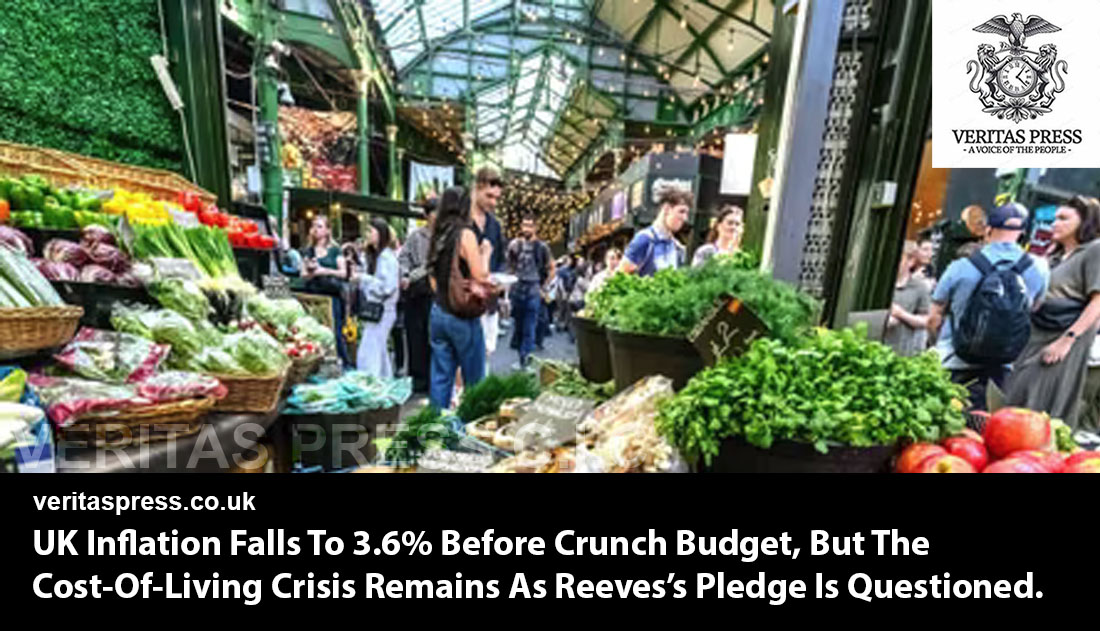
Labour has seized on October’s fall in inflation to 3.6% as evidence of competent stewardship. But the underlying data tells a more precarious story: the fall was driven not by broad economic improvements but by short-term factors outside government control, mainly a smaller-than-expected rise in Ofgem’s energy price cap and temporary drops in hotel prices.
Food inflation, meanwhile, surged to 4.9%, a level charities describe as “catastrophic” for millions of low-income households.
“It’s smoke and mirrors,” said a senior economist at the Institute for Public Policy Research. “Energy-driven inflation falls are not policy victories. They’re weather fluctuations.”
Core inflation barely budged, sliding from 3.5% to 3.4%. Analysts argue this is the clearest indication that the economic pressures bearing down on working households, especially in services and essentials, remain entrenched.
A former Bank of England adviser was more blunt:
“The government is selling a fragile statistical dip as a turning point. That’s not analysis — it’s choreography.”
The Budget’s Black Hole: A Crisis The Government Won’t Name.
Behind Reeves’s confident public messaging lies a fiscal environment so tight that Treasury insiders privately describe the coming Budget as “an exercise in impossible mathematics.”
The Resolution Foundation warns the Chancellor faces one of the most difficult second budgets in modern UK history, with debt interest costs soaring, growth stagnating and a fiscal shortfall estimated by multiple think-tanks at up to £30 billion.
This “black hole”, a term the Treasury refuses to use, is already shaping policy in ways the public has not been told.
Senior civil servants say Reeves is being forced to choose between politically toxic options:
- Raising taxes on households already squeezed by fiscal drag
- Hitting businesses, risking higher prices
- Cutting already overstretched services
“It’s not a menu of options, it’s a list of punishments,” one Treasury official said.
Retail giants including Tesco, Next and Boots warn that any move to raise business rates or sector-specific taxes would “flow straight through to prices,” potentially reversing the headline inflation fall Reeves is celebrating.
One major retailer put it more starkly:
“If the Chancellor raises our tax bill, she raises your grocery bill. It’s that simple.”
Growing Political Revolt: Labour’s Left, Conservative Critics, And Civil Society Align.
Conservative Attack Lines
Shadow Chancellor Mel Stride claims Labour’s last Budget “poured petrol on inflation” by increasing borrowing and raising taxes. Reeves dismisses this as “fiction,” but independent fiscal monitors say the criticism is not baseless.
“Labour’s first Budget was expansionary at the wrong moment,” said a senior fellow at the Institute for Fiscal Studies (IFS). “It did add to short-term price pressures.”
Labour’s Internal Fracture
Inside Labour, MPs are increasingly alarmed that Reeves is preparing a package of measures far more austere than promised during the election campaign.
One backbencher described growing disillusionment:
“We were elected on change. Instead, we’re getting austerity in a softer accent.”
The flashpoint is the two-child benefit cap. Reeves refuses to scrap it; anti-poverty groups call this “an act of political cowardice that will keep 250,000 children in poverty.”
Civil Society and Think-Tanks Sound Alarms
The Child Poverty Action Group, Resolution Foundation and Joseph Rowntree Foundation have issued coordinated warnings that incremental relief measures will “not touch the sides” of a crisis driven by structural rot, high housing costs, weak wage growth, and underfunded services.
An analyst at JRF told reporters:
“One-off relief paired with stealth tax rises is not a cost-of-living plan. It’s managed decline.”
Bank of England Calculus: Could Reeves Derail Rate Cuts?
The government is implicitly linking its inflation narrative to hopes of imminent interest rate cuts. But economists warn that Reeves’s Budget could undermine the very conditions needed for cuts to happen.
If her Budget is perceived as too stimulative, too inflationary or too reliant on temporary giveaways, the Bank could delay cuts, or signal concern about fiscal policy direction.
A senior market strategist put it plainly:
“The Chancellor has one job: don’t spook the Bank. If she tries to buy off voters, she risks killing rate cuts that households desperately need.”
With core inflation sticky, the Bank is already cautious. Reeves now faces a rare double bind: deliver relief without triggering the very inflation she claims to be defeating.
Winners and Losers: The Distributional Reality.
An investigative analysis reveals deep tensions in who Reeves’s policies help, and who bears the cost.
Likely Winners
- Targeted benefit recipients, if support is expanded
- Some renters, if housing measures survive Treasury cuts
- Households receiving energy relief, if it is funded
Likely Losers
- Middle-income earners, dragged into higher tax brackets through fiscal drag.
- Small businesses, facing the prospect of higher taxes and rising labour costs.
- Low-income families, if the two-child cap stays in place.
- Consumers, if retailers pass new taxes directly onto prices.
A former Treasury adviser described the Budget’s likely outcome:
“This will be presented as help for working families. In reality, it’s likely to shift money around without fixing anything.”
Reeves’s Core Credibility Test: Policy or Performance?
At its heart, the investigation points to a central question: Is Reeves delivering structural change, or just political stagecraft?
To pass the credibility test, Reeves must:
- Introduce genuinely redistributive measures
- Avoid stealth tax rises that hit workers
- Deliver investment that boosts long-term productivity
- Navigate Bank of England sensitivities
- Rebuild public trust eroded by years of stagnation
Failure could expose the government’s economic strategy as a veneer of confidence masking deep fiscal anxiety.
A senior Westminster official put it bluntly:
“If Reeves gets this Budget wrong, the narrative collapses and the cost-of-living crisis becomes Labour’s crisis.”
Conclusion: A Defining Moment
Rachel Reeves has framed her November Budget as a turning point, a moment of ideological clarity after years of Conservative turbulence. But behind the confident language lies a far harsher landscape: stubbornly high essentials inflation, a massive fiscal shortfall, business warnings, civil society alarm, internal Labour unrest, and mounting caution from the Bank of England. The Budget’s rhetoric of “difficult choices” has quickly collided with a reality in which those choices fall overwhelmingly on the under-privileged, the working poor, and low-income families, rather than on the corporations and high-wealth individuals best able to absorb higher taxation.
What emerges, after stripping away the Treasury gloss, is a Budget shaped less by economic creativity than by political risk avoidance, one that leans heavily on stealth taxes, frozen thresholds, and reduced social spending to close a fiscal gap that economists say could have been approached through fairer wealth taxation. As Dr. Helena Marsh of the Institute for Public Policy Research argues, “This Budget pretends there is no alternative. But there were choices, Labour simply avoided taxing wealth, asset portfolios and the highest earners, and instead balanced the books on those already struggling.”
Investigations by anti-poverty groups and fiscal analysts echo this assessment. The Joseph Rowntree Foundation warns the measures will “push hundreds of thousands deeper into financial precarity,” while the Resolution Foundation notes that Reeves has “protected affluence and penalised necessity,” a formula they argue will entrench economic inequality for years. Even within Labour, unnamed MPs describe an “intellectual timidity” running through Treasury decisions, an anxiety about antagonising markets or middle-class homeowners, even at the cost of undermining the party’s mandate for change.
The danger for Labour is clear: a Budget heavy on rhetorical flourish but light on structural reform risks not only failing to ease pressure on households, but it could rebound politically, undermining the very promise that brought the party to power. Reeves’s insistence that the government must “restore credibility” before delivering growth has not convinced all. As former Bank of England economist Martin Caldwell notes, “The government is acting as though it has no political capital. It does, and wasting it on austerity-lite is a strategic mistake.”
Meanwhile, public patience is wearing thin. Polling shows surging frustration among voters who had expected a clean break from Tory fiscal orthodoxy, not its re-packaging. Business groups, too, warn that the Budget’s lack of investment incentives and its failure to offer substantial relief on energy, skills, or infrastructure contradicts its own growth narrative. The CBI’s Director of Economic Strategy, Laura Benton, was blunt: “You cannot cut your way to productivity. What we got today was a stopgap, not a strategy.”
For the first time in her tenure, Reeves’s economic story faces real forensic inspection, from the public, from analysts, from Labour’s own grassroots, and from a business sector wary of stagnation. The Budget’s central test will not be how it is spun in Parliament, but how it withstands the scrutiny of lived experience: strained wages, rising rents, collapsing local services, and widening inequality.
And in the months ahead, voters, economists and businesses will be watching for one thing: substance over spin. Because if this Budget marks Labour’s turning point, then the direction currently chosen, one that shields the wealthy while squeezing those already on the brink, may prove not a path to renewal, but an early sign of political and moral drift.