



Title: UK Democracy Under Threat: Draconian Protest Laws And A Labour Government’s Alarming Continuity
Press Release: Veritas Press C.I.C.
Author: Kamran Faqir
Article Date Published: 08 Jan 2026 at 10:55 GMT
Category: UK | Politics | UK Democracy Under Threat: Draconian Protest Laws And A Labour Government’s Alarming Continuity
Source(s): Veritas Press C.I.C. | Multi News Agencies
Website: www.veritaspress.co.uk

Business Ads

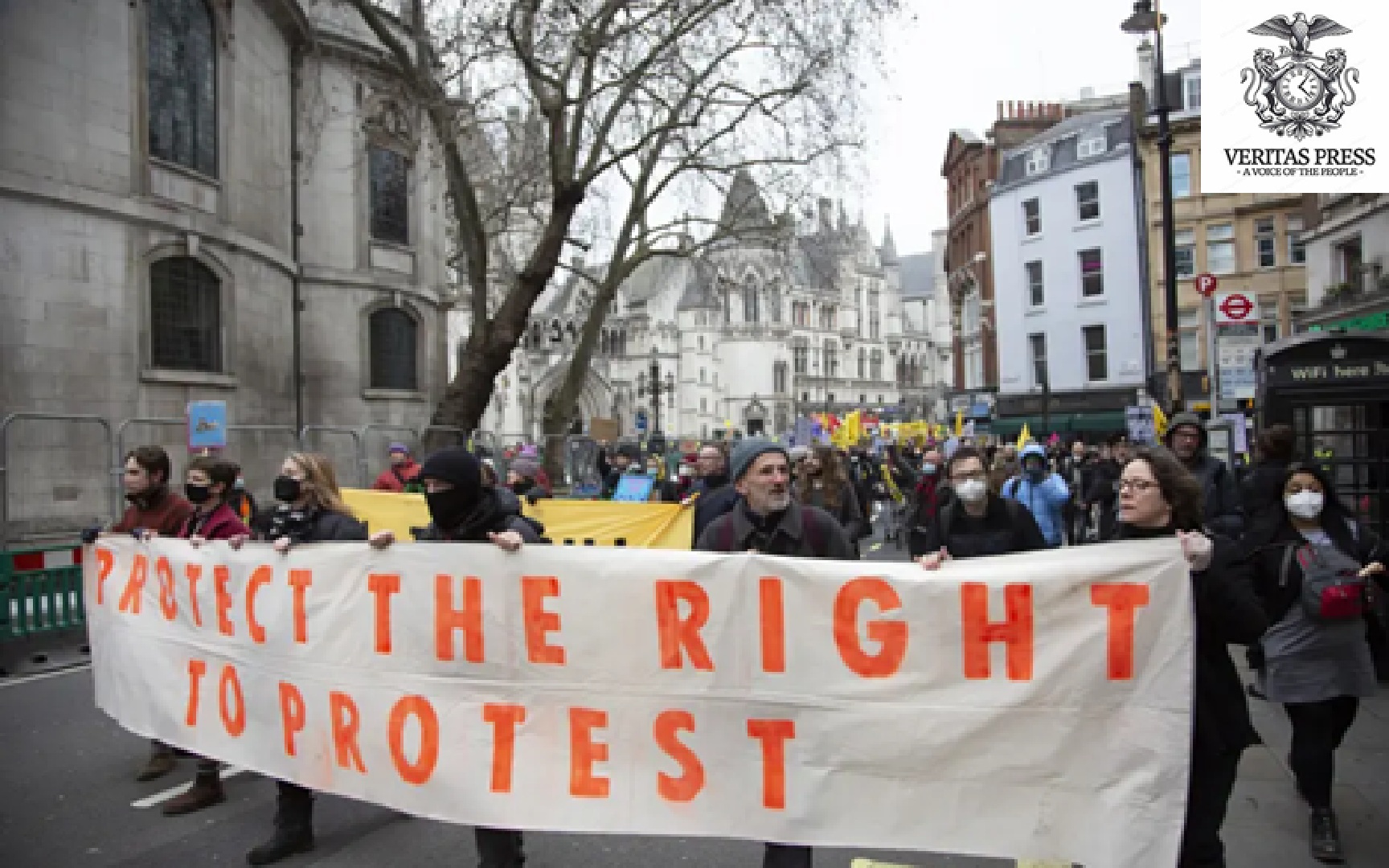
LONDON, January 8, 2026 – The United Kingdom is systematically dismantling the right to peaceful protest, adopting tactics more commonly associated with authoritarian backsliding and creating an environment where dissent is treated as a criminal act. This conclusion is central to a major new report by Human Rights Watch, ‘Silencing the Streets’: The Right to Protest Under Attack in the UK, released today.
The 47-page report details how the Labour government, elected in July 2024 on promises of change, has not only failed to repeal the sweeping anti-protest laws enacted by the previous Conservative administration but is actively seeking to expand them. This policy continuity represents a profound betrayal of democratic principles and the UK’s international human rights obligations.
- The UK government has significantly limited the ability to protest, which violates its international human rights commitments.
- The Labour government, instead of curbing repressive measures against protesters in previous legislation under the Conservative government, is in the process of expanding them.
- The UK government should repeal anti-democratic protest restrictions and review and publicly account for all protest arrests and convictions made under laws that courts have ruled unlawful.
The Legislative Assault On Protest:
The foundation of the crackdown rests on two key pieces of legislation: the Police, Crime, Sentencing and Courts Act 2022 (PCSCA) and the Public Order Act 2023 (POA). These laws:
- Introduced vague, subjective thresholds for police intervention, such as protests causing “serious disruption,” “serious annoyance,” or “serious unease.”
- Created new criminal offences like “locking on” and “being equipped to lock on,” criminalising peaceful civil disobedience tactics.
- Granted police sweeping powers to impose conditions on protests pre-emptively and to conduct “no-suspicion” stop and searches at demonstrations.
- Enabled the use of Serious Disruption Prevention Orders (SDPOs), which could restrict individuals’ rights based on past lawful protest activity, without a conviction.
Despite a landmark Court of Appeal ruling in May 2025 that declared key parts of these laws unlawful, specifically striking down the government’s attempt to lower the threshold for police intervention from “serious” to “more than minor” disruption, the government’s response has been inadequate. While the Crown Prosecution Service discontinued some pending cases, there has been no comprehensive review or remedy for past arrests and convictions made under the unlawful provisions.
Labour’s Alarming Trajectory: Expansion, Not Reversal.
Instead of curbing these excesses, the Labour government has chosen a path of escalation:
- Defending the Indefensible: The government initially pursued an appeal against the High Court’s May 2024 ruling that found the previous Home Secretary, Suella Braverman, acted unlawfully. Although it ultimately accepted the Court of Appeal’s final verdict, this defensive stance signalled a commitment to restrictive powers.
- The Crime and Policing Bill 2025: This pending legislation, debated in the House of Lords in January 2026, seeks to further erode protest rights. Its most concerning provisions include:
- Blanket bans on face coverings at protests would deter participation for legitimate reasons (privacy, health, fear of reprisal) and disproportionately impact marginalised groups or minorities.
- Expanded restrictions on protests near places of worship, a measure criticised as vague and unnecessary given existing public order powers, and one that risks being used to target specific groups, particularly in the context of pro-Palestine demonstrations.
- Powers that could put migrants and asylum seekers at risk of deportation for participating in protests.
- Unprecedented Use of Terrorism Legislation: In a deeply alarming move, the government proscribed the direct action group Palestine Action as a terrorist organisation in July 2025. This decision, criticised by UN experts, dangerously conflates property damage protest with terrorism. Its effect has been immediate and chilling: over 1,600 people have been arrested for peacefully holding signs stating “I oppose genocide, I support Palestine Action” or similar sentiments. This represents a radical weaponisation of counter-terrorism law to suppress political dissent.
The Human Cost: Criminalisation Of Peaceful Dissent.
The report documents a sharp shift towards the harsh criminalisation of non-violent protest:
- Lengthy Prison Sentences: Climate activists from Just Stop Oil have received prison sentences of up to five years for planning protests via Zoom or for peaceful, disruptive actions. While appellate courts have called some sentences “manifestly excessive,” reductions have been marginal, and the chilling effect is profound.
- Arbitrary Arrests: Protesters across causes, from anti-monarchy activists during the Coronation to pro-Palestine marchers and Hong Kong democracy advocates, face confusing, conflicting police instructions and arbitrary arrests, even after extensive prior liaison with authorities.
- Targeting of Legal Observers and Support: The case of retired social worker Trudi Warner, arrested for holding a sign reminding jurors of their rights outside a court, illustrates the state’s overreach. The High Court dismissed the case as “fanciful,” yet the government initially sought to appeal.
- Erosion of Legal Defences: Courts are increasingly ruling that protesters cannot cite their human rights to freedom of expression or assembly, or the necessity of climate action, as defences in trials. This strips away a fundamental legal protection for civil disobedience.
A Democracy Undermined:
“The UK is now adopting protest-control tactics imposed in countries where democratic safeguards are collapsing,” said Lydia Gall, senior Europe and Central Asia researcher at Human Rights Watch. “The Labour government should oppose such measures, not replicate and endorse them. By failing to reverse course, it is seriously undermining a cornerstone of UK democracy.”
The cumulative impact of these laws and policies is a severe chilling effect. Potential protesters, from first-time attendees to seasoned activists, report fear of arrest, punitive bail conditions, surveillance, and life-altering criminal convictions for peaceful actions.
The Path Forward: Recommendations.
Human Rights Watch calls on the UK government to immediately:
- Repeal or substantially amend the protest-related provisions of the PCSCA 2022 and POA 2023.
- Withdraw the draconian clauses in the Crime and Policing Bill 2025 that further restrict protest.
- Conduct a comprehensive, independent review of all arrests and convictions under the provisions ruled unlawful by the courts, providing remedies and accountability.
- Reverse the proscription of Palestine Action as a terrorist organisation and suspend all related prosecutions for peaceful protest.
- Enact a statutory right to protest that clarifies and strengthens the state’s obligation to facilitate and protect peaceful assembly.
“The right to protest is not a gift from the state; it is a fundamental democratic right,” Gall said. “The UK government must choose whether it will protect this right or continue down a path that strips it away, damaging its democracy and its reputation as a guardian of human rights.”