

Title: Trump’s Venezuela Gambit: A Law-Stretching Pressure Campaign That Leaves Data, Motives And Civilians In The Dark.
Press Release: Veritas Press C.I.C.
Author: Kamran Faqir
Article Date Published: 26 Nov 2025 at 11:58 GMT
Category: Americas-Latin America | Politics | Trump’s Venezuela Gambit
Source(s): Veritas Press C.I.C. | Multi News Agencies
Website: www.veritaspress.co.uk

Business Ads

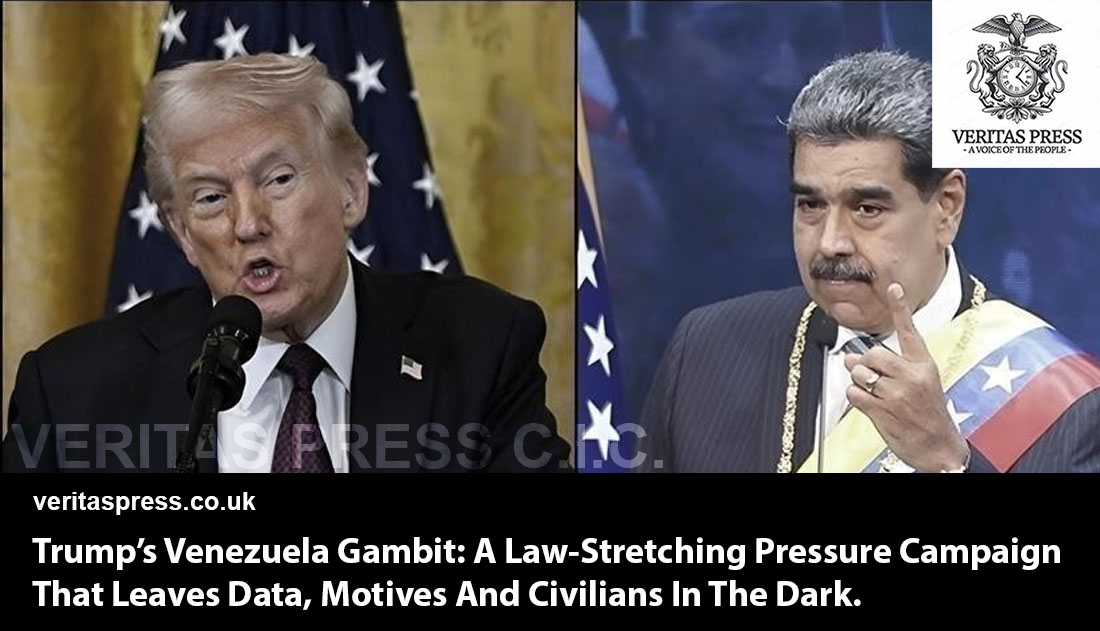
President Donald Trump’s repeated public mix of threats and open-ended diplomacy towards Venezuela, announcing deadly maritime strikes, designating an alleged “Cartel de los Soles” as a Foreign Terrorist Organisation, and publicly signalling he “might talk” to Nicolás Maduro, has created a high-stakes, legally fraught standoff that demands hard, sceptical scrutiny. The administration’s actions have widened the gap between rhetoric and evidence, blurred the boundary between criminal law and the laws of war, and produced mounting calls from legal and human-rights institutions for transparency and accountability.
What Washington Has Done, The Facts That Matter:
• Since early September, the U.S. military has conducted a campaign of airstrikes against small vessels in the Caribbean and eastern Pacific that it says were trafficking narcotics. Open reporting counts at least 21 strikes on about 22 vessels and roughly 80–83 dead (with only a handful of survivors publicly reported). The Pentagon defends the strikes as counter-narcotics operations; critics call them lethal, extra-judicial executions.
• On 24 November 2025, the U.S. placed the Cartel de los Soles on the State Department’s Foreign Terrorist Organisation list, a legal escalation that brings terrorism-related prohibitions and additional sanctions into play. U.S. officials, including Secretary of State Marco Rubio and Defence Secretary Pete Hegseth, have framed the designation as opening new legal and operational options. Caracas rejects the claim, calling it a fabrication and a pretext for intervention.
• The U.S. has also massed forces in the Caribbean, most visibly the aircraft carrier strike group around the USS Gerald R. Ford, F-35 deployments and thousands of personnel, while reportedly preparing a “new phase” of operations, including covert activities authorised by the CIA, according to U.S. sources. Meanwhile, Trump has publicly left the door open to speaking with Maduro.
These are the operational facts. The critical questions are legal justification, evidentiary basis, and political motive.
The Evidentiary Gap: Who Provides Proof, And For What?
The U.S. government asserts the boat strikes targeted “narco-terrorists” and that the Cartel de los Soles is run by Maduro and senior officials. But the public record is thin:
• American officials have not publicly released the underlying intelligence, chain-of-custody evidence, or law-enforcement findings that would establish those boats were active participants in organised drug-trafficking or posed an imminent threat justifying lethal force at sea. Independent reporters and human-rights groups say the evidence made publicly available so far is sparse.
• Investigations by Human Rights Watch and Amnesty International document striking inconsistencies: eyewitness testimony, local reporting, and satellite/imagery timestamps in some instances point to the victims being small-boat fishers or otherwise unarmed civilians, not combatants. Human Rights Watch concluded the strikes “amount to extrajudicial killings.” Amnesty called the strikes “murder” and urged Congress to halt them pending an investigation.
• UN experts and the UN High Commissioner for Human Rights, Volker Türk, have said the strikes “appear to be unlawful killings” and urged an immediate halt and independent investigations, arguing that counter-drug responses belong to law enforcement rather than the battlefield. That analysis is echoed by international legal scholars.
Taken together, the evidence disclosed publicly so far does not meet the standard required to demonstrate that the use of lethal force abroad complied with international human-rights law or the law of armed conflict. That vacuum matters: the government is using lethal force with minimal public oversight or judicial review.
Legal Red Flags: Why Major Legal Experts And Institutions Are Sounding The Alarm:
Legal critique of the campaign falls into three categories:
- Jurisdiction and imminence. The U.S. justification relies on arguments that drug traffickers constitute an extraordinary threat amounting to armed attack or “narco-terrorism.” But eminent international law scholars and former U.S. government lawyers note there is no public evidence these boats posed an imminent lethal threat to the United States sufficient to justify extraterritorial lethal force in international waters. Former law-of-war advisers and UN experts say this is a law-enforcement problem, not an armed conflict that permits summary killing.
- Due process and accountability. The strikes have been executed without criminal indictments, arrests, or transparent prosecutions; families of the dead have received little information. Human Rights Watch and Amnesty say this looks like executive-branch killing without due process, a recipe for impunity.
- Precedent and mission creep. Designating allegedly state-linked criminal networks as FTOs stretches the terrorism regime. Vox and other analysts warn that equating drug networks and corrupt state actors with terrorism could be used to mask extrajudicial or geopolitical objectives, setting a precedent for future interventions.
Pete Hegseth has said the terrorist designation “brings a whole bunch of new options” to the United States; that unspecified language, amplified by a militarised posture offshore, has led international and legal observers to warn of mission creep from counter-narcotics to regime pressure or even direct action inside Venezuela.
Motives under scrutiny: drugs, oil, geopolitics, and the domestic political calendar
A rigorous investigation separates proximate claims (counter-narcotics) from strategic incentives:
• Counter-narcotics logic. The administration frames its actions as stopping trans-Atlantic fentanyl and cocaine flows that kill Americans. Polling in some corners shows public support for aggressive anti-drug measures; yet legal scholars say lethal military options rarely produce measurable, sustained reductions in trafficking without robust regional law-enforcement cooperation.
• Energy and geostrategy. Analysts caution that Venezuela’s vast hydrocarbon reserves make it geopolitically significant. Reuters and other outlets report that some U.S. officials and analysts view access to Venezuela’s oil as a leverage point, a plausible, if politically sensitive, motive for seeking negotiations or pressuring Maduro. That raises a hard question: could oil diplomacy and geostrategic competition with Russia/China be shaping the use of force and the terms of any dialogue?
• Domestic politics and signalling. The administration’s mix of forceful action with a public willingness to talk may aim both to satisfy hawks who want Maduro removed and to leave options open for transactional deals. Trump’s public line, “If we can do things the easy way, that’s fine. And if we have to do it the hard way, that’s fine too”, is a negotiating gambit that simultaneously raises the price of resistance and obscures concrete objectives.
In short, the counter-narcotics rationale is the proximate justification; resource geopolitics and domestic signalling look like plausible drivers of policy design and timing. That mixture is dangerous because it marries a thin evidentiary base to powerful strategic incentives.
International and regional reactions, fractures and diplomatic strain
• United Nations / human-rights bodies: The UN High Commissioner for Human Rights and a group of UN experts have called for investigations and stopped strikes, saying the attacks may amount to extrajudicial killings.
• Human-rights organisations: Human Rights Watch and Amnesty have publicly condemned the strikes as unlawful and called for Congressional action and accountability.
• Allied caution: Several European governments (reported in major outlets) have limited intelligence sharing and urged restraint, a signal that U.S. unilateral action is straining alliances. Regional neighbours worry about spillover, refugee flows and destabilisation.
• Caracas and allies: Maduro’s government has denounced the designation and strikes as “infamous” lies and a pretext for “illegal intervention,” and has sought support from Russia, China and Cuba, emphasising sovereignty and the risk of regional war. Maduro’s televised declarations reframed the threat as a rallying cry at home: “We are invincible,” he told state TV audiences, leveraging the external threat to consolidate support.
This diplomatic fragmentation increases the risk of miscalculation.
Voices On The Ground And Expert Testimony, Who’s Saying What:
• “Based on the very sparse information provided publicly by the U.S. authorities, none of the individuals on the targeted boats appeared to pose an imminent threat to the lives of others…” — Volker Türk, UN High Commissioner for Human Rights.
• “The U.S. is not engaged in an armed conflict with Venezuela… these attacks amount to extrajudicial executions.” — Juanita Goebertus Estrada, Americas director, Human Rights Watch, summing the organisation’s legal assessment.
• “If Trump’s administration wants to address drug addiction, it should fully fund public-health programmes … instead of illegally blowing up boats in Latin America.” — Daphne Eviatar, Amnesty International USA.
• “There is a psychological component to this operation, and it’s starting to lose its credibility… the regime thinks it has weathered the worst of U.S. pressure.” — Geoff Ramsey, Atlantic Council (Venezuela analyst), warning that sabre-rattling without action can weaken leverage.
• “The designation brings a whole bunch of new options to the United States.” — Pete Hegseth, U.S. Secretary of Defence, signalling potential operational expansion.
These voices build a consistent narrative: major legal and human-rights bodies see serious problems; think-tank analysts question the campaign’s strategic coherence; Pentagon rhetoric hints at escalation.
Four Investigative Lines Reporters And Editors Should Pursue Now:
- Demand the evidence. Press the White House, Pentagon and DOJ to release the intelligence, targeting data, and legal memos that justify strikes and the FTO designation, or obtain them via leaks, FOIA, or Congressional oversight. If lethal force is used, the public and victims’ families deserve to see the evidentiary basis. (The Guardian and Reuters have already sought such materials; the DOJ Office of Legal Counsel reportedly produced internal memoranda that depart from public statements, a line worth following up.)
- Track casualties and victims’ stories. Independent verification, on-the-ground interviews with families, local port records, fishermen’s associations, and forensic evidence, is essential to determine whether the dead were traffickers, civilians, or something in between. Humanitarian actors and regional NGOs can be critical sources.
- Map financial and oil links. Investigate whether energy access or sanctions relief is driving back-channel talks. Look for U.S. private sector or third-party intermediaries engaging with PDVSA assets, and follow bond markets (which have, paradoxically, seen speculative interest in Venezuelan paper after escalation).
- Explain legal rationales and the chain of command. Obtain the OLC and Pentagon legal opinions, orders authorising strikes, and communications between the White House, CIA and regional commanders to assess whether executive action bypassed Congress or international legal constraints.
Worst-Case Scenarios And Democratic Risks:
If the administration continues striking without a transparent legal justification, the consequences are severe:
- Regional war risks and refugee flows. An expanded campaign could provoke retaliatory or defensive measures by Caracas or its allies, producing instability across northern South America and the Caribbean.
- Normalisation of extra-judicial tools. Using the terrorism label and military force against alleged state-linked criminal networks risks normalising targeted killing as standard policy for non-combat threats. Experts warn this undermines the rule of law and sows global precedent.
- Domestic legal erosion. Executive action without robust congressional oversight or public evidence risks creating a permanent executive latitude to kill abroad with limited accountability. Human rights groups are already calling for Congressional intervention.
Here Are Three Hypothetical Scenarios Outlining How Events In Washington Could Unfold.
Scenario A: “Escalation to Limited Military Campaign” (Low–Medium probability).
Summary (what happens): U.S. military pressure transitions from maritime strikes and covert action to limited, targeted ground or air strikes inside Venezuela against alleged narco-trafficking infrastructure and regime command nodes. Washington calls actions “limited counter-narco operations”; Caracas treats them as an invasion and mobilises. Fighting is geographically constrained (key ports, airfields, jungle transit hubs) but produces significant civilian casualties and mass displacement.
Typical six-month timeline
• Weeks 0–4: Additional carrier/aircraft and SOF presence; intelligence ops intensify. (Already observed deployments include the Ford carrier group in the Caribbean.)
• Weeks 4–8: Classified “new phase” operations transition to overt strikes on land targets after legal memos reframe infrastructure as legitimate targets under the FTO designation. (Administration has signalled a “new phase” of operations.)
• Months 2–6: Limited ground raids or airstrikes occur; Venezuelan military fights back. Regional tensions spike; refugee flows increase.
Key triggers/indicators
• Public release (or credible leak) of legal memos justifying strikes on land targets.
• Surge in U.S. air sorties and special-operations tempo over Venezuelan border areas.
• Increased missile/air defence activations or mobilisation by Caracas; pronounced allied support (Cuba/Russia) signals.
Actors and moves
• U.S.: Joint Force assets (carrier, F-35s), CIA covert teams, DOJ/Treasury enforcement leveraging FTO tools.
• Venezuela: Armed Forces defensive operations; accelerated appeals to Russia, China, Cuba; mobilisation of pro-government militias.
• Region: Colombia, Brazil, border instability, refugee management; some governments restrict intel sharing.
Consequences
• Humanitarian: civilian deaths, internal displacement and cross-border refugees (Colombia/Caribbean), major humanitarian access issues.
• Legal: heightened allegations of extrajudicial killings and breaches of the UN Charter; calls for independent investigations (UN/HR bodies opposed prior maritime strikes).
• Diplomatic: fracture with European partners; condemnation from left governments in Latin America; Russia/China deepen support to Caracas.
• Economic: oil market volatility, sanctions ripple effects; potential disruption of Venezuelan production and exports.
Investigative + oversight priorities
• Demand release of OLC/Pentagon legal opinions, strike targeting data, and chain-of-command authorisations.
• Collect forensic evidence and survivor/family interviews for any alleged land strike sites.
• Track cargo/insurance/charter records for oil shipments if seizures or re-routing occur.
• Congressional oversight hearings: subpoena the legal memos and after-action reports.
Likelihood & risk assessment: Low–Medium probability but high impact. Politically attractive to hawks; legally and morally risky; greatest danger of regional escalation and prolonged instability.
Scenario B: “Transactional Deal / Negotiated Freeze” (Medium Probability).
Summary (what happens): Behind-the-scenes talks, facilitated by third parties (e.g., Qatar, Turkey, or intermediaries in the Gulf), produce a time-limited arrangement where Venezuela provides constrained economic concessions (oil sales, limited PDVSA access, arrests/extraditions of named traffickers) in exchange for cessation of strikes, partial sanctions relief, and U.S. forbearance on regime-change operations. Trump publicly frames it as “saving lives,” while both sides claim victory.
Typical six-month timeline
• Weeks 0–6: Quiet back-channel contacts begin; intermediaries and energy traders engage. Reuters reporting already identifies oil access as a likely bargaining chip.
• Months 1–3: Triangulated agreements (memoranda of understanding) on limited oil exports to approved buyers, prisoner/extradition arrangements, and observable restrictions on certain military activities.
• Months 3–6: Formal US policy adjustments: targeted sanctions eased, FTO list tools used as leverage to monitor compliance; public diplomacy emphasises de-escalation.
Key triggers/indicators
• High-level envoys or intermediaries privately meeting with Venezuelan and U.S. interlocutors.
• Sudden uptick of PDVSA cargo contracts to neutral or U.S.-friendly refineries; payment or escrow arrangements announced. Reuters
• Public statements from third-party mediators, or conditional “freeze” language from the White House.
Actors and moves
• U.S.: State Department + Treasury architects of sanctions relief packages; White House political office for optics.
• Venezuela: PDVSA concessions; selective cooperation on narcotics investigations or expulsions of named suspects.
• Private sector: oil traders, refineries, and intermediaries execute deals; sanctions-compliance lawyers are active.
Consequences
• Humanitarian: immediate reduction in violent strikes at sea; limited easing of economic pressure may alleviate fuel shortages marginally.
• Legal: FTO designation remains as leverage; some sanctions lifted under strict monitoring. Critics argue deal legitimises Maduro and leaves deeper reforms unaddressed.
• Diplomatic: short-term diplomatic thaw with potential for Russian/Chinese pushback; regional reaction mixed.
• Political: domestic audiences divided, hawks decry appeasement; others claim pragmatic outcome.
Investigative + oversight priorities
• Trace oil sale contracts, escrow arrangements, and intermediaries via shipping manifests, port authorities, and AIS satellite tracking.
• Obtain any quid-pro-quo documentation (e.g., letters detailing arrests/extraditions or PDVSA carve-outs).
• Monitor compliance mechanisms, who verifies arrests, how proceeds are traced, and remedies for breaches.
Likelihood & risk assessment: Medium probability. Offers lower immediate human cost than Scenario A, and is politically plausible given Trump’s public willingness to talk and PDVSA’s continuing value. But it risks legitimising a regime implicated in corruption and may entrench illicit networks if monitoring is weak.
Scenario C: “Prolonged Low-Intensity Campaign / Policy Stalemate” (Most Likely).
Summary (what happens): The U.S. maintains and modestly intensifies maritime strikes, covert action, legal pressure (FTO listing), financial sanctions and diplomatic isolation, but avoids a full ground intervention or a binding negotiated settlement. Caracas survives with tighter internal controls, international backing from geopolitical partners, and continued domestic repression; low-grade instability and humanitarian suffering continue.
Typical six-month timeline
• Weeks 0–12: Maritime strikes continue intermittently; U.S. keeps carrier and air assets in region; State and Treasury deploy sanctions and visa restrictions. UN and rights groups call for investigations but get limited access.
• Months 3–6: Covert operations, some targeted arrests or renditions, and cyber/financial pressure campaigns. No decisive military move; negotiations occur but fail to produce durable results.
Key triggers/indicators
• Continued pattern of vessel strikes and new FTO-related sanctions; absence of clear legal evidence release.
• Repeated public offers to talk without a concrete agenda; ongoing presence of carrier/air groups.
Actors and moves
• U.S.: steady drumbeat of military and legal pressure; covert activities by intelligence services; symbolic diplomacy.
• Venezuela: domestic clampdowns; selective propaganda victories; appeals to allied states and regional forums.
• Global: ambiguous responses, some governments restrict intelligence sharing; others hedge.
Consequences
• Humanitarian: protracted suffering, continued migration, shortages, and fear among civilians.
• Legal: persistent accusations of unlawful strikes; international institutions repeatedly demand accountability but face access and political barriers.
• Diplomatic: long-term erosion of regional trust in U.S. policy; possible long-term opening for Russia/China to consolidate influence.
• Strategic: the U.S. keeps a costly posture without decisive results; narco flows may adapt or shift routes.
Investigative + oversight priorities
• Build a rolling database of strike incidents, victims, dates, locations, and any official claims; corroborate with AIS/satellite imagery.
• Ongoing FOIA/Congressional requests for rules of engagement and legal guidance; monitor intelligence community whistleblower filings.
• Track refugee and humanitarian indicators in neighbouring countries.
Likelihood & risk assessment: Highest probability. Maintains U.S. leverage and political flexibility while avoiding the enormous costs and legal exposure of Scenario A, but it prolongs human suffering and institutional erosion.
Conclusion: An Immediate Test Of U.S. Accountability And International Law.
In the end, the trajectory of U.S. foreign policy under Donald Trump points unmistakably toward a re-entrenchment of extractive imperialism, one sharpened, not softened, by the cascading crises in Gaza, the Middle East, and across Latin America. Officials, advisers, and industry-aligned analysts now speak with striking openness about using geopolitical disorder to reclaim American primacy in global energy and security markets. This posture is not subtle: it is strategic, intentional, and increasingly unrestrained.
Nowhere is this clearer than in Trump’s revived fixation on Venezuela’s vast oil reserves, the largest on Earth. Analysts from the Centre for Economic and Policy Research warn that the administration’s rhetoric mirrors the pre-2019 destabilisation campaign, sanctions, regime-change pressure, and “transition plans” drafted in Washington, not Caracas. A former senior State Department official told The Intercept: “The administration sees Venezuela not as a crisis to resolve, but as a resource bank to be seized once the political climate becomes favourable.”
This dynamic sits uncomfortably alongside Trump’s public framing of U.S. policy as a mission to fight drugs, criminal networks, and terrorism. The administration does have a legitimate security interest in stopping trafficking and protecting citizens. But national security claims cannot substitute for legal and evidentiary transparency. Trump’s current mix of lethal military action, sprawling terrorism designations, and rhetorical openness to back-channel deals with Nicolás Maduro has created a volatile policy cocktail, one that risks civilian lives, erodes legal norms, alienates regional partners, and leaves multilateral institutions scrambling for answers.
Human rights groups, including Amnesty International, WOLA, and REDH-LAC, warn that this approach weaponises counterterror and counternarcotics tools in ways that distort their legal purpose. A UN special rapporteur recently told Le Monde: “When evidence is hidden, oversight is blocked, and the word ‘terrorist’ becomes a policy lever, not a legal designation, you are looking at a system built for abuse.”
Meanwhile, Venezuelan journalists and activists are unequivocal: Trump’s strategic interest in Caracas is not democracy, it is oil. As investigative reporter Patricia Villegas notes, “Every time Washington says ‘democracy,’ Wall Street hears ‘drill.’” Energy economists point out that Trump’s advisers, several of whom have ties to ExxonMobil and Heritage Foundation networks, have openly floated post-Maduro “transition authorities” that would grant preferential extraction rights to U.S. firms. In this context, the administration’s escalatory posture cannot be separated from the commercial ambitions circling Venezuela’s reserves like vultures.
If the U.S. genuinely seeks to “save lives,” the first step is public accountability:
- Release the evidence underlying terrorism and counternarcotics claims.
- Open independent investigations into every lethal strike.
- Restore meaningful congressional and judicial oversight over the legal authorities being invoked.
- And ensure that any diplomatic engagement with the Maduro government is transparent, verifiable, and conditioned on protecting Venezuelans’ rights, not U.S. commercial or geopolitical advantage.
The alternative is a catastrophic precedent in which the label “terrorist” becomes a convenient ‘slap on’ tool for cross-border killing, resource extraction, and geopolitical leverage, a precedent that will outlive any single administration and corrode the global legal order for decades.
Viewed through this lens, Trump’s parallel backing of Israeli military operations in Gaza and his designs on Venezuelan oil are not disparate policies but manifestations of the same doctrine: leverage crisis, secure resources, reward loyal allies, and monetise geopolitical instability. As one senior UN humanitarian official put it: “Every delay in aid, every veto, every drone strike ultimately protects someone’s profit margin.”
What emerges is a sobering conclusion: Washington’s strategic calculus is not guided by human rights, international law, or regional stability. It is driven by extraction, dominance, and opportunity, whether in the starving ruins of Gaza or the sanctions-strangled streets of Caracas. And the communities whose land or resources lie at the centre of this strategy are the ones who will continue to pay the highest price.