
Date Published:
Modified Date:
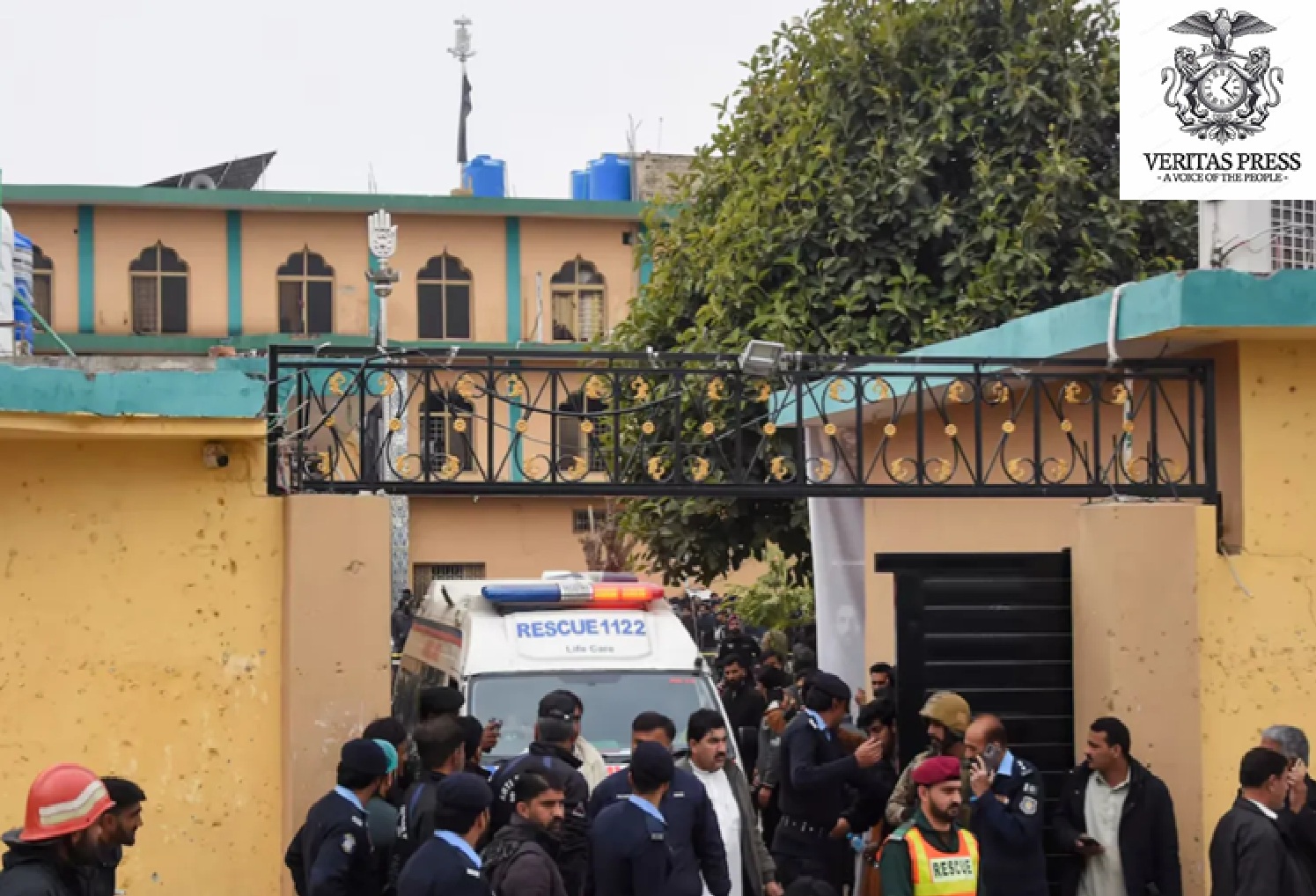
ISLAMABAD, PAKISTAN — A devastating suicide bombing at the Khadija al‑Kubra Imambargah in the Tarlai Kalan area on Friday, 6 February 2026, killed at least 31 worshippers and wounded 169 more during Friday prayers, the deadliest explosion in the capital in over a decade. Security sources fear the toll may rise as dozens of the injured remain in critical condition.
The attack stunned a city long considered insulated from the waves of militant violence that have ravaged Pakistan’s northwestern and southwestern border regions. But as the smoke clears, harrowing witness accounts and political reactions paint a picture not just of tragedy, but of sectarian targeting, security failures, and deep distrust between citizens and the state.
Chaos, Bloodshed And The Moments Before The Blast:
Worshippers inside the crowded mosque described transforming a sudden celebration into horror.
“I was praying just like every Friday,” said Hussain Shah, an eyewitness, “then a thunderous blast, bodies were thrown into the air. I saw people without limbs. I saw children crying for their fathers.”
Local media footage from the scene showed worshippers and bystanders transporting the wounded to hospitals themselves, some carrying blood-soaked men and women on their shoulders. Outside the mosque, more victims lay on prayer rugs in the garden, crying for help.
One young man sobbed as he crossed the courtyard moments after the blast:
“It felt like the earth opened beneath our feet. People were on fire, screaming… the blood was everywhere.” — Local resident near the mosque.
A Suspect Stopped At The Gate, But What Went Wrong?
Police and officials offered conflicting accounts of the bomber’s movements, underscoring glaring security gaps even under heightened alert.
According to police sources, the attacker was stopped at the mosque gate before detonating his explosives, an act that likely prevented even more casualties inside the prayer hall.
But eyewitness accounts differ, with some suggesting an exchange of gunfire before the explosion:
“First we heard shots, then boom,” one congregation member told local broadcaster Geo News, “then bodies were thrown everywhere.”
That difference matters: it suggests not just a suicide attack, but a coordinated assault, exposing potential failures of screening and perimeter security despite multiple checkpoints around the capital because of an ongoing state visit by Uzbekistan’s President.
Sectarian Dimensions And Minority Fear:
No group has immediately claimed responsibility, but suspicion falls on militant organisations historically targeting Shia Muslims in Pakistan, including the Islamic State’s local affiliates and the Tehrik‑e‑Taliban Pakistan (TTP), both of which have repeatedly carried out sectarian attacks in recent years.
For Pakistan’s Shia community, already under threat for decades, the attack was deeply unsettling:
“They came to pray, not to fight,” said Allama Raja Nasir, a senior Shia cleric and opposition leader, “yet we see our sons cut down at places of worship. This is a failure of the state’s primary duty, protection.”
His critique mirrored a broader sentiment among activists and minority rights organisations: that sectarian violence remains inadequately addressed, despite promises of protection from governments.
Government Response: Condemnation, Deflection, And Blame.
Prime Minister Shehbaz Sharif, Interior Minister Mohsin Naqvi, and President Asif Ali Zardari strongly condemned the attack, promising a full investigation and justice:
“No one will be allowed to spread violence and instability in the country,” Sharif said, pledging swift action.
Naqvi called the assault a “heinous crime against humanity” and vowed the best medical care for the victims.
But the government’s political messaging quickly veered into broader strategic narratives: Sharif’s spokesman accused “India’s terrorist proxies” of trying to destabilise Pakistan.
That shift drew sharp criticism from opposition figures and civil society:
“Blaming foreign actors diverts from asking how a bomber reached a crowded mosque during peak security,” said a human rights activist in Islamabad.
“Security policy must be about protecting citizens, not geopolitical blame games.”
Security Failures And Broader Militancy Surge:
Experts stress that this attack is not an isolated incident, but a symptom of rising militancy inside Pakistan’s heartland.
Recent weeks have seen an escalation of violence in both Balochistan and the Khyber Pakhtunkhwa border area, with armed groups exploiting porous borders and weak intelligence. Earlier insurgent attacks in Balochistan alone killed dozens and prompted sweeping military offensives.
Islamabad’s last major bombing was in November 2025, when a suicide bomber killed at least 12 outside a court, challenging the narrative that the capital was safe from such violence.
One senior security analyst said:
“Militants are recalibrating their strategy, striking symbolic targets like religious sites to provoke fear, sectarian retaliation, and delegitimise the state.”
Humanitarian Toll And Community Trauma:
Hospitals declared emergencies, with appeals for blood donations streaming from medical centres overwhelmed by the wounded.
Families of the dead wailed outside PIMS and Polyclinic, grieving relatives piled on stretchers. Children orphaned, families shattered, and a mosque, a sanctuary, turned into a battlefield.
A local teacher who lost his cousin said:
“How do we rebuild faith when people cannot pray without fearing death?”
A Nation At A Crossroads:
This attack throws into sharp relief what many analysts have long warned: Pakistan’s struggle with extremism, sectarianism, and failing protective security architecture has come home, not in distant tribal zones, but in the heart of its capital.
Whether the government will deliver on its promises of accountability and real security reform remains an open question. For now, the memories of the dead lie scattered across bloody prayer rugs, a stark testament to what happens when political priorities fail to match the lived reality of citizens.
Conclusion: Beyond The Blast, Pakistan’s Sectarian Crisis, Civil Discord, And Geopolitical Vulnerability.
The Islamabad Imambargah bombing is not just a tragic act of terrorism; it exposes deep structural failures in Pakistan’s security and governance, and highlights the deliberate strategies of perpetrators seeking to destabilise society along sectarian lines. By targeting a Shia place of worship during Friday prayers, militants aim not only to kill but to incite sectarian violence between Shia and Sunni communities, fueling cycles of retaliation that threaten the country’s social fabric.
Witnesses and survivors describe horrifying scenes of blood and chaos, yet the psychological impact extends far beyond the mosque’s walls. Analysts warn that such attacks are designed to provoke fear, hatred, and mistrust, further fueling civil unrest and extremist sentiments across communities. The perpetrators’ strategy is clear: turn citizens against each other, weaken internal cohesion, and create a climate in which militant ideologies flourish.
By inflaming sectarian tensions, these attacks also provide openings for foreign actors to intervene under the pretext of “protection” or geopolitical interests, deepening divisions not only within Pakistan but across the Muslim world. Civil society leaders and clerics have noted that this form of proxy destabilisation threatens regional unity, undermining efforts to foster solidarity among Muslim-majority nations while allowing extremist narratives to gain traction.
The government response, strong condemnations and promises of justice, is necessary but insufficient. Without systemic reforms in intelligence, border security, urban policing, and minority protection, Pakistan risks repeated attacks that do more than kill: they erode trust in the state, polarise society, and allow violent extremism to seep into everyday life.
“They came to pray, not to fight,” said one cleric. “Yet our mosques have become battlefields, our communities pitted against each other, and our youth are poisoned by hatred. How long before this fear destroys our unity?”
The bombing of Khadija al-Kubra mosque is a tragic symbol of how sectarian targeting, civil unrest, and foreign interference intersect, warning that without decisive and comprehensive action, terrorism will continue to kill not just lives, but the cohesion and moral integrity of the nation itself.
GREEK ISLANDS – A controversial proposal by Israeli politician Avri Steiner to purchase Greek islands
TEHRAN, IRAN – In the early hours of Thursday, the Islamic Revolutionary Guard Corps (IRGC)
LONDON, UK – In the early hours of Monday morning, a quiet street in Golders
SEOUL / TEHRAN — In a packed press conference at the Iranian Embassy in Seoul’s
Pakistan’s imprisoned former prime minister Imran Khan has issued one of his most forceful denunciations
At the Rubaya mining complex in eastern Democratic Republic of Congo, the hillside known as
On the 25th day of a conflict that has already rewritten the geopolitical map of
On the outskirts of Nabatieh, where the Mediterranean breezes once carried the scent of olive
On December 27, 2024, Israeli occupation forces raided Kamal Adwan Hospital in northern Gaza, one

Senior officials within the US military have drawn up contingency plans for a potential ground