
Title: Terror As Governance: Legal Accountability For Psychological Warfare Against Palestinian Children In Hebron.
Press Release: Veritas Press C.I.C.
Author: Kamran Faqir
Article Date Published: 04 Jan 2026 at 12:05 GMT
Category: Middle-East | Palestine-Gaza-West Bank | Terror as Governance: Legal Accountability for Psychological Warfare Against Palestinian Children in Hebron.
Source(s): Veritas Press C.I.C. | Multi News Agencies
Website: www.veritaspress.co.uk

Business Ads

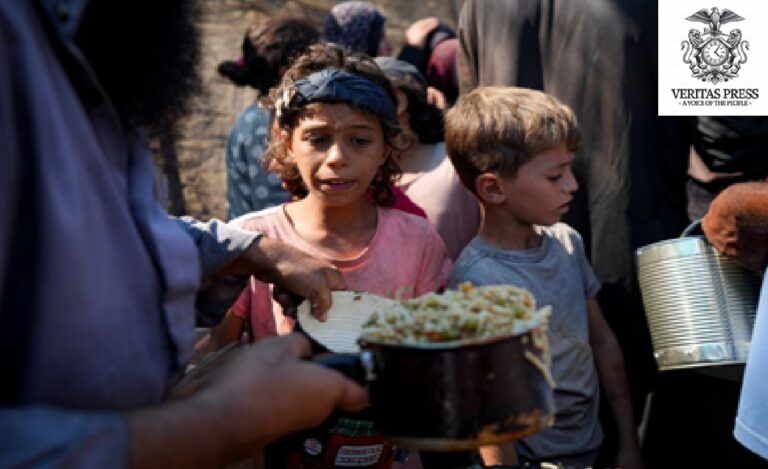
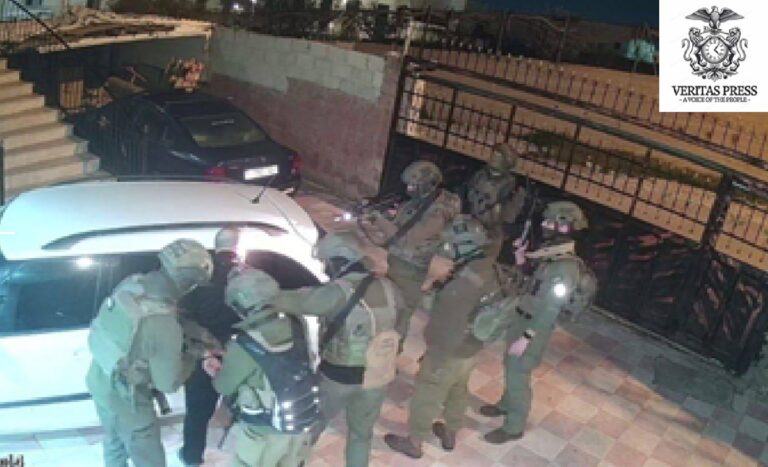
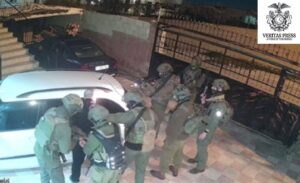
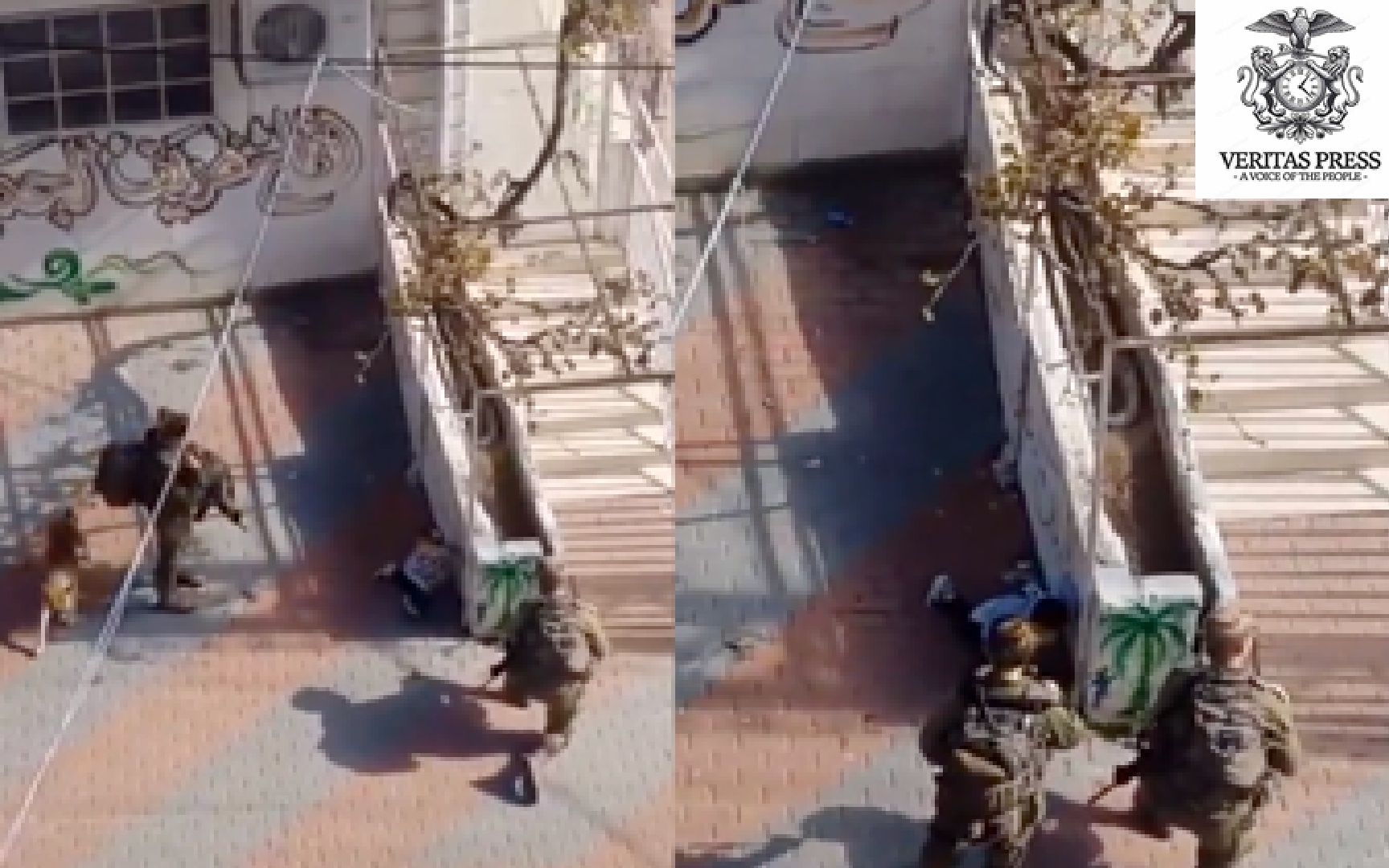
HEBRON, OCCUPIED WEST BANK — When Israeli soldiers held a two-and-a-half-year-old Palestinian child at gunpoint during a curfew in Hebron’s H2 zone, they did more than intimidate a toddler. They crossed a threshold defined clearly in international law: the intentional infliction of severe psychological suffering on a protected civilian child under occupation.
This was not a lapse in judgment. It was an act embedded in a system of control that uses fear as a governing instrument, with children deliberately exposed to intimidation to fracture families, communities, and the very idea of safety.
Psychological Warfare, Not “Security”:
Under military occupation, power is exercised not only through bullets and arrests but through unpredictability, curfews, arbitrary enforcement, and humiliation. The targeting of children is central to this strategy.
By forcing a toddler to stand immobilised against a wall, rifles aimed at his small body, soldiers enacted what psychologists describe as acute terror conditioning, a method by which fear is implanted before rational cognition develops.
This is psychological warfare at the most intimate scale.
UN Special Rapporteur on Torture Nils Melzer has repeatedly stated that “psychological violence can be as destructive as physical torture, particularly when inflicted on children whose sense of safety and trust is still forming.” The objective, Melzer notes, is often not information extraction but domination and deterrence.
In Hebron, the deterrent is not directed at the child; it is directed at the population watching.
Child Trauma As A Tool Of Occupation:
Child psychologists working in the occupied West Bank have long documented how militarised fear rewires childhood development. According to reports cited by UNICEF and Save the Children:
- Children exposed to armed intimidation show elevated cortisol levels, linked to lifelong anxiety disorders
- Early exposure to threat impairs language development, emotional regulation, and memory formation
- Trauma experienced before the age of three can permanently alter neural stress-response systems
Dr. Samah Jabr, a Palestinian psychiatrist and former head of Gaza’s mental health unit, has described Israeli military practices toward children as a form of “developmental sabotage”, stating:
“When a child learns fear before language, the occupation has already entered the body. This is not incidental, it is structural.”
In this context, pointing rifles at a toddler is not excessive force; it is force calibrated to maximum psychological impact.
Legal Framework: Grave Breaches And War Crimes.
Under international humanitarian law, the child in Hebron is a protected person.
Several legal instruments are directly implicated:
1. Fourth Geneva Convention (1949)
- Article 27: Protected persons must be treated humanely at all times
- Article 31: Prohibits coercion, including moral or psychological coercion
- Article 33: Prohibits collective punishment and intimidation
Applying a curfew enforced through armed threat against an entire civilian population, including toddlers, constitutes collective punishment, which is a grave breach of the Convention.
2. Convention Against Torture (CAT)
Psychological torture is defined as:
“Severe mental pain or suffering intentionally inflicted by or with the consent of a public official.”
Holding a child at gunpoint for 15 minutes, long enough to induce panic, exhaustion, and dissociation, meets internationally recognised thresholds for severe mental suffering, particularly given the power imbalance and intentionality involved.
3. Convention on the Rights of the Child (CRC)
Israel is legally bound to:
- Protect children from “all forms of physical or mental violence”
- Provide special protection during armed conflict
- Ensure the best interests of the child are a primary consideration
The conduct in Hebron violates every one of these obligations.
Collective Punishment Disguised As Curfew:
The curfew under which the child was detained was imposed not in response to an imminent threat, but as a routine measure tied to settler movement and military convenience. This is a hallmark of collective punishment, penalising an entire population for administrative or political ends.
UN Office for the Coordination of Humanitarian Affairs (OCHA) has repeatedly warned that Israeli curfews in Hebron’s H2 zone:
- Are imposed arbitrarily
- Lack of individualised security justification
- Disproportionately impacts children, the elderly, and the sick
By enforcing such measures with zero discretion, soldiers demonstrate that the objective is submission and torture, not safety.
A Pattern, Not An Anomaly:
This incident aligns with a broader, well-documented pattern:
- Thousands of Palestinian children have been detained since October 2023
- Armed harassment on school routes
- Night raids are deliberately timed when children are asleep
- Interrogations without guardians present
Former Israeli soldiers, testifying to groups like Breaking the Silence, have described explicit instructions to “make our presence felt”, a euphemism for intimidation meant to “deter unrest.”
In legal terms, this establishes systematic practice, a key criterion for crimes against humanity when acts are committed as part of a widespread or systematic attack against a civilian population.
Accountability And Impunity:
Despite the International Court of Justice’s 2025 advisory opinion declaring Israel’s occupation illegal, no meaningful accountability mechanisms have been enforced. Israeli military investigations, when opened at all, overwhelmingly result in exoneration.
This entrenched impunity enables escalation: when terrorising a toddler carries no consequence, there is no lower boundary left to cross.
Conclusion: When A Toddler Becomes The Evidence.
What happened in Hebron is not shocking because it is unusual.
It is shocking because it is so routine within the architecture of Israel’s occupation.
The toddler in Hebron was not detained because he posed a threat.
He was detained because his fear serves a function.
In the logic of occupation, a frightened child today is a subdued population tomorrow. Psychological warfare begins early, precisely because it lasts longest. The rifle aimed at a two-and-a-half-year-old was not merely a weapon; it was a message. It told parents that they cannot protect their children. It told communities that innocence offers no shield. And it told the child, before he could fully speak, that power in his world is arbitrary, omnipresent, and violent.
This is how domination reproduces itself.
International law is explicit: children are entitled to special protection; psychological torture is prohibited; collective punishment is a grave breach. Yet in Hebron’s H2 zone, these protections collapse under a regime of permanent militarisation, settler privilege, and institutionalised impunity. When a curfew is enforced against a toddler at gunpoint, legality has already been abandoned.
This is not a moral failure alone; it is a legal one, a war crime, and a deliberate violation of the most basic protections afforded to children under international law.
Israeli authorities may attempt to dismiss the footage as an isolated lapse or an operational error. But the evidence tells a different story. The curfews, checkpoints, night raids, harassment of schoolchildren, and mass detention of minors reveal a systematic practice, not an exception. Soldiers did not deviate from policy; they enacted it. Absolute control, zero discretion, total submission, even from a child.
The true crime here is not only the trauma inflicted on one toddler. It is the normalisation of terror as governance. It is the transformation of fear into policy and psychological harm into a routine instrument of rule. And it is the certainty, reinforced daily, that no institution will intervene and no accountability will follow.
Until fear itself is recognised as a weapon, and prosecuted as such, Palestinian childhoods will remain a battlefield.
In Hebron, a toddler was taught the lesson that the occupation depends on most:
That even existence can be a punishable offence.
Under international law, that is not security.
It is a crime.
When fear is systematically inflicted on children to enforce control, how much more evidence is required before psychological warfare is recognised — and prosecuted — as a war crime?