



Title: Storms Turn Gaza’s Ruins Into Death Traps As Floods Kill Displaced Families And Paralyse Hospitals.
Press Release: Veritas Press C.I.C.
Author: Kamran Faqir
Article Date Published: 16 Dec 2025 at 14:30 GMT
Category: Middle-East | Palestine-Gaza-West Bank-OPT | Storms Turn Gaza’s Ruins Into Death Traps As Floods Kill Displaced Families And Paralyse Hospitals.
Source(s): Veritas Press C.I.C. | Multi News Agencies
Website: www.veritaspress.co.uk

Business Ads


GAZA CITY — As torrential winter storms batter the Gaza Strip, the resulting deaths, flooding and mass displacement are being widely described by Palestinians, medics and humanitarian organisations not as a natural disaster, but as the foreseeable outcome of two years of systematic destruction, siege, and deliberate obstruction of humanitarian relief.
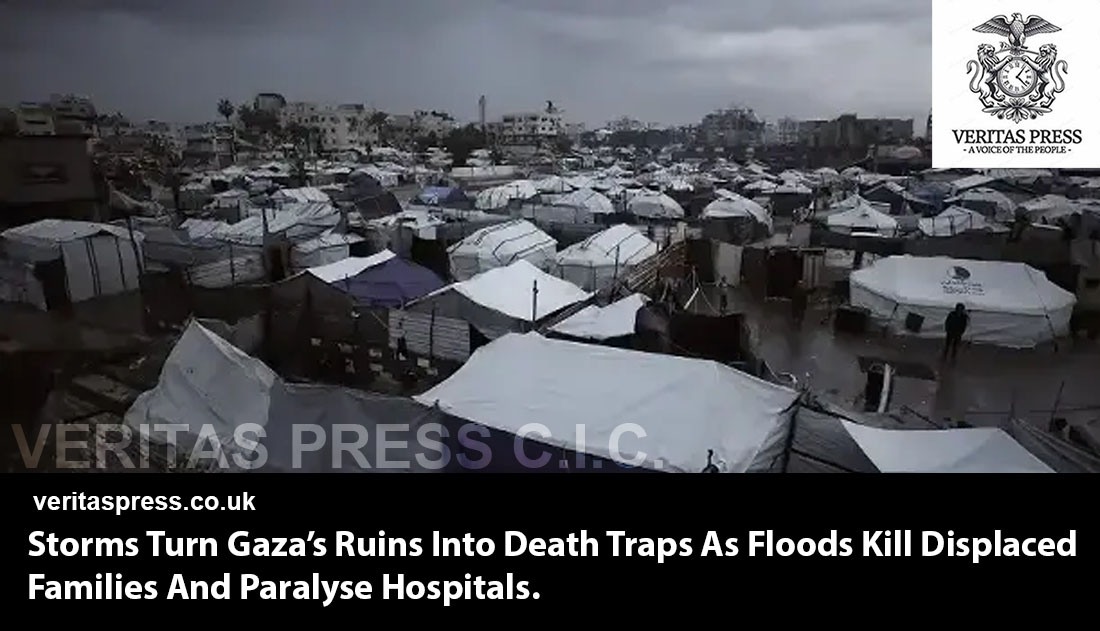
At least 14 Palestinians were killed this week after heavy rainfall caused partially destroyed buildings to collapse and displacement camps to disintegrate across Gaza City, the north and southern Khan Younis. Civil Defence officials say the true toll may rise as rescue teams struggle to reach those trapped under rubble amid flooded streets and fuel shortages.
“This is not just weather,” Gaza-based journalist Hind Khoudary wrote. “This is rain falling on ruins, on homes Israel bombed and never allowed to be rebuilt.”
Hospital Flooded, Health System Pushed To The Brink:
Rainwater poured into Gaza’s largest medical complex, Al-Shifa Hospital, flooding reception areas and the emergency department, forcing staff to improvise care while parts of the facility became unusable. Anadolu Agency correspondents on the ground reported water leaking through damaged ceilings and pooling near patient areas.
Dr. Mohammed Abu Salmiya, director of Al-Shifa Hospital, said the flooding exposed the reality of Gaza’s shattered health system. “Al-Shifa is operating far below minimum safety standards,” he said. “The hospital was bombed, stripped, and partially destroyed. We warned that without reconstruction materials, even rain would become a threat to patients’ lives.”
Despite a ceasefire announced on October 10, Gaza’s Health Ministry says Israel continues to block the entry of critical equipment, generators, spare parts, and construction materials needed to rehabilitate hospitals. Médecins Sans Frontières (MSF) said in a statement that Gaza’s medical facilities are “one storm away from collapse” due to cumulative war damage and siege.
“The flooding of Al-Shifa is a direct result of repeated attacks on civilian infrastructure and the denial of repairs,” MSF noted. “Hospitals cannot function when roofs are broken, drainage systems destroyed, and electricity is unreliable.”
Tents Washed Away, Families Left In The Open:
Across Gaza, tens of thousands of displacement tents were torn apart or swept away by powerful winds and floodwaters. Civil Defence officials say more than 27,000 tents were damaged or destroyed during the latest storm alone.
Khaled Abdel Aziz, a displaced father in Gaza City, described losing everything overnight. “The wind ripped the tent out of the ground,” he told Anadolu. “Our clothes, food, mattresses, everything flew away. I’m sitting in the rain with my children. Where are we supposed to go?”
In Khan Younis, Maha Abu Jazar ran through knee-deep water clutching her three children after their tent was submerged in the Al-Mawasi area. “We escaped the bombs only to drown in the rain,” she said. “There is no safe place left.”
Journalist Yousef Hammash described scenes of desperation as families crowded beneath the remains of bombed buildings. “People are sheltering under collapsed roofs and broken walls,” he wrote. “They know these structures could fall at any moment, but tents no longer exist.”
Collapsing Buildings: Deaths Foretold, Warnings Ignored.
Gaza Civil Defence spokesperson Mahmoud Basal said thousands of partially destroyed homes are now structurally unsound, turning rain into a lethal trigger.
“These houses were bombed, cracked, and left standing without repair,” Basal said. “Rain and wind finish what airstrikes started. We warned repeatedly that people would die this way, but no action was taken.”
At least 13 buildings collapsed during the storm, according to Gaza’s Government Media Office. In Beit Lahia, five people were killed when floodwaters weakened a damaged home. In al-Rimal, west of Gaza City, two displaced Palestinians died when a wall collapsed onto their tent. Another fatality was reported in the al-Shati refugee camp.
Urban planning analyst Rami Nasrallah said Gaza has effectively become “an open-air demolition zone.” “When 92 percent of housing is damaged or destroyed, every storm becomes a mass-casualty event,” he said. “This is the long-term consequence of bombing without reconstruction.”
Children Freeze To Death In ‘Humanitarian Failure’:
Medical sources confirmed at least 14 Palestinians, including multiple children, died from cold exposure and collapsing shelters in the past 24 hours.
Nine-year-old Hadeel Hamdan and infant Taim Khawaja died from a cold in Gaza City. In Khan Younis, eight-month-old Rahaf Abu Jazar died after rainwater soaked her family’s tent overnight.
Paediatrician Dr. Yasser Abu Shahla described the deaths as “entirely preventable.” “Children are dying not from disease, but from exposure,” he said. “This is what happens when families are denied shelter, heating, and basic protection.”
UNICEF warned that winter conditions are pushing children “beyond the limits of survival.” “Cold, damp shelters, malnutrition and lack of medical access create a deadly combination,” the agency said.
Jabalia And The North: Total Destruction, Total Abandonment.
Jabalia Mayor Mazen Al-Najjar said the storm struck communities already living amid complete infrastructural collapse. “More than 90 percent of buildings and streets in northern Gaza are destroyed,” he said. “Sewage overflowed within hours of the rain. There is no drainage, no shelter, no safety.”
He warned residents to evacuate damaged buildings, noting dozens were killed or injured during previous storms. “But evacuate to where?” he asked. “There are no tents, no homes, no safe zones.”
Local activist and aid coordinator Ayman Abu Hashem said international assistance remains “symbolic rather than sufficient.” “Municipalities and volunteers are overwhelmed,” he said. “What is needed is large-scale shelter entry, not emergency statements.”
Aid Blocked Despite Ceasefire Commitments: A Policy Of Harm.
Although a ceasefire halted large-scale fighting, Israel has continued to impose sweeping restrictions on the entry of humanitarian aid, tents, mobile homes, fuel, medical equipment, and construction materials, measures that legal experts, rights groups, and Palestinian officials describe as a deliberate policy of harm.
Under the humanitarian protocol attached to the October ceasefire agreement, Israel committed to allowing at least 300,000 tents and mobile homes into Gaza. Months later, the vast majority remain blocked. Gaza authorities say this obstruction has directly exposed civilians to lethal weather conditions.
Palestinian human rights lawyer Raji Sourani said the policy amounts to “state violence carried out by administrative means.” “When a population is knowingly left without shelter, medicine, or sanitation after its homes have been destroyed, this is not negligence,” he said. “It is the intentional infliction of conditions of life calculated to bring about physical destruction, which is prohibited under international law.”
Multiple legal frameworks prohibit such conduct. The Fourth Geneva Convention obliges an occupying power to ensure food, medical supplies, and public health for the civilian population. The Rome Statute of the International Criminal Court defines the intentional deprivation of objects indispensable to civilian survival as a war crime. UN experts have repeatedly warned that blocking aid, shelter, and reconstruction materials constitutes collective punishment.
The Norwegian Refugee Council described Israel’s continued obstruction as “collective punishment by design.” “People are being forced to face winter in rubble,” the organisation said. “This is not a logistical failure, it is a political decision with fatal consequences.”
Palestinian analyst and academic Yara Hawari argued that the policy should be understood as a form of structural terror. “When a state knowingly engineers conditions where children freeze, hospitals flood, and homes collapse, the violence is indirect but no less real,” she said. “It is meant to break civilian life itself.”
ActionAid Palestine went further, calling the restrictions “a form of terror imposed through siege.” Country director Jamil Sawalmeh said: “Denying shelter, fuel and winterisation after destroying homes is an act of coercion against a civilian population. Under international law, this is a grave violation.”
Since October 2023, Israeli attacks have killed more than 70,600 Palestinians and injured over 377,000 others, while around 92 percent of residential buildings have been damaged or destroyed. Nearly 1.5 million people remain displaced, most living in tents or unsafe structures.
As Storm Byron continues, aid groups warn the death toll will rise unless restrictions are lifted immediately. “Winter has become another weapon,” Sawalmeh said. “This is not relief failure, it is policy.”
From Siege To Genocide: Legal Thresholds Being Met.
International law experts argue that Israel’s continued denial of shelter, aid, and reconstruction materials, despite clear knowledge of the consequences, meets legal thresholds far beyond humanitarian violations.
Under the Genocide Convention, genocide includes the “deliberate infliction on the group of conditions of life calculated to bring about its physical destruction in whole or in part.” Palestinian legal scholar Raji Sourani said Gaza’s winter deaths must be understood within this framework. “People are not dying because it is cold,” he said. “They are dying because Israel destroyed their homes and then blocked shelter, aid, and repairs. This is the creation of lethal conditions of life.”
Former UN Special Rapporteur on the situation of human rights in the occupied Palestinian territory, Michael Lynk, has previously warned that the siege of Gaza constitutes “collective punishment in its clearest form.” In recent statements, UN-appointed experts have reiterated that denying civilians shelter, water, sanitation, and medical care after large-scale destruction may amount to crimes against humanity.
Francesca Albanese, the current UN Special Rapporteur, has repeatedly stated that Israel’s actions in Gaza show “hallmarks of genocide,” including the systematic destruction of civilian infrastructure and the obstruction of humanitarian relief. “There is no ambiguity when a population is deliberately left to starve, freeze, and live among ruins,” she said in a recent briefing. “Intent can be inferred from conduct.”
‘Administrative Terror’: How Policy Replaces Bombs.
Analysts describe Israel’s post-ceasefire restrictions as a continuation of warfare by other means. Political analyst Tareq Baconi said the siege has evolved into “administrative terror.” “When bombs pause, but aid is blocked, the violence has not ended, it has been bureaucratised,” he said. “The outcome is the same: civilian death and the erosion of life.”
Journalist Maha Hussaini noted that Israel’s refusal to allow tents and mobile homes is not due to capacity, but choice. “This is a state deciding that Palestinians should endure winter in rubble,” she wrote. “That decision kills as surely as an airstrike.”
Human Rights Watch has documented how Israel uses permit regimes and border controls to collectively punish Gaza’s population. “The denial of shelter and aid after widespread destruction constitutes a grave breach of international humanitarian law,” the organisation said.
Journalists And Medics: ‘We Are Watching Preventable Deaths.’
Palestinian journalists describe the storms as exposing what bombs left behind. “Every collapsed wall tells the story of an earlier strike,” wrote reporter Yousef Hammash. “The rain only reveals the crime scene.”
Doctors say the deaths overwhelming emergency rooms are entirely preventable. “We are treating hypothermia, respiratory infections, and trauma from collapsing structures,” said Dr. Yasser Abu Shahla. “None of these deaths should be happening. Shelter would save lives.”
MSF warned that Gaza’s health system is being forced to operate inside ruins. “Flooded hospitals, power shortages, and damaged sanitation systems create conditions where survival itself becomes uncertain,” the organisation said.
Conclusion: Policy, Intent, And The Crime Behind The Storm.
The winter storms battering Gaza have stripped away the last pretence that civilian suffering is incidental. Rain did not create this catastrophe; it merely exposed it. Palestinians are dying not because of the weather, but because Israel destroyed their homes and then deliberately prevented shelter, reconstruction, and humanitarian aid from entering the Strip.
What is unfolding in Gaza is not an unfortunate convergence of war damage and bad weather. It is the predictable outcome of a sustained campaign in which civilian life has been rendered unviable by design. Israeli bombardment weakened buildings, shattered hospitals, destroyed roads, drainage systems, and sewage networks, and when the rains came, the state responsible for that destruction refused to allow the materials necessary for survival to enter.
In this context, the storm is not an act of nature; it is an accelerant applied to policies already deemed illegal by international law. International humanitarian law does not require proof of declared intent. Intent can be inferred from conduct, pattern, and consequence. When a state knows that blocking tents will expose families to lethal cold, knows that preventing hospital repairs will flood emergency wards, knows that forcing civilians into bomb-damaged structures will cause collapse and death, and persists regardless, the threshold of criminal responsibility is met.
This is why Palestinian legal scholars, UN experts, and human rights organisations increasingly describe Gaza not as a humanitarian emergency but as a crime scene. The deprivation of shelter, aid, and reconstruction is not collateral to military action; it is itself a method of violence. By transforming rain, winter, and exposure into instruments of harm, Israeli policy has weaponised the environment against a captive civilian population.
As children freeze in tents, hospitals flood, and families shelter beneath collapsing concrete, the message from Gaza is unambiguous: when a state engineers conditions where survival is impossible, the crime is not the weather, it is the policy behind it. The deaths now occurring in displacement camps and ruined neighbourhoods carry the same legal and moral weight as those caused by airstrikes. They are foreseeable, preventable, and the direct result of decisions taken at the highest levels of power.
To describe this as a tragedy without attribution is to erase responsibility. To call it a disaster without naming the policy is to enable impunity. For the displaced families of Gaza, winter has become another front in a war that never truly stopped, one waged not only with bombs, but with siege, denial, and calculated neglect.
History will not ask whether the world knew. It will ask why, knowing it allowed policy-driven suffering to masquerade as weather, and why accountability was delayed while Gaza drowned.