


Press Release: Veritas Press C.I.C.
Author: Kamran Faqir
Article Date Published: 23 Oct 2025 at 12:02 GMT
Category: Middle-East | Palestine-Gaza-West Bank | Settler Violence Escalates
Source(s): Veritas Press C.I.C. | Multi News Agencies

Business Ads

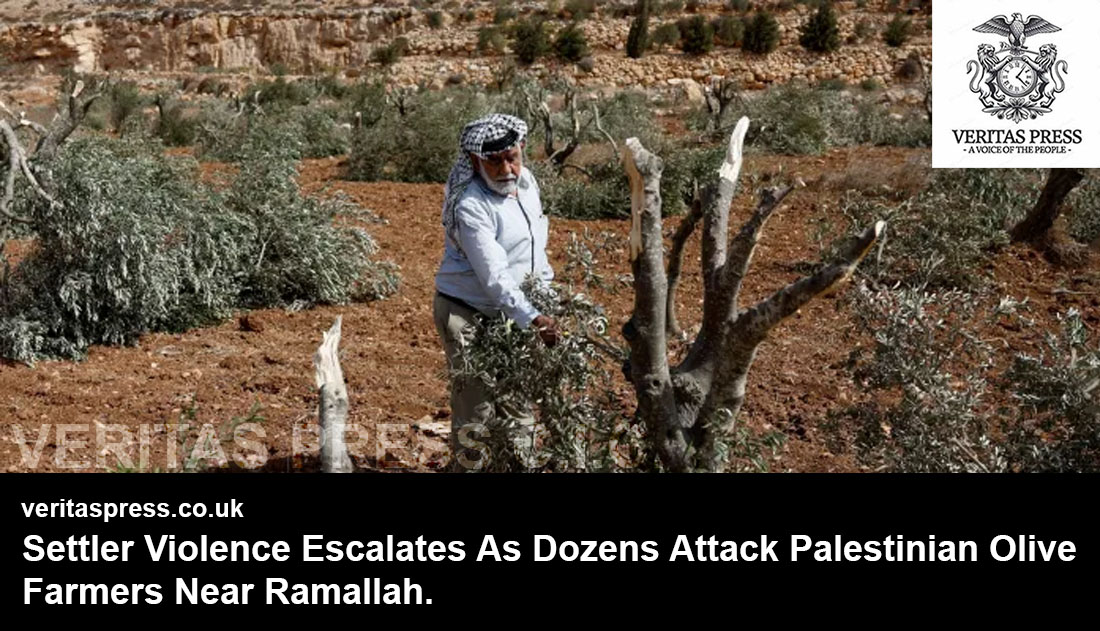
RAMALLAH, OCCUPIED WEST BANK | OCTOBER 2025 – Israeli settlers armed with clubs and protected by soldiers stormed Palestinian olive groves in the town of Turmus Ayya, north of Ramallah, on Sunday, brutally attacking farmers and activists during the annual olive harvest. Videos verified by the Associated Press and Al Jazeera show masked men, some wearing ritual tzitzit garments, beating harvesters and torching vehicles. One woman was hospitalised with serious injuries.
“This was a scene of terror,” said Mahmoud Abu Samra, a 52-year-old farmer who witnessed the attack. “They came down from the hilltop outpost shouting, ‘This is our land,’ beating men and women. Soldiers stood watching. We were forced to abandon our olives and run for our lives.”
Rising Settler Violence Amid Gaza War:
According to the Palestinian Colonisation and Wall Resistance Commission, there have been 158 attacks on olive pickers in the first two weeks of the 2025 harvest season, 17 carried out by Israeli forces and 141 by settlers. The assaults include beatings, shootings, arson, and widespread tree destruction. More than 765 olive trees have been uprooted, burned, or bulldozed, cutting off vital income for Palestinian families.
The UN Human Rights Office warned that “settler violence has skyrocketed in scale and frequency.” Its head in the occupied Palestinian territory, Ajith Sunghay, said:
“Two weeks into the start of the 2025 harvest, we have already seen severe attacks by armed settlers against Palestinian men, women, children and foreign solidarity activists. The failure to prevent or prosecute these attacks points to systemic complicity.”
The UN estimates that 80,000 to 100,000 Palestinian families depend on the olive harvest for their livelihoods. Yet, each year, settler attacks escalate, often under the protection of Israeli forces.
Activists Deported, Soldiers Passive:
Adding to the tensions, Israel deported 32 foreign activists who had joined Palestinian farmers in solidarity. Interior Minister Yariv Levin and National Security Minister Itamar Ben-Gvir claimed the activists were affiliated with the Union of Agricultural Work Committees (UAWC), an organisation Israel has accused, without evidence, of ties to Palestinian resistance groups. The activists were handed 99-year entry bans, their identities and nationalities undisclosed.
“These expulsions show Israel’s intent to silence witnesses,” said Nora Aruri, a Ramallah-based activist with the group Farming for Justice. “They want no cameras, no protection, no evidence, only unchecked settler terror.”
Despite an order by the head of the Israeli Civil Administration to protect Palestinian farmers during harvest season, soldiers are frequently accused of either turning a blind eye or actively participating.
“They stood right there,” said Abed al-Latif, a farmer injured during the Turmus Ayya attack. “When settlers hit my brother with a club, one soldier laughed. Another fired tear gas at us when we tried to film.”
A Climate Of Impunity:
Israel’s Channel 12 reported that the head of the West Bank police admitted that footage of the attack “kept him up at night” and instructed his forces to “bring the suspect to justice.” However, no arrests have been made. Human rights groups say such statements are performative.
“Israeli authorities rarely hold settlers accountable,” said Hagai El-Ad, director of B’Tselem, the Israeli human rights group. “This is a system of state-enabled violence. Soldiers and settlers operate in tandem to dispossess Palestinians from their land under the guise of ‘security’.”
Turmus Ayya, a predominantly Palestinian-American town surrounded by Israeli outposts, has long been a flashpoint. Locals say attacks surged after Israeli forces killed 14-year-old Palestinian-American Amer Rabee in April. “We buried Amer six months ago,” said his uncle, Samir Rabee. “Now we’re burying our olives, the same army that killed him guards the settlers who burn our trees.”
The Broader Pattern:
The violence in Turmus Ayya is part of a larger escalation across the occupied West Bank since the start of the Gaza war. The UN Office for the Coordination of Humanitarian Affairs (OCHA) has documented over 757 settler attacks in 2025 alone, a 13% increase over the same period last year. More than 1,000 Palestinians have been killed by Israeli forces or settlers since October 2023, while thousands have been forcibly displaced through demolitions and land seizures.
There are now over 700,000 settlers living in 278 settlements and outposts, all illegal under international law. Many are armed, often escorted by soldiers during raids on Palestinian land.
“The settlers are an extension of Israel’s occupation,” said Dr. Yara Hawari, senior analyst at Al-Shabaka, the Palestinian Policy Network. “These attacks are not isolated incidents; they are a strategy of gradual annexation, designed to make life unbearable for Palestinians and erase their claim to the land.”
“The Olives Are Our Resistance”:
Despite the violence, Palestinian farmers vow to continue harvesting. “The olive tree is sacred, it’s our heritage and our resistance,” said Umm Ibrahim, a 63-year-old farmer from nearby Beita. “Every year they burn them, and every year we replant. One day, justice will grow again from this soil.”
As smoke still lingers over scorched fields in Turmus Ayya, the images of settlers beating farmers and setting vehicles ablaze have ignited fresh outrage worldwide. Yet for many Palestinians, such attacks are a grim reminder of what they have long known, that the olive harvest, once a season of life, has become a season of fear.
In Summary: A System Of Occupation, Not “Isolated Violence.”
The assault on Palestinian olive farmers in Turmus Ayya is not an aberration; it is the inevitable outcome of a systemic architecture of domination, where settler militias, the Israeli army, and the state apparatus work in concert to uproot a people from their land. Each burning olive tree, each bloodied farmer, and each deported activist forms part of a deliberate campaign of erasure and ethnic cleansing, targeting not only Palestinian lives but the very foundations of their existence, their livelihoods, culture, and ancestral connection to the land.
What unfolds in the olive groves is not simply “settler violence”; it is state-sanctioned displacement by design. The blurred line between soldiers and settlers has effectively disappeared; both now function as arms of the same policy. Soldiers stand by, or even participate, as armed civilians descend on Palestinian farms. Police rarely intervene, and when they do, it is to punish the victims rather than the perpetrators. Military decrees restrict Palestinian farmers from reaching their own groves, while courts routinely dismiss cases of settler violence or treat them as minor offences.
Every olive harvest exposes this collusion. It is a stage-managed cycle of terror and dispossession, replayed annually under the guise of “security.” As Muayyad Shaaban, head of the Palestinian Wall and Settlement Resistance Commission, said:
“When settlers burn olive trees, they are not only destroying our crops, they are burning our history, our hope, and our right to remain on this land.”
The destruction of olive trees, some centuries old, is not an act of random vandalism; it is the systematic dismantling of a sustainable economy and social fabric that has sustained Palestinian communities for generations. By targeting agriculture, the cornerstone of rural Palestinian life, Israel’s policies aim to break the backbone of Palestinian self-reliance, forcing displacement and dependency.
Analysts and rights groups warn that this escalating violence, particularly since the war in Gaza, represents a coordinated campaign of ethnic cleansing and de facto annexation. Reports from the UN, B’Tselem, and Human Rights Watch have repeatedly concluded that Israel’s settlement expansion and protection of violent settlers constitute acts of apartheid and forcible transfer under international law.
Yet, global silence and complicity persist. Western governments that invoke “shared democratic values” with Israel continue to arm and fund the very system that enforces this violence. As Dr. Yara Hawari, senior analyst at Al-Shabaka, observes:
“The West Bank is being emptied village by village, field by field. This is not chaos, it’s policy. It’s a slow, deliberate erasure of a people through the destruction of their towns and livelihoods.”
In Turmus Ayya and across the West Bank, the olive harvest has become an annual front line, a quiet act of resistance against a military occupation that seeks to erase Palestinians not just physically, but economically and spiritually. Every uprooted olive tree and torched grove is a wound in the land itself, a reminder that the goal is not just control, but eradication through exhaustion.
Until the international community confronts this reality, that these attacks are not sporadic “clashes” but a systematic form of erasure and ethnic cleansing, justice will remain out of reach, and the groves of Palestine will continue to burn under the shadow of impunity.