







Press Release: Veritas Press C.I.C.
Author: Kamran Faqir
Article Date Published: 08 Nov 2025 at 11:45 GMT
Category: World | Science & Space | Scientists Baffled As Interstellar Visitor
Source(s): Veritas Press C.I.C. | Multi News Agencies
Website: www.veritaspress.co.uk

Business Ads


November 2025 — A cosmic mystery deepens. Just weeks before its closest approach to Earth, the interstellar object 3I/ATLAS has confounded scientists by mysteriously shrinking in size and changing course in ways no known natural comet should. NASA data confirms that the object, only the third interstellar visitor ever detected, has shed nearly 13 percent of its mass after its close encounter with the Sun in late October, yet shows no visible signs of outgassing, melting, or dust trails that would normally accompany such a loss.
The unexplained behaviour has reignited a fierce debate among astronomers, physicists, and ufologists about whether 3I/ATLAS is truly a comet or something far more extraordinary.

A Cosmic Enigma Emerges:
Discovered in July 2025 by Larry Dennau and the Asteroid Terrestrial-impact Last Alert System (ATLAS) telescope in Chile, 3I/ATLAS is speeding through our solar system at more than 244,000 km/h. NASA confirmed that it is on a hyperbolic trajectory, meaning it entered our system from deep interstellar space and will never return.
The object’s strange behaviour first caught attention when its brightness abruptly increased before perihelion, the point where it came closest to the Sun, on October 29, followed by a sudden acceleration that defied gravitational expectations. According to NASA’s Jet Propulsion Laboratory (JPL), 3I/ATLAS actually moved away from the Sun faster than predicted, changing its orientation as if an unseen force had nudged it off course.
This phenomenon, known as non-gravitational acceleration, is not unheard of in comets, but the lack of accompanying gas or dust emissions has baffled observers. Normally, outgassing acts like a natural rocket, pushing a comet slightly off its expected path. Yet images from NASA’s Solar and Heliospheric Observatory (SOHO) and the Hubble Space Telescope show that no tail or coma has formed around 3I/ATLAS, even after it lost mass equivalent to five billion tons of material.
Avi Loeb’s Alarming Hypothesis:
Among those most intrigued by the anomaly is Harvard astrophysicist Avi Loeb, head of the Galileo Project, which investigates possible extraterrestrial technologies. Loeb, who previously suggested that 2017’s ʻOumuamua might have been an alien probe, believes 3I/ATLAS could represent a similar enigma.
“For a typical comet,” Loeb wrote in a recent blog post, “the loss of this much material should produce a bright tail of dust and gas, easily visible from Earth. No such tail is visible in the new images from November 5. The lack of outgassing combined with the change in trajectory makes this object extremely unusual.”
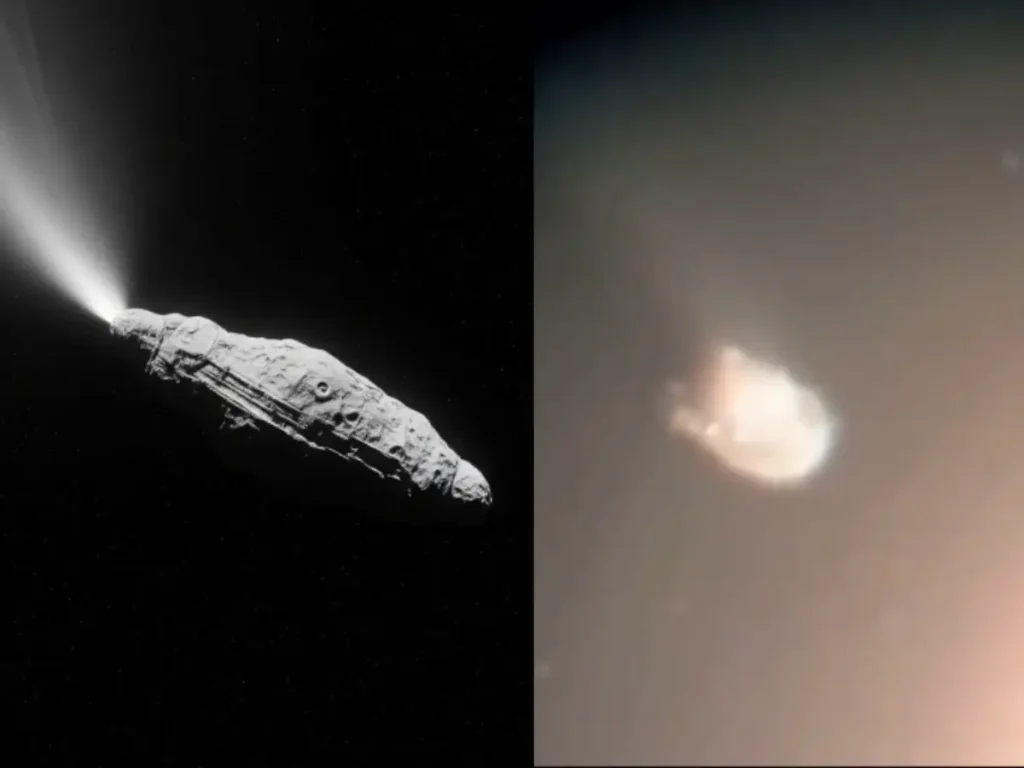
Loeb argues that the shrinkage and directional shift may not be natural at all, suggesting that the object could be using some form of propulsion, perhaps akin to a “rocket engine” adjusting its course. He warned earlier this year that 3I/ATLAS could be a “black swan event”, a once-in-a-lifetime anomaly that forces humanity to reconsider its place in the cosmos.
NASA Confirms Speed Change “Beyond Gravity’s Control”:
According to data first reported by The Daily Mail, NASA quietly confirmed this week that 3I/ATLAS’s trajectory shifted “beyond gravity’s control” shortly after perihelion. The object’s velocity jumped from 209,000 km/h to approximately 244,000 km/h, far exceeding the expected gravitational acceleration caused by the Sun.
NASA attributed the anomaly to thermal reactions, possibly sublimating carbon dioxide or frozen gases escaping from the comet’s crust, but so far, no observational evidence of gas release has been found.
Ground-based telescopes in Chile and Arizona recorded the object turning slightly sideways while its reflective surface dimmed and its shape appeared to contract. That contraction, around 13 percent in radius, suggests mass loss, yet again without any traceable emissions.
“This isn’t just odd, it’s unprecedented,” said Dr. Darryl Seligman, a planetary scientist at Michigan State University. “We’ve seen interstellar comets before, but none that behave like this. The lack of dust or tail formation challenges our understanding of how comets evolve near the Sun.”

A Strange “Anti-Tail” And Shifting Colours:
Adding to the puzzle, several observatories have noted that 3I/ATLAS briefly displayed an “anti-tail”, a faint beam of light pointing toward the Sun, not away from it. This rare optical illusion, previously seen only in a handful of comets, may result from geometric effects of sunlight scattering off larger dust grains. But in this case, the anti-tail appeared even though no dust emission was detected at all.
Even more puzzling, the object’s colour has changed multiple times. Astronomers recorded it turning blue as it neared the Sun, contrary to typical comets, which grow redder as they heat. This suggests an unusual surface composition or an artificial reflective layer.
Ufologists Claim Evidence Of An Artificial Craft:

While most astronomers maintain that 3I/ATLAS is natural, a growing number of ufologists and independent researchers believe the evidence points to something far more deliberate.
According to Dr. Eliza Romero, a physicist and UFO researcher with the European Extraterrestrial Studies Network, the light spectrum and albedo pattern of 3I/ATLAS indicate “a smooth, possibly metallic surface inconsistent with dusty cometary nuclei.”
“The light being emitted represents not reflected sunlight alone,” Romero claimed in a recent interview. “It shows spectral lines consistent with a structured, manufactured material, perhaps some form of alloy or engineered coating. The pattern of reflectivity, combined with the precise way it adjusted trajectory, strongly suggests that this is not a random ice-rock. We could be looking at a constructed vessel.”
Supporters of this theory point out that the object’s steady rotation, its precise speed modulation, and the absence of natural disintegration are hallmarks of artificial control. Some even speculate that 3I/ATLAS could be a probe or a derelict craft, possibly ejected from a distant civilisation millions of years ago.
Key Notes:
“For a typical comet, this kind of shrinkage should produce a bright tail of dust and gas. No such tail is visible.” — Prof. Avi Loeb, Harvard University.
“It shows spectral lines consistent with a structured, manufactured material. We could be looking at a constructed vessel.” — Dr. Eliza Romero, European Extraterrestrial Studies Network.
“Extraordinary claims require extraordinary evidence. So far, nothing about 3I/ATLAS requires an extraterrestrial explanation.” — Dr. Laurie Glaze, NASA Planetary Science Division.

NASA’s Official Position: A Natural Visitor, Not An Alien Ship.
NASA, however, continues to urge caution. The agency’s Jet Propulsion Laboratory states that all current data “remain consistent with a cometary origin,” and that the non-gravitational accelerations can still be explained by sublimation of deep-ice pockets beneath a hardened crust.
“Extraordinary claims require extraordinary evidence,” said Dr. Laurie Glaze, director of NASA’s Planetary Science Division. “So far, nothing about 3I/ATLAS requires an extraterrestrial explanation. But we will continue monitoring it closely.”
Still, NASA acknowledges that the object’s shrinkage without visible outgassing remains an “open question.” The James Webb Space Telescope (JWST) is expected to capture its most detailed infrared images in late November, while the Mars Reconnaissance Orbiter has reportedly photographed the object during its solar pass, though those images have not yet been publicly released.
An Ancient Traveller Or A Technological Relic?
As 3I/ATLAS emerges from the Sun’s glare, astronomers are entering a critical observation window. The Lowell Observatory in Arizona and ESO’s Very Large Telescope in Chile are both tracking the object, with early optical data confirming its continued brightness, and continued mystery.
Some scientists believe the comet could be older than our solar system, possibly 3 billion years older, formed in the cold outskirts of a distant, now-lost star system. Its unique chemistry, dominated by carbon dioxide, suggests it originated far beyond any region previously sampled.
Others, including Avi Loeb, remain open to the possibility that it might be a technological relic drifting through interstellar space, a silent emissary from an ancient civilisation.
Countdown To The December Flyby:
3I/ATLAS will make its closest approach to Earth on December 19, 2025, at a distance of about 270 million kilometres, farther than the Sun, but close enough for ground-based telescopes to observe its structure in detail.
By then, NASA’s Webb Telescope, ESA’s Juice mission, and a host of smaller observatories will have gathered unprecedented data that could finally determine what this enigmatic visitor really is.
Until then, 3I/ATLAS remains an open cosmic mystery, a shrinking, shifting, silent traveller from the stars, defying our understanding of natural law and reminding us that the universe still holds secrets far beyond imagination.
Scientific/Mainstream Researcher Quotes & Findings:
- “We look forward to a bounty of new data and insights as this object warms itself on sunlight before continuing its cold, dark journey between the stars.” — Martin Still, NSF programme director for the International Gemini Observatory, on 3I/ATLAS.
- “Its CO₂-to-water ratio in the coma … is among the highest ever seen in any comet.” — Martin Cordiner, astronomer at the Catholic University of America, discussing the chemical composition of 3I/ATLAS.
- “It looks like a comet. It does comet things. It very, very strongly resembles, in just about every way, the comets that we know.” — Tom Statler, NASA’s lead scientist for Solar System small bodies, responding to claims of an artificial origin.
- “3I/ATLAS is an active comet. It clearly shows a coma and likely contains a significant amount of water ice.” — Bin Yang (Universidad Diego Portales) on Space.com.
- Observational summary: “Observations have revealed the comet’s fuzzy coma, hinted at a weird tail, and suggested an ancient history.” — from Sky & Telescope’s review of known facts about 3I/ATLAS.
Ufologist / Speculative-Theory Quotes & Findings:
- “On the ‘Loeb scale’, where ‘0’ refers to a definitely natural comet and ‘10’ implies a definitely artificial object, I currently rank 3I/ATLAS as a ‘4’.” — Avi Loeb, in his blog post reflecting his agnostic but open position on the object’s nature.
- “The hypothesis in question is that [3I/ATLAS] is a technological artefact, and furthermore has active intelligence.” — Avi Loeb, co-authoring a paper exploring the possibility of alien technology.
- “We must be open to the possibility that new data on interstellar objects does not reflect the same science as past data on solar system comets. … This recognition should motivate us to get as much data as possible about a new interstellar object like 3I/ATLAS and be agnostic in the interpretation of its anomalies.” — Avi Loeb.
- From ufology-oriented outlets: claims that 3I/ATLAS “appears to emit its own light” or shows “pure nickel in the composition” anomalously, e.g., “The discovery of nickel is … extremely unusual for comets … While a rare natural explanation remains, the artificial-technological process seems much more plausible.”
Tags: