





Title: Saudi Arabia’s Ambition To Host The World’s Cheapest Data Centres.
Press Release: Veritas Press C.I.C.
Author: Kamran Faqir
Article Date Published: 18 Dec 2025 at 10:10 GMT
Category: Middle-East- Saudi Arabia | Business-Technology | Saudi Arabia’s Ambition To Host The World’s Cheapest Data Centres.
Source(s): Veritas Press C.I.C. | Multi News Agencies
Website: www.veritaspress.co.uk

Business Ads

How desert sun, cheap power, and Vision 2030 are reshaping the digital infrastructure landscape
Two hours south of Jeddah, Saudi Arabia’s Al Shuaiba solar farm stretches across 50 square kilometres of desert, producing electricity at roughly 3.9 Saudi halalas (just over a cent) per kilowatt-hour, a fraction of the cost of power from new nuclear plants in the UK. The kingdom sees this ultra-low-cost renewable energy not as a side project but as a linchpin in its bid to become a global hub for hyperscale data centres and AI infrastructure.
Reimagining The Kingdom’s Digital Economy:
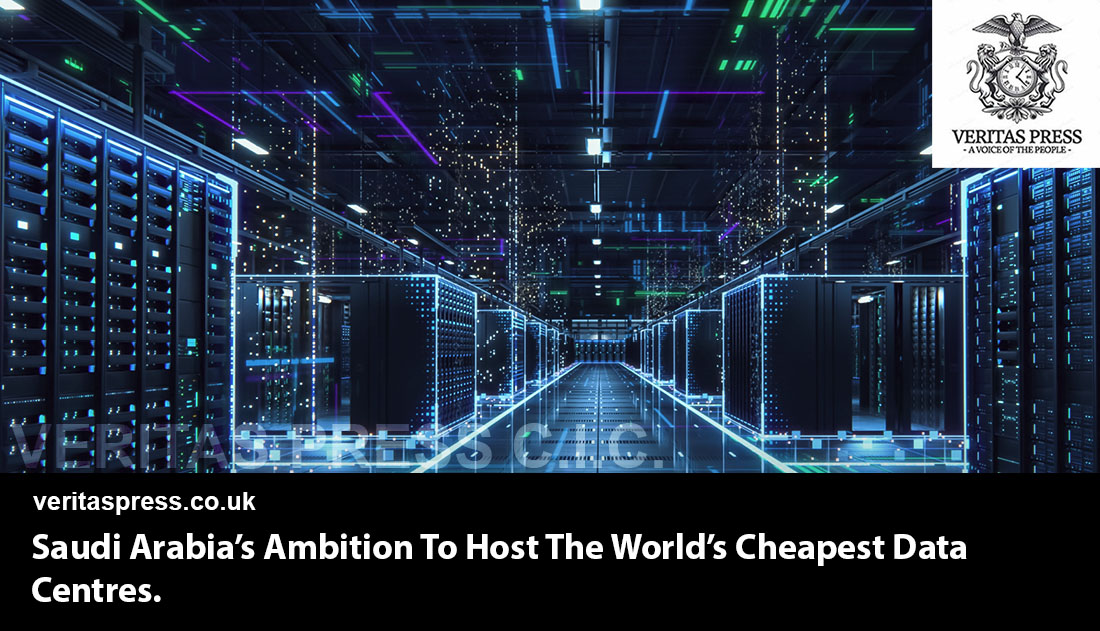
Under Vision 2030, Saudi Arabia has made digital transformation central to its economic diversification away from oil. Hyperscale data centres, facilities that house vast computing power for applications like AI, cloud services, IoT, and big data, are emerging as a strategic pillar of that vision. Saudi officials and industry analysts argue that the kingdom’s combination of cheap power, ample land, and political will gives it an “edge” few traditional tech hubs can match.
Saudi Arabia’s cloud and data centre market is growing rapidly. Independent analyses project revenues rising from approximately $2.07 billion in 2025 to nearly $2.83 billion by 2030, alongside surging hyperscale demand for computing power.
Market research firms also forecast that the data centre colocation segment alone, where third parties host and manage facilities for clients, could grow from about $675 million in 2025 to nearly $1.8 billion by 2034, reflecting sustained interest from enterprises seeking scalable, secure computing capacity.
Power + Land: The Saudi Advantage.
Saudi Arabia’s vast desert terrain, geologically stable and free from major natural hazards, offers a rare blank slate for building massive computing campuses. Land costs, cited at roughly $10–$50 per square metre, are a fraction of those in established U.S. tech hubs. At the same time, cheap electricity, especially from renewable sources, locks in competitive operating costs for data centres’ heavy power demands.
Beyond solar, the kingdom is tendering large quantities of renewable capacity, tens of gigawatts of solar and wind, at record-low prices, aiming to back data centre ecosystems with green energy and grid reliability.
Infrastructure Growth & Policy Frameworks:
Saudi Arabia’s infrastructure buildup has accelerated in 2025, with substantial investment in grid expansions, renewable generation, and network connectivity:
- Renewable pipeline: Around 64 GW of renewables tendered by year’s end, with ultra-low levelled costs of electricity around 1.1–1.5 cents/kWh, strengthening the power foundation for hyperscale computing.
- Grid build-out: Over 24 new substations and 4,327 km of transmission lines are underway to support massive data-centre power draws.
- Regulatory innovation: A draft Global AI Hub Law seeks to codify data residency and compute sovereignty requirements, mandating that sensitive data and critical AI models stay within designated Saudi compute hubs.
These elements send clear signals to investors and hyperscalers: Saudi Arabia is serious about building sovereign digital infrastructure, not just attracting isolated data centres.
Commercial Commitments & Hyperscale Momentum:
Saudi Arabia’s data centre ecosystem is not theoretical; it is rapidly materialising through global and local partnerships:
- Major land acquisitions and operator entries: UAE-based Khazna Data Centres has secured 225,000 sqm in Dammam and appointed a country head to drive AI-ready buildouts of up to 200 MW of capacity.
- Colocation deals: XDS Datacentres signed a 15-year agreement to deploy 10 MW of AI workloads with Saudi colocation provider Desert Dragon, with plans to expand to roughly 50 MW of immersive-cooled AI capacity across four cities by 2029. saudigazette
- Global hyperscale entries: Companies like Equinix are investing over $1 billion in a Saudi data centre, while Microsoft and Oracle continue to expand cloud regions and capacity locally.
- Thickening cloud ecosystem: Global hyperscalers, Google, AWS, Microsoft Azure, Oracle, and Alibaba, are planning or expanding Saudi cloud infrastructure, with massive long-term demand predicted as enterprises shift from on-premises servers to cloud models.
In parallel, Saudi AI company Humain, backed by the Public Investment Fund, has secured partnerships with Nvidia, AMD, and others to anchor AI compute platforms and chip supply, affirming Riyadh’s ambition to build not just data centres but a regional AI stack.
Regional Competition: The Gulf Digital Arms Race.
Saudi Arabia’s push is part of a broader Gulf competition for digital supremacy:
- Qatar is leveraging cheap power to attract AI infrastructure through its QAI initiative, though observers note it remains behind Saudi Arabia and the UAE in scale and capacity.
- The UAE continues heavy investment in AI-oriented data centres and quantum research hubs.
Yet Saudi Arabia’s size, renewables strategy, and integrated policy framework may give it a structural edge in attracting hyperscale compute and cloud investment.
Challenges Beneath the Promise:
Despite the bullish narrative, significant hurdles remain:
- Capital intensity: Hyperscale facilities require enormous upfront costs, often tens or hundreds of millions of dollars before revenue flows.
- Water and cooling demands: Data centres’ thirst for cooling, especially in desert environments, could strain resources and complicate sustainability goals; initiatives around liquid cooling and water-use mitigation are in early phases.
- Talent and regulatory maturity: Building and retaining specialised AI and cloud expertise is an ongoing challenge, and legal frameworks for data governance and cross-border flows will shape investor confidence.
Global Context: Riding The AI Infrastructure Boom.
These developments mirror a broader global phenomenon: the AI data centre market worldwide is expected to grow from about $17.3 billion in 2025 to nearly $147.6 billion by 2034, driven by exponential demand for AI processing and storage. Straits Research
Saudi Arabia is positioning itself not just as another node in this network but as a cost-advantaged, sovereign data infrastructure hub, a vision underpinned by the kingdom’s energy wealth, regulatory support, and deep pockets of capital.
Conclusion: Digital Ambitions Rooted In Desert Power.
Saudi Arabia’s bid for the world’s cheapest data centres encapsulates a larger strategy: cast aside legacy economic dependence on oil, and reforge national identity around digital innovation and computational power. The economics are persuasive: cheap land, cheap power, renewable energy, and strategic geography, but execution will require sustained investment, regulatory clarity, and human capital development.
If Saudi Arabia succeeds, it will not only reshape the digital map of the Middle East but potentially influence how global cloud and AI infrastructure is distributed in the decades to come.














a4dang