




Original Article Date Published:
Article Date Modified:
Help support our mission—donate today and be the change. Every contribution goes directly toward driving real impact for the cause we believe in.
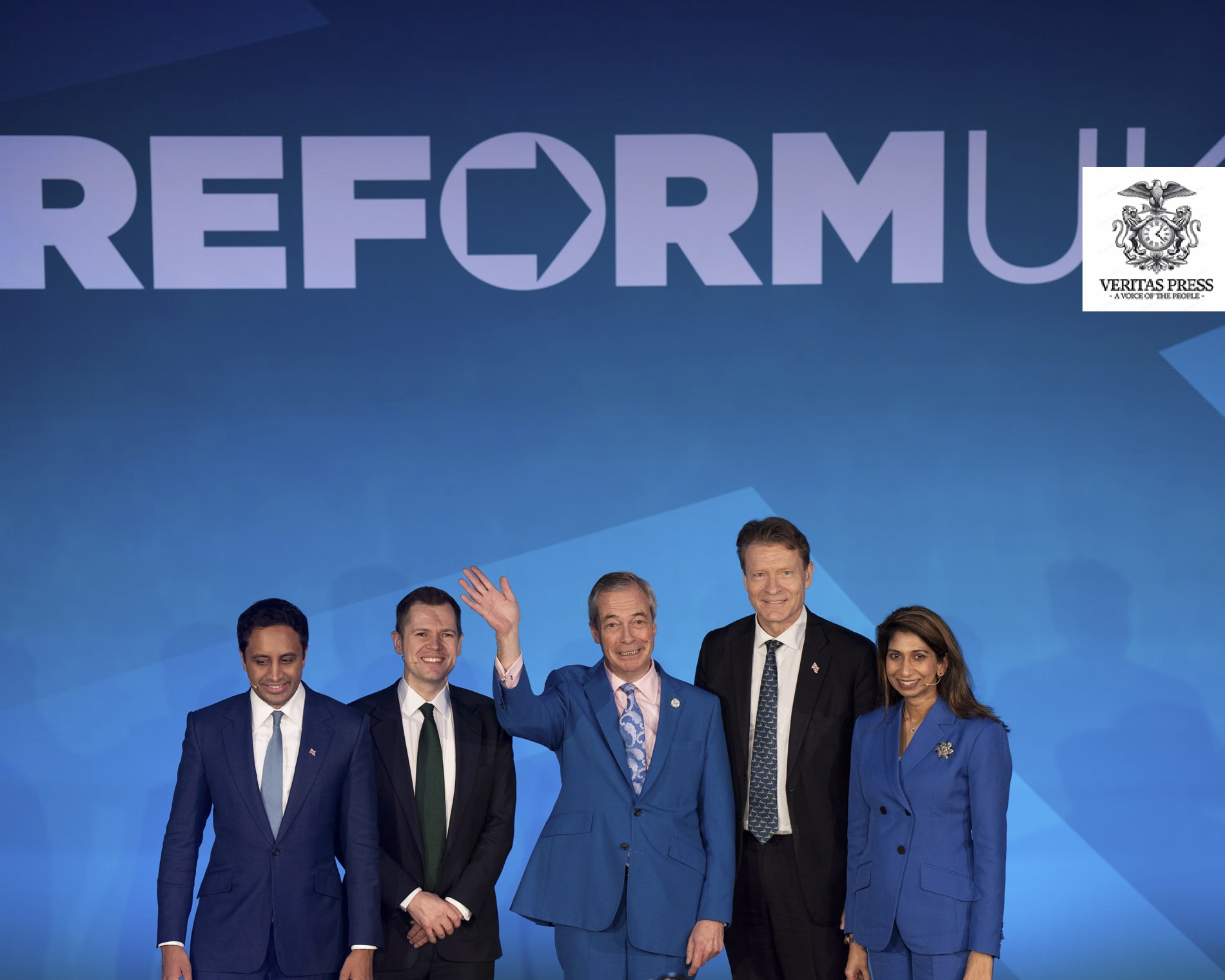
Nigel Farage has completed the first stage of his party’s transformation from insurgent force to government-in-waiting, unveiling a four-strong frontbench team headed by Conservative defectors Robert Jenrick and Suella Braverman, while announcing radical plans to repeal the Equality Act 2010 and withdraw from the European Convention on Human Rights.
In a significant political development, the Reform leader used a London press conference to declare his party the “voice of opposition” to Keir Starmer’s Labour government, citing consistent double-digit polling leads and growing parliamentary representation. The appointments mark the most concerted effort yet to professionalise Reform’s offering ahead of the next general election, due by summer 2029.
‘On day one, we will repeal the Equality Act’: Braverman sets out radical platform.
The most striking policy announcement came from Suella Braverman, the former home secretary who defected from the Conservatives last month. Taking on the education, skills and equalities brief, Braverman declared that a Reform government would immediately abolish the Equalities Minister role, her own position, and scrap the Equality Act 2010 in its entirety.
“The Britain that I love is being ripped apart by diversity, equality and inclusion policies,” Braverman told the press conference. “Do you know what a Reform government will do? Well, on day one, we will get rid of the equalities department, we will scrap the equalities minister, yes, I’m doing myself out of a job! And we will repeal the Equality Act.”
The former attorney general argued that current diversity policies had strayed from their original purpose. “DEI has become less about diversity and more about conforming to left-wing ideology. Less about equality and more about prejudice against white people. Less about inclusion and more about exclusion of those who dare to challenge the dogma,” she said.
Braverman questioned why “white, Christian men” could be discriminated against by official bodies, why police had allegedly ignored grooming gangs affecting white working-class girls, and why “white working-class boys have the worst educational outcomes in our country today.”
The party proposes replacing the Equality Act with a “British Bill of Rights” that would apply only to British citizens and those with a legal right to live in the UK – a move campaigners warn would create a “two-tier” justice system based on citizenship status and effectively legalise discrimination against non-citizens living, working and studying in Britain.
Fierce Backlash: ‘A Charter For Discrimination Against Minorities’.
The announcement drew immediate condemnation from trade unions, civil liberties groups and race equality campaigners, who pointed out that Braverman’s focus on “prejudice against white people” obscures the reality that ethnic minorities and migrants bear the overwhelming brunt of discrimination in Britain.
TUC general secretary Paul Nowak said: “It’s official – Reform UK think discrimination should be legal. Scrapping the Equality Act would be a sledgehammer to hard-won rights that working people fought for over generations. If you’re discriminated against because you’re a woman, black, disabled, pregnant or gay – that’s fine with them.”
Nowak warned the move represented “a blank cheque for bad employers to mistreat their staff,” adding that Reform had made clear “whose side they’re on – and it’s not working people.”
The Runnymede Trust, Britain’s leading race equality think tank, issued a stark warning about the real-world impact of Braverman’s proposals. “When Suella Braverman talks about ‘prejudice against white people,’ she is deliberately obscuring the reality that discrimination in Britain disproportionately affects Black, Asian and ethnic minority communities,” said Dr Shabna Begum, interim co-chief executive.
“Ethnic minority workers are already paid less than their white counterparts for the same work. Black job applicants already have to send twice as many applications to get a positive response. Muslim women already face discrimination in the workplace for wearing the hijab. Repealing the Equality Act would remove the only legal protection these communities have. This isn’t about ‘protecting white people’ – it’s about dismantling the safeguards that minority communities fought for decades to achieve.”
Jenrick Handed The Treasury Brief As ‘Shadow Chancellor’:
Robert Jenrick, who left the Conservatives in January, was appointed as Reform’s economic spokesman, effectively shadow chancellor, tasked with developing what Farage described as “the most comprehensive plan of any political party” to address Britain’s economic challenges.
Jenrick, a former communities secretary under Boris Johnson, pledged to “oppose the wrecking ball that is Rachel Reeves and this Labour Government” and focus on cutting taxes, scaling back welfare, and tackling youth unemployment.
“We’re going to set out our economic plans tomorrow, but it’s going to be about reducing bills, having a sensible energy policy to make our country more competitive once again, reducing taxes as we can, and bringing back good jobs in all parts of the country,” Jenrick said.
His appointment came barely a month after joining Reform, representing a rapid elevation for the Newark MP. Prior to his defection, both Richard Tice and Zia Yusuf had been regarded as potential economic spokesmen for the party.
Tice To Lead New ‘Super-Department’ For Business And Energy:
Richard Tice, Reform’s deputy leader, was named spokesman for business, trade and energy, with responsibility for leading a proposed new “super-department” aimed at increasing economic growth to 4% of GDP.
A longtime sceptic of net zero policies, Tice pledged to abandon the UK’s climate targets and focus instead on exploiting offshore oil and gas reserves, along with fracking. He also announced plans to create a “serious” British wealth fund to support reindustrialisation.
“If we achieve those things, then we can reindustrialise Britain, we can reenergise Britain, we can renew Britain, and yes, we can rebuild Britain,” Tice said. “These are absolutely essential to create growth.”
Despite being passed over for the Treasury role many had expected him to take, Tice insisted he was “delighted” with his appointment.
Yusuf Takes Home Affairs Brief With The Promise Of Mass Deportations:
Zia Yusuf, the party’s head of policy and the only frontbencher not in Parliament, was appointed home affairs spokesman with a specific remit to address legal and illegal migration.
Yusuf delivered some of the most robust rhetoric of the day, telling the London rally: “More people have turned up on our beaches uninvited in the last seven years than stormed the beaches of Normandy on D-Day.”
He accused the government of providing irregular migrants with “free accommodation, free meals, free access to healthcare, free taxis, free leisure activities at the expense of the British people, to the tune of tens of billions of pounds every single year” – describing the situation as “the most profound betrayal of the British electorate in history.”
In a direct message to those in the UK without legal status, Yusuf warned: “If you are in this country illegally right now and you are watching this, I want to be crystal clear: as Reform’s home secretary, I will ensure that you are deported from these lands.”
ECHR Withdrawal And Mass Deportation Plans:
The home affairs announcement built on migration policies Farage set out earlier, including a commitment to withdraw the UK from the European Convention on Human Rights, “no ifs, no buts”, and disapply the 1951 UN Refugee Convention for a five-year period.
Farage has proposed the mass deportation of irregular migrants, with estimates suggesting between 500,000 and 600,000 people could be removed over five years. Under the plans, migrants would have a six-month window for voluntary return, including a £2,500 government payment – before facing forced detention and removal using surplus army bases and new detention centres.
The policy would cost an estimated £10 billion over five years, the party said.
Downing Street dismissed the plans as “not serious,” with a spokesperson noting that the ECHR is a key element of international agreements, including the 1998 Belfast Agreement. Anyone proposing to renegotiate that agreement is “not serious,” the spokesperson added.
‘No Dissent, No Disloyalty’: Farage Asserts Firm Control.
Throughout the press conference, Farage made clear that while he was expanding his team, he retained ultimate authority over party direction. Asked about potential internal tensions over job allocations, Farage replied: “Not as yet that has been made known to me. And if there is? Tough. We’re not mucking about here. We haven’t got time.”
He issued a stark warning to his new colleagues: “Very simple. If people mess about, behave badly or are disloyal, we’re not going to put up with it.”
The message appeared directed at avoiding the factional infighting that has plagued both the Conservatives and, at times, Reform’s predecessor parties. Braverman, who was twice sacked as home secretary under the previous government, sought to distance herself and her new colleagues from Tory psychodramas.
“Contrary to what is very typical in the Conservative Party, I would say, which is a lot of jostling, a lot of powerplays, I am very, very honoured to have this role,” Braverman said. “I am really chuffed for Richard, Zia and Robert with the briefs that they’ve been handed – I feel part of a great team.”
The event also saw Farage clash with a Financial Times reporter, telling her to “just write some silly story” when she pressed him on a question, a moment that underscored his combative approach to media scrutiny.
‘Failed Tories’ Or Government-In-Waiting? Political Rivals Respond:
The appointments drew fierce criticism from Labour and the Conservatives, both of whom accused Farage of assembling a team of rejects from the previous administration.
Labour chair Anna Turley said: “Farage’s top team of failed Tories spent over 3,000 days inflicting untold damage on our country in government, trashing our economy, hammering families’ mortgages, and leaving our borders open. They failed Britain before, they’d do the same again under Reform.”
Turley added that the appointments revealed “neither keeping our nation safe nor tackling NHS waiting lists are priorities for Farage or Reform UK.”
Conservative Party chairman Kevin Hollinrake sought to portray Reform as little more than a tribute act. “After months of infighting and leaks, Nigel Farage has unveiled a frontbench dominated by ex-Conservatives – a lineup that looks more like a tribute act to the old Conservative Party than a credible alternative,” he said.
Hollinrake claimed some appointees were “already eyeing their next career move, while others who were clearly expecting promotion have been left out in the cold,” adding that “today’s underwhelming announcement proves Reform remains a one-man band.”
Liberal Democrat deputy leader Daisy Cooper described the event as a “Reform-Tory ‘Fifty Shades of Blue’ love-in,” noting that Jenrick had “voted for Liz Truss’s economic disaster of a mini-budget” and warning he would “do the same damage to the economy all over again.”
Polling Context: Reform Leads As Public Mood Darkens.
Farage’s claim to represent the real opposition is grounded in recent polling. Opinium figures from late January showed Reform leading on 31%, with Labour on 22% and the Conservatives on 17%. The same polling found 62% of voters believe the country is moving in the wrong direction under Starmer, with two-thirds saying the government lacks a clear economic plan.
On immigration, identified by 49% of voters as a top concern, Reform is seen as the party best placed to handle the issue, underlining a “clear vulnerability for the government,” according to pollsters.
The party has also made strides in Scotland, opening a five-point lead over Scottish Labour for second place ahead of May’s Holyrood elections, with 20% support in both constituency and regional votes.
Community Cohesion Warning: ‘These Policies Target Minorities, Not Protect White Britons’.
Beyond the immediate political response, community leaders and human rights organisations have issued stark warnings that Reform’s policy platform, framed by Braverman as protecting white Britons from discrimination, would in reality devastate the legal protections relied upon by ethnic minority and migrant communities, while actively encouraging hatred, Islamophobia, and racial division.
The Reality Of Discrimination In Britain:
The Equality and Human Rights Commission’s most recent data paints a starkly different picture from Braverman’s narrative of widespread discrimination against white people. Ethnic minority workers are paid on average 23% less than their white counterparts. Black graduates earn 15% less than white graduates in the same roles. Muslim women face the highest unemployment rate of any demographic group.
“When Suella Braverman claims that DEI policies discriminate against white people, she is inventing a problem to justify dismantling protections that minority communities desperately need,” said Dr Halima Begum, director of the Runnymede Trust. “The Equality Act exists because of centuries of evidence showing that Black, Asian and minority ethnic Britons face systemic barriers. Repealing it doesn’t create a ‘level playing field’, it removes the only mechanism for challenging discrimination when it happens.”
The proposed repeal of the Equality Act would remove legal protections that have, for fifteen years, safeguarded minority communities from discrimination in housing, employment, and public services. But campaigners argue the damage would extend far beyond the courtroom.
“The Equality Act isn’t just a piece of legislation – it’s a statement of national values,” said Sunder Katwala, director of British Future, a think tank working on integration and migration. “It tells every citizen that they have a right to be treated fairly regardless of their background. Scrapping it would send a signal that some people, based on their race, religion, or citizenship status, are no longer entitled to the same basic protections as others.”
Islamophobia And The Politics Of Division:
Critics point to Farage’s repeated use of language such as “invasion” to describe migration across the Channel, rhetoric he doubled down on at the press conference despite Downing Street’s refusal to condemn the term. Tell Mama, a group that monitors anti-Muslim hatred, has previously documented spikes in Islamophobic incidents following political figures using such language.
“When political leaders describe human beings seeking safety as an ‘invasion,’ they are not just using strong language, they are actively dehumanising people and creating a climate where hatred can flourish,” said Iman Atta, director of Tell Mama. “We have seen time and again that when this rhetoric enters mainstream political discourse, British Muslims bear the brunt of the consequences in the form of street abuse, online hatred, and physical attacks.”
Tell Mama’s monitoring shows that Islamophobic incidents increased by 335% in the week following the Southport attacks last summer, with far-right actors using misinformation about the suspect’s background to target Muslim communities. “The language used by Reform politicians directly feeds this violence,” Atta said. “When they talk about ‘two-tier policing’ and claim that Muslim communities are treated differently, they are giving permission for hatred to flourish.”
Migrants And Non-White Britons Face The Sharp End:
The party’s proposal to prioritise the rights of British citizens over others in a new “British Bill of Rights” would, according to human rights lawyers, create a dangerous two-tier system where non-white Britons and migrants would be most vulnerable to discrimination and abuse.
“Human rights are universal precisely because they are based on human dignity, not on passport status,” said Martha Spurrier, director of Liberty. “Creating a two-tier system where some people have rights and others don’t is the opposite of what human rights law stands for. It would inevitably lead to abuse, exploitation, and the normalisation of discrimination.”
The Joint Council for the Welfare of Immigrants warned that Farage’s deportation plans, combined with the proposed legal changes, would have a “chilling effect” on community relations. “When you create a climate where millions of people are told they don’t belong, where their very presence is framed as an ‘invasion,’ where their legal protections are stripped away – you are creating a breeding ground for hate,” said chief executive Satbir Singh.
“British Muslims, Black Britons, and ethnic minority communities who have been here for generations will find themselves constantly having to prove their belonging. Children will grow up in a country where the message is clear: some of us are more equal than others.”
The Muslim Council of Britain issued a statement expressing “profound concern” over the proposals. “The repeal of the Equality Act would leave British Muslims and other minority communities vulnerable to discrimination without legal recourse,” the organisation said. “At a time when Islamophobia is already rising, removing these protections would send a dangerous signal that hate has no consequences.”
Human Rights Are Under Threat For Everyone:
Legal experts have warned that withdrawal from the European Convention on Human Rights, a cornerstone of post-war European stability, would leave the UK as one of only two Council of Europe members (alongside Belarus) outside the convention, joining Russia, which was expelled following its invasion of Ukraine.
The Human Rights Act, which would also be repealed under Reform’s plans, requires UK courts to take European Court of Human Rights rulings into account and has been instrumental in protecting vulnerable groups from state overreach. Its removal would, according to lawyers, eliminate a crucial check on executive power.
“These aren’t abstract legal technicalities,” said Adam Wagner, a human rights barrister. “The Human Rights Act has protected Windrush generation citizens from wrongful deportation. It has safeguarded disabled people from discrimination. It has ensured that children in care are treated with dignity. Stripping these protections away doesn’t just affect migrants – it affects every single person in this country.”
The Farage Project: From Insurgency To Institution.
Tuesday’s announcements represent the most significant step yet in Farage’s long-standing ambition to transform his political vehicle from a pressure group into a credible governing alternative. The Reform leader acknowledged past criticism that he ran a “one-man band,” arguing the new appointments demonstrated the party was now “creating a machine for government.”
“Now, if I were hit by a bus tomorrow, Reform has its own brand, Reform has its own identity,” Farage said. “Reform now has its own senior characters with their own departments to lead. I’m enormously proud of that.”
In a BBC interview days before the announcement, Farage predicted that May’s local elections would bring a “collapse in support for the two biggest parties” and declared that the Conservatives were finished as a national force. “We’ve replaced the old fuddy-duddy existing Conservative Party with a new force on the centre-right, that’s got a bit more energy, a bit more enthusiasm, a little bit more fire,” he told Radio 4’s Political Thinking programme.
What Happens Next:
Reform faces its next electoral test in the Gorton and Denton by-election on 26 February, where candidate Matthew Goodwin, an academic who has previously suggested some UK-born ethnic minority individuals may not be fully British, is seeking to win the party’s ninth parliamentary seat.
Farage has set a May deadline for further Conservative defections, though he indicated few remaining Tory frontbenchers would be welcome. “There are very, very few, hardly any, left in the frontlines of the Conservative party who we would even be vaguely interested in,” he said.
He also hinted at imminent Labour defections, telling the BBC: “There are going to be several. I haven’t got a magic wand. Things don’t always happen immediately, but it will happen.”
The party’s frontbench expansion comes alongside a string of policy announcements designed to cement its position as the primary challenger to Labour. Beyond migration and equality reforms, Reform has pledged to create a new “Department for Growth,” abandon net-zero targets, and implement sweeping tax cuts, a platform Farage believes can translate polling leads into parliamentary majorities.
But as the party moves from the fringes towards the political mainstream, the question increasingly asked by community leaders, human rights organisations, and faith groups is not whether Reform can win, but what kind of country it would leave behind if it does.
“We cannot afford to be complacent,” said Sunder Katwala. “The rights and protections we have taken for granted for decades are not guaranteed forever. They can be dismantled. And if they are, the consequences will be felt not just in courtrooms and workplaces, but on every street, in every school, in every community across this country.”

TEHRAN – The fog of war thickened over central Iran on Sunday, as sharply conflicting

ISFAHAN PROVINCE, IRAN – April 5, 2026, In the rugged, mountainous terrain south of the

Original Article Date Modified: Article Date Modified: Help support our mission, donate today and be
The raw numbers tell a story of profound inequality. On 1 April 2026, more than

What began on February 28, 2026, as a coordinated US-Israeli campaign to decapitate Iran’s military

The idea of a “freedom flotilla” carries a ghost in its hold: the 2010 Mavi

Original Article Date Published: Article Date Modified: Help support our mission, donate today and be

Original Article Date Published: Article Date Modified: Help support our mission, donate today and be

A United States fighter jet has been shot down over Iran, marking a dangerous and

On February 28, the United States and Israel launched coordinated strikes on Iran, reported by