


Original Article Date Published:
Article Date Modified:
Help support our mission—donate today and be the change. Every contribution goes directly toward driving real impact for the cause we believe in.
When Sheikh Mohammad Hussein confirmed the sighting of the crescent moon over Al-Aqsa Mosque, the announcement marked the beginning of Ramadan, a moment traditionally defined by spiritual renewal, communal meals, and illuminated streets across the Muslim world.
This year, however, the holy month arrives across Palestine under radically altered conditions.
Across Muslim-majority societies, Ramadan is associated with crowded markets, lantern-lit neighbourhoods, and families gathering around abundant iftar tables. In Gaza, the month begins amid physical devastation and psychological trauma after nearly two years of Israeli military assault that has killed tens of thousands and displaced most of the population.
The experience is no less constrained in the occupied West Bank, where intensified Israeli security measures, economic paralysis, and movement restrictions have transformed what was once a deeply communal period into one lived under surveillance and control.
Together, these realities raise a broader investigative question: what does religious life look like when the infrastructure of society, homes, mosques, livelihoods, and family networks, has been systematically shattered?
Gaza: Worship Amid Ruins.
Ramadan in Gaza unfolds across a landscape marked by bomb craters, collapsed apartment towers, and vast tent encampments.
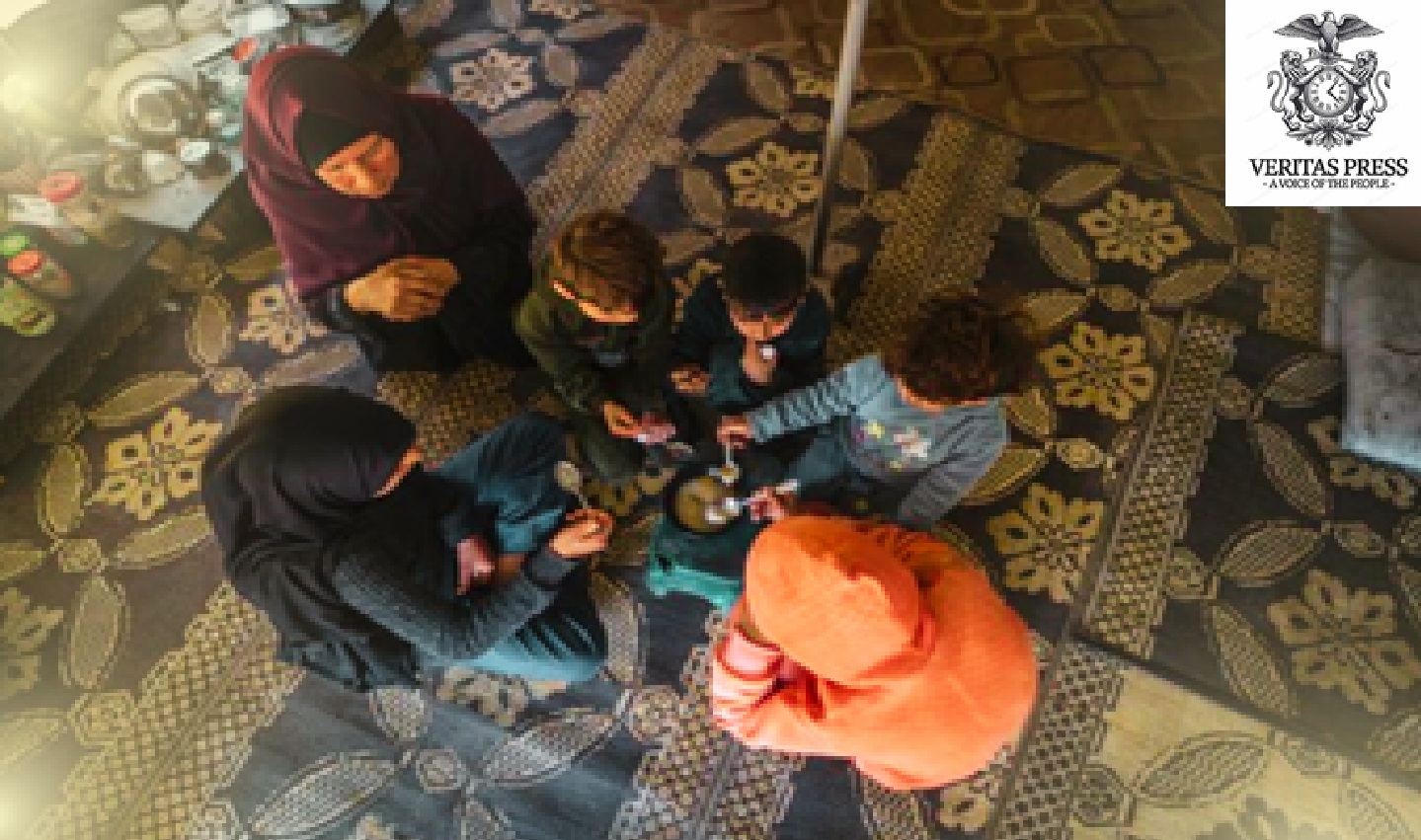
Entire neighbourhoods remain uninhabitable. Families that once prepared elaborate meals now structure their days around humanitarian aid schedules.
Zahra Abdel Raouf, speaking to the World Food Programme, recalled earlier Ramadans when her children eagerly awaited home-cooked meals.
Today, her family lives in a tent after their house was destroyed.
Meals depend on whatever relief kitchens distribute, often rice, lentils, or bulgur.
Sometimes, she says, the family walks long distances searching for food and returns empty-handed.
“We survive with whatever we can afford.”
That transformation captures the deeper story of Ramadan in Gaza: a shift from celebration to subsistence.
Before the war, children anticipated sweets and lanterns. Now they wait in distribution lines.
Meat has largely vanished from daily diets. Bread disappears quickly in large households. The pre-dawn meal is often reduced to tea and bread, chosen not for nutrition but for availability.
Humanitarian agencies warn that even with a fragile ceasefire in place, most households remain dependent on assistance.
The United Nations Office for the Coordination of Humanitarian Affairs reports that aid flows have improved compared with peak fighting periods but remain inconsistent and vulnerable to political and logistical disruptions.
Markets have partially reopened, yet prices remain far beyond the reach of families whose incomes collapsed long ago.
In practical terms, famine may have receded, but food security has not returned.
Starvation Warnings And Aid Constraints:
Aid officials increasingly describe hunger in Gaza as structurally driven rather than incidental.
Jonathan Whittall, a senior UN humanitarian official, warned:
“With each day that passes, Gaza is becoming a bigger and bigger crime scene… People are being starved and then drip-fed in the most undignified way possible.”
More than 100 humanitarian organisations have similarly warned that “mass starvation” is spreading, with even aid workers joining food queues.
Mara Bernasconi of Humanity & Inclusion described the crisis as reaching the “peak level of starvation.”
A joint international statement cautioned that at least 41,000 children face a heightened risk of death from malnutrition, stressing:
“This is a manmade crisis. The use of starvation as a weapon of war is clearly prohibited under international humanitarian law.”
Such language reflects a widening legal debate among analysts and rights advocates over whether restrictions on aid could amount to violations of humanitarian law, questions likely to reverberate long after the war ends.
A Fragile Ceasefire And Persistent Fear:
Gaza observes Ramadan under a tenuous truce that began in late 2025. While the relative quiet has allowed limited commercial activity to resume, residents widely describe the calm as deceptive.
Many still expect the war to restart.
Last year’s renewed offensive began during Ramadan, a memory now shaping daily behaviour.
Families quietly stockpile flour when possible. Parents ration food. Children overhear conversations about preparing for another siege.
Maisoon al-Barbarawi, displaced to the Bureij area, summarised the prevailing anxiety:
“Everyone knows the war hasn’t truly stopped.”
Bullet holes from drone fire remain visible in her tent, a reminder of how quickly conditions can deteriorate.
Investigatively, this persistent fear reveals a crucial dimension often overlooked in ceasefire narratives: the absence of bombs does not equal the presence of safety.
Instead, Gaza exists in a state of suspended catastrophe.
Grief At The Iftar Table:
For many families, the deepest rupture is emotional rather than material.
Ramadan is structured around gathering, yet thousands now sit before empty chairs.
Hanan al-Attar, a displaced mother of eight, received a food parcel containing beans, dates, oil, and cheese, modest items that nonetheless brought visible relief.
But as she prepared for iftar, her thoughts turned to her two sons killed in an airstrike.
“When the family gathers, and members are missing, you feel deep pain.”
Psychologists describe this as collective bereavement, grief experienced not privately but across an entire society.
Even survivors report guilt. Many admit they were so focused on staying alive that they never imagined what survival itself would feel like.
Ramadan, often described as a mirror for the soul, now reflects absence.
Cooking Over Fire, Guarding Gas Like Treasure:
Infrastructure collapse continues to define daily life.
With electricity networks shattered and refrigeration scarce, families buy food day by day to prevent spoilage.
Cooking gas is so rare that some households treat a single cylinder as a strategic reserve. Others rely on firewood, shielding flames from the wind with sheets of plastic.
One displaced resident explained:
“Gas is like treasure for us.”
Such details point toward a broader structural reality: Gaza is not merely damaged, it has been functionally de-modernised.
Urban systems have regressed toward emergency survival conditions.
Cultural Survival As Resistance:
Yet amid devastation, residents continue to construct fragments of normalcy.
Artists fashion lanterns from rubble. Children carry decorations made from recycled cans. Murals appear on fractured walls.
With many mosques destroyed, worshippers pray outdoors, courtyards, sidewalks, and tent clearings becoming temporary sanctuaries.
Scholars of conflict note that cultural continuity often becomes a form of resistance when violence threatens social identity.
One Gazan writer captured the transformation starkly:
“One aim of genocide is to destroy culture… What is Ramadan now, in a city soaked in blood?”
Whether framed politically or sociologically, Ramadan in Gaza now represents not celebration, but preservation.
The War Within Survivors:
Months after large-scale bombardments subsided, many residents describe an internal battlefield; no ceasefire has ended.
People speak openly of depression, numbness, and unresolved trauma.
Some say the war “continues inside us.”
Mental health specialists increasingly warn that Gaza faces a long-term psychological crisis likely to outlast reconstruction by decades.
This raises a deeper investigative concern:
How does a society rebuild when its emotional fabric has been torn alongside its physical infrastructure?
West Bank: Ramadan Under Military Control.
While Gaza confronts devastation, Palestinians in the West Bank enter Ramadan under intensified Israeli deployment.
Additional battalions have been stationed across the territory, with arrest raids and demolitions continuing.
Access to Jerusalem, and particularly Al-Aqsa, is tightly restricted. Israeli authorities have limited entry permits largely to older worshippers, leaving most Palestinians unable to reach one of Islam’s holiest sites during the sacred month.
The restrictions carry layered consequences:
- Religious exclusion
- Economic strain
- Social fragmentation
Roughly 140,000 Palestinian workers remain barred from jobs inside Israel, deepening hardship during a period typically associated with charity.
Administrative changes transferring building licensing powers in parts of Hebron and Bethlehem to military authorities have heightened Palestinian fears of accelerated settlement expansion, a development analysts warn could further inflame tensions.
Even Israeli security sources reportedly acknowledge the risk.
Checkpoints Instead Of Night Visits:
Ramadan nights in the West Bank were once defined by movement, prayers, family visits, and vibrant public spaces.
Now they unfold under checkpoints and patrol routes.
Families calculate travel around potential delays or detention. Some avoid leaving home altogether.
Schools operate partially amid a financial crisis, while unemployment remains widespread.
In effect, the rhythms of Ramadan persist, but within a geography increasingly shaped by control mechanisms.
Faith As Continuity:
Despite radically different circumstances, a common thread runs across Gaza and the West Bank: determination to observe the holy month.
Parents still wake children for suhoor. Neighbours still share what little food they have. Communities still gather at sunset, whether in streets, camps, or courtyards.
If abundance once defined Ramadan, meaning now does.
Testimonies repeatedly emphasise patience over celebration, continuity over festivity.
A Shared Moon, Divergent Realities:
The sighting of the crescent moon marks a unified spiritual calendar across Palestine.
Yet beneath that shared symbol lies a fractured reality:
- In Gaza, fasting accompanies survival amid devastation.
- In the West Bank, prayer navigates military restrictions.
Ramadan Continues, But Transformed.
What emerges is not merely a humanitarian story, nor solely a political one. It is a portrait of a society attempting to sustain ritual, memory, and identity while living through one of the most destabilising periods in its modern history.
And perhaps the clearest investigative conclusion is this:
Even when homes are destroyed, economies collapse, and families are shattered, the architecture of faith often becomes the last structure left standing.
The raw numbers tell a story of profound inequality. On 1 April 2026, more than
What began on February 28, 2026, as a coordinated US-Israeli campaign to decapitate Iran’s military
The idea of a “freedom flotilla” carries a ghost in its hold: the 2010 Mavi
Original Article Date Published: Article Date Modified: Help support our mission, donate today and be
Original Article Date Published: Article Date Modified: Help support our mission, donate today and be
A United States fighter jet has been shot down over Iran, marking a dangerous and
On February 28, the United States and Israel launched coordinated strikes on Iran, reported by

LONDON, UK – Just weeks after being appointed as the government’s “Cost of Living Champion”,
On February 28, 2026, the first wave of U.S.-Israeli pre-emptive strikes hit Iranian military and

USA, NASA – Spurred by American ingenuity, astronauts on NASA’s Artemis II mission are in