


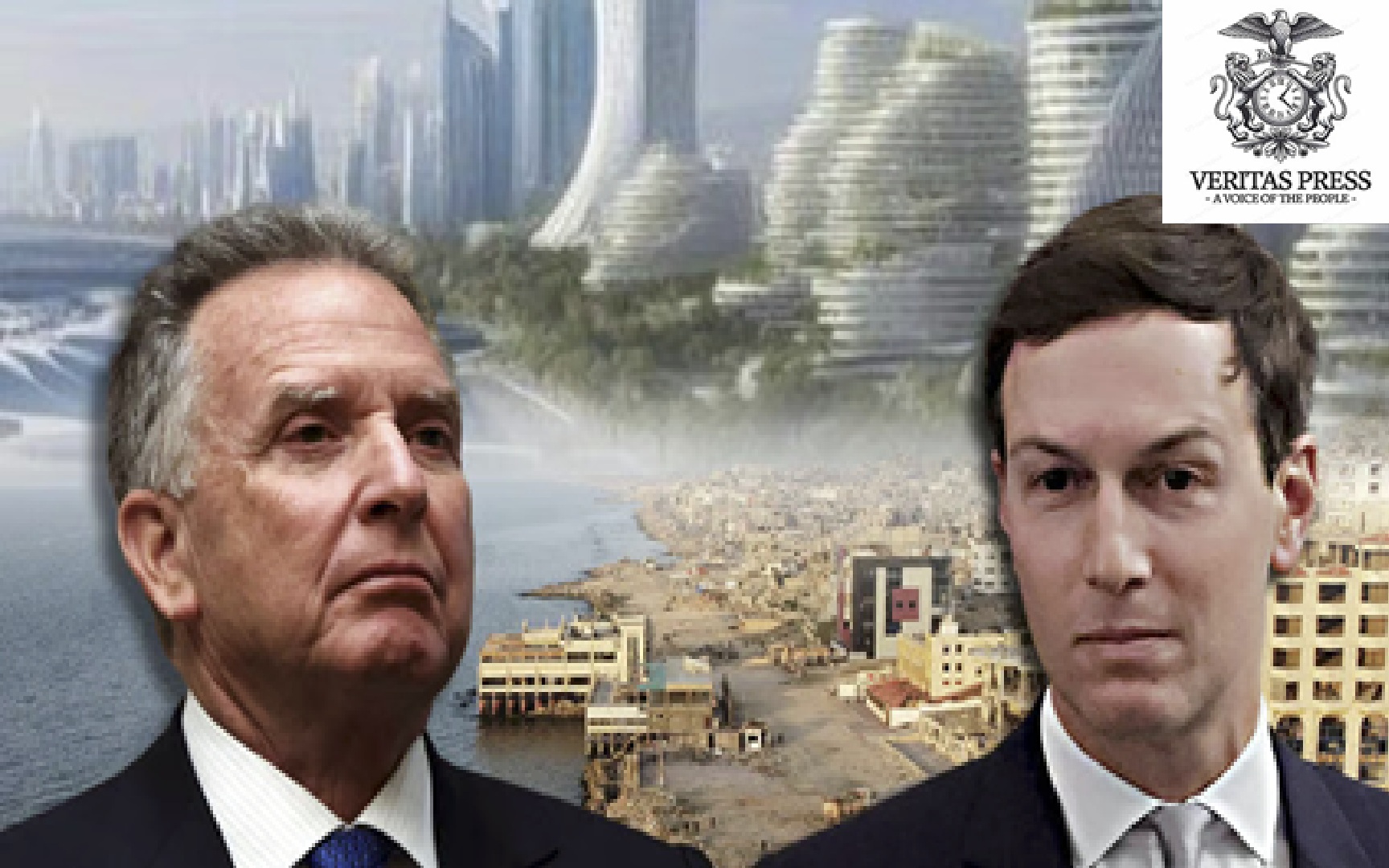

Title: “Project Sunrise”: Inside Kushner And Witkoff’s Vision To Rebuild Gaza As A Luxury Metropolis
Press Release: Veritas Press C.I.C.
Author: Kamran Faqir
Article Date Published: 28 Dec 2025 at 13:05 GMT
Category: US | Palestine-Gaza-West Bank | Project Sunrise
Source(s): Veritas Press C.I.C. | Multi News Agencies
Website: www.veritaspress.co.uk

Business Ads

From mass graves and rubble to penthouses and AI railways, Washington’s latest Gaza blueprint raises profound questions about displacement, accountability, and the political economy of reconstruction.
As more than two million Palestinians remain displaced across the ruins of Gaza, many living in flooded tents amid winter storms, the Trump administration has quietly circulated a glossy proposal envisioning a radically different future for the enclave: a high-tech, luxury coastal metropolis built atop the wreckage of war.
(Photo: From The Wall Street Journal)
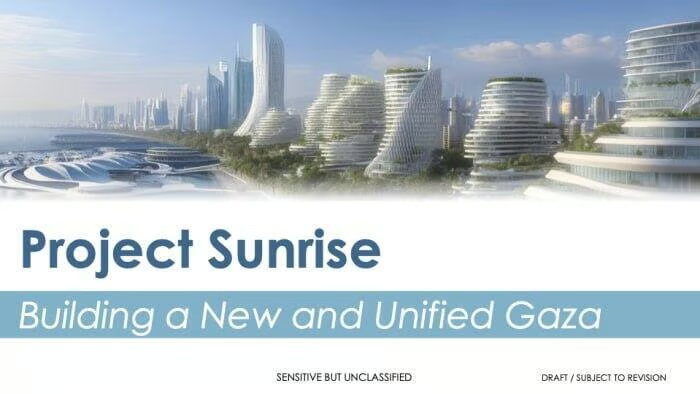
Dubbed “Project Sunrise,” the plan is the brainchild of a team led by Jared Kushner, President Donald Trump’s son-in-law, and Steve Witkoff, Trump’s Middle East envoy. According to US officials and reporting by The Wall Street Journal, the proposal is laid out in a 32-slide PowerPoint presentation, labelled “sensitive but unclassified,” and pitched to wealthy Gulf states, Turkey, Egypt, and international financial institutions.
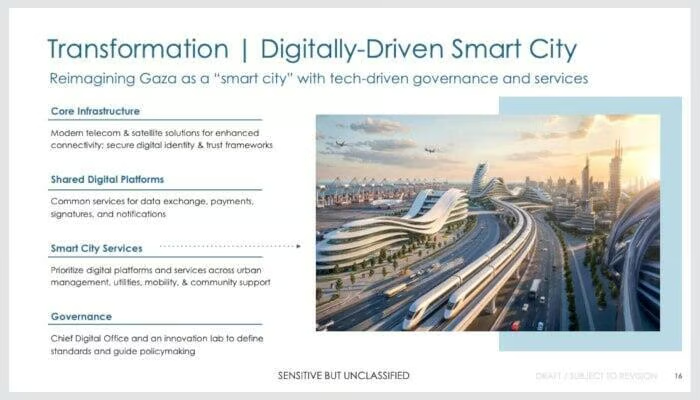
Its premise is sweeping and deeply controversial: transform Gaza from a besieged, devastated territory into a futuristic economic hub featuring luxury beachfront resorts, high-speed rail, AI-managed power grids, tech industry, and a monetised Mediterranean coastline, all within a 10- to 20-year reconstruction roadmap.
Yet behind the sleek renderings and cost tables lies a plan that critics say sidesteps core political realities, erases Palestinian rights, and treats Gaza less as a homeland than as a post-war development opportunity.
From Rubble to ‘Gazalago’
(Photo: From The Wall Street Journal)
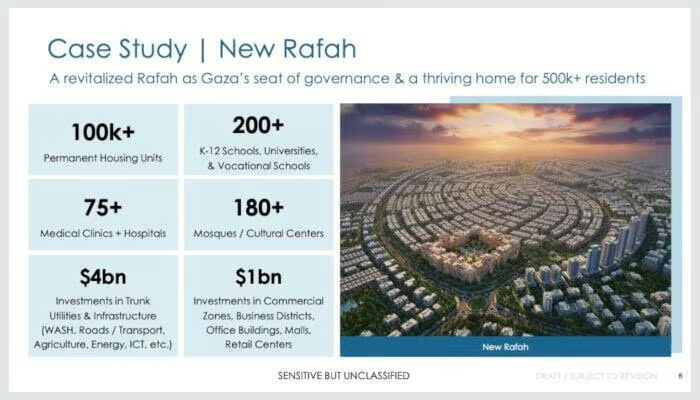
Project Sunrise imagines a Gaza rebuilt in four geographic phases, beginning in the south and ending in Gaza City. The plan proposes:
- “New Rafah” as Gaza’s new seat of governance, housing over 500,000 residents in more than 100,000 housing units
- Over 200 schools, 75 medical facilities, and 180 mosques and cultural centres
- Gaza City re-envisioned as a “smart city” with tech-driven governance
- By year 10, 70% of Gaza’s coastline is “monetised” into luxury developments, expected to generate $55 billion in long-term returns.
The total projected cost: $112.1 billion over 10 years, with the United States offering to “anchor” nearly $60 billion in grants and loan guarantees, roughly 20% of the overall financing, while expecting Gulf states and private investors to cover the rest. The World Bank is expected to play a central role in structuring financing.
But the proposal is notably silent on one central issue: where Gaza’s displaced population would live during the years-long reconstruction.
Demilitarisation As Precondition:
On the second slide of the presentation, highlighted in bold red text, is a condition without which the entire plan collapses:
Hamas must fully demilitarise and decommission all weapons and tunnels.
Only then, the proposal states, would Israeli forces withdraw, an interim authority take over governance, and reconstruction begin.
US and Israeli officials have insisted that no rehabilitation is possible without Hamas’ disarmament, an outcome the group has repeatedly rejected. Even within Washington, officials have expressed scepticism. Steven Cook of the Council on Foreign Relations remarked bluntly:
“They can make all the slides they want. No one in Israel thinks they will move beyond the current situation, and everyone is okay with that.”
The plan remains stuck in what it calls “Phase 1,” pending unresolved hostage issues and Hamas’ refusal to disarm. Yet Kushner and Witkoff have continued pitching the proposal as if political obstacles are merely technical delays.
Reconstruction Without Accountability:
What Project Sunrise does not address is just as striking as what it promises.
According to the United Nations, more than 123,000 buildings in Gaza have been destroyed, with another 75,000 damaged, accounting for over 80% of all structures in the enclave. The devastation has produced 68 million tons of rubble, much of it contaminated with unexploded ordnance and the remains of an estimated 10,000 bodies still buried beneath the debris.
Yet the plan frames rubble removal and reconstruction as a clean slate, not as a process entangled with war crimes investigations, property rights, or the right of return.
Human rights organisations warn that large-scale reconstruction without accountability risks cementing the results of military destruction. “You cannot rebuild Gaza as if the destruction were a natural disaster,” one legal analyst noted. “This was the outcome of deliberate policy choices.”
The plan also assumes Israeli cooperation in allowing heavy machinery, explosives-clearing equipment, and construction materials into Gaza, despite Israel’s ongoing restrictions on such items, which aid agencies say have already stalled basic rubble removal.
Luxury Futures Amid Humanitarian Collapse:
The timing of Project Sunrise has drawn particular criticism. As the proposal circulates among diplomats and investors, most Palestinians in Gaza remain homeless, exposed to flooding, hunger, and disease. Winter storms have killed dozens, including children, as tents collapse and waterlogged camps become uninhabitable.
Aid groups say the contrast between Gaza’s present reality and Washington’s luxury renderings is jarring. “We are treating hypothermia and crush injuries from collapsing buildings,” one Gaza-based medic said. “And they are talking about penthouses.”
The Palestinian NGOs Network estimates more than 900,000 displaced people are living in fragile tents, many reused after multiple storms. Meanwhile, fuel shortages, destroyed sewage systems, and blocked aid convoys continue to exacerbate public health risks.
(Photo: From The Wall Street Journal)
A Political Economy Of Reconstruction:
Analysts describe Project Sunrise as part of a broader trend: post-war reconstruction as an investment frontier, where donor states and private capital shape political outcomes through development frameworks.
By envisioning Gaza as a revenue-generating Riviera, rather than a besieged territory whose population has legal and political rights, the plan reflects what critics call a “real estate logic” of peacebuilding.
“This is Oslo with better PowerPoint,” said one regional analyst. “Economic incentives are being offered in place of political self-determination.”
Even US officials concede the risks. Secretary of State Marco Rubio acknowledged that investors will not commit if another war remains likely. “No one will invest if they think everything will be destroyed again,” he said, an admission that underscores the fragility of the proposal’s assumptions.
Conclusion: Reconstruction Without Justice Is Another Form Of Ruin.
Project Sunrise presents itself as a bold vision for Gaza’s future, but beneath its glossy slides and futuristic renderings lies a deeply troubling premise: that Gaza’s devastation can be treated as a technical problem of urban planning and investment rather than the outcome of sustained military violence, mass displacement, and political siege. By leaping from rubble to Riviera without reckoning with responsibility, the plan risks transforming reconstruction into a mechanism that normalises destruction instead of repairing it.
The proposal’s silence on accountability is not incidental. It does not confront who destroyed more than 80 percent of Gaza’s buildings, who rendered over two million people homeless, or who continues to exercise control over Gaza’s borders, airspace, coastline, and access to reconstruction materials. Instead, it assumes these realities can be erased through capital flows and architectural vision. In effect, the reconstruction being proposed is built upon the blood of innocents, on neighbourhoods levelled, families buried beneath rubble, and lives extinguished without justice or redress.
By conditioning Gaza’s rehabilitation on the total demilitarisation of Hamas while leaving Israel’s military dominance, siege architecture, and record of devastation untouched, Project Sunrise embeds a profoundly asymmetrical logic. Palestinians are required to surrender political agency as a prerequisite for survival, while those responsible for the physical destruction of the enclave face no parallel obligations of withdrawal, reparations, or guarantees against renewed assault. This is not peacebuilding; it is compliance dressed as recovery.
Equally alarming is the plan’s treatment of Gaza’s population as a logistical obstacle rather than a rights-bearing people. The absence of clear guarantees on where displaced Palestinians would live during a decade-long reconstruction, while vast stretches of coastline are earmarked for monetisation and luxury development, raises serious concerns about displacement by design. Human rights organisations warn that rebuilding without explicit protections for property rights, return, and local consent risks permanently entrenching the consequences of mass destruction under the language of development.
In this context, Project Sunrise exemplifies a broader and dangerous trend: the conversion of catastrophe into opportunity, where war devastation becomes a gateway for speculative investment, and humanitarian collapse is reframed as a blank slate. Gaza is not being offered sovereignty, security, or self-determination; it is being offered a marketable future, contingent on political submission and donor confidence.
Meanwhile, Palestinians on the ground are not living inside PowerPoint slides. They are surviving winter storms in collapsing tents, digging loved ones from rubble, and mourning children killed not only by bombs, but by exposure, starvation, and neglect. The distance between Gaza’s lived reality and Washington’s luxury renderings is not merely rhetorical; it is proof of a vision detached from the human cost it refuses to acknowledge.
A genuine path to recovery cannot begin with beachfront resorts or AI-powered grids. It must begin with ending the siege, lifting restrictions on aid and rebuilding materials, enforcing accountability for mass civilian harm, and recognising Palestinians’ sovereignty with the right to determine their own future. Until justice is treated as a foundation rather than an inconvenience, any reconstruction plan, no matter how ambitious, will remain what Project Sunrise ultimately represents: a vision erected atop unresolved ruins and the blood of innocents.