





Press Release: Veritas Press C.I.C.
Author: Kamran Faqir
Article Date Published: 07 Nov 2025 at 17:15 GMT
Category: US | Economy | People Will Go Hungry
Source(s): Veritas Press C.I.C. | Multi News Agencies
Website: www.veritaspress.co.uk

Business Ads

Inside the Trump Administration’s SNAP Funding Standoff, and How 42 Million Americans Were Dragged Into a Shutdown Power Game.
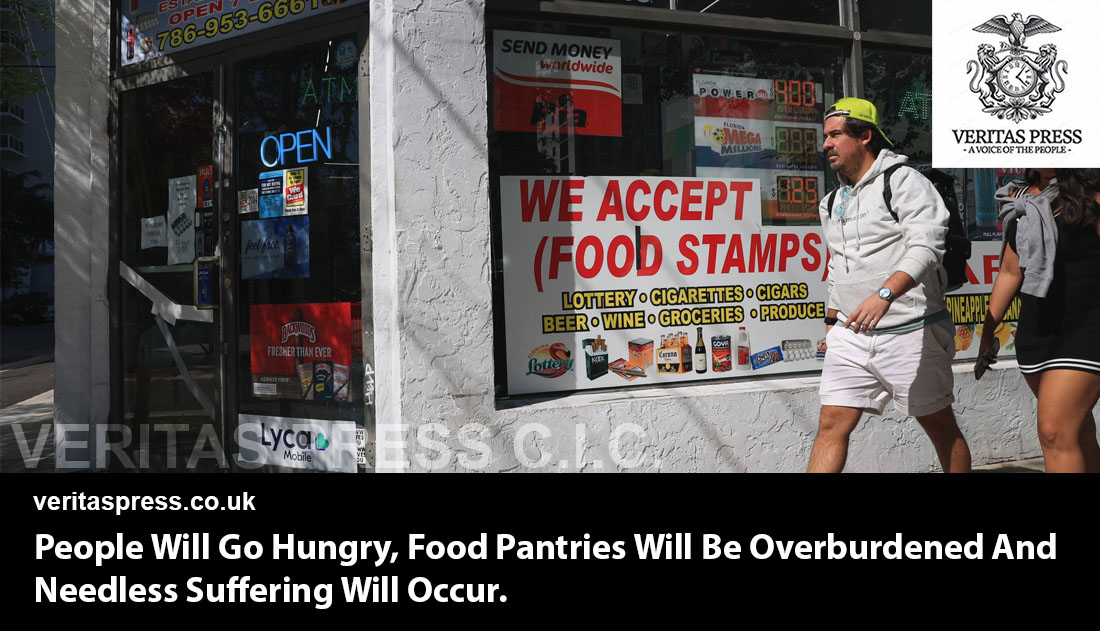
“The evidence shows that people will go hungry, food pantries will be overburdened, and needless suffering will occur.” Those were the words of U.S. District Judge John J. McConnell Jr., issued from a Providence courtroom on November 6, 2025, as he ordered the Trump administration to fully fund Supplemental Nutrition Assistance Program (SNAP) benefits for more than 42 million Americans by the following Friday.
In a sharply worded 52-page ruling, Judge McConnell said the administration’s decision to issue only partial payments to millions of low-income families during the ongoing government shutdown was “not merely negligent but unlawful.” He accused federal officials of ignoring their legal authority to use available funds and allowing political considerations to shape a policy that would directly increase hunger across the United States.
“People will go hungry,” the judge said. “Food pantries will be overburdened, and needless suffering will occur. The law does not permit the executive to use essential nutrition assistance as a bargaining tool.”
A Political Standoff Becomes A Human Emergency:
The case, Democracy Forward et al. v. USDA, was filed by a coalition of food security advocates, legal aid groups, and state-level nonprofits. Their complaint alleged that the administration’s partial payment plan, covering only 65% of benefits for November, would plunge millions into a crisis.
The USDA, under Secretary Ted McKinney, had argued that it lacked sufficient contingency funds to deliver full payments and that Congress’s failure to pass a continuing resolution left the department “legally constrained.” It proposed using roughly $4.65 billion from its emergency reserve to fund partial benefits while holding back other resources, including a $23.3 billion Section 32 fund used for agricultural support programs.
But the court was unconvinced.
“Those funds are not hypothetical,” McConnell wrote. “They exist, and the executive has discretion to use them in the public interest.”
The ruling, effective immediately, ordered the government to use any available funds, including Section 32, to deliver full benefits by November 8.
The White House responded furiously. Vice President J.D. Vance called the decision “an absurd judicial overreach,” accusing “activist judges” of interfering in budgetary politics. “Courts can’t appropriate funds,” he told Fox News. “Congress controls spending, not liberal judges in Rhode Island.”
Yet for millions of SNAP recipients, the fight in Washington was less about constitutional theory and more about survival.
“People Are Just Nervous, Scared”
In cities and towns from Newark, New Jersey, to Tucson, Arizona, food banks have been operating at full capacity since the shutdown began.
At the Community FoodBank of New Jersey, volunteers load boxes of produce, canned beans, and milk substitutes into long lines of cars. “People are just nervous, scared,” says Jill Corbin, director of a St. Vincent de Paul soup kitchen in nearby Bergen County. “We’re seeing families we’ve never seen before, people who had jobs until a few weeks ago, or retirees waiting for their SNAP cards to reload.”
That anxiety has become widespread. In Ohio, where the average monthly SNAP benefit is about $190, local agencies reported a 40% surge in emergency pantry visits during the first week of November alone. “We’re rationing food,” says Linda Hayes, coordinator of the Akron-Canton Regional Food Bank. “It’s not supposed to be this way.”
Skye Perryman, president of Democracy Forward, the nonprofit that filed the suit, called the ruling a “lifeline for millions who have been caught in a political crossfire.”
“What the administration tried to do was leverage hunger to gain partisan advantage,” Perryman said. “The court saw through that. Hunger is not a bargaining chip; it’s a human right.”
Inside The Numbers: A Calculated Shortfall.
SNAP, the federal government’s largest anti-hunger program, reaches roughly one in eight Americans. Its $8–9 billion monthly cost is distributed across 50 states and territories via Electronic Benefit Transfer (EBT) cards.
But SNAP is also a joint federal–state operation, reliant on outdated technology and patchwork administrative systems. In many states, EBT updates can take weeks to process, making even short-term funding lapses disastrous.
The USDA acknowledged in court filings that partial funding would create “administrative burdens” and “delivery delays” in some states. Yet it still opted for the 65% plan, rather than using Section 32 or other discretionary funds to bridge the gap.
Legal experts say that the decision was political, not logistical.
“This wasn’t about capability,” said Dr. Anne Brody, a policy analyst at the Centre on Budget and Policy Priorities (CBPP). “It was about optics, the administration wanted to make the shutdown feel. SNAP became a pressure point.”
Judge McConnell agreed. His opinion cites internal USDA memos showing the agency was warned that partial payments would cause “widespread food insecurity,” but senior officials declined to change course.
“The harm was not only foreseeable, it was foreseen,” he wrote.
The Shutdown Logic: Hunger As Leverage.
The court’s findings cast the administration’s approach as part of a broader strategy: using social programs to amplify pressure on congressional Democrats.
Throughout October, President Trump repeatedly told reporters he would “not reward obstruction” by Democrats seeking to pass a “clean” funding bill.
“We’re not going to pay for programs while Democrats hold government hostage,” Trump said at a rally in Pennsylvania on October 25. “They want open borders and bloated welfare. I’m not signing that.”
That rhetoric, legal advocates argue, crossed into policy when the USDA refused to use available discretionary funds.
Kristin Bateman, senior counsel for Democracy Forward, told reporters after the ruling that the President’s own words became evidence of intent.
“The administration admitted its motive in public,” she said. “They wanted people to feel pain so Congress would bend.”
Democratic Lawmakers Seized On That Point.
Sen. Patty Murray (D–Wash.), chair of the Senate Appropriations Committee, said in a statement:
“I have never seen an American President so desperate to force children and seniors to go hungry.”
Republican allies, however, defended the administration’s approach as “fiscal realism.”
Rep. Jim Jordan (R–Ohio) argued that “courts can’t compel spending we haven’t appropriated,” and accused Democrats of “weaponising the judiciary to override the Constitution.”
Legal And Political Fallout:
The administration immediately filed an emergency appeal to the First Circuit Court of Appeals, arguing that the ruling “usurps executive discretion and separation-of-powers principles.”
But constitutional scholars say the court’s decision reflects a well-established precedent: the executive has an ongoing duty to administer essential programs when Congress has already authorised them.
“This is not about appropriations, it’s about administration,” said Prof. Leah Litman, a constitutional law expert at the University of Michigan. “Congress has already legislated SNAP as permanent law. The question is whether the executive used available means to uphold it. The judge found they did not.”
Still, even with the ruling, logistical barriers remain.
Many state SNAP systems are understaffed, and delayed updates mean that millions of EBT cards may not reflect full balances until late November, even if federal money arrives.
Advocates fear the temporary gap could cause lasting damage.
“When a family skips meals for a week, it’s not just hunger, it’s stress, lost school attendance, health decline,” said Dr. Rajeev Menon, a nutrition researcher with Feeding America. “The recovery time can be months.”
The Human Cost: Stories From A System Under Strain.
In Birmingham, Alabama, 32-year-old Crystal Johnson, a mother of three, checked her EBT balance on November 3 and found $78 instead of her usual $120.
“I thought it was a mistake,” she said. “Then I saw on the news it wasn’t.”
Crystal now relies on a church pantry that gives her two bags of groceries every Thursday.
“I voted for Trump,” she said quietly. “I didn’t think it would come to this.”
In Fresno, California, farmworker Miguel Ortega, 58, said he stopped buying meat altogether.
“We just buy rice, beans, and eggs. My kids eat first,” he said. “They say the money is stuck in Washington, but we are stuck here.”
At Bread for the City, a nonprofit in Washington, D.C., director George Aponte said demand has doubled since mid-October.
“It’s like 2020 all over again,” he said. “Lines around the block. People crying. And all for something that could’ve been avoided.”
Analysts Warn Of Precedent: “The New Normal Of Weaponised Welfare.”
Policy experts say the standoff signals a dangerous shift in U.S. governance, one where social safety nets become instruments of political leverage.
“What we’re seeing is the normalisation of brinkmanship using human needs,” said Kathryn Eden, senior fellow at the Brookings Institution. “If one administration can suspend or underfund SNAP to extract policy concessions, what’s next, Medicaid, Social Security?”
The concept, sometimes called “administrative starvation”, has appeared before. During the 2019 shutdown, the Trump administration advanced February SNAP payments early to avoid funding lapses, a move that left recipients with gaps the following month.
But this time, the administration chose not to act pre-emptively, and, according to the court, did so for political effect.
“We’re watching a test case for how far executive power can go in withholding legally mandated aid,” said Ellen Weiss, a Washington Post economic correspondent. “And the courts are now the last barrier.”
Inside The USDA: What The Documents Reveal.
Court exhibits reviewed by Reuters and The Washington Post show internal USDA legal memos debating the use of Section 32 funds as early as mid-October.
One draft, marked Confidential, warned that “refusal to deploy available resources could be viewed as capricious given predictable harm.”
Another memo from the Office of Budget and Program Analysis (OBPA) raised concerns that tapping Section 32 could “set a precedent for other entitlement programs,” signalling the administration’s political calculus.
“They knew they could do it,” said a former USDA official who requested anonymity. “But the directive from above was clear: hold the line. No funding without a deal.”
That aligns with what the judge called “deliberate inaction.”
“This was not bureaucratic inertia,” McConnell wrote. “It was policy.”
A Crisis Measured In Meals:
According to Feeding America, every 1% cut in SNAP benefits translates to 400 million fewer meals per month nationwide.
Under the administration’s partial-payment plan, the reduction would have amounted to 3.5 billion lost meals in November alone.
Food banks can absorb only a fraction of that demand.
The Community FoodBank of New Jersey, one of the largest in the country, distributed 97 million meals in 2024. “That’s not even three days of SNAP,” said its CEO, Carlos Rodriguez. “We can’t replace federal infrastructure with charity.”
The knock-on effects are severe: grocery stores in low-income areas see falling sales; local governments face rising emergency-aid costs; hospitals report spikes in nutrition-related illnesses.
“It’s a chain reaction,” said Dr. Menon. “Hunger is not isolated; it cascades.”
The Appeal And What Comes Next?
As of publication, the Justice Department has filed an emergency motion for a stay, arguing that the district court “overstepped by compelling discretionary spending.” The First Circuit has scheduled an expedited hearing for November 12.
Legal analysts say the case could reach the Supreme Court if the administration refuses compliance or seeks a long-term ruling on executive discretion. But advocates fear that by then, the damage will already be done.
“The courts can’t refill empty pantries,” said Perryman. “Justice delayed is dinner denied.”
Meanwhile, several Democratic governors, including Gretchen Whitmer (Michigan) and Josh Shapiro (Pennsylvania), have directed their state treasuries to frontload SNAP benefits in case federal transfers stall.
“We won’t let politics starve our people,” Whitmer said in a televised address.
Republican-led states, however, have mostly declined to intervene. In Texas, a spokesperson for Governor Greg Abbott said the state “will not assume federal obligations created by judicial activism.”
The Broader Pattern: Governance By Crisis, This Isn’t An Isolated Episode.
From the CDC pandemic funding freeze earlier this year to delayed child-nutrition reimbursements, federal agencies have increasingly used discretionary levers as bargaining tools.
Analysts warn that this trend erodes both program stability and public trust.
“We are entering an era of governance by crisis,” said Dr. Brody of CBPP. “Each shutdown becomes a test of who suffers first, and SNAP recipients are always near the front of the line.”
At its core, the dispute reflects a clash of two visions of government: one that sees social programs as guarantees of basic dignity, and another that treats them as negotiable policy instruments.
The courts have now drawn a line. But whether that line holds will depend on how forcefully Congress, the judiciary, and the public respond to the weaponisation of hunger.
“The Law Doesn’t Stop At The Grocery Store”:
On Friday morning, as the order took effect, the USDA instructed states to “begin preparations” to load full SNAP benefits. But implementation remains uneven.
In Kentucky, officials said benefits would not reach EBT cards until November 15, citing “processing constraints.”
In Arizona, the state portal crashed under heavy traffic from anxious recipients checking their balances.
And in New York, advocates reported that thousands of families still received partial payments.
“The law doesn’t stop at the grocery store,” said Sarah Silver, policy director at Hunger Free America. “If the court says full benefits, families should see full benefits. Anything less is contempt, moral if not legal.”
For now, the ruling stands as a legal and symbolic rebuke, but not yet as relief in the checkout aisle.
Conclusion: A Policy War Over Hunger.
The court’s ruling is more than a bureaucratic rebuke; it is a moral indictment of an administration accused of waging a silent war on the poor. Behind the numbers, 42 million Americans facing hunger are the exhausted parents juggling bills, the elderly cutting medication to buy food, and children going to school hungry in the world’s wealthiest nation.
Legal experts warn that this decision underscores an alarming pattern of executive defiance against judicial oversight. “The administration has treated food assistance not as a right, but as a bargaining chip,” said constitutional scholar Dr. Maya Green of Georgetown University. “That sets a dangerous precedent for how future governments might weaponise poverty itself.”
Anti-hunger groups hailed the ruling as a “rare victory for accountability,” but many activists remain sceptical. “The court can compel action, but it can’t force compassion,” said Feeding America’s policy director, Jordan Mills. “We’ve seen this administration drag its feet before delays mean empty plates.”
Media analysts have also noted how the issue of food insecurity has been buried under partisan noise. “It’s stunning how normalised hunger has become in American politics,” wrote journalist Maria Sanchez in The Guardian. “The richest country on Earth debates whether feeding its people is too costly.”
When historians look back on this shutdown, they may not remember the partisan talking points. They’ll remember the empty refrigerators, the crowded food banks, the parents skipping dinner so their children could eat. They’ll remember a federal government that treated hunger as negotiable.
Judge McConnell’s order may force the administration’s hand. But it also exposes how fragile America’s safety net has become, dependent not only on budget votes but on political will. “The test of government,” the judge wrote, “is not how it rewards the powerful, but how it treats the hungry.”
For 42 million Americans, that test isn’t theoretical. It’s what’s for dinner, or what isn’t.
Ultimately, this is not merely a story about administrative compliance; it’s about the collapsing moral architecture of governance. As public trust erodes and inequality deepens, the fight over food aid exposes a broader crisis: a government increasingly indifferent to the suffering of its citizens.
As one community organiser in Detroit put it, “We don’t need court orders to know people are starving. We need a government that acts before the judge has to tell it to.”
And as billions are withheld from the nation’s hungry, one question remains unanswered, if not to feed its people, where is this money going?
Tags: