





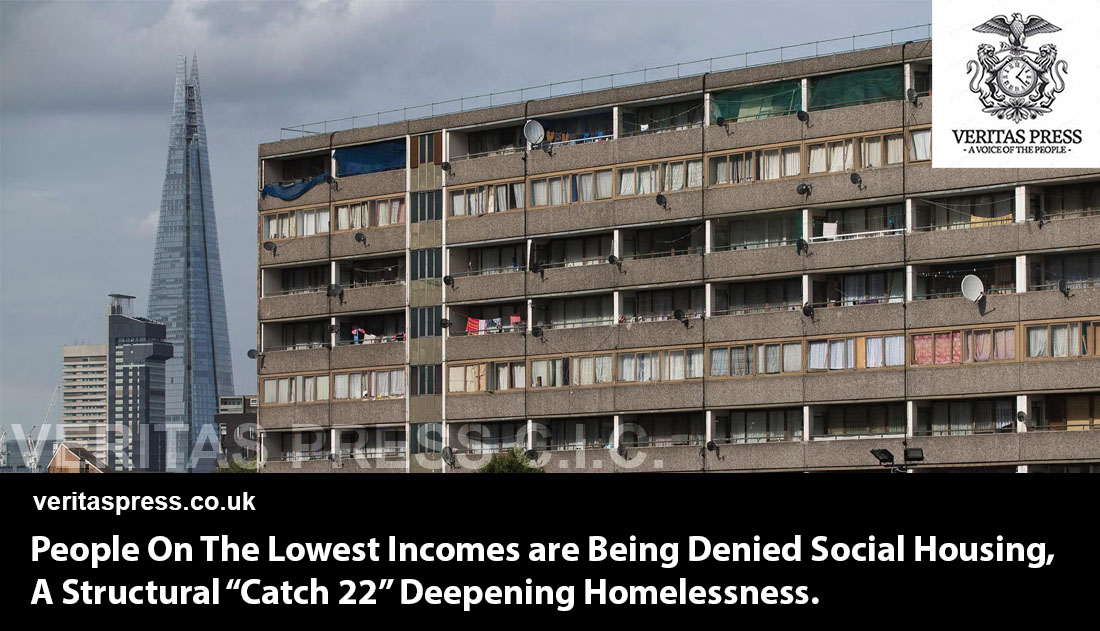

Title: People On The Lowest Incomes are Being Denied Social Housing, A Structural “Catch‑22” Deepening Homelessness.
Press Release: Veritas Press C.I.C.
Author: Kamran Faqir
Article Date Published: 08 Dec 2025 at 14:46 GMT
Category: UK | Politics | People On The Lowest Incomes Being Denied Social Housing
Source(s): Veritas Press C.I.C. | Multi News Agencies
Website: www.veritaspress.co.uk

Business Ads


A landmark new report by Crisis, conducted in collaboration with Heriot-Watt University and the UK Collaborative Centre for Housing Evidence, reveals a shocking reality: in England, the poorest individuals are being systematically denied access to social housing because they rely on benefits or have incomes deemed too low or too risky by housing associations.
With the supply of social homes dwindling, housing associations are increasingly applying strict criteria, from “affordability checks” to benefit‑status screening, that disproportionately penalise the most financially vulnerable, pushing them further into housing insecurity, temporary shelters, or outright homelessness. One housing association summed up the grim logic as akin to “rearranging the deckchairs on the Titanic,” underlining the sense of a doomed system shuffling people around while the underlying housing crisis intensifies.
On any given night in England, over 26,000 single people are homeless. They include people who are employed, benefit-dependent, or living on minimal incomes, the very groups social housing was meant to protect. Yet, according to the Crisis report, these individuals are increasingly denied access to social housing because their incomes or benefit status make them “too risky” for housing associations.
Francesca Albanese, executive director of policy and social change at Crisis, describes the problem as a “catch-22”:
“People are looking to move into a social rent home, and they’re basically told no because of their financial circumstances. But where else can people live?”
The research, published in 2025, paints a stark picture. Roughly a third of housing associations surveyed admitted that affordability checks, which evaluate a tenant’s income against rent costs, led to refusals. Nearly a quarter reported excluding households below a certain income threshold from registering for social housing at all. Meanwhile, 71% cited benefit restrictions, such as the benefit cap and freezes on housing benefit, as key factors driving rejections.
Structural Failures: Shrinking Stock And Rising Demand.
Social housing in England has shrunk dramatically over the last two decades. In 2023–24 alone, 20,560 social homes were lost while just 19,910 were delivered, a net loss of 650 homes. Meanwhile, waiting lists continue to grow, with around 1.33 million households queued for social housing.
“We’re seeing households with no acute support needs trapped in temporary accommodation for months, sometimes years,” says Jon Sparkes, chief executive of Crisis.
“Restricted eligibility for social housing is trapping more and more people in a cycle of homelessness that they have no route out of.”
The social housing crisis compounds a private rental market that is increasingly unaffordable. Less than 3% of private rental properties are affordable to people on housing benefit, leaving low-income households with few alternatives. Many are pushed into temporary accommodation or shelters, often with minimal support, further destabilising their lives.
Affordability Checks And Risk Aversion: The Commercialisation Of Social Housing.
Housing associations increasingly behave like private lenders, conducting affordability checks and setting income thresholds that disproportionately exclude benefit-dependent applicants. The new research confirms what earlier investigations warned: welfare-dependent tenants are often viewed as “too risky,” and applicants with complex needs are similarly disadvantaged.
“Housing associations are more wary in terms of taking on risk, and clearly, welfare reform is part of that,” explains Albanese.
“They also don’t want to take on applicants with high vulnerability if they can’t support them, because they are worried about tenancy sustainment.”
This risk-averse approach has transformed social housing from a public good into a selective, market-style system, prioritising tenants who can guarantee rent payments over those in genuine need.
Case Studies: Real People Caught In The System.
James, 32, Birmingham: James has worked part-time in retail while relying on housing benefit to cover his rent. Despite stable employment and no prior arrears, he was refused access to social housing.
“I’m not claiming I can’t pay my rent, I just don’t earn enough to meet their thresholds. I ended up in a hostel for three months. It’s dehumanising,” he says.
Amina, 28, Manchester: A single mother with two children, Amina was denied a place on the local housing register due to past rent arrears. She now cycles between temporary B&Bs, struggling to maintain her children’s schooling.
“Every time we move, it’s a new school, new teachers, new friends. I feel like my kids are paying for mistakes I made when I was younger,” she says.
These cases highlight the human cost of policies that deny access based on income or perceived financial risk, leaving households trapped in precarity.
Government Response: Promises Versus Reality.
The Ministry of Housing, Communities and Local Government has pointed to a record £39 billion investment over the next decade, in social and affordable housing and a £1 billion fund aimed at tackling homelessness.
“We’re taking decisive action to fix this, building the biggest boost to social and affordable housing in a generation,” said a spokesperson.
Yet critics argue that investment alone will not solve the problem. Net social housing stock continues to decline, and temporary accommodation has become the default option for households that cannot access social housing. As Crisis notes, without reforming eligibility criteria, affordability checks, and benefit alignments, the system will continue to exclude those most in need.
“The government’s new social housing initiative is welcome, but it doesn’t address the rules that shut out the poorest people,” says Sparkes.
Policy gaps and solutions:
England lags behind Scotland, where housing associations have a legal duty to accommodate homeless households. In England, only 27% of new social lettings go to homeless households, compared to 54% in Scotland.
Crisis Calls For:
- Ending blanket housing register exclusions based on income, past arrears, or local connection.
- Legal obligations for housing associations to house the homeless and low-income households.
- Welfare reforms to ensure housing benefit reflects real rental costs.
- Rapid expansion of social housing at social rent levels, rather than affordable or shared ownership options.
- Prioritising long-term housing solutions over temporary accommodation.
Media And Public Perspectives:
The Guardian, reporting on the Crisis findings, warned that social housing is increasingly “reserved for those with steady incomes, while the most vulnerable are abandoned.”
Public testimony mirrors this critique. In online forums and interviews conducted by Crisis, applicants describe a system that feels punitive rather than supportive. One Twitter user from London wrote:
“They want you to be poor enough to need housing but rich enough to qualify for it. Where’s the sense in that?”
Housing commentators and charities also highlight the systemic nature of the crisis. The UN recently raised concerns over social landlords failing to provide adequate habitability standards, further compounding insecurity for tenants.
The Human Toll: Humiliation, Instability, Inter-Generational Harm:
Thousands of households, many with no acute support needs, face lives defined by instability, uncertainty, and indignity:
- Low-income retirees are forced to continue working to cover rent.
- Families and single people are trapped in temporary accommodation, with children’s schooling disrupted.
- A widening divide between those with “enough income” to access social housing and those without, effectively creating a two-tier system.
“People are trapped in a system that sees poverty itself as disqualifying,” Albanese warns.
Conclusion: England’s Social Housing System Is In Crisis, And The Poorest Are Paying The Price.
The evidence is unmistakable: England’s social housing system no longer functions as a safety net for those who need it most. Instead, it operates as a gatekeeping mechanism, systematically excluding the very people it was designed to protect. Housing associations, constrained by dwindling stock and increasingly punitive welfare reforms, have turned risk aversion into a structural barrier, denying access to benefit-dependent households and those with the lowest incomes.
This is not a temporary flaw or a bureaucratic hiccup; it is a policy-driven failure. Government welfare freezes, benefit caps, and insufficient investment in social housing combine with housing associations’ income thresholds to create a self-reinforcing cycle of exclusion. Thousands of households are trapped in temporary accommodation, shelters, or rough sleeping, while new homes, even when built, often fail to reach those most in need.
The human cost is severe and multidimensional. Families are destabilised, children’s education and wellbeing are disrupted, and single adults face prolonged periods of uncertainty and mental health strain. The poorest are being penalised for being poor, forced to navigate a housing system that treats poverty itself as a disqualifier.
Yet the solutions are clear. England must learn from Scotland and introduce legal obligations on housing providers to accommodate homeless and low-income households. Welfare support must align with actual rental costs, and social housing expansion must prioritise accessibility over marketised “affordable” schemes. Without these interventions, social housing will continue to reproduce inequality rather than alleviate it, turning one of society’s foundational safety nets into a system that perpetuates vulnerability.
The question is no longer whether reform is needed, it is whether policymakers have the political will to stop punishing the poorest and start guaranteeing the homes they deserve. Until then, the cycle of exclusion, instability, and homelessness will continue, leaving the most vulnerable trapped in a housing system that has failed them at every turn.