





Title: ‘Patients Are Dying In Corridors’: NHS Whistleblowers Expose A Crisis Engineered By Cuts, Not Chance.
Press Release: Veritas Press C.I.C.
Author: Kamran Faqir
Article Date Published: 30 Jan 2026 at 14:06 GMT
Category: UK | Health-NHS | ‘Patients Are Dying In Corridors’: NHS Whistleblowers Expose A Crisis Engineered By Cuts, Not Chance
Source(s): Veritas Press C.I.C. | Multi News Agencies
Website: www.veritaspress.co.uk

Business Ads


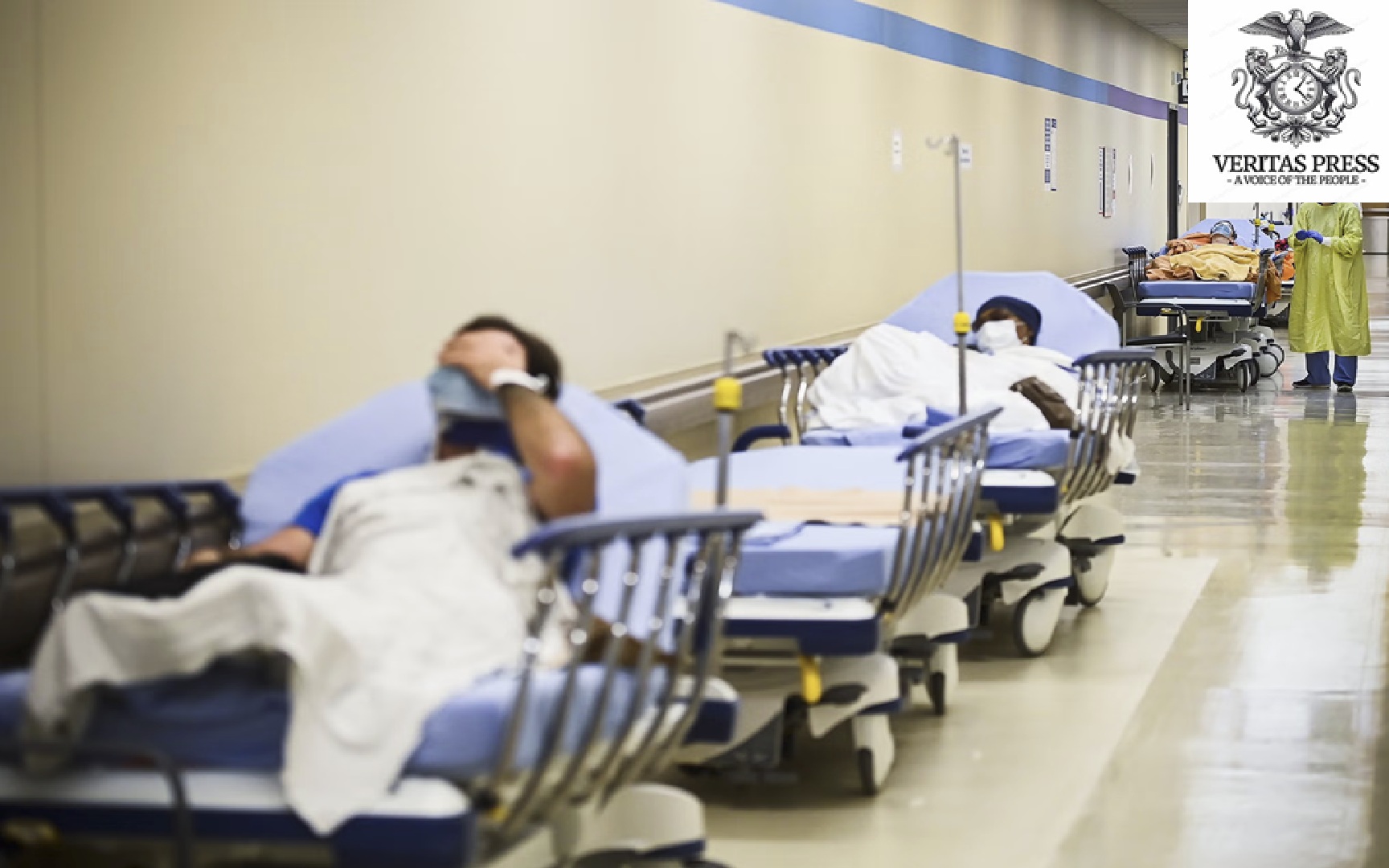
Patients are dying on hospital corridors across England as the NHS buckles under relentless pressure, a crisis that frontline workers, families and medical bodies say is no longer seasonal, accidental or unavoidable, but the foreseeable result of years of underfunding and resource depletion.
An NHS whistleblower has told ITV News that critically ill patients are routinely being treated on trolleys in corridors, cupboards and offices because hospitals have run out of beds, often without adequate monitoring, privacy or dignity.
“Today I walked through A&E, and there were patients upon patients on oxygen in the corridors,” the anonymous A&E worker said.
“It’s embarrassing to work for the NHS. It’s heartbreaking. It’s depressing.”
The worker described a system where so-called “corridor care” has become normalised.
“I feel ashamed that I’m allowing patients to be treated in this way. It’s like it’s normal, and it’s not normal. Patients are dying in corridors, and we’re just watching people die, and there’s nothing we can do about it.”
Thousands Of Deaths Linked To Delays, Even In Summer:
Exclusive analysis by the Royal College of Emergency Medicine (RCEM), shared with ITV News, shows the consequences are fatal. Last summer alone, outside the winter surge, more than 4,750 deaths in England were associated with long A&E waits.
RCEM estimates suggest around 16,600 people a year, 320 every week, now die as a direct result of delays in accessing emergency care or a ward bed.
Dr Ian Higginson, President of the RCEM, said the link between delays and death is no longer disputed.
“There is absolutely rock-solid evidence that long waits in emergency departments are associated with an increased risk of dying,” he said.
“We’ve published the data. We’ve warned about it. This isn’t a knowledge gap, it’s an action gap.”
Dr Higginson said even experienced staff are reaching the breaking point.
“In my last two shifts, I’ve had very senior nurses in tears. At times, I feel like crying too. We could do a really good job for our patients, but it’s so hard when the department is so full.”
‘Carnage’: Three Days On A Corridor With Sepsis.
For patients and families, the crisis is not abstract.
In August, not during winter pressures, Bernard Parkinson, 75, from Chorley, spent three days on a corridor at Royal Preston Hospital while being treated for sepsis.
His daughter, Sharron Smith, described the scene as “carnage”.
“There were people everywhere. Staff were running up and down. There was no privacy at all,” she said.
“It was horrendous. We were in tears most of the time.”
Bernard, who is partially sighted and unable to walk unaided, was left food he could not see.
“He didn’t know where he was. He was just talking to the wall,” Smith said.
“He ended up with severe burns from lying in his own urine.”
“No one told us this was dangerous,” she added. “If I’d known that lying there could kill him, I would have screamed louder. Instead, we were made to feel this was just how things are now.”
Corridor Care ‘A Type of Torture’:
The Royal College of Nursing (RCN) says such experiences are no longer exceptional. In a dossier based on testimony from 436 nurses across the UK, the union described corridor care as “a type of torture” that is killing patients and traumatising staff.
In one case, an elderly patient choked to death in a corridor, unseen. Another nurse said they were “having nightmares” after a patient died in a makeshift ward created from a departure lounge. A terminally ill patient in Yorkshire spent a week in an overflow area before dying shortly after being moved to a side room.
“I won’t ever forget that,” the nurse said.
Prof Nicola Ranger, the RCN’s general secretary, said corridor care now extends far beyond emergency departments.
“This testimony shows the devastating human consequences of a practice which has no place in our NHS,” she said.
“We declared this a national emergency because patients are being harmed in ways that are entirely preventable.”
Delayed Discharges And The Collapse Of Social Care:
At the centre of the crisis is a chronic lack of beds, driven in large part by delayed discharges, patients medically fit to leave the hospital but unable to do so because community and social care no longer exist at scale.
RCEM analysis shows that in 2025, an average of 12,906 patients per day were stuck in hospital despite being ready for discharge, the worst figure ever recorded. Last year, there were only 15 days when more patients were discharged than delayed.
Doctors say this is not an operational failure, but a structural one.
“When you cut social care, those patients don’t vanish,” said a senior emergency consultant. “They occupy beds. Those beds block emergency flow. And the people who arrive next wait, sometimes until they die.”
A Crisis Decades In The Making:
England now has one of the lowest hospital bed-to-population ratios in Europe, after tens of thousands of beds were removed over years of austerity. At the same time, workforce shortages have deepened, with staff leaving due to burnout, pay erosion and unsafe conditions.
“We’re not overwhelmed because people suddenly got sicker,” said an A&E nurse in the north of England.
“We’re overwhelmed because capacity was stripped out, beds, staff, community care. This is what underfunding looks like.”
The NHS safety watchdog has warned that “temporary care environments” pose serious risks, including infection, lack of monitoring and undetected deaths.
“We are managing collapse, not delivering care,” one senior nurse said. “Corridor care exists because it’s cheaper than fixing the system.”
Political Promises, Limited Accountability:
Health Secretary Wes Streeting has pledged to end corridor care by 2029 and restore the 18-week maximum wait for planned care. The government says it has invested £450 million in urgent and emergency care and points to AI triage, “super clinics” and new care centres as evidence of progress.
But staff say these measures manage pressure rather than reverse it.
“You can’t innovate your way out of austerity,” said one emergency physician.
“You can only fund your way out of it.”
Hospitals continue to declare OPEL 4, the highest safety alert, yet no mechanism exists that forces government intervention when corridor care becomes routine.
“The system is designed so no one is accountable,” said a consultant. “If a clinician caused this level of harm, they’d lose their licence. When policy causes it, nothing happens.”
‘This Is Not The NHS We Were Promised’:
For families, the erosion of dignity is inseparable from the erosion of trust.
“My mum died surrounded by strangers, not care,” said the daughter of a patient who died after waiting overnight in an overflow area. “They call it corridor care. There was no care.”
NHS workers say the most damaging aspect is knowing these deaths are preventable.
“We know what safe care looks like,” said an RCN nurse. “We just aren’t given the resources to deliver it.”
The evidence now leaves little ambiguity: patients die when care is delayed; delays are caused by bed shortages; bed shortages are the result of political choices.
Until funding is restored, new development needs met to match demand, across hospitals, workforce and social care, corridor deaths will remain not a tragic anomaly, but a grim feature of a hollowed-out system.
As one senior doctor put it:
“If this were a one-off disaster, there would be an inquiry.
Because it happens every day, we call it pressure.”
And in NHS corridors across England, patients continue to pay the price for that normalisation, quietly, invisibly, and far too often, fatally.

When Lieutenant Colonel Ebrahim Zolfaqari, spokesman for Iran’s Khatam al-Anbiya Central Headquarters, issued a warning

The historic Christian presence in Palestine, dating back to the earliest centuries of Christianity, is

JERUSALEM – For the first time since the aftermath of the Six-Day War, the courtyards

TEHRAN – As the sun rose on Eid al-Fitr, a day meant for celebration and

HUNGARY – As Benjamin Netanyahu prepares to travel to Hungary this weekend, a mounting legal

LONDON — In the polished corridors of 10 Downing Street, the language remains meticulously calibrated:

On March 20, 2026, the Pentagon quietly announced what amounts to a fundamental restructuring of

WASHINGTON / ISLAMABAD — A fresh warning by US Director of National Intelligence Tulsi Gabbard