

Title: Pakistan Joins Trump’s ‘Board Of Peace’: A Strategic Trap In Gaza And The Middle East Riviera Project.
Press Release: Veritas Press C.I.C.
Author: Kamran Faqir
Article Date Published: 31 Jan 2026 at 15:06 GMT
Category: South Asia-Pakistan | Politics | Pakistan Joins Trump’s ‘Board of Peace’: A Strategic Trap in Gaza and the Middle East Riviera Project
Source(s): Veritas Press C.I.C. | Multi News Agencies
Website: www.veritaspress.co.uk

Business Ads

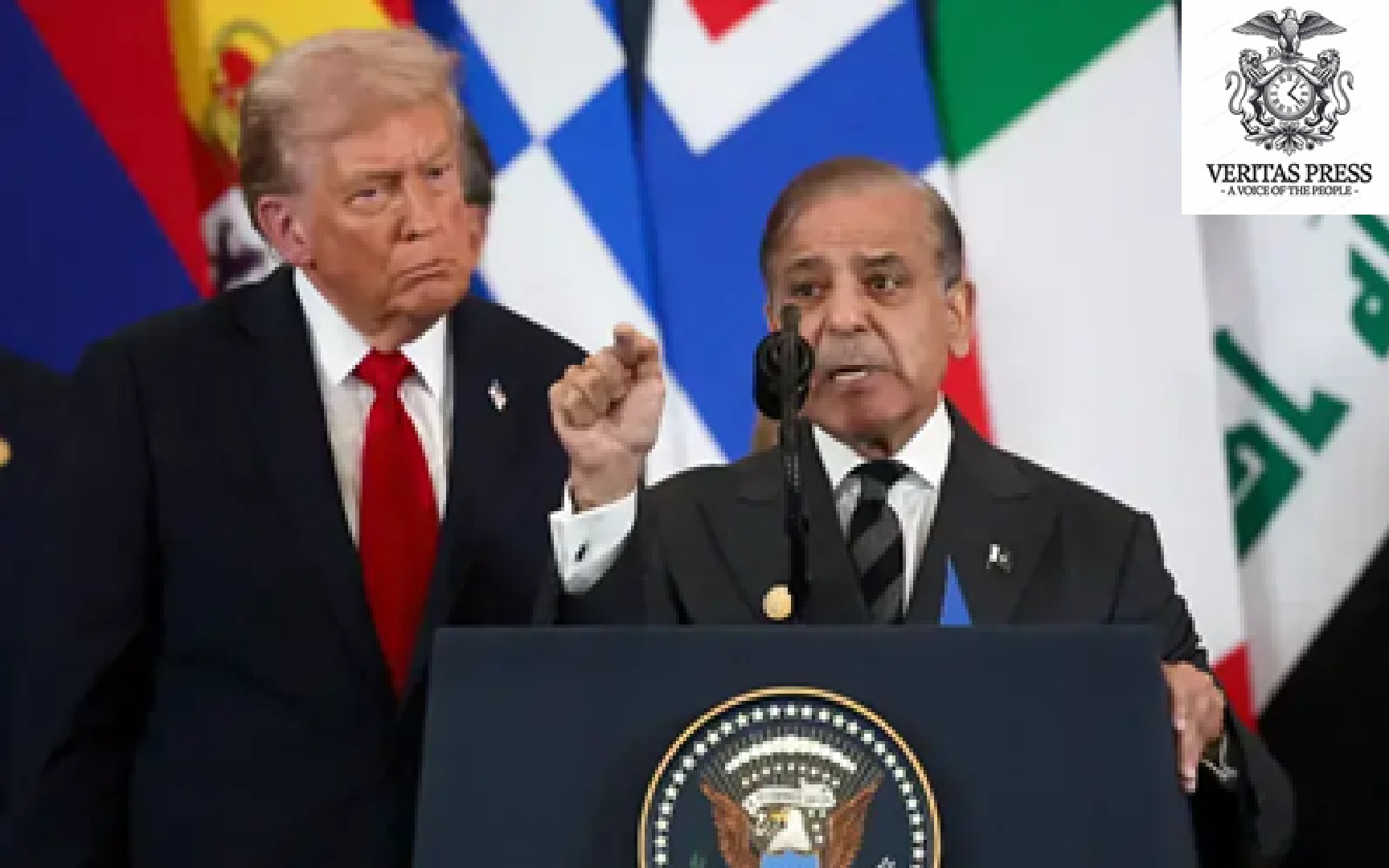
ISLAMABAD / GAZA / WASHINGTON — Pakistan’s recent acceptance of US President Donald Trump’s invitation to join the so-called “Board of Peace” has sparked widespread controversy, both domestically and internationally. While Islamabad insists that its participation is unrelated to the Abraham Accords and poses no threat to its long-standing position on Palestine, analysts and political figures warn that the initiative is a carefully designed US–Israel strategy to entangle Muslim-majority states in the administration of post-war Gaza, legitimise Israeli territorial gains, and co-opt participating countries into a parallel governance and security framework.
Trump’s Board Of Peace: A Rebranded Enforcement Mechanism.
Trump ratified the board’s charter on January 22, 2026, presenting it as a “new global peace mechanism.” The initiative includes 26 founding members include Argentina, Armenia, Azerbaijan, Albania, Bahrain, Belarus, Bulgaria, Cambodia, El Salvador, Egypt, Hungary, Indonesia, Jordan, Kazakhstan, Kosovo, Kuwait, Mongolia, Morocco, Pakistan, Paraguay, Qatar, Saudi Arabia, Türkiye, the United Arab Emirates, Uzbekistan, and Vietnam, spanning the Middle East, Asia, Europe, Latin America, and the Caucasus.
Despite Islamabad’s official assurances, the board’s structure, composition, and operational powers suggest it is not a neutral peace forum, but rather a rebranded enforcement mechanism designed to consolidate Israel’s military and political dominance in Gaza while hollowing out Palestinian self-determination.
The charter reportedly contains no explicit reference to Gaza, while granting Trump sweeping powers over membership, agenda-setting, vetoes, and operational oversight. Analysts argue that this constitutes a strategic evolution of the Abraham Accords model: rather than formal diplomatic normalisation, the framework embeds Muslim states into a governance and security structure that externalises the costs of occupation and legitimises Israeli control.
“This is about replacing Israeli boots with Muslim ones,” said international affairs analyst Syed Bilal Fatimi, highlighting the board’s potential to deploy participating countries as proxies in Gaza.
Under the model:
- Israel maintains military supremacy and territorial leverage
- The US provides political cover and enforcement mechanisms
- Muslim-majority states are tasked with legitimising, financing, and policing the aftermath
Effectively, Gaza is being transformed into an internationally managed dependency, while Israel avoids accountability for widespread destruction, civilian deaths, and the systematic weaponisation of aid.
Gaza As Bait: The Humanitarian Pretext.
Pakistan’s Foreign Office has maintained that its engagement is narrowly focused on supporting a Gaza ceasefire, post-conflict reconstruction, and humanitarian relief.
But critics argue that Gaza is being used as bait, masking a broader strategy to normalise occupation. Since the latest conflict, Israel has:
- Flattened large sections of Gaza
- Destroyed hospitals, universities, and civil infrastructure
- Weaponised starvation and controlled humanitarian access
Under the Board of Peace, reconstruction efforts are detached from Palestinian governance, leaving borders, security, resources, and administrative authority effectively controlled by external actors. Analysts compare the arrangement to earlier US-led interventions in Iraq and Afghanistan, where “peacebuilding” functioned as a euphemism for long-term occupation enforced by external powers.
Linking To The Middle East Riviera: Gaza As An Economic Project.
The Board of Peace is not operating in isolation. It is integrally connected to the Middle East Riviera project (New Gaza), a vision floated by Trump, Netanyahu, and allied Gulf and Western investors to turn Gaza into a luxury coastal zone, trade hub, and regional economic asset.
Under this framework, Gaza is envisioned as:
- A centre for luxury tourism, marinas, and real estate
- A hub for regional trade and energy transit
- A territory whose population is politically neutralised, economically marginalised, and socially subordinated
The board functions as the administrative arm of this project, providing legitimacy, security oversight, and governance structures to implement the Riviera vision (New Gaza), while sidelining the Palestinian authority and self-determination. Participation by Muslim states like Pakistan is essential to launder the occupation through international legitimacy and local enforcement.
“This is a neo-colonial framework,” said opposition leader Allama Raja Nasir Abbas. “By placing reconstruction, security, and political oversight in the hands of outside actors, it undermines Palestinian self-determination and marginalises the UN system.”
Pakistan’s Strategic Dilemma:
Pakistan’s inclusion is not merely symbolic; it is strategically valuable to Washington and Tel Aviv. Unlike Gulf monarchies, Pakistan possesses:
- Nuclear capability
- Large military manpower
- Historical refusal to recognise Israel
- Popular domestic support for Palestine
By engaging Pakistan, the Trump–Netanyahu axis aims to:
- Break the psychological barrier around Pakistan’s non-engagement with Israel-linked frameworks
- Undermine Islamic consensus on Palestinian rights
- Neutralise Pakistan’s moral and diplomatic authority on Palestine, Kashmir, and international law
- Potentially create pathways for future coercion, including stabilisation or peacekeeping missions
Former international affairs analyst Fatimi warned that the initiative could turn Pakistani forces into proxies enforcing Israeli interests in Gaza, rather than independent actors supporting humanitarian objectives.
Legal, Diplomatic, And Domestic Contradictions:
Pakistan’s participation raises serious domestic and legal concerns. No parliamentary debate, public consultation, or legal justification was undertaken before joining. Pakistan’s longstanding position has been clear: no engagement with Israel-linked frameworks without Israeli withdrawal from occupied territories and recognition of Palestinian statehood.
Former ambassador Maleeha Lodhi highlighted the contradiction:
“Pakistan cannot invoke UN primacy where it suits its interests while participating in structures that actively erode the UN elsewhere.”
Domestic criticism has been vociferous. Opposition leaders, analysts, and activists have labelled the decision:
- “Morally incorrect and indefensible”
- “A betrayal dressed up as diplomacy”
- “Neo-colonial governance by proxy”
Former human rights minister Shireen Mazari called the move “a very unwise decision,” while activist Ammar Ali Jan described it as a “shameful betrayal” at a time when the world is witnessing Gaza’s devastation.
Complicity By Design:
The danger lies not in what the Board of Peace claims to do, but in what it enables. Its broad powers allow the chairman to:
- Redefine “peace” and “good governance” at will
- Redefine and veto at will
- Designate resistance movements as threats
- Sanction or intervene against states deemed destabilising
Once Pakistan is embedded in the framework, analysts warn it could face subtle or overt pressure to:
- Endorse Israeli security narratives
- Participate in stabilisation operations that suppress the Palestinian agency
- Support the disarmament of resistance forces
Withdrawal would be politically costly, and dissent could result in diplomatic or economic retaliation.
A Strategic Trap Under The Guise Of Peace:
Viewed in totality, the Board of Peace is less a peace initiative than a strategic trap, using humanitarian catastrophe to legitimise Israeli expansionism, co-opt Muslim states into enforcing post-conflict order, and replace international law with personalised US-Israeli governance.
For Pakistan, the stakes are high:
- Its principled stance on Palestine may be diluted
- Its credibility in the Global South could be undermined
- Participation may create precedents used against Pakistan in future regional disputes
What is being sold as a “glimmer of hope” for Gaza may ultimately prove to be a smoke screen that protects Israel, empowers Washington, and leaves participating Muslim nations historically accountable.
“The question is not whether Pakistan recognises Israel,” said analyst Fatimi. “The question is whether it is being quietly positioned to protect Israel’s gains under the language of peace.”
Conclusion: Pakistan’s Entry, The Biggest Strategic And Legal Mistake.
Pakistan’s entry into Trump’s Board of Peace is being framed domestically as a humanitarian effort to support Gaza’s ceasefire and reconstruction. Yet beneath this official narrative lies a far more troubling reality: the board is neither neutral nor benevolent. It is a carefully constructed instrument of US–Israeli strategy, designed to entangle Muslim-majority states in administering post-war Gaza, legitimising Israeli expansionism, and enforcing a governance framework that undermines Palestinian sovereignty.
The Board of Peace, intertwined with the Middle East Riviera project, exemplifies a new form of proxy governance: militarily enforced, economically exploitative, and politically sanitised to appear humanitarian. Pakistan’s entry into this framework carries profound strategic, ethical, and legal implications, entangling the country in a post-genocide reconstruction and occupation project whose ultimate beneficiaries are Israel, Trump-aligned investors, and US geopolitical strategy, rather than the Palestinian people themselves.
Under international law, this participation raises serious concerns:
- Political complicity — Sitting alongside Israel, Jared Kushner, and Tony Blair in a body that dictates Gaza’s political, administrative, and security arrangements without Palestinian representation risks violating the principle of self-determination, protected under the UN Charter and customary international law.
- Moral hazard and potential legal complicity — By managing reconstruction, governance, and security, Pakistan could become complicit in actions amounting to prolonged occupation, resource exploitation, and human rights violations, including systematic deprivation of essential services and the suppression of resistance movements.
- Strategic vulnerability — Embedded in the framework, Pakistan may face pressure to endorse Israeli security objectives, contribute to stabilisation missions, or enforce policies contrary to Palestinian interests. Exit or dissent could invite political, economic, or diplomatic retaliation, exposing Pakistan to long-term liability under international norms.
The broader strategy is clear: divide the Muslim world, co-opt wealthy and militarily capable states, and channel Muslim resources into a framework that protects Israeli territorial expansion. Gaza’s destruction, followed by the Middle East Riviera project, transforms Palestinian land into a commercialised coastal enclave, while Palestinians are stripped of governance, sovereignty, and control over their own resources, a textbook case of economic exploitation under occupation.
Viewed in totality, the Board of Peace is not a peace initiative but a geopolitical trap, consolidating Israeli dominance, fracturing Muslim unity, and bypassing international law. Pakistan’s participation, while sold domestically as humanitarian, risks making the country politically, morally, and legally complicit in the subversion of Palestinian rights, the exploitation of Muslim wealth, and the enforcement of a post-genocide occupation framework.
For Islamabad, joining the board is arguably the biggest strategic and legal mistake in recent history. It risks undermining Pakistan’s credibility in the Islamic world and the Global South, weakening its moral authority on Palestine and Kashmir, and setting a dangerous precedent that could later be leveraged against Pakistan’s own sovereignty.
The crucial question is no longer whether Pakistan recognises Israel. The real issue is whether it has been quietly positioned to enforce Israeli gains, administer Palestinian territory under occupation, and finance a project that violates fundamental international norms, all under the guise of peace. If so, history will judge this not as diplomacy, but as Pakistan’s gravest strategic, ethical, and legal miscalculation, with profound consequences for Palestinian self-determination, Muslim unity, and the rule of international law.
When Lieutenant Colonel Ebrahim Zolfaqari, spokesman for Iran’s Khatam al-Anbiya Central Headquarters, issued a warning
The historic Christian presence in Palestine, dating back to the earliest centuries of Christianity, is
JERUSALEM – For the first time since the aftermath of the Six-Day War, the courtyards
TEHRAN – As the sun rose on Eid al-Fitr, a day meant for celebration and
HUNGARY – As Benjamin Netanyahu prepares to travel to Hungary this weekend, a mounting legal
LONDON — In the polished corridors of 10 Downing Street, the language remains meticulously calibrated:
On March 20, 2026, the Pentagon quietly announced what amounts to a fundamental restructuring of
WASHINGTON / ISLAMABAD — A fresh warning by US Director of National Intelligence Tulsi Gabbard