



Press Release: Veritas Press C.I.C.
Author: Kamran Faqir
Article Date Published: 07 Nov 2025 at 18:10 GMT
Category: Middle-East | Palestine-Gaza-West Bank | Over 16,500 Gaza Patients Require Urgent Care
Source(s): Veritas Press C.I.C. | Multi News Agencies
Website: www.veritaspress.co.uk

Business Ads

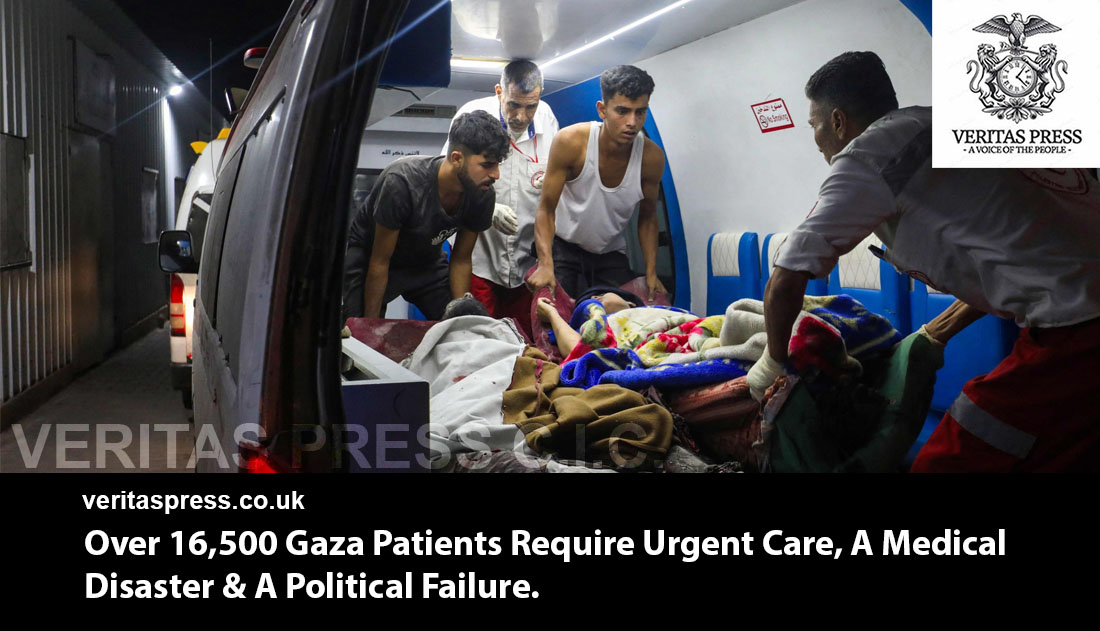
The number now invoked by the World Health Organization (WHO) — over 16,500 patients in the Gaza Strip who urgently need medical care that cannot be delivered inside the enclave– is not simply a statistic. It is a testament to the systematic destruction of health services, the failure of evacuation mechanisms, and the calculated marginalisation of civilians caught in war.
On 7 November 2025, WHO Director‑General Tedros Adhanom Ghebreyesus declared that while “19 critically ill patients and 93 companions” were recently evacuated to Italy, the bulk of the patients in need remain stuck inside Gaza. He urged more countries to receive these patients, and called for the opening of all evacuation routes, “particularly to the West Bank, including East Jerusalem.”
But even as this call goes out, the system of care is unravelling. Medics working inside Gaza speak of a health system in collapse, and these are not appeals to sympathy, but demands for accountability.
1. “This is nothing short of a health‑system massacre”
The collapse is well documented. In its May 2025 briefing, WHO noted that of Gaza’s 36 hospitals, only 19 remained partially operational; 94 % of all hospitals had been damaged or destroyed.
Dr Rik Peeperkorn, WHO Representative for the West Bank and Gaza, described in August 2025 the situation as “catastrophic”, pointing to hospitals functioning at 180–300% of capacity, with 52% of medicines and 68% of consumables already at zero stock.
In a blistering interview, a medic from Médecins Sans Frontières (MSF) working in Gaza made the calculation bluntly:
“Medicine is being strangled.”
And British‐American doctors who recently returned from Gaza described the scene:
“I was in the car‑park of Nasser hospital and heard an explosion and everything shook… You were having to step over dead and dying people to reach the people that you’re trying to treat.”
One trauma surgeon, Dr Khaled Dawas, remarked:
“Those who’ve been killed have had more mercy bestowed on them than those who are surviving.”
These are not random casualties. This is a systematic collapse of infrastructure, access, supplies, and evacuation mechanisms.
2. Evacuation: The “miracle” few, the thousands left behind
The WHO commissioned evacuation efforts, but the scale is pitiful relative to need. A January 2025 WHO statement noted only 5,383 patients had been evacuated since October 2023, leaving over 12,000 still waiting.
And yet, on 7 November, the figure for “urgent medical care not available in Gaza” was raised to over 16,500. This gap speaks volumes: the system of evacuation is overwhelmed, bottlenecked, blocked or politically constrained.
Dr Peeperkorn warned in January:
“At the current rate, it would take five to ten years to evacuate all these critically ill patients.”
In other words, while patients wait, their conditions deteriorate, some perish, and many require more complex treatment. Medics interviewed say that waiting lists have become death lists.
An MSF coordinator described the logistical nightmare:
“The wounded and sick in Gaza are just like everyone else in the world. They have dreams, ambitions and hopes, but their situation is currently catastrophic. They’re all suffering.”
3. Political calculus: Access denied, routes blocked, hospitals targeted
This is where the critical angle deepens. Because the health crisis cannot be divorced from the politics of siege, destruction, access denial, and occupation.
Hospitals as battlegrounds:
WHO’s January 2025 briefing declared:
“Hospitals have become battlegrounds… only 16 of the region’s 36 hospitals remain partially operational.”
Doctors arrested, infrastructure dismantled:
A recent investigation by The National documented multiple cases of doctors being arrested simply for practising medicine in Gaza:
“There is still no formal charge against him,” said the wife of Dr Ahmad Mhanna. “… the evidence indicates a deliberate strategy by the Israeli military to dismantle Gaza’s medical infrastructure.”
This is not collateral damage. This is the dismantling of civilian protection and medical neutrality, clear violations of international humanitarian law.
Evacuation routes blocked:
WHO noted in May 2025 that evacuation routes and safe corridors have been repeatedly restricted, hospitals within evacuation zones are threatened, and access for patients and staff is “difficult, if not impossible.”
Fuel, supplies, and consumables all exhausted:
“More than 50 % of WHO’s medical stocks in Gaza are depleted… 33 WHO trucks are waiting at Al Arish and 15 in the West Bank.”
This is a health system not just under strain, but under siege.
4. Voices from the ground
Surgeon in Gaza (via MSF)
“There are corridors packed with the sick and displaced people… We were treating two badly injured children who were both put on the same trolley.”
Dr Mohammed Abu Mughaisib (MSF deputy medical coordinator in Gaza):
“Over 50 per cent of all hospitals are out of service, and those that remain open are only partially functional. The siege has left our facilities without critical life-saving supplies.”
Dr Peeperkorn (WHO representative):
“The health system simply can’t afford the loss of Nasser hospital… it is currently the sole provider of ICU and neurosurgery services in Khan Younis… Its dialysis unit is currently serving more than 200 patients.”
Analyst on media coverage bias:
“Western journalists created a false balance, equating Israeli and Palestinian suffering … When reporting on numbers of Palestinian victims … journalists used language that casts doubt about the credibility of the information.”
5. Deep Analysis
a) The evacuation gap is a de‑facto death sentence:
When 16,500+ people are in urgent need and the evacuation machinery operates at a trickle, each delay is a human rights violation. The calculation of “need” vs “actual evacuation” becomes a metric of failure. Financial or logistical constraints do not absolve the occupation power’s obligations under the Fourth Geneva Convention to ensure access to health care for the occupied population.
b) Hospitals as war zones = civilian infrastructure destruction:
The repeated attacks, evacuations, internal displacement of health facilities, and the arrest of medical professionals amount to more than collateral damage. They point to a strategic degradation of health infrastructure. The vital role of medical neutrality is being systematically undermined. When medics are arrested, hospitals are bombed or evacuated, and access is blocked, the line between military objective and civilian destruction disappears.
c) Evacuation itself reveals geopolitical priorities:
Evacuations to Italy, UAE, Jordan, etc, are being celebrated, but the small numbers obscure the structural problem. Why only 19 patients + 93 companions in the latest Italian evacuation? Why are thousands still stuck? The barriers are political: crossing closures, security clearances, host country willingness, and Israeli permission processes. The rhetoric of “medical evacuation” becomes a lifeline for some, but a door slammed shut for many. The WHO knows this:
“We urge Israel to increase the approval rate for medical evacuations… allow all possible corridors and border crossings to be used for safe medical evacuations.”
d) The longer-term damage and generational crisis:
With hospitals barely functional, children missing vaccinations, and chronic disease care interrupted, the consequences will extend far beyond immediate fatalities. WHO’s October 2025 report warns rebuilding Gaza’s health system will cost over US$7 billion, and that is just for the health sector, not the full humanitarian and infrastructure cost.
e) The moral dimension: complicity by silence:
When major states pledge humanitarian aid but do little to press for corridors, evacuation or protection of hospitals, that is complicity. As the MSF Director General stated recently:
“Doctors cannot stop a genocide. Our leaders can.”
It is not enough to treat the wounded. The system of destruction must be confronted, legally, politically and morally.
6. Updated Context & Developments
- New WHO briefings and independent media show that evacuations have fallen to “fewer than four patients a day” since the closure of the southern Rafah crossing in May 2024.
- MSF and other organisations report multiple staff deaths (15 MSF staff killed so far) and targeted attacks on hospitals and ambulances.
- Emerging academic research reveals patterns of Western media bias in coverage of Gaza’s health crisis, undermining public awareness and accountability.
7. What Must Change, And Why Sooner Matters.
Immediate demands:
- Evacuation routes must be opened without delay. That includes West Bank/East Jerusalem routes, Rafah/Egypt, Jordan, and other host‑countries.
- Host countries must commit capacity for Gazan patients: children, cancer, trauma, burns, dialysis and guarantee fast‑track visas and transfers.
- Hospitals in Gaza must be protected from attack; fuel, oxygen, and medicine must flow. International organisations must have unimpeded access.
- The backlog of 16,500+ urgent cases must be treated as an emergency operation, not a waiting list. Each day of delay means more death, disability, and generational injury.
Long-term structural steps:
- The health system’s rebuilding must be treated as a component of any peace settlement or truce mechanism. The WHO’s estimate of US$7 billion must be integrated into reconstruction funding.
- Full transparent investigations into attacks on health facilities, arrests of medical staff, and evacuation denials are potential war crimes.
- Media coverage, especially Western outlets, must adjust bias that equates suffering rather than centres the civilian experience in Gaza. The academic study noted selective language undermining Palestinian reports.
- Donor fatigue must be reversed. The health crisis is not the “aftermath” of war; it is still unfolding, and the longer the delay, the deeper the harm.
8. Conclusion
The figure “over 16,500 people needing urgent medical care” is more than a headline. It is a verdict: that the health system in Gaza has been broken, the evacuation system has been stalled, and the international community has allowed a scale of human suffering to become routine. When doctors say hospitals are “nothing short of hell”, when medics say “medicine is being strangled”, when local surgeons talk about walking among the dead and dying, then the issue is no longer about accident – it is about design.
States, non-state actors, international agencies and media all share responsibility: to open doors, to protect care, to uphold the law, to speak honestly. Because when care is denied, when evacuation is blocked, when hospitals are neutralised, the war on health becomes part of the war itself.
This is not humanitarian minutiae. This is life and death. And the world must act, not tomorrow, not next week, but today.