

Title: Over 100 Palestinians Killed Or Injured As Israeli Strikes Pound Displaced Families In Gaza.
Press Release: Veritas Press C.I.C.
Author: Kamran Faqir
Article Date Published: 20 Nov 2025 at 11:03 GMT
Category: Middle-East | Palestine-Gaza-West Bank-OPT | Middle-East | Palestine-Gaza-West Bank-OPT | Over 100 Palestinians Killed Or Injured
Source(s): Veritas Press C.I.C. | Multi News Agencies
Website: www.veritaspress.co.uk

Business Ads


Investigative Report On A Pattern Of Attacks Hitting Supposed “Safe” Zones
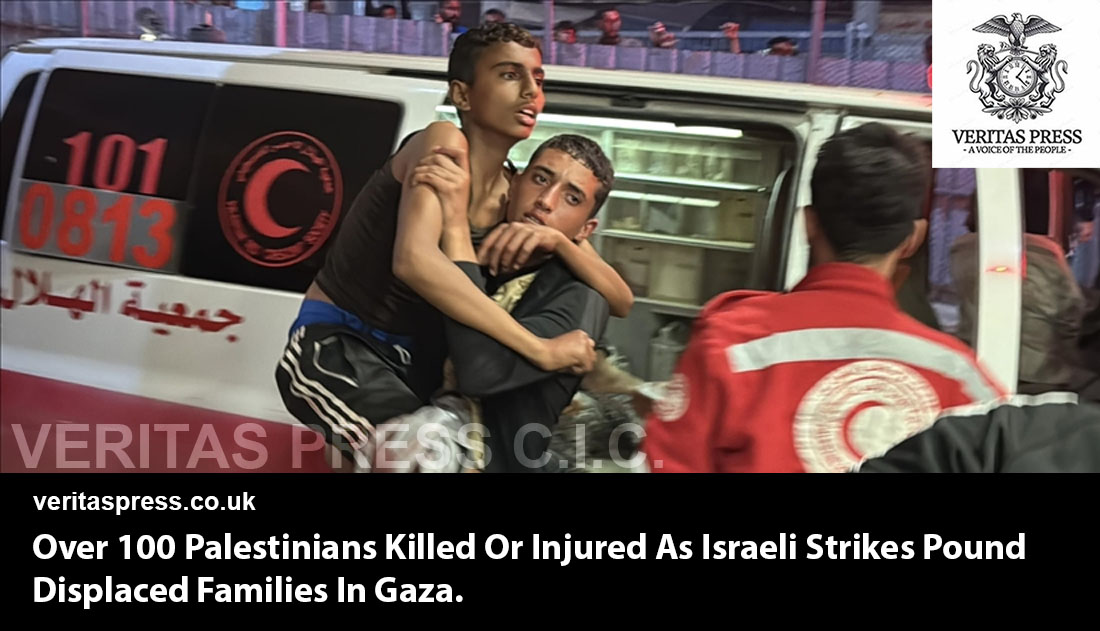
Gaza Strip – Israeli air and drone strikes over two days have killed dozens of Palestinians and wounded many more, most of them from families already displaced by the war, in what medics, aid workers and rights groups describe as a deliberate pattern of attacks on areas known to shelter civilians.
Israeli officials insist the strikes targeted “Hamas command nodes” and were launched in response to fire on their forces in the Khan Yunis area. But hospital staff, eyewitnesses and local officials say bombs and missiles slammed into residential buildings, tent encampments and a UN-run club being used as emergency shelters – well inside areas that were supposed to be protected under a US-brokered ceasefire.
“We were told this area was safe. That’s why we came here,” said Umm Ahmad, a displaced mother from northern Gaza now in Khan Yunis. “We ran from the bombs in one place, and the bombs followed us here.”
Wave Of Strikes, Rising Death Toll:
Gaza health authorities and hospital sources reported around 28 people killed and more than 77 injured in a single wave of attacks on Gaza City and Khan Yunis. Children made up a large share of the dead and wounded.
Medics say the real toll could be higher, with bodies still being pulled from the wreckage.
“We received entire families,” said a doctor at Nasser Medical Complex. “In some cases, the only way we knew who they were was from neighbours pointing at the bodies.”
According to local officials and international media:
- In Zeitoun, a neighbourhood of Gaza City, strikes hit a building sheltering displaced families, reportedly owned by religious authorities.
- In al-Mawasi and other parts of Khan Yunis, Israeli drones and aircraft bombed tented shelters and a UN-run club, both known sites where displaced people had taken refuge.
Within minutes, ambulances and private cars flooded hospital courtyards with the dead and wounded. Al-Ahli Baptist Hospital and Nasser Medical Complex both declared mass-casualty emergencies.
“We are operating with the last of our supplies. We’ve used sutures that expired months ago. We’ve cut gauze into smaller pieces to stretch it,” said a surgeon at Al-Ahli. “The number of wounded cannot be called a ‘mistake’. This is policy.”
‘Whole Families Were Wiped Out’:
From The Ruins In Zeitoun, An Al Jazeera Correspondent Reported:
“A father, a mother, and their three children were killed inside this building.”
That formulation – an entire nuclear family erased in a single blast – was echoed by civil defence workers combing through the rubble.
“We pulled out the father first; he was holding his daughter,” said Mahmoud, a rescue worker with Gaza civil defence. “The way he was covering her, you could see he tried to protect her in the last seconds. Neither survived.”
In Khan Yunis, paramedics described scenes of chaos in the al-Mawasi tent area.
“People were screaming, running between the tents,” said a paramedic who asked not to be named. “We saw children with shrapnel in their faces and chests. Some were still holding their toys.”
Outside Nasser Medical Complex, families of missing people gathered in a spontaneous protest, holding up mobile phones with photos of loved ones.
“They told us to go to the hospital, then to the police station, then to the mosque, then back again,” said one man clutching photos of two missing nephews. “We don’t know if our relatives are alive, detained, or lying under the rubble. Nobody is answering us.”
Israel’s Story: ‘Hamas Targets’ And A ‘Response To Fire’.
The Israel Defence Forces (IDF) publicly framed the strikes as a tactical response to gunfire directed at Israeli troops in the Khan Yunis area. A military statement said jets and drones hit “Hamas command and control infrastructure,” including what it described as a meeting of Hamas commanders in the Zeitoun district.
Israeli media, citing security sources, reported that the United States was informed in advance of some of the strikes. The same outlets also quoted officials acknowledging that “the results of the attack are still unclear” – an implicit admission that even the Israeli side could not confirm whether the purported high-value targets were actually present or killed.
On paper, the operation is presented as a narrow counter-terrorism action. On the ground, its effects are anything but narrow.
“If this were a meeting of commanders, why were there tents full of children next to it?” asked a local council member from Khan Yunis. “Either the intelligence was catastrophically wrong, or civilian life simply did not factor into the calculations.”
Residents say there had been no visible armed presence in some of the areas hit.
“There were no fighters, no rockets, nothing,” insisted Abu Yasser, a displaced man whose family had been sleeping in a tent near the UN-run club that was struck. “Only women, old men, and children. If they say we are Hamas, then they are saying all Palestinians are Hamas.”
Hamas And Local Authorities: ‘Flimsy Pretexts’ And A War On The Displaced.
Hamas condemned the attacks as a “flimsy and transparent attempt to justify crimes and violations”, accusing Prime Minister Benjamin Netanyahu of seeking to “resume the genocide” in Gaza under the cover of a ceasefire.
Local officials and civil defence teams say the latest wave of bombing fits an established pattern since the October truce:
- Strikes in or near displacement sites designated as “safe” or “less dangerous”.
- Shelling beyond the so-called yellow line, the notional boundary meant to separate Israeli and Palestinian-controlled areas under the ceasefire.
- Repeated incidents in which shelters, clinics and UN-linked facilities are hit.
“They tell people, ‘Move here, it’s safer,’ then they hit exactly those areas after a few weeks,” said a volunteer from a local NGO. “It feels like a trap. People begin to believe that nowhere is safe because that is the message being sent.”
A Clear Pattern: Displaced Civilians As Repeat Targets.
Taken together, witness reports, hospital records and on-the-ground footage point to a pattern, not an accident:
- Strikes on known displacement sites.
Buildings housing displaced families, UN-run facilities and tent encampments are repeatedly being struck. These are not secret locations; many are marked, mapped, and publicly known to international agencies. - Claims of precision vs. documented civilian tolls.
Israeli statements focus on the precision of targeting and the alleged presence of commanders. Yet the overwhelming visibility of civilian casualties – children pulled from rubble, women arriving in hospitals with blast injuries – raises serious questions about target verification and proportionality. - Escalation under a ceasefire framework.
The attacks come amid a US-brokered ceasefire and ongoing mediation by Qatar, Egypt and Türkiye. Analysts say these “managed escalations” risk normalising violence within a framework that is supposed to reduce it.
“What we are witnessing is the institutionalisation of ‘acceptable’ civilian casualties,” said a regional analyst with a European think tank. “If mediators keep the ceasefire on paper while tolerating these violations, the truce becomes little more than a diplomatic screen for continued warfare.”
Law, Responsibility, And The Investigative Void:
Under international humanitarian law, parties to a conflict must distinguish at all times between civilians and combatants and ensure that any attack is proportionate to the concrete and direct military advantage anticipated.
Legal experts and human rights organisations say the latest strikes raise three central questions:
- Were these sites lawful military objectives, based on reliable, up-to-date intelligence?
- Did the IDF take all feasible precautions to minimise civilian harm, including adjusting timing, weapon choice, or cancelling strikes when civilian presence was detected?
- Given the repeated pattern, do these attacks amount to systematic or reckless disregard for civilian life?
“We have documented multiple incidents in which displacement sites, schools, and medical facilities have been struck,” said a lawyer with a Palestinian rights organisation. “This is not a story of one tragic mistake; it is the story of a targeting policy that views the entire civilian environment as expendable.”
Despite calls from UN experts and groups such as Human Rights Watch for independent, international investigations, Gaza’s hospitals and NGOs remain largely alone in cataloguing casualties and damage.
“We can record names, ages, wounds, and GPS coordinates,” said an administrator at Nasser Medical Complex. “What we cannot do is force anyone to open a war crimes investigation. That power lies outside Gaza, and so far, it has not been used.”
Mediators Under Pressure, Credibility on the Line:
Qatar, Egypt and Türkiye – key players in brokering and guaranteeing the ceasefire – have publicly warned that strikes on civilian areas risk collapsing the truce framework altogether.
The memory of Israeli strikes on Hamas officials in Doha, which killed Hamas-affiliated figures and a Qatari security officer, still looms large. That operation rattled diplomatic ties and showed how the conflict can spill beyond Gaza when Israel pursues targets extraterritorially.
“If mediators cannot protect even the most basic ceasefire lines, then their guarantees begin to look meaningless,” said a regional diplomat. “You cannot ask displaced people to move based on your assurances while allowing those assurances to be violated without consequence.”
What Survivors, Medics, And Ngos Demand:
Those living the consequences are clear about what needs to happen next:
- An independent, international investigation into the Zeitoun, al-Mawasi and Khan Yunis strikes, with access to sites, witnesses, satellite imagery and weapon fragments.
- Public clarification of targeting rules near displacement shelters, UN facilities and hospitals – and a binding commitment that such areas will not be struck.
- Real enforcement by guarantor states, including political and economic pressure on Israel to halt strikes that violate ceasefire terms and to reopen border crossings so that medical supplies, fuel and food can reach the wounded and displaced.
“We don’t need more statements,” said a nurse at Al-Ahli, her uniform stained with dried blood. “We need them to stop the bombs. And if they don’t stop, we need the world to finally say this is a crime, not a ‘tragic incident’.”
The Questions That Won’t Go Away:
As the morgues fill and families dig through the ruins of what were supposed to be safer areas or designated safe zones, four essential questions confront the international community:
- Were these strikes proportionate, lawful military actions – or reckless operations in areas known to be full of displaced civilians?
- What intelligence and legal assessments did Israeli commanders rely on before authorising strikes on these sites?
- Why have the United States and regional guarantors failed to prevent repeated breaches of the ceasefire they themselves brokered?
- Will any independent body be allowed to investigate – or will another chapter of Gaza’s history be written without accountability?
For now, the pattern is unmistakable: people who fled previous bombardments are being bombed again, often in zones they were told would be safer. Whether through flawed intelligence, systemic indifference, or deliberate military calculation, the result is the same – a mounting civilian death toll, a collapsing humanitarian landscape, and a deepening indictment of a world that has so far refused to enforce its own rules.
Conclusion:
The testimonies emerging from Gaza of mothers clawing through rubble for scraps of food, children collapsing from hunger beside bombed-out aid trucks, and medics performing amputations without anaesthetic form a body of evidence that can no longer be dismissed as the fog of war. They reveal a deliberate architecture of deprivation, constructed not by accident, but by systemic policy. Israeli officials continue to deny any famine and insist aid “flows without restriction,” yet every UN field report, every satellite photograph of burned convoys, every journalist’s dispatch from the ground, and every death certificate issued inside Gaza’s collapsing hospitals contradict those claims.
As Dr. Samer Abu Nasser, an emergency physician in Rafah, told us, “Starvation here is not a consequence, it is a weapon.”
This humanitarian catastrophe does not exist in a vacuum. It is inseparable from the wider pattern unfolding across the occupied Palestinian territories: systematic erasure through mass displacement, psychological warfare, and methodical ethnic cleansing, operating with the clear aim of entrenching Israeli, and increasingly US-backed, dominance over the land. Forced evacuations, repeated displacement cycles, targeted attacks on shelters, and the destruction of the food system form the backbone of what rights groups describe as a campaign to make Gaza uninhabitable.
A senior Israeli analyst critical of the government put it starkly:
“The objective is to empty Gaza, even if not by direct expulsion, then by making life impossible for those who remain.”
This pattern is further reinforced by the proposed International Gaza Force, a Trump–Netanyahu initiative marketed publicly as a “security mechanism,” but viewed by diplomats, analysts, and aid groups as a thinly veiled project to lock Palestinians into controlled enclaves while freeing vast stretches of land for redevelopment and strategic annexation. Critics warn that this force would function less as a peacekeeping entity and more as an occupation outsourcing model, enabling international troops to police Palestinians while Israel and US-aligned investors pursue reconstruction contracts and land-use projects without accountability.
One European diplomat familiar with the discussions said, off-record:
“The International Gaza Force is not about protecting Palestinians. It’s about stabilising the territory for investors while keeping Palestinians confined and compliant.”
To many Palestinians, it is understood as yet another mechanism of dispossession. As one displaced mother in Deir al-Balah said:
“They want our land without us. First, they destroy our homes, then they bring foreigners to guard the empty land.”
Meanwhile, international actors, governments, corporations, defence industries, and development firms continue supplying arms, intelligence, logistics and contracts while issuing sterile statements of “concern.” The result is a humanitarian crisis transformed into a profitable frontier, where reconstruction plans are drafted even as the bodies of children are pulled from rubble and famine spreads through tent camps.
A UN official familiar with donor discussions captured the hypocrisy succinctly:
“Gaza is being seen as a development opportunity, not a humanitarian emergency. Too many states are preparing to profit from the rubble they refused to prevent.”
The starvation, mass displacement, and engineered social collapse of Gaza therefore stand not only as evidence of Israeli policy, but as an indictment of a global order unwilling to restrain a state engaged in what legal scholars increasingly describe as annexationist warfare.
As one exhausted aid worker asked, watching yet another family arrive skeletal from hunger:
“How can anyone claim this is accidental when the world keeps helping it happen?”
The question is no longer whether Gaza is being starved, emptied, and erased.
It is whether the world intends to stop it, or whether it has already accepted a future built on the ruins of a people deliberately pushed toward disappearance.