

Original Article Date Published:
Article Date Modified:
Help support our mission, donate today and be the change. Every contribution goes directly toward driving real impact for the cause we believe in.
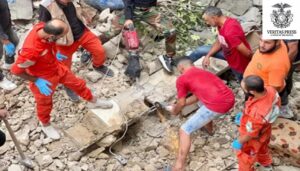
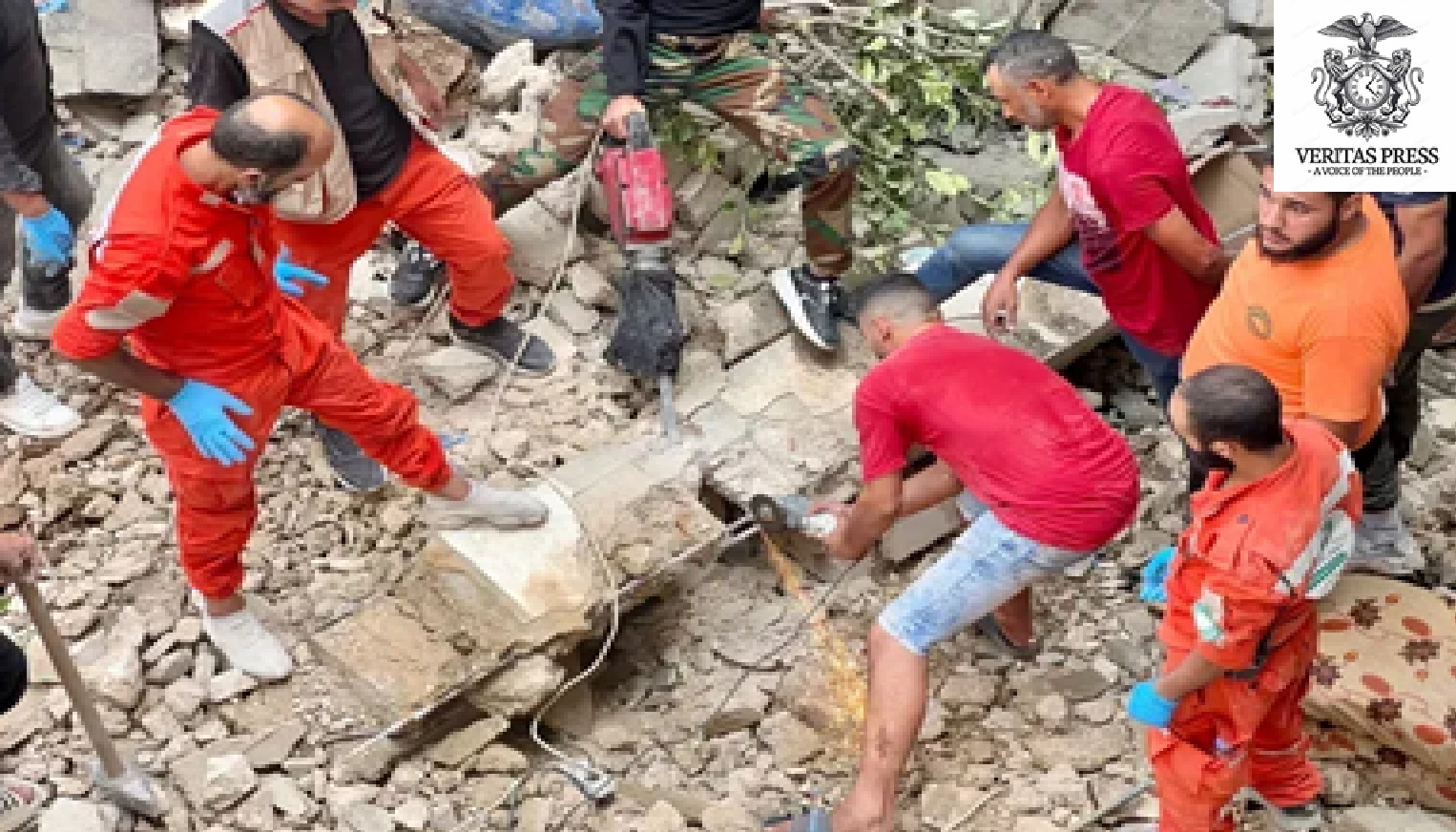
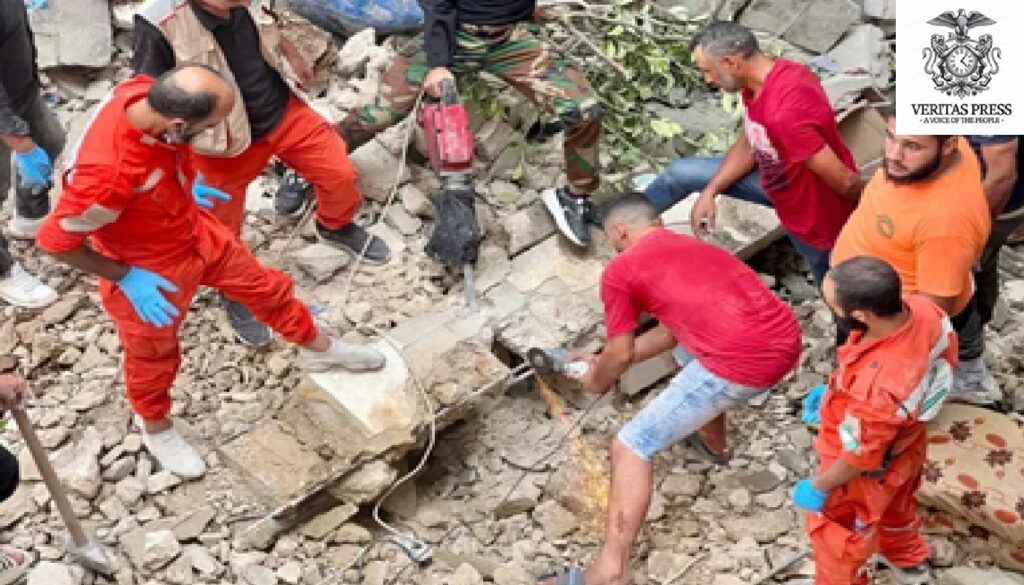
BINT JBEIL, LEBANON – The airstrike came just after midnight. Israeli warplanes targeted the perimeter of Bint Jbeil Hospital in southern Lebanon early Sunday morning, killing two paramedics and wounding several others. It was the latest in a bloody tally that has seen Lebanon’s emergency responders systematically targeted, raising urgent questions about adherence to international humanitarian law.
According to Lebanon’s National News Agency (NNA), the strike on Bint Jbeil was part of a wider wave of violence that included the complete destruction of a home in the town of Abba and attacks on the town of Khiyam. By midday Sunday, Lebanese authorities updated the grim statistics: at least 11 people had been killed across the south, including seven in the Tyre district town of Hanniyeh and two in Jwaya.
These attacks on Sunday follow a disturbing pattern established over the preceding 48 hours, where saving lives has become a death sentence.
The Double Tap: Journalists And The Paramedics Who Followed.
The crisis of civilian protection reached a fever pitch on Saturday when the conflict claimed the lives of three journalists in a strike that legal experts say may constitute a war crime.
An Israeli airstrike hit a vehicle clearly marked “Press” on the road near Jezzine, southern Lebanon. Killed were reporters Ali Shuaib of Al-Manar, Fatima Ftouni of Al Mayadeen, and her brother, photographer Abbas Ftouni. Witnesses reported that four precision missiles struck the vehicle, obliterating it.
Al Mayadeen described the attack as an “assassination,” while Lebanon’s Information Minister condemned the “blatant violation” of international protections for journalists. In a statement, the Israeli military acknowledged the strike, claiming that Shuaib was a member of a Hezbollah “intelligence unit” tracking Israeli troop positions, an allegation Hezbollah has vehemently denied.
However, the horror did not end there. As rescue workers rushed to the scene of the journalists’ incinerated vehicle to retrieve the bodies, the Israeli Air Force struck again.
In what emergency services describe as a “double tap” strike, a tactic designed to target first responders, another paramedic was killed while attempting to assist the slain journalists. This brings the total number of medical personnel killed in the last week alone to staggering figures.
“They want to empty the south of people, but they also want to ensure that no one comes to help those who are bleeding,” says “Ali” (a pseudonym), a 60-year-old volunteer paramedic with the Islamic Health Association (IHA) speaking to EL PAÍS from Mazraat Al Yahoudiyeh. His own ambulance, now windowless and scarred by shrapnel, sits idle after an airstrike killed three people inside it. “Why would I be afraid? What am I supposed to do, leave my country? I’m not leaving here,” he told the reporter, his calm tone belying the wreckage around him.
A Deliberate Strategy Or Systematic Collapse?
The international community is increasingly using the term “decapitation” to describe the state of Lebanon’s healthcare system.
According to a report released this week by the World Health Organization (WHO), the situation is nothing short of catastrophic. Since the escalation began on March 2, the WHO has documented 64 separate attacks on healthcare infrastructure in Lebanon. These attacks have resulted in the deaths of at least 53 healthcare workers and injuries to 91 others.
The physical destruction is equally devastating:
- Five major hospitals have been forced to close, including Bint Jbeil Public Hospital and Al-Sahel Hospital in Beirut.
- 50 Primary Healthcare Centres have shut their doors.
- 75 attacks on the health sector have been recorded by the Lebanese Ministry of Health.
“Access to healthcare has worsened dramatically,” the WHO report stated, noting that the attacks are crippling the ability to respond to the rising number of war casualties. WHO Director-General Tedros Adhanom Ghebreyesus specifically condemned the violence, reminding all belligerents that health workers are protected under international humanitarian law and “should never be targeted”.
The Burden Of Proof: Legal Loopholes vs. Lived Reality.
The Israeli military has consistently justified these strikes by alleging that Hezbollah uses ambulances and medical facilities for military purposes.
In a series of posts on X (formerly Twitter) preceding the strikes, Israeli military spokesperson Avichay Adraee accused Hezbollah of “hiding weapons in civilian trucks” and warned that any vehicle moving in the area was at risk. Regarding the Islamic Health Association (IHA), the primary target of many strikes, Israel claims its personnel serve Hezbollah’s armed wing.
However, international law expert Rizk Zgheib, Associate Professor of Law at Saint Joseph University of Beirut, explains that the burden of proof lies squarely with the attacker.
“Under the Geneva Conventions, an ambulance or hospital loses its protected status only if it is being used to commit, outside its humanitarian duties, acts harmful to the enemy,” Zgheib told L’Orient Today. “The attacker must provide clear and convincing evidence, such as drone footage or captured documentation, proving that the vehicle was transporting weapons or fighters. In case of doubt, it must be presumed that the ambulance was not being used for such acts.”
Lebanese Health Minister Rakan Nasser Al-Din has categorically rejected the Israeli claims. “Our medical staff wear full uniforms, drive marked vehicles, and operate with warning lights. To accuse them of transporting missiles is a lie designed to justify murder,” he said.
Despite the rhetoric, the ground truth is that of blood-soaked gurneys. On March 13, an Israeli strike on a primary health care centre in Burj Qalaouiyah (Bint Jbeil district) killed 12 medical workers in a single moment, including doctors, nurses, and paramedics who were treating the wounded. Last week, in Kfar Tibnit, an IHA ambulance was struck, killing two paramedics aged just 16 and 23.
The Regional Inferno:
The violence in Lebanon cannot be divorced from the wider regional war. The escalation came amid a joint US-Israeli offensive on Iran that began on Feb. 28. Following the death of Iran’s then-Supreme Leader Ali Khamenei in Tehran, Hezbollah launched cross-border attacks on March 2, triggering the current Israeli ground and air offensive.
As Iran retaliates with drones and missiles targeting Israel and Gulf states, Lebanon has become a proxy battleground. Israeli Defence Minister Israel Katz has declared the army’s goal to extend its military occupation up to the Litani River, effectively seeking to clear the southern third of the country of its population and Hezbollah infrastructure.
For the civilians caught in between, the international legal protections feel academic. Over 1,142 people have been killed and 3,315 wounded in Lebanon since March 2, according to Lebanese authorities, with over a million internally displaced.
“If you give me money, I’ll leave!” Mahmoud, a restaurant manager in the red-zoned town of Sarafand, told EL PAÍS. He cannot afford to flee again, having spent his savings on displacement during the 2024 war. He sends his wife and daughter north while he stays behind to run an empty restaurant to send them money.
As the sun rose over the ruins of Bint Jbeil on Sunday, the paramedics who remain face an impossible choice: heed the Israeli warnings and abandon the wounded, or uphold their Hippocratic oath and risk incineration from the sky.
“If there were a state that protected the borders, we wouldn’t need to maintain the resistance,” Ali, the paramedic, said as he loaded his damaged vehicle with firewood instead of medical supplies. “What matters is that the country remains.”
As he drove toward the border, the question of whether the country or its healthcare system will survive the month remains terrifyingly unanswered.
Source: Multiple News Agencies
Submissions:
For The Secure Submission Of Documentation, Testimonies, Or Exclusive Investigative Reports From Any Global Location, Please Utilise The Following Contact Details For Our Investigations Desk: enquiries@veritaspress.co.uk or editor@veritaspress.co.uk
Help Support Our Work:
Popular Information is powered by readers who believe that truth still matters. When just a few more people step up to support this work, it means more lies exposed, more corruption uncovered, and more accountability where it’s long overdue.
Help Protect Independent Journalism, Which Is Currently Under Attack.
If you believe journalism should serve the public, not the powerful, and you’re in a position to help, becoming a DONATOR or a PAID SUBSCRIBER truly makes a difference.
DONATION APPEAL: If You Found This Reporting Valuable, Please Consider Supporting Independent Journalism.
Help Support Our Work – We Know, We Know, We Know …
Seeing these messages is annoying. We know that. (Imagine what it’s like writing them … )
Your support fuels our fearless, truth-driven journalism. In unity, we endeavour to amplify marginalised voices and champion justice, irrespective of geographical location.
But it’s also extremely important. One of Veritas Press’s greatest assets is its reader-funded model.
1. Reader funding means we can cover what we like. We’re not beholden to the political whims of a billionaire owner. We are a small, independent and impartial organisation. No one can tell us what not to say or what not to report.
2. Reader funding means we don’t have to chase clicks and traffic. We’re not desperately seeking your attention for its own sake: we pursue the stories that our editorial team deems important and believe are worthy of your time.
3. Reader Funding: enables us to keep our website and other social media channels open, allowing as many people as possible to access quality journalism from around the world, particularly those in places where the free press is under threat.
We know not everyone can afford to pay for news, but if you’ve been meaning to support us, now’s the time.
Your donation goes a long way. It helps us:
- Keep the lights on and sustain our day-to-day operations
- Hire new, talented independent reporters
- Launch real-time live debates, community-focused shows, and on-the-ground reporting
- Cover the issues that matter most to our communities, in real time, with depth and integrity
We have plans to expand our work, but we can’t do it without your support. Every contribution, no matter the size, helps us stay independent and build a truly people-powered media platform.
If you believe in journalism that informs, empowers, and reflects the communities we serve, please donate today.
LONDON, UK – On a crisp Saturday in late March, central London became the stage
BINT JBEIL, LEBANON – The airstrike came just after midnight. Israeli warplanes targeted the perimeter
More than half a decade after COVID-19 first reshaped global society, a new variant dubbed
TEHRAN, IRAN – Twenty-eight days after the assassination of Iran’s Supreme Leader Ayatollah Seyyed Ali
Original Article Date Published: Article Date Modified: Help support our mission, donate today and be
NEW YORK, US – On the night of March 26, 2026, Nerdeen Kiswani received a
JERUSALEM — For the 29th consecutive day, the heavy iron gates surrounding the Al-Aqsa Mosque
GAZA, March 27, 2026 — The cries of 28-day-old Adam Al-Ustaz shattered the silence of
TEHRAN – In the pre-dawn hours of March 27, 2026, the Islamic Revolution Guards Corps
MOSCOW, LONDON – In what marks a significant escalation in the prolonged confrontation between London