

Title: Israel’s Raids On Birzeit & Al-Quds And The Surge Of Settler Arson Across The West Bank.
Press Release: Veritas Press C.I.C.
Author: Kamran Faqir
Article Date Published: 09 Dec 2025 at 12:14 GMT
Category: Middle-East | Palestine-Gaza-West Bank-OPT | Israel’s Raids On Birzeit & Al-Quds And The Surge Of Settler
Source(s): Veritas Press C.I.C. | Multi News Agencies
Website: www.veritaspress.co.uk

Business Ads


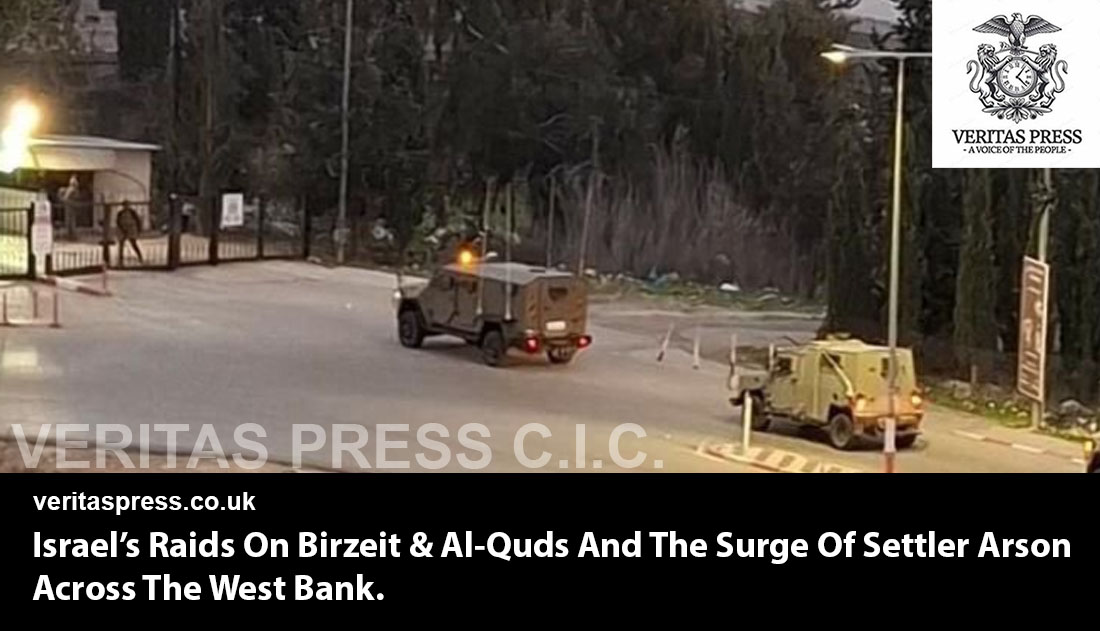
On 9 December 2025, Israeli forces staged synchronised pre-dawn raids on two of the West Bank’s most important universities, Birzeit (Ramallah) and Al-Quds (Abu Dis), while illegal settlers across multiple governorates escalated arson, beatings, property destruction and land seizures. The pattern is not random: human-rights groups, UN officials and independent researchers say the raids, detentions, movement restrictions and settler attacks form an integrated strategy that physically and socially dismantles Palestinian life, targeting education, livelihoods and the possibility of a future Palestinian polity. This investigation brings together eyewitness testimony, NGO field research, official UN findings and independent reporting to map how the operations work on the ground, who is affected, and why experts say the trend amounts to more than ad-hoc security measures.
What Happened On The Ground (Key Facts):
- Birzeit University was stormed at 04:00 on 9 December. Soldiers entered from multiple gates; Birzeit reported that five campus security personnel were arrested and their phones confiscated and that academic and administrative operations were postponed “out of concern for the safety of students and staff.”
- Al-Quds University in Abu Dis was also raided in predawn operations the same day. Local reporters and university sources said military vehicles and troops moved through faculty and student spaces.
- Simultaneously, the West Bank saw a wave of settler arson, vehicle torching, stone-pelting and home attacks in Hebron (Masafer Yatta/Wadi al-Rakhim), Ramallah governorate, Salfit, Nablus, Jericho and Bethlehem, with multiple reports of cars and tractors set alight, graffiti-ed walls, and farmers physically attacked while tending land.
- These events take place against a documented backdrop: UN and NGO monitoring show a sharp spike in settler attacks, demolitions and forcible displacement across late 2024–2025. OHCHR and Human Rights Watch have warned that the scale and pattern of displacement and settler violence risk amounting to war crimes and crimes against humanity.
Patterns, Intent And Method: Why Investigators Say This Is Coordinated.
- Simultaneous targeting of civic hubs (universities)
Universities are civic infrastructure: they educate, incubate leadership and host student unions and documentation archives. Storming Birzeit and Al-Quds in the same operation, detaining security staff, searching student offices and confiscating phones does more than arrest individuals. It disrupts organisational memory, breaks networks of mobilisation and intimidates a generation of activists and academics. Human-rights researchers call repeated campus incursions part of a “scholasticide”, a policy of undermining Palestinian education and public life. - Settler violence as territorial control
Research and field interviews show settlers’ violence is concentrated where settlements or outposts seek greater territorial contiguity or agricultural control (Area C, South Hebron Hills, Jordan Valley). Activists document a recurrent sequence: settlers arrive, harass or attack farmers; soldiers either observe without intervening or impose movement restrictions that leave Palestinians unable to protect land, then outposts expand. Human Rights Watch’s November 2025 report concluded that settler violence has functionally displaced entire communities and that state actors have frequently acquiesced. - Military practices that enable settler action
NGOs, UN agencies and journalists have repeatedly documented cases where settlers act in the presence of soldiers, or where military checkpoints and closures prevent Palestinians from accessing their land while settlers move freely. B’Tselem’s executive director, Yuli Novak, put it plainly: “Settler attacks are a form of Israeli state violence … they are Israeli civilians living in the West Bank being armed by the state. Sometimes, many of them wear [army] uniforms.”
Voices From The Ground, Testimony And Official Statements:
- University community (Birzeit): Birzeit told local media it postponed operations “out of concern for the safety of students and staff” after security personnel were detained and phones seized. The closure, even temporary, reverberates across student life, exams and staff livelihoods.
- A Palestinian father forced to leave: Reuters reporters quoted Mahmoud Mleihat, a 50-year-old Bedouin father of seven, describing how “the settlers are armed and attack us, and the (Israeli) military protects them. We can’t do anything to stop them. We can’t take it anymore, so we decided to leave.” That testimony captures the immediate calculus of fear and flight.
- UN human-rights office: the Office of the UN High Commissioner for Human Rights declared the surge “abhorrent,” warned that “permanently displacing the Palestinian population within occupied territory amounts to unlawful transfer, which is a war crime,” and demanded accountability. High Commissioner Volker Türk reiterated that attacks must stop and those responsible must be held to account.
- Human Rights Watch: HRW’s 20 November 2025 report, “All My Dreams Have Been Erased,” documents the large-scale forced displacement of West Bank communities and accuses Israeli authorities of failing to protect Palestinians while expanding settlements and using demolition-and-detention policies that produce systematic dispossession. It includes first-hand interviews and geolocated evidence of expulsions and destruction.
- B’Tselem: Yuli Novak warned that the conditions that enabled the Gaza catastrophe remain normalised, and that the West Bank violence is another arm of an entrenched system of control and impunity. “As long as these things are still in place, we are very concerned that the violence that we’ve seen is not over,” she told Al Jazeera in November.
Case Studies, Concrete Incidents Showing The Method:
- Masafer Yatta / Wadi al-Rakhim (Hebron): settlers reportedly set fire to a vehicle and an agricultural tractor, sprayed racist graffiti, and attempted to expel farmers from land. Video and field reports document tractors torched and farmers beaten. This is symptomatic: agricultural equipment, the physical basis of livelihoods, is a deliberate target.
- Jordan Valley (Mleihat Bedouin community): Reuters filmed families dismantling their own homes after repeated harassment and concluded they left “because we can’t take it anymore,” showing how long-term pressure produces self-eviction, a feature of forced displacement without formal eviction orders.
- Universities: the IDF’s pattern of pre-dawn incursions, detentions of student leaders and seizure of phones/archives mirrors previous tactics designed to disrupt organisation and chill dissent. The cumulative effect is a sustained attrition of civic life.
Legal And Policy Implications:
- International law risks: OHCHR has called many of the forcible transfers and settlement entrenchment policies in the West Bank unlawful; the office warns permanent displacement can amount to the war crime of forcible transfer. HRW’s November report likewise outlines actions that could meet thresholds for crimes against humanity and war crimes given scale, intent and state facilitation.
- Impunity and accountability gap: NGOs document a consistent pattern: settlers who commit violence often go unprosecuted; military actors involved in the use of lethal force or home seizures rarely face independent investigation. Rights groups argue this impunity makes settler violence an instrument of policy rather than random criminality.
What Israeli Authorities Say (Official Framing):
- The Israeli military typically frames West Bank operations as “counter-terrorism” or security measures aimed at dismantling armed cells and preventing attacks. Press briefings around recent northern-West-Bank operations described broad counter-terrorism aims; Israeli ministers at times condemn individual settler violence while defending large-scale security operations. The language used by the military is important because it sets the legal and political frame for actions that NGOs interpret as collective punishment or territorial consolidation.
Expert Analysis, Connecting The Dots:
- Mechanics of territorial control: analysts and field researchers describe a three-pronged strategy: (1) security operations that justify military presence and closures; (2) settler violence/outpost expansion that changes facts on the ground; and (3) administrative tools (permit regime, demolitions, road closures) that hollow out the Palestinian economy and mobility. When combined, these measures produce de facto exclusion zones and demographic shifts. Human Rights Watch documents the displacement numbers; OHCHR and B’Tselem map the tactics.
- Why universities matter: scholars call the targeting of higher-education institutions “scholasticide”; it is both symbolic and strategic. Attacks on campuses are attacks on future civil society leaders, archives, research and professional training. By disrupting campuses, the occupation chips away at Palestinian institutional continuity.
What Local Leaders And Communities Say They Need:
Across interviews and field reports, the demands repeat: physical protection, accountability for settler perpetrators, restraint on military incursions into civilian and educational spaces, and international mechanisms able to investigate systematic displacement. UN and rights groups ‘ calls for investigations and for halting evacuation/demolition policies have gone unimplemented; communities repeatedly stress that temporary relief is not enough, and they seek legal, security, protection and political guarantees.
Why The International Response Matters (And So Far, Why It’s Failed):
- UN & NGOs: UN human-rights statements, OCHA snapshots and HRW/B’Tselem reporting have documented the trend and urged action. OHCHR has explicitly warned that some practices could meet the legal definitions of forcible transfer and war crimes. Yet symbolic statements have not produced effective remedies on the ground.
- Diplomacy and politics: geopolitical currents (arms policies, diplomatic re-engagements and shifting alliances) have blunted punitive measures. As B’Tselem’s Yuli Novak told Al Jazeera, normalisation of the violence and the lack of accountability create conditions where the underlying policies can be reproduced.
Immediate Implications & What To Watch Next:
- Education under siege: recurrent campus incursions mean dropped courses, expulsions, and long-term brain-drain. Watch university statements, student-union actions, and international academic bodies (e.g., Scholars at Risk).
- New displacements: HRW and UN data show tens of thousands displaced already in 2025; new demolitions and settler-outpost expansions could trigger further waves. Monitor OCHA snapshots and HRW updates.
- Legal moves: advocacy and rights groups are compiling evidence for international mechanisms (ICJ, ICC). If political pressure is applied, that evidence could feed formal accountability processes.
- Field reporting: independent journalists and human-rights videography (B’Tselem, local photographers) are crucial, and visual and geolocated evidence has been decisive in documenting patterns.
Conclusion: A Strategy In Plain Sight.
Taken together, the storming of Birzeit and Al-Quds Universities, the mass detentions, the house demolitions, the settler arson attacks, and the strangling of Palestinian mobility through checkpoints are not isolated security incidents. The raid on Birzeit and Al-Quds, when read alongside daily reports of settler arson, farmer expulsions, house demolitions and checkpoints, maps onto a broader strategy: the systematic shrinking of Palestinian civic, economic and territorial life in the West Bank, under the logic of security and territorial expansion. Experts and UN officials warn the cumulative effect is not incidental but structural, an engineered attrition that undermines rights, destroys livelihoods and narrows the future. As Roland Friedrich of UNRWA put it while describing emptied refugee camps, “Refugee camps that were once full of life…are now reduced to rubble. …This is not just destruction: it is part of systematic forced displacement.” The UN human rights office (OHCHR) has issued similar warnings, stressing that “those responsible must be held to account.”
Within this framework, the current escalation appears less as an emergency response and more as a continuation of a long-term state project. Israeli analysts, international rights groups and even former officials increasingly describe a clearly articulated expansionist doctrine, one that aims to make Palestinian presence fragmentary, provisional, and ultimately removable. Ministers such as Bezalel Smotrich and Itamar Ben-Gvir openly advocate annexation of the West Bank, insisting Israel must “exercise full sovereignty” over what they call the biblical homeland. This rhetoric is not detached from policy: new outposts are being legalised, budgets for settlement expansion have surged, and military orders continuously restrict Palestinian movement while shielding armed settlers from accountability.
Israeli rights groups argue the policy architecture now mirrors annexation “in all but name.” B’Tselem and Peace Now note that civilian ministries and military commanders are increasingly coordinating on land confiscation, road re-engineering, and settlement expansion in ways that erase the boundary between Israel and the occupied territories. One former Israeli general told Channel 12 that “annexation is already happening, just without the ceremony,” describing a deliberate strategy of creating irreversible “facts on the ground.” Amnesty International, Human Rights Watch, and multiple UN mandate-holders have concluded that the accelerating entrenchment of settlements, expansion of closed military zones, and systematic transfer of Palestinian communities constitute elements of apartheid and forcible displacement.
On the ground, Palestinians describe a map being erased in real time. A farmer in Masafer Yatta told local media that every grazing route is now patrolled by settlers: “They burn the tractors, they chase the shepherds, and the army protects them. They want us to leave by making life unlivable.” A student from Birzeit University said the campus raids aim to break social life: “They want to show they can enter any institution and shut it down. Education is not safe, roads are not safe, homes are not safe.”
Humanitarian agencies, too, warn that the sweep of policies, from university raids to settler militias torching homes, is part of a coherent machinery of dispossession. UN OCHA and OHCHR have repeatedly stated that “piecemeal violence” must be understood as part of a structural system. The UN Special Rapporteur on the occupied territories has called the pattern “a slow-motion annexation achieved through coercive environment and engineered displacement.”
In this light, the events documented in this report cannot be understood as random episodes or symmetrical confrontation. They form the visible front edge of a deeper political project: the consolidation of permanent Israeli control over the West Bank and the dismantling of Palestinian social, economic, and territorial cohesion. The raids on universities, the very institutions that anchor civic life, signal that no space is exempt from this pressure.
The central question facing the international community is whether it will continue to treat these developments as isolated breaches of humanitarian law, or recognise them as components of a coordinated expansionist program whose end goal is irreversible annexation. Western governments continue issuing statements of “concern” that remain empty and hollow, and yet expand military aid and diplomatic protection. The result, rights groups say, is a cycle of impunity in which settler militias act as an auxiliary force, the army enforces spatial domination, and Palestinian communities are squeezed into smaller, more precarious pockets of land.
As one humanitarian official bluntly stated, “This is not a conflict of equals. It is a deliberate re-engineering of a society.” Unless systematic accountability replaces political indulgence, and unless annexation is confronted not as a hypothetical but as a present reality, the destructive trajectory will continue unabated. What remains clear from the testimonies of locals, the assessments of analysts, and the warnings of international bodies is that the landscape is being reshaped not by accident but by design, a map redrawn through force, erasure, illegal occupation, mass displacement, genocide and the steady tightening of control over a people whose future is being deliberately constrained.