



Press Release: Veritas Press C.I.C.
Author: Kamran Faqir
Article Date Published: 10 Nov 2025 at 12:30 GMT
Category: Middle-East | Palestine-Gaza-West Bank |
Source(s): Veritas Press C.I.C. | Multi News Agencies
Website: www.veritaspress.co.uk

Business Ads

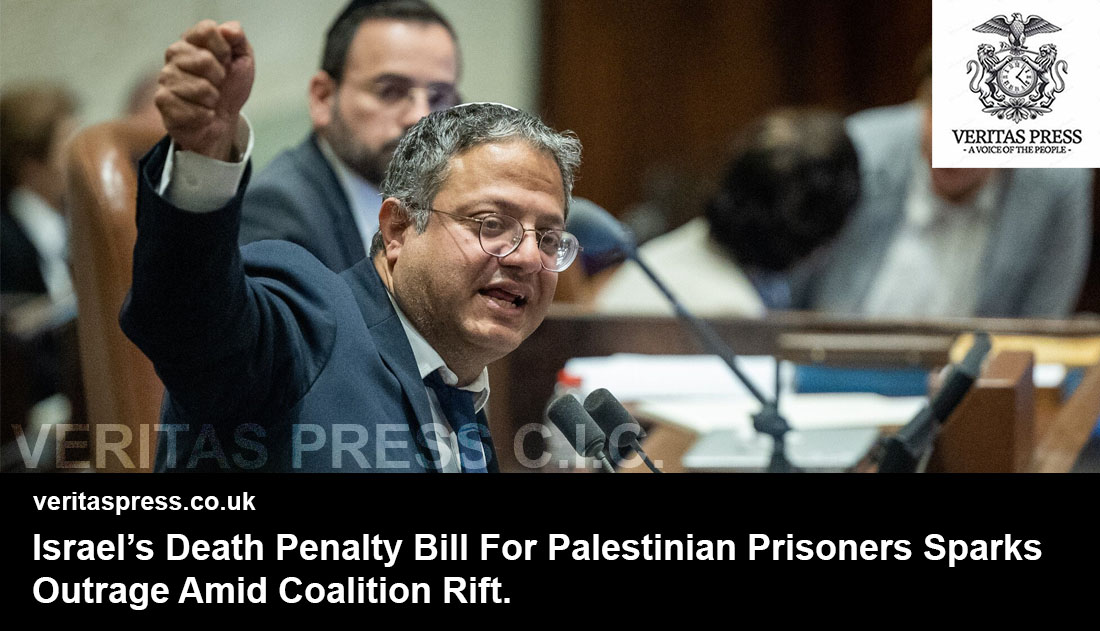
TEL AVIV — Israel’s parliament, the Knesset, is set to hold its first reading on Monday on a bill that would impose the death penalty on Palestinian prisoners convicted of what Israel defines as “terrorist acts in which Israelis are killed.”
The proposal, championed by far-right National Security Minister Itamar Ben-Gvir and backed by Prime Minister Benjamin Netanyahu, has reignited fierce debate within Israel’s fragile coalition government and drawn condemnation from Palestinian and international human rights organisations.
A Divided Coalition And A Contentious Vote:
According to Israeli media, the first reading comes amid deep divisions within Netanyahu’s governing bloc. The ultra-Orthodox parties United Torah Judaism (UTJ) and Shas have both withdrawn from the coalition over a separate dispute regarding the military conscription of Haredi men.
While the Shas party’s position remains unclear, Channel 15 reported that the UTJ alliance, made up of the Degel HaTorah and Agudat Yisrael factions, will vote against the death penalty bill.
Rabbi Dov Landau, a senior authority within Degel HaTorah, reportedly instructed lawmakers to oppose the measure, warning that its passage “could provoke further bloodshed.”
The loss of support from the ultra-Orthodox parties has left Netanyahu’s government without a clear parliamentary majority. Despite the instability, Ben-Gvir’s Jewish Power (Otzma Yehudit) party has threatened to block government-backed legislation if the death penalty bill is not brought to a vote within three weeks.
“This law is a historic step,” Ben-Gvir declared in a televised statement. “History will hold accountable anyone who dares to raise a finger against the death penalty law. It’s time to put politics aside.”
Inside The Bill: Death Penalty For Palestinians Only.
The bill, approved by the Knesset’s National Security Committee on November 3, stipulates the death penalty for any person who “intentionally or through negligence causes the death of an Israeli citizen out of racist or hateful motives and to harm Israel.”
While the law’s language appears broad, it would apply exclusively to Palestinians, as Israelis convicted of killing Palestinians would remain exempt.
Palestinian rights groups and international observers say the bill would institutionalise racial discrimination in Israel’s legal system. The Palestinian Centre for Human Rights (PCHR) described it as “a grave escalation in Israel’s widespread violations against Palestinians, including hundreds of extrajudicial executions.”
A joint position paper by Palestinian organisations said the bill would apply retroactively, potentially targeting hundreds of Palestinian detainees, particularly those captured after October 7, 2023.
“The essence of this draft bill reflects a retaliatory and revengeful motive, rather than serving as a measure of deterrence or prevention,” the groups said.
Historical Context: Israel Never Abolished The Death Penalty.
Contrary to popular perception, Israel never fully abolished capital punishment. It inherited the British Mandate’s 1945 Emergency Regulations, which allowed executions under military law.
The death penalty was later limited to crimes of genocide, treason, and Nazi collaboration, and was last carried out in 1962, when Adolf Eichmann, the Nazi war criminal, was hanged after his conviction for genocide and crimes against humanity.
Human rights experts say the new bill marks an unprecedented departure from those limits. “The proposed legislation would turn a symbolic relic into an operational weapon of repression,” said one Israeli legal analyst quoted by Haaretz. “It transforms judicial discretion into political vengeance.”
A Broader Pattern Of Violence And Repression:
The proposed law comes against the backdrop of mounting evidence of abuse and torture inside Israeli prisons, particularly against Palestinians detained from Gaza during and after last year’s war.
An investigation published by The Guardian on November 9 revealed that Israel has been operating a secret underground prison beneath the Ramla complex, known as Rakefet, where detainees from Gaza are held in conditions that rights lawyers describe as “torture.”
According to the Public Committee Against Torture in Israel (PCATI), detainees are kept in total darkness, shackled for long periods, deprived of food and medical care, and routinely beaten by guards.
One lawyer, Janan Abdu, who visited the site, said:
“In the cases of the clients we visited, we are speaking about civilians. One was an 18-year-old food vendor arrested at a checkpoint. He asked me: ‘Where am I, and why am I here?’ He didn’t even know the name of the prison.”
PCATI’s director, Tal Steiner, warned that underground confinement “has extreme psychological implications” and “amounts to torture under international law.”
The facility, built in the early 1980s and shuttered for being “inhumane,” was reopened in late 2023 on the orders of Ben-Gvir, who described it as “terrorists’ natural place, under the ground.”
Over 9,000 Palestinians Behind Bars:
According to Addameer, a Palestinian prisoner rights group, Israel currently holds around 9,250 Palestinian detainees, including:
- 3,368 administrative detainees held without charge or trial
- 350 children
- 49 women
Rights groups have long documented systematic medical neglect, overcrowding, denial of family visits, and torture in Israeli prisons.
Since October 2023, dozens of Palestinian detainees have reportedly died under torture or medical neglect, while hundreds more remain forcibly disappeared. Human rights organisations warn that Israel’s detention regime now constitutes a form of “slow death”, a method of collective punishment in violation of international humanitarian law.
Legal And Human Rights Backlash:
Palestinian human rights groups and international organisations have condemned the bill as part of Israel’s “apartheid legal framework.”
In a statement, PCHR said:
“This law will apply solely to Palestinians, thereby revealing yet another facet of Israel’s apartheid regime. It codifies the death penalty as a tool of occupation and racial domination.”
Israel is not a signatory to the Second Optional Protocol to the International Covenant on Civil and Political Rights, which requires the abolition of capital punishment. Critics argue that the proposed law would further isolate Israel internationally and could invite new scrutiny at the International Criminal Court.
Opposition And Uncertain Outcome:
Despite Netanyahu’s public support, the bill’s passage remains uncertain. The ultra-Orthodox bloc’s rebellion and broader coalition tensions could derail it, at least temporarily.
But analysts warn that even if the bill stalls, its mere advancement represents a dangerous normalisation of state violence against Palestinians.
“This isn’t about deterrence,” said one rights advocate based in Jerusalem. “It’s about legislating revenge and legalising the occupation’s brutality.”
Conclusion: A Legal Framework For Elimination.
The death penalty bill does not emerge in isolation. It represents the culmination of a decades-long shift in Israel’s governance of Palestinians, from a military occupation enforced by checkpoints and curfews to a juridical occupation in which extermination is framed as law.
By codifying execution for Palestinians alone, the Israeli government is not simply expanding punitive powers; it is transforming apartheid into capital law. The proposal effectively fuses Israel’s security apparatus with its judicial system, turning the courtroom into an extension of the battlefield, where the death sentence replaces administrative detention as the ultimate form of “security control.”
Legal experts warn that the bill’s language, “racist or hateful motives” and “to harm the State of Israel”, is deliberately vague, allowing prosecutors to apply it retroactively and without clear evidentiary standards. This opens the door for mass executions justified under national security rhetoric, with little or no international oversight.
Human rights advocates argue that Israel is weaponising the rule of law to grant legal immunity to its most violent impulses. “This bill doesn’t reform the justice system,” said one Israeli lawyer who works with Palestinian detainees. “It annihilates it, turning it into an instrument of death.”
For Palestinians, the measure signals a deepening of a carceral logic already evident in mass arrests, torture, and indefinite detention. It is the endpoint of a system that began with occupation and has evolved into what scholars call “the bureaucratisation of disappearance.”
The death penalty bill reflects a broader shift in Israel’s security and legal doctrine, from indefinite detention and administrative punishment to formalised execution as a state-sanctioned tool of control. If enacted, it would mark a watershed in the seven-decade occupation: a transition from extrajudicial killings and covert assassinations to legalised execution of an occupied people.
If passed, the law would create a judicial mechanism to formalise what has long occurred extrajudicially, the systematic killing of Palestinians without accountability. The gallows, in this sense, become merely symbolic: the real machinery of execution has been operating in Gaza’s bombed hospitals, in West Bank raids, and in Israel’s underground detention sites.
International jurists and UN experts have repeatedly warned that Israel’s carceral and military practices already constitute crimes against humanity, including apartheid and persecution. The death penalty bill pushes that framework further, embedding state killing into statutory legitimacy, a move that would put Israel at odds not only with international law but with the foundational principles of human civilisation.
At its core, the law is less about justice and more about vengeance as governance. It seeks to reassert Israel’s political dominance amid domestic fractures, offering the far-right a legal spectacle of retribution while deflecting attention from Gaza’s humanitarian collapse and Netanyahu’s deepening isolation abroad.
In doing so, Israel risks erasing the final distinction between a state that punishes and a state that eliminates. The gallows, once reserved for war criminals like Eichmann, may soon serve as a mirror, reflecting a nation’s descent from law to legalised violence.
And as one Palestinian detainee reportedly told his lawyer before being returned to an underground cell:
“Please come see me again.”
Key Figures:
- Over 9,250 Palestinian prisoners are currently held in Israel
- 3,368 held under administrative detention
- 1,000+ Gazan detainees still imprisoned under wartime conditions
- 1962: last execution in Israel (Adolf Eichmann)
- November 10, 2025: date of the Knesset’s first reading on the bill