
Title: Israeli Occupation Forces Escalate West Bank Crackdown For Fourth Day – War Crimes, Crimes Against Humanity, And Ongoing Forcible Transfer.
Press Release: Veritas Press C.I.C.
Author: Kamran Faqir
Article Date Published: 22 Jan 2026 at 14:20 GMT
Category: Middle East | Palestine-Gaza-West Bank-OPT | Israeli Occupation Forces Escalate West Bank Crackdown For Fourth Day – War Crimes, Crimes Against Humanity, And Ongoing Forcible Transfer.
Source(s): Veritas Press C.I.C. | Multi News Agencies
Website: www.veritaspress.co.uk

Business Ads

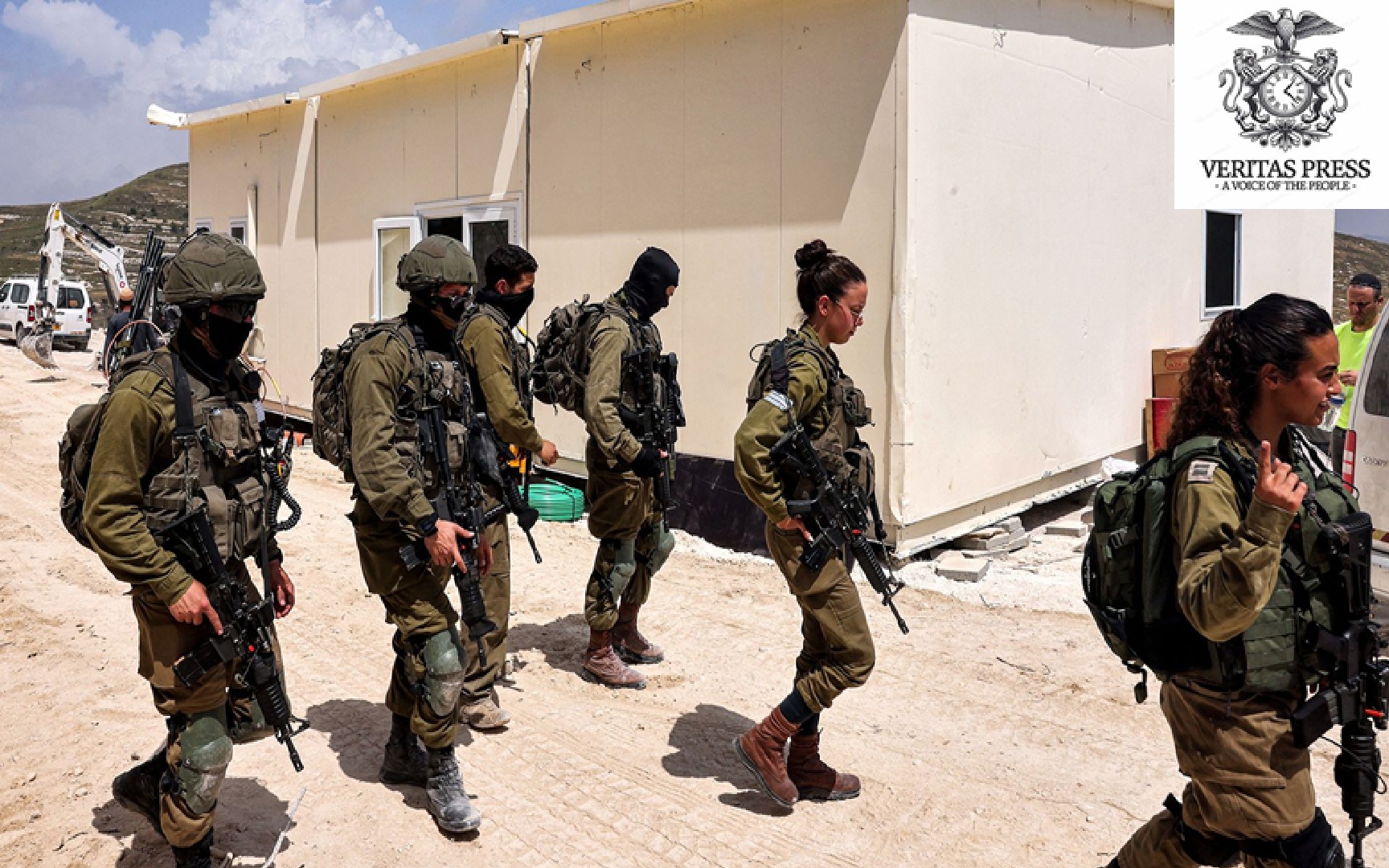
Israeli occupation forces continued an intensified military campaign across the occupied West Bank for a fourth consecutive day, deepening what Palestinian officials, international jurists, and human rights organisations increasingly describe as a pattern of war crimes and crimes against humanity, carried out through collective punishment, forcible transfer, and the systematic erasure of Palestinian presence.
Centred on Hebron (Al‑Khalil) but extending across nearly every governorate, the operation has involved mass arrests, blanket curfews, home demolitions, settler pogroms under military protection, and the large-scale destruction of civilian property. Taken together, these acts align closely with prohibitions under the Fourth Geneva Convention, the Rome Statute of the International Criminal Court, and customary international humanitarian law.
Hebron Under Siege: Collective Punishment As A War Crime.
In Hebron, Israeli occupation forces reinstated a sweeping curfew after briefly easing restrictions that had confined entire neighbourhoods for days. Troops redeployed heavily across Jabal Jawhar and southern districts, sealing residential areas with checkpoints, iron gates, and internal roadblocks.
Residents were permitted to leave their homes on foot for only a few hours to obtain food and medicine. Vehicles were banned. Even during this window, Israeli soldiers assaulted civilians, injuring at least five people.
Under Article 33 of the Fourth Geneva Convention, collective punishment is explicitly prohibited. Legal analysts note that blanket curfews imposed on civilian populations, absent immediate hostilities, constitute unlawful punishment rather than legitimate security measures.
“This is textbook collective punishment,” said international law scholar Ardi Imseis. “When an occupying power imposes curfews, restricts food access, and assaults civilians to coerce compliance, it crosses into war‑crime territory.”
Occupation forces destroyed dozens of civilian vehicles and conducted warrantless home invasions accompanied by property vandalism and interrogations. Neighbourhoods were deliberately isolated from one another, a tactic B’Tselem has previously described as part of Israel’s “architecture of control.”
Mass Arrests And Coercion: Arbitrary Detention And Persecution.
Across the West Bank, Israeli forces carried out mass arrest campaigns targeting youths, former detainees, and political activists, including women previously released from detention.
Arbitrary detention without charge or trial violates Articles 9 and 14 of the International Covenant on Civil and Political Rights. When such detentions are widespread and systematic, they may constitute the crime against humanity of persecution under Article 7 of the Rome Statute.
In Ras Karkar, Israeli soldiers threatened to arrest a young man’s parents unless he surrendered himself, a form of coercion condemned by Amnesty International as unlawful and abusive.
“These arrests are not about individual culpability,” said Sahar Francis, director of Addameer. “They are about crushing political life and making Palestinian existence itself criminal.”
Settler Violence As State Policy: Delegated Crimes.
In Salfit and south of Hebron, settlers assaulted Palestinian civilians, after which Israeli forces detained the Palestinian victims rather than the attackers. In several cases, settlers acted openly alongside armed soldiers.
Human rights organisations argue that when a state knowingly enables, protects, or incorporates settler violence into its control strategy, responsibility transfers to the occupying power.
Yesh Din has described settler attacks as a “delegated mechanism of land seizure,” while Human Rights Watch has warned that Israel’s failure to prosecute settlers amounts to systemic impunity, a key indicator of crimes against humanity.
“This is not mob violence,” said Issa Amro of Youth Against Settlements. “It is organised, armed, and protected. The army does the paperwork; the settlers do the terror.”
Home Demolitions And Forcible Transfer:
Israeli forces demolished three homes in Shuqba without prior warning, forcibly displacing at least 22 Palestinians.
Forcible transfer of protected persons is a grave breach of the Fourth Geneva Convention and a war crime under Article 8 of the Rome Statute. UN Office for the Coordination of Humanitarian Affairs (OCHA) has repeatedly warned that Israel creates “coercive environments” designed to compel Palestinians to leave their land without direct deportation.
UN Special Rapporteur Francesca Albanese has stated that Israeli demolitions and land seizures constitute “the material elements of ethnic cleansing.”
“They don’t load people onto trucks anymore,” Albanese said. “They destroy homes, livelihoods, and safety until people have no choice but to leave.”
Arming Settlers: Militarising Civilian Colonisation.
Israel’s National Security Minister Itamar Ben‑Gvir has approved gun licences for residents of 18 additional illegal settlements, bringing the total number of armed settlers to more than 240,000 since late 2023.
Legal experts warn that arming civilians inside occupied territory violates the occupying power’s duty to protect the civilian population and may amount to the use of proxy forces, a recognised form of international criminal liability.
Hagai El‑Ad, former director of B’Tselem, described the policy as “the privatisation of ethnic cleansing under state supervision.”
The Crime Of Apartheid And Ethnic Cleansing:
Israeli policies in the West Bank, including separate legal systems, racialised movement restrictions, and the violent expansion of settlements, meet the legal definition of apartheid under the International Convention on the Suppression and Punishment of the Crime of Apartheid.
When combined with systematic displacement, home destruction, and demographic engineering, these policies also meet the threshold for ethnic cleansing, a term used by UN bodies to describe the removal of a population through force or coercion.
Israeli journalist Gideon Levy wrote this week: “The goal is not order. It is disappearance.”
International Law Defied:
In 2024, the International Court of Justice ruled that Israel’s occupation is unlawful and must end “as rapidly as possible,” ordering the dismantling of settlements and reparations for Palestinian victims.
Israel has ignored the ruling. Military operations, settlement growth, and settler violence have accelerated.
As the fourth day of escalation unfolds, legal experts warn that failure by third states to act may constitute complicityunder international law.
“This is not a future case,” said a European jurist involved in universal‑jurisdiction litigation. “The crimes are ongoing, documented, and prosecutable.”
For Palestinians in Hebron and beyond, the legal language offers little immediate protection.
“They call it security,” said Umm Khaled, standing outside her sealed street. “But what they are doing has a name. It is a crime.”
Conclusion: An Occupation Built On Crimes, Sustained By Impunity.
What is unfolding across the occupied West Bank is not a temporary security escalation nor a series of isolated abuses. It is a coherent, long-term project of domination that relies on war crimes and crimes against humanity as governing tools. Curfews, mass arrests, home demolitions, settler violence, and the arming of civilians are not parallel phenomena; they are mutually reinforcing mechanisms designed to empty the land of its Indigenous Palestinian population.
Legal experts stress that the defining feature of these crimes is not chaos, but coordination. The Israeli military seals neighbourhoods, restricts movement, and arrests residents; settlers, often armed and escorted, attack civilians and seize land; civil authorities retroactively legalise outposts and issue gun licences. Together, they form what Human Rights Watch has described as an “institutionalised regime of domination and oppression.”
“The point is not just to control Palestinians,” said a senior international investigator familiar with ICC submissions. “It is to make their continued presence untenable. That is the essence of forcible transfer.”
The cumulative effect is unmistakable. Families are displaced not by a single expulsion order, but by relentless pressure: streets sealed by iron gates, livelihoods destroyed, children arrested, homes demolished at dawn, and settlers roaming with military-grade weapons. As UN OCHA has repeatedly warned, such “coercive environments”are deliberately engineered to produce displacement without the optics of mass deportation.
Israeli journalist Amira Hass has long noted that “most people leave not because they are expelled, but because staying becomes impossible.” The current escalation demonstrates that this logic remains central to Israeli policy in the West Bank.
Under international law, intent can be inferred from a pattern. The pattern here is overwhelming. Since October 2023, violence has intensified, settlements have expanded, and legal restraints have been openly discarded, even after the International Court of Justice ruled the occupation unlawful. This persistence, jurists argue, strengthens rather than weakens the legal case, transforming violations into ongoing crimes.
The failure of the international community to intervene is no longer neutral. As legal scholars warn, continued military, political, and diplomatic support for Israel in the face of documented crimes raises the spectre of state complicity, a principle firmly embedded in international law.
For Palestinians in Hebron, Jenin, Nablus, and beyond, the reality is immediate and brutal. “They don’t need to announce ethnic cleansing,” said Umm Khaled, whose street has been sealed for days. “We live it every hour.”
What remains is not a question of evidence, but of enforcement. The crimes are documented. The laws are clear. The victims are known. What is missing is the political will to hold a state accountable, before the erasure becomes irreversible.