







Original Article Date Published:
Article Date Modified:
Help support our mission—donate today and be the change. Every contribution goes directly toward driving real impact for the cause we believe in.
Beyond A Land Grab, A Blueprint For Erasure:
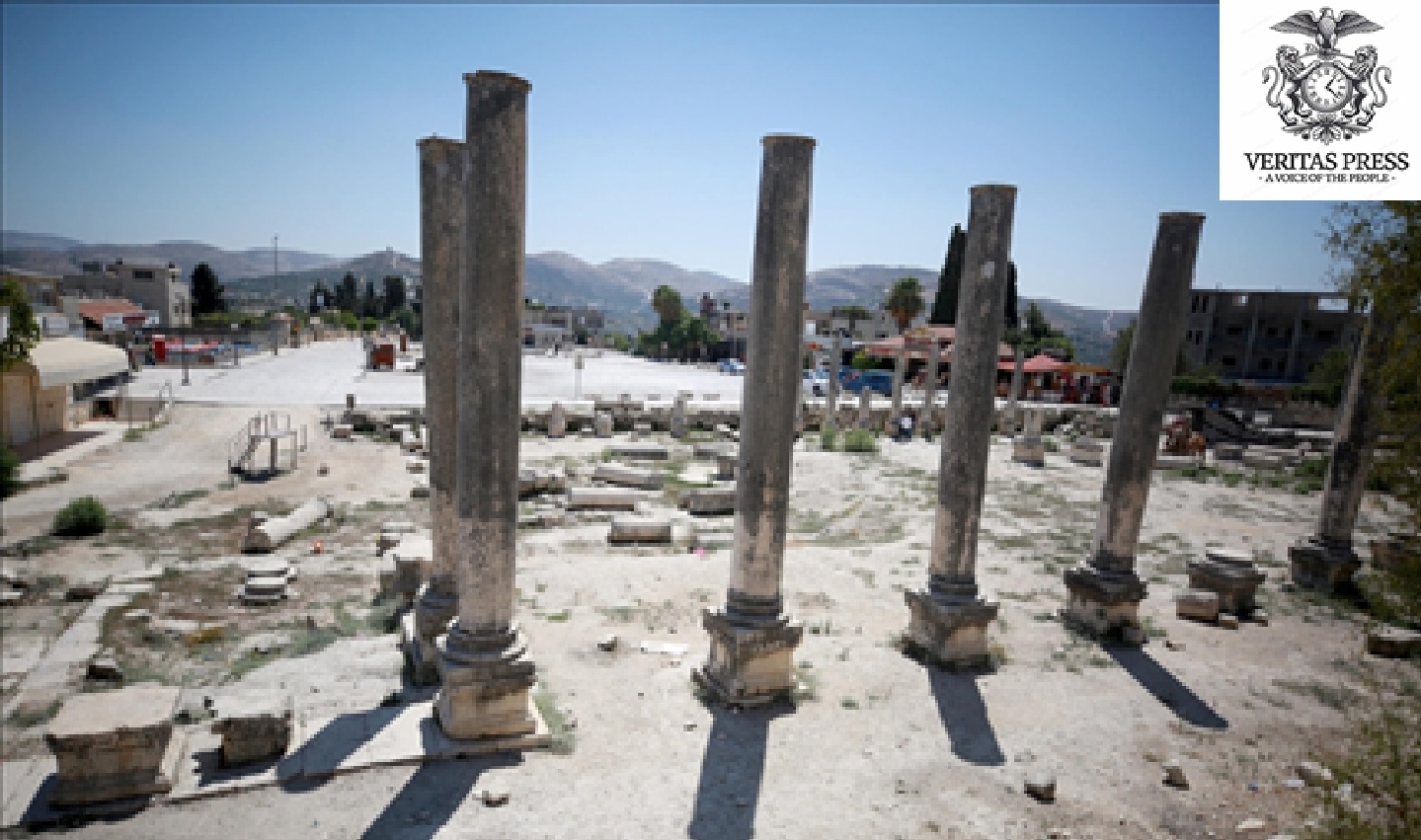
On February 17, 2026, the Israeli Civil Administration formalised an order to seize 2,000 dunams (494 acres) of land in the northern occupied West Bank, targeting the villages of Sebastia and Burqa in the Nablus governorate. While officially presented as a procedural step to develop an archaeological park, this expropriation, numbered Order No. 26/1, represents a qualitative escalation in Israel’s strategy toward the Palestinian territories.
This is not merely an expansion of settlements; it is the “weaponisation” of archaeology. By wrapping annexation in the cloak of heritage preservation, the Israeli government, driven by its far-right coalition, is executing a blueprint to fragment Palestinian communities, erase multilayered histories, and render a two-state solution physically impossible. The seizure of Sebastia must be read not as an isolated incident, but as the cultural front of a broader campaign that includes the approval of 52 new settlements in 2025 alone and a radical new policy to register West Bank land as Israeli “state property” for the first time since 1967.
The Scale Of The Seizure: From Intent To Execution.
The formalisation of this order marks the culmination of a process initiated in January 2025. Moayad Shaaban, head of the Palestinian Wall and Settlement Resistance Commission, confirmed that the initial declaration of intent (Order No. 2/25) lacked precision, whereas the new order (No. 26/1) reveals the full, devastating scope of the plan.
- Geographic Reach: The seizure extends far beyond the ancient tell (archaeological mound) itself. It encompasses fertile agricultural lands and olive groves that belong to the towns of Sebastia and Burqa, effectively severing the Palestinian residents from their primary sources of income and their ancestral heritage.
- A New Precedent: Anti-settlement watchdog Peace Now has noted that this constitutes the largest seizure of archaeologically significant land since Israel’s occupation of the West Bank began in 1967, dwarfing previous confiscations near the site of Susya. The inclusion of privately owned Palestinian land under the guise of a “national park” sets a dangerous legal precedent for the rest of Area C.
The Ideological Driver: Smotrich, Sovereignty, And The “Nullification” Of Oslo.
To understand the timing and nature of this move, one must look at the statements coming from Israel’s far-right leadership. On the night of February 17, 2026, Finance Minister Bezalel Smotrich addressed his Religious Zionism Party, laying bare the ideology driving the Sebastia seizure.
Smotrich declared his intent to “finally, formally, and in practical terms nullify the cursed Oslo Accords.” He explicitly called for “encouraging emigration” (a term widely interpreted as ethnic transfer) of Palestinians from both Gaza and the West Bank, stating, “There is no other long-term solution”.
The Sebastia expropriation is the physical manifestation of this rhetoric:
- Oslo’s Demise: The Oslo Accords designated the Palestinian Authority as having civilian control over Areas A and B. By extending Israeli law (via the Israel Antiquities Authority) and sovereignty over heritage sites deep in the northern West Bank, Israel is effectively dissolving the last vestiges of the interim agreements.
- Settler Integration: The newly seized land is not for the benefit of the international community or universal heritage. It is designated exclusively for illegal Israeli settlers. The plan includes a new access road bypassing Sebastia entirely, connecting the site directly to Israel and facilitating the expansion of the nearby Shavei Shomron settlement.
The Mechanism: How “Heritage” Masks Annexation.
The Israeli government has allocated over 30 million shekels ($9.24 million) to develop the site into the “Shomron National Park”. While Minister of Heritage Amichai Eliyahu (Otzma Yehudit) frames this as strengthening the “connection between the people, their heritage, and their country,” critics argue this is a cynical manipulation of history.
- Selective History: The site of Sebastia is one of the oldest inhabited areas in the region, with layers spanning the Canaanite, Israelite (Samaria), Roman (where Herod built a city honouring Augustus), Byzantine, Crusader, and Islamic periods. It is also revered in Christian and Muslim tradition as the burial site of John the Baptist (Nabi Yahya). By rebranding it exclusively as the capital of the Iron Age Israelite kingdom, the government is engaging in a politically motivated act of historical erasure.
- The NGO Perspective: Alon Arad of the Israeli NGO Emek Shaveh, which fights to keep archaeology a public asset, has condemned the move as “unprecedented in its scale” and “very cynical.” He notes, “It is not about history, it is really just about land and annexation”.
- Violation of International Law: International law, specifically the Hague Regulations, prohibits an occupying power from excavating or altering archaeological sites except for the purpose of preservation. Furthermore, the UN Security Council Resolution 2334 (2016) reaffirms that settlements have “no legal validity.” The advisory opinion of the International Court of Justice (ICJ) from July 2024 explicitly declared the occupation unlawful and called for the evacuation of all settlements.
The Human Cost: The Siege Of Sebastia.
For the 3,500 residents of Sebastia, this order is an existential threat. Mayor Mohammad Azem has described the situation as a “dark tunnel,” warning that the project is designed to alter the “geographic and demographic landscape”.
- Economic Strangulation: Residents like Mahmud Ghazal, whose home and restaurant overlook the Roman ruins, face being cut off from their livelihood by a planned fence that will separate the town from the site.
- Settler Violence: The formal seizure is accompanied by rampant vigilante violence. In the lead-up to this order, attacks on Palestinian farmers have intensified. Reports indicate that in October 2024, farmers were attacked with concussion grenades while harvesting olives. Tragically, in November 2024, an elderly man, Ahmed Ghazal, died from injuries sustained during a settler attack involving pepper spray as he tried to tend his groves near the site.
- A Christian Exodus: The site is also vital to the dwindling Palestinian Christian community. The desecration of heritage and the constant threat of violence are accelerating the exodus of these ancient communities from the land.
International Reaction: Condemnation Without Consequence.
The move has triggered a wave of international condemnation, though concrete action remains elusive.
- Diplomatic Fury: On February 17, 2026, a joint statement from 85 countries at the UN strongly condemned the measures, calling them a violation of international law and demanding an immediate reversal. UN Secretary-General Antonio Guterres described the policy as “destabilising” and “unlawful”.
- Regional Unity: In a rare show of unity, the foreign ministers of eight Muslim nations, including Egypt, Jordan, Saudi Arabia, Turkey, and Pakistan, issued a joint statement slamming the “state land” designation as a “dangerous escalation” and a violation of the Fourth Geneva Convention.
- European Response: The European Union called on Israel to reverse the decision, warning that it undermines the viability of the two-state solution and constitutes a form of de facto annexation.
- The Palestinian Response: The Palestinian Foreign Ministry has declared the order “null and void” and has called on the International Criminal Court to hold Israeli officials accountable. However, with the Israeli political establishment united behind the far-right on this issue, diplomatic protests have so far failed to halt the bulldozers.
Analysis: The End Of The Two-State Solution?
The seizure of Sebastia, combined with the February 2025 Security Cabinet decisions to register land in Area C as “state property” and repeal laws restricting sales to Israelis, signals a paradigm shift.
This is no longer about managing the occupation; it is about permanent annexation. By targeting a site of immense cultural and touristic value, the Israeli government is effectively “branding” its sovereignty over the territory in the minds of the international public, hoping that a heritage site will be more palatable than a settlement bloc.
However, as Wala’a Ghazal, curator of the local museum in Sebastia, noted, to focus on just one layer of Sebastia’s history is to deny the truth of the land. “There has been continual habitation,” she said. “It is not right just to focus on one or other period”.
The world is now witnessing the erasure of that continuum. The question remains whether the international community’s strong words will translate into measures that can protect a heritage that belongs to humanity, or whether Sebastia will become another archaeological casualty of a conflict that has already claimed too many.

The raw numbers tell a story of profound inequality. On 1 April 2026, more than

What began on February 28, 2026, as a coordinated US-Israeli campaign to decapitate Iran’s military

The idea of a “freedom flotilla” carries a ghost in its hold: the 2010 Mavi

Original Article Date Published: Article Date Modified: Help support our mission, donate today and be

Original Article Date Published: Article Date Modified: Help support our mission, donate today and be

A United States fighter jet has been shot down over Iran, marking a dangerous and

On February 28, the United States and Israel launched coordinated strikes on Iran, reported by

LONDON, UK – Just weeks after being appointed as the government’s “Cost of Living Champion”,

On February 28, 2026, the first wave of U.S.-Israeli pre-emptive strikes hit Iranian military and

USA, NASA – Spurred by American ingenuity, astronauts on NASA’s Artemis II mission are in