



Press Release: Veritas Press C.I.C.
Author: Kamran Faqir
Article Date Published: 10 Nov 2025 at 18:50 GMT
Category: South Asia | India | I Just Want To Breathe
Source(s): Veritas Press C.I.C. | Multi News Agencies
Website: www.veritaspress.co.uk

Business Ads

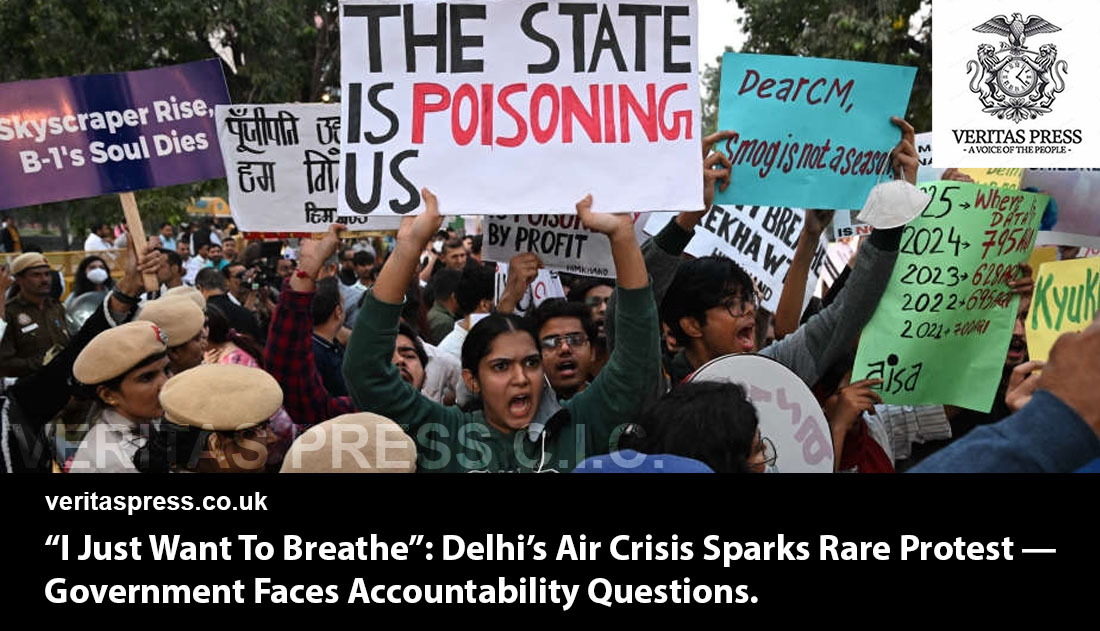
New Delhi, November 10, 2025 — In a rare public demonstration against one of the deadliest urban health crises in the world, dozens of Delhi residents were detained by police at India Gate on Sunday, demanding government action to tackle toxic air engulfing the city and the surrounding National Capital Region (NCR).
Masked parents, children, professionals, and activists carried banners declaring, “Breathing is killing us” and “Our right, clear air”, yet the protest ended with dozens forcibly loaded into police buses, sparking a political and ethical storm over civil liberties and government accountability.
1. The Protest: Frustration Boiling Over
Sunday’s protest was emblematic of mounting public anger. Neha, a young woman attending with her child, told reporters:
“We have only one problem, and that is clean air. This has been going on for years, but no action is being taken.”
Visuals from ANI and other media outlets showed police dragging demonstrators, including some young students, as chants of “I just want to breathe” echoed. Despite the high stakes for public health, Delhi Police cited procedural rules, stating India Gate was not a designated protest site and protesters had refused to relocate to Jantar Mantar. DCP Devesh Kumar Mahla said:
“Approximately 60–80 people were detained… those blocking Mansingh Road were preventing traffic and public movement.”
Activists, however, claim the detentions were selective and aimed at intimidating citizens, calling attention to systemic neglect. Environmentalist Vimlendu Jha alleged that children were also detained, although police denied this.
2. A Health Crisis Beyond Numbers
New Delhi’s air is ranked among the most polluted in the world. On Monday, the Air Quality Index (AQI) reached 345, classified as very poor, and several districts recorded PM2.5 levels 13 times above the World Health Organization’s daily limits.
This annual smog crisis is not new. Winters in Delhi trap vehicle emissions, industrial pollutants, construction dust, and agricultural stubble smoke in stagnant air, creating a lethal cocktail. Research in The Lancet Planetary Health estimates 3.8 million deaths in India between 2009–2019 were linked to air pollution, with children and outdoor workers most affected. UNICEF warns of rising susceptibility to acute respiratory infections in children exposed to such contaminated air.
Protesters underscored that daily exposure is more than an inconvenience; it is a public health emergency. Namrata Yadav, a mother at the protest, said:
“I am here because I don’t want to become a climate refugee. My child should be able to play outside safely.”
3. Government Measures: Cosmetic Solutions or Structural Failure?
The BJP-led Delhi government claims it is taking action. Environment Minister Manjinder Singh Sirsa stated:
“We will continue every possible effort to rid us of pollution… this is the resolve of our government.”
Yet experts and protestors argue that measures such as water-spraying trucks, limited vehicle restrictions, and cloud-seeding trials have proven insufficient. Cloud-seeding experiments last month failed to produce meaningful rainfall, and Stage III of the Graded Response Action Plan (GRAP), intended to trigger emergency pollution controls, remains inconsistently enforced despite severe AQI readings.
Critics note the state’s approach is reactive, not preventative. “Water trucks and cloud-seeding do not reduce emissions at the source,” said Tanvi Kusum, a lawyer and protest participant. “Every winter, it’s the same story: temporary fixes, no systemic change.”
4. The Politics of Pollution
Sunday’s protest also exposed the politicisation of public health data. Delhi AAP leader Saurabh Bharadwaj criticised the government for alleged manipulation of pollution figures:
“Major institutions like the DPCC, CPCB, CAQM, and IMD are fudging data. When a government tampers with numbers, it erodes public trust and forces citizens to protest.”
Senior Congress leader Rahul Gandhi echoed this, calling clean air a basic human right and questioning why citizens peacefully demanding it were treated like criminals.
Meanwhile, BJP officials shifted blame to previous AAP administrations for systemic failures. This blame-shifting underscores a long-standing lack of accountability that transcends party lines, leaving citizens exposed to chronic health risks.
5. Civil Liberties Under Pressure
The detention of peaceful protesters highlights the growing tension between environmental activism and state authority. Activists argue that the government’s crackdown on demonstrations near India Gate is emblematic of a broader pattern of restricting civic space under the guise of security and procedural regulations.
Even animal rights activists joining the protest over a recent Supreme Court ruling on stray dogs faced restrictions. Protesters highlighted the intersection of urban governance, environmental crises, and civic rights, raising questions about the state’s priorities.
6. The Human Cost
Delhi’s residents live with daily trade-offs between safety and freedom. Parents limit outdoor play, outdoor workers inhale toxic air for hours, and street vendors, traffic police, and informal sector workers bear disproportionate risk.
One protester working in the development sector remarked:
“The ultra-rich can install air purifiers everywhere, but the common man has nowhere to escape. Nothing changes because there is no political will.”
The protest reflects not only anger at air pollution itself but deep-seated frustration at governance failure, public health negligence, and lack of transparency.
7. Investigative Takeaways
The November 9 protest exposes several urgent investigative angles:
- Data Transparency: Are monitoring stations deliberately suppressed or manipulated to downplay severity?
- Policy Efficacy: How effective have state pollution measures been given the continued spike in AQI and PM2.5 levels?
- Resource Allocation: How are budgets for air-quality mitigation spent, and what measurable outcomes have been achieved?
- Civil Rights: Why are peaceful environmental protests met with detentions? Are vulnerable populations being silenced in their demand for survival?
- Cross-Border Accountability: How are states in the NCR collaborating (or failing to) address stubble-burning and industrial emissions?
Conclusion:
Delhi’s smog is not just an annual inconvenience; It is a chronic, life-threatening public health emergency compounded by political inertia, administrative opacity, and systemic failure. Sunday’s protest was a wake-up call: citizens are no longer willing to accept excuses, partial measures, or data manipulation.
Without transparent governance, emergency interventions, and enforcement of systemic solutions, the crisis will persist. The stakes are existential: clean air is not a luxury for the privileged; it is a fundamental human right, one that millions of Delhi residents are demanding with urgency, courage, and now, increasing insistence on accountability.
“I just want to breathe,” read one torn protest banner, a plea for survival, a demand for justice, and a challenge to a government whose inaction threatens the lives of its citizens.
Tags: