


Title: How The Homs Mosque Bombing Exposed Syria’s Fragile Transition, Sectarian Fault Lines, And Regional Stakes
Press Release: Veritas Press C.I.C.
Author: Kamran Faqir
Article Date Published: 26 Dec 2025 at 17:25 GMT
Category: Middle-East | Palestine-Gaza-West Bank | How The Homs Mosque Bombing Exposed Syria’s Fragile Transition, Sectarian Fault Lines, And Regional Stakes
Source(s): Veritas Press C.I.C. | Multi News Agencies
Website: www.veritaspress.co.uk

Business Ads


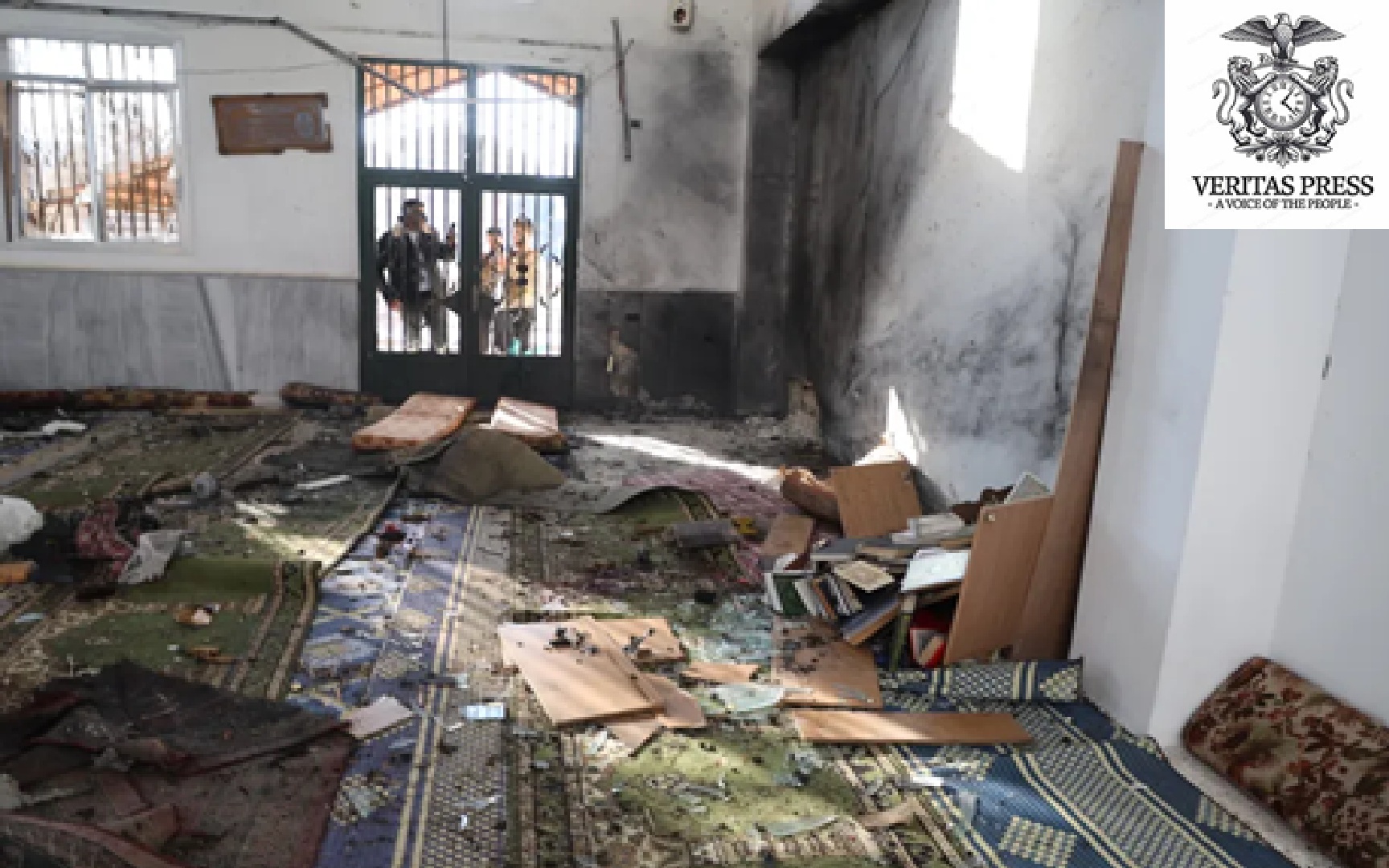
HOMS, SYRIA — On 26 December 2025, an explosion at the Imam Ali ibn Abi Talib Mosque in the Alawite‑majority Wadi al‑Dhahab neighbourhood of Homs killed at least eight worshippers and wounded 18 more during Friday prayers. What local officials call a terrorist attack has become a flashpoint revealing Syria’s unresolved sectarian tensions, enduring extremist threats, and deep regional anxieties about stability in a country still reassembling itself after years of war and the collapse of the Assad regime.
International And Regional Condemnation: Broad, But Politically Charged.
The bombing prompted swift condemnations from governments across the Middle East and beyond, with statements that reveal both common ground and regional political calculus.
Türkiye’s Foreign Ministry denounced the attack as “heinous terrorism,” extending condolences to the Syrian people and reaffirming Ankara’s support for “security, unity and solidarity” in Syria. The statement underscored Türkiye’s continued diplomatic engagement despite complex relations with Damascus over border security and Kurdish forces.
Qatar’s foreign ministry issued a forceful denunciation of the bombing, stressing Qatar’s “absolute rejection of targeting places of worship and terrorising peaceful civilians,” and expressing full solidarity with Damascus’s efforts to maintain security.
The Gulf Cooperation Council (GCC) Secretary‑General Jasem Mohamed AlBudawi condemned the blast “in the strongest terms.” He tied the attack to broader regional instability, urging rejection of all forms of terrorism that threaten “Syria and the world,” and offered condolences to the victims’ families.
Saudi Arabia also condemned the bombing, reiterating its “categorical rejection of terrorism in all forms,” and emphasising that attacks on places of worship are unacceptable and contrary to international norms.
Jordan also denounced the attack, with its Foreign Ministry reaffirming “complete solidarity with the Syrian government and people” and calling for a collective stand against violence aimed at undermining stability.
Lebanon’s President Joseph Aoun described the bombing as an affront to “the dignity of free societies” and extended solidarity to Syria, highlighting the challenge of combating hate speech and exclusion in societies emerging from conflict.
These statements reflect near-universal condemnation of violence against worshippers and civilian targets, but also underscore how regional capitals view Syria as a strategic arena where terrorism, state fragility, and ideological contestation intersect.
A Deeper Investigative Analysis: Security, Sectarian Narratives, And Strategic Stakes.
1. A Targeted Strike Amid Fragile Security Structures
The blast, which Syrian authorities say was caused by explosive devices planted inside the mosque, struck a community already sensitive to violence. Security forces cordoned off the area after the explosion and are investigating, but confidence in the transitional state’s capacity to prevent such attacks remains low.
A Syrian police lieutenant, speaking anonymously, told independent journalists:
“We are chasing leads but lack technical forensic tools. The state structure is still rebuilding. These attacks exploit our weaknesses.”
This highlights a major security gap: despite official statements promising accountability, Syria’s security apparatus, wrestling with incomplete reorganisation and limited capacity, is ill-equipped to prevent complex attacks.
2. Sectarian Narratives and Weaponised Fear
The mosque, located in an Alawite district, carries symbolic weight. Although a Sunni extremist cell calling itself Saraya Ansar al‑Sunnah claimed responsibility on encrypted messaging platforms, a claim security analysts view as political posturing in search of relevance, the targeting of an Alawite space of worship risks deepening sectarian fault lines in a society already fractured from years of war.
Political analyst Hamza al‑Muhimid told Al Jazeera:
“Targeting a mosque in a city with a delicate sectarian composition cannot be separated from attempts to strike at the fragile social fabric and stir mistrust between communities.”
Expert commentary suggests that such attacks are less about religious animosity per se and more about political signalling and destabilisation by armed networks seeking to disrupt any emergence of civil peace.
Voices From The Ground: Communities, Scholars, And Human Rights Advocates.
Worshippers and Residents
“I heard a loud boom, then people were screaming,” said Khalid, a worshipper who escaped the blast.
“We came here to pray. Some had just bowed their heads. Then the children were crying. This was a place of peace.”
Local regions erupted in shock and fear, with neighbours recounting chaotic moments as ambulance sirens filled the streets.
Medics on the Frontlines
At Homs Central Hospital, medics said many of the wounded were in critical condition, and staff were grappling with trauma cases. One medic, who requested anonymity, told journalists:
“We are seeing familiar patterns, shock, dread, and families shattered.”
Muslim Scholars and Community Leaders
Religious leaders in Wadi al‑Dhahab decried the bombing as an attack on Islamic sanctity and communal harmony. One Sunni scholar in Homs said:
“This violence is not an expression of faith; it is terror dressed up in ideology.”
Their statements reflect broader concerns among clergy that extremist exploitation of religion undermines inter‑communal trust.
Human Rights Organisations and Activists
Human rights advocates condemned the attack as part of a broader pattern of violence against civilians. Noura al‑Zahra, Middle East director for a prominent rights group, commented:
“Violence in places of worship is a crime against humanity. We must hold perpetrators accountable, not just criminally, but politically and socially.”
Activists warned against narratives that cast communities as inherently oppositional, calling instead for inclusive justice mechanisms and independent investigations.
Regional Geopolitics and Strategic Context
The Homs attack also comes amid renewed U.S. military pressure on extremist cells in Syria, linked to recent retaliatory strikes targeting ISIS infrastructure after separate deadly incidents involving foreign personnel, moves that reflect broader great‑power involvement in Syria’s security landscape. The Sun
Syria’s neighbours, particularly Türkiye, the GCC states, and Jordan, view the bombing not only as a humanitarian outrage but as a barometer of stability with direct implications for refugee flows, border security, and regional diplomacy. Their coordinated statements of condemnation underscore both shared security concerns and the political leverage each state seeks in shaping Syria’s future amid continuing tensions over governance, rebel factions, and radicalised groups.
Conclusion: Syria’s Fragile Peace Under Siege, Bombings, External Interference, And The Struggle For Sovereignty.
The Homs mosque bombing lays bare how deeply Syria’s peace remains unanchored. This attack is not merely a tragic act of terror; it is emblematic of the systematic targeting of civilians and sacred spaces to destabilise a vulnerable state, exploiting the weaknesses of a transitional government and unresolved sectarian fractures. Reports and analysts suggest that these bombings are part of a broader strategy supported by external actors, including Israeli forces, designed to provoke sectarian tensions, inflame communal mistrust, and justify regional intervention. By striking symbolic sites like the Imam Ali ibn Abi Talib Mosque during Friday prayers, the attacks aim to fuel divisions and create pretexts for war, while puppet rulers administer Syria under foreign influence, undermining genuine sovereignty and local security.
Without robust, community-level security reforms, independent legal investigations, and genuine platforms for political reconciliation, such attacks will continue to erode trust, not just between religious groups, but between citizens and a transitional government struggling to assert control. Human rights advocates and independent observers warn that this pattern of violence, targeting civilians, religious minorities, and places of worship, is deliberately instrumentalised to weaken Syria’s social fabric, manipulate narratives, and maintain the country in a state of political and security dependency.
Voices from the ground, worshippers, medics, activists, and scholars, underscore a profound truth: ordinary Syrians yearn not just for safety, but for a justice and political order that sees them as stakeholders in peace, not targets in war. Yet, under continued external interference and the looming threat of insurgent and extremist violence, this aspiration remains precarious.
The Homs bombing is therefore a stark symbol, not only of loss and grief, but of a nation struggling to assert sovereignty, protect its citizens, and resist forces that weaponise violence and division for strategic gain. Syria’s future depends on systemic reform, accountability for perpetrators, and the creation of inclusive political and security frameworks that can safeguard civilians and restore genuine trust in governance. Until these measures are implemented, attacks like the Homs mosque bombing will continue to undermine the fragile peace, provoke regional instability, and perpetuate cycles of fear and displacement.