

Original Article Date Published:
Article Date Modified:
Help support our mission, donate today and be the change. Every contribution goes directly toward driving real impact for the cause we believe in.
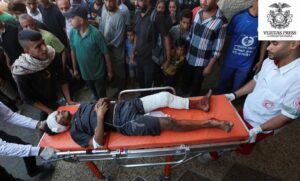
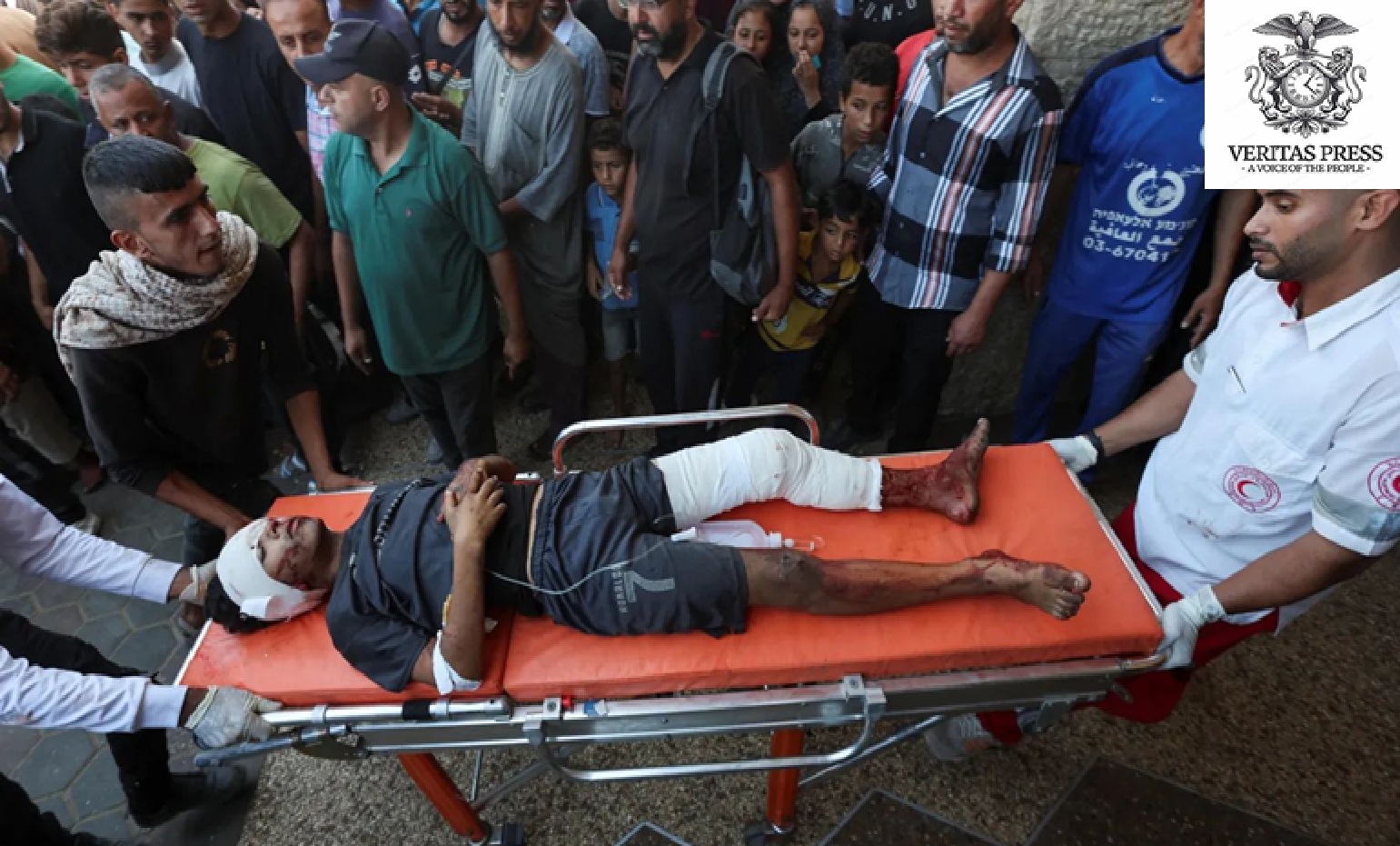
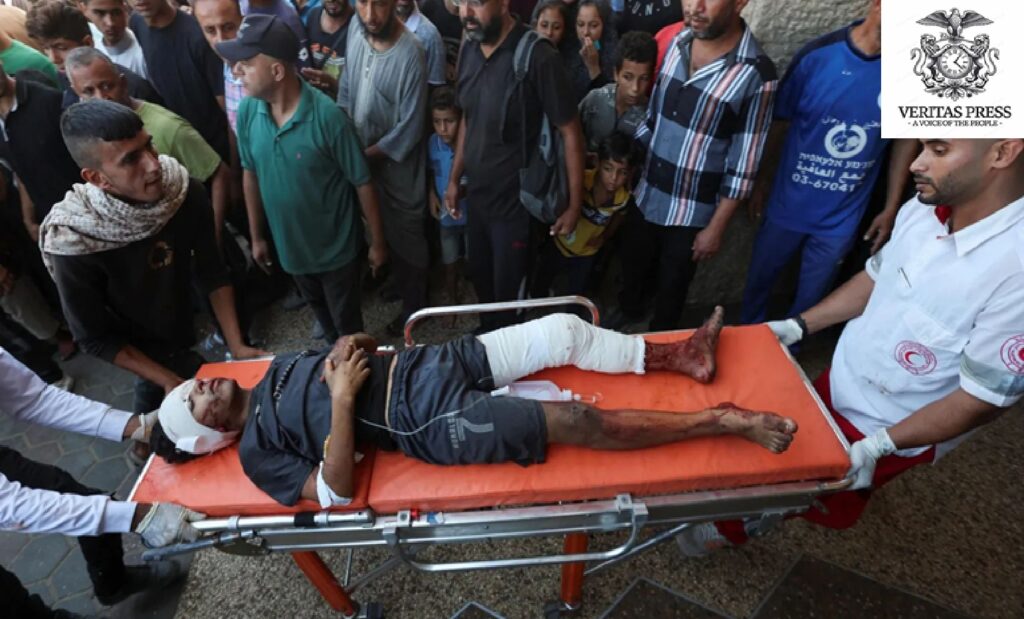
GAZA CITY — In the predawn stillness of the 27th day of Ramadan, the sound of drone motors and subsequent explosions ripped through the al-Mawasi area west of Khan Younis. Families gathering for suhoor, the last meal before the daily fast, were instead met with death and shrapnel.
The Israeli strike, which killed six Palestinians, including a police officer, was not an isolated incident but the latest in a grim, near-daily ritual that has defined the so-called “ceasefire” in the Gaza Strip since it was signed in October 2025.
What was heralded by U.S.-backed diplomatic architects as the end of a genocidal war has, for Palestinians in Gaza, morphed into a slow-burning continuation of the same violence by other means. While international diplomats in Washington and European capitals applaud the cessation of major hostilities, the ground truth in Gaza tells a story of systematic erasure, targeted killings, and a humanitarian catastrophe deliberately deepened by the Israeli occupation.
The Anatomy Of A Violation:
Early Friday morning, medical sources at Nasser Medical Complex in Khan Younis received the bodies of six Palestinians killed in a strike on a police checkpoint at the al-Maslakh intersection in al-Mawasi. Simultaneously, a separate drone strike targeted a police post at the entrance to the Bureij refugee camp in central Gaza, killing two more.
The Gaza Interior Ministry confirmed that one of the dead was a police officer, adding to what officials describe as a mounting toll among security personnel since the ceasefire’s implementation.
Crucially, these areas lie outside the zones designated under Israeli military control, the so-called “Yellow Line”, suggesting that Israeli forces are conducting targeted killings in areas theoretically returned to Palestinian administrative oversight.
Since the agreement took effect on Oct. 10, 2025, Israel has killed at least 642 Palestinians and wounded another 1,663, according to the Gaza Centre for Human Rights. Among the dead are 197 children and 85 women. The Centre states that the pattern reflects “repeated targeting of groups protected under international humanitarian law … amounting to serious violations of the Geneva Conventions that warrant international criminal accountability.”
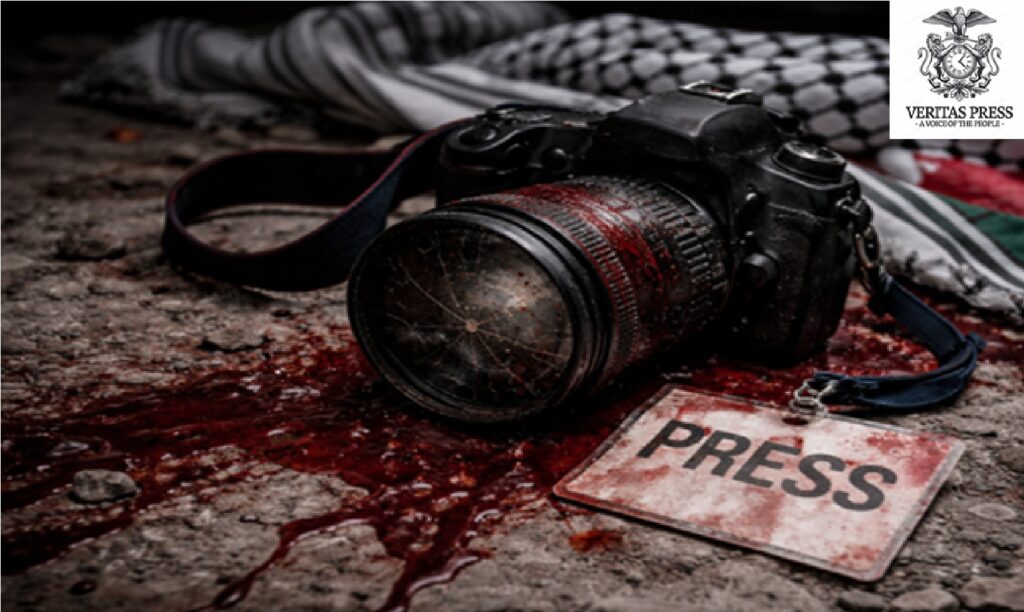
Mariam Dagga, a 33-year-old freelance journalist who worked with Associated Press, was among those killed last year when Israeli forces struck Nasser Hospital. Her death, along with four other reporters, contributed to a chilling statistic released by the Committee to Protect Journalists: 2025 was the deadliest year on record for journalists globally, with two-thirds of the 129 killed allegedly slain by Israeli forces.
The Humanitarian Siege: Death By Attrition.
While global headlines fixate on airstrikes, aid agencies warn that a slower, structural form of violence is tightening its grip.
The ceasefire agreement stipulated the entry of 600 aid trucks per day, the minimum deemed necessary to sustain Gaza’s population. Reporting by Al Jazeera and the Gaza Centre for Human Rights indicates deliveries have not exceeded 43% of that figure, with fuel deliveries dropping to just 15%.
“The effect would be immediate, extending well beyond individual organisations to the wider humanitarian system,” warned Oxfam in a recent statement.
In what aid groups describe as a drastic escalation, Israel has ordered 37 international organisations, including Doctors Without Borders, Norwegian Refugee Council, and Save the Children, to halt operations unless they submit personal data on Palestinian staff to Israeli authorities.
Aid workers say compliance would place employees at risk of targeting or arrest. Noncompliance would suspend lifesaving programs for a population of more than two million.
“This is not bureaucracy; this is a trap,” said a Palestinian aid coordinator for an international NGO, speaking anonymously. “If we give Israel these lists, our staff become targets. If we don’t, we stop feeding two million people.”
World Central Kitchen has warned it may soon be forced to cease operations entirely under the new restrictions. Meanwhile, heavy rains and flooding have submerged tent encampments across central and southern Gaza, compounding displacement and disease risks.
Diplomacy And Displacement:
As Gaza endures airstrikes and shortages, diplomatic manoeuvring continues abroad.
U.S. President Donald Trump convened a summit in Washington under the banner of a “Board of Peace,” a body critics say sidelines the United Nations while granting sweeping powers over Gaza’s post-war reconstruction.
Israeli Foreign Minister Gideon Sa’ar framed the campaign as a moral imperative. “All previous plans for Gaza failed because they never addressed the core issues: terror, hate, incitement and indoctrination,” he said, adding that disarmament of Hamas was central to the plan.
On the same day, Israeli forces reportedly conducted airstrikes east of Gaza City and demolished residential buildings east of Khan Younis.
Hamas spokesperson Hazem Qassem dismissed the diplomatic efforts as cover for continued violence. “The occupation continues its war of extermination and destruction,” he said following Friday’s attacks.
International Lawlessness: Words Without Mechanisms.
At the UN Security Council, UK Home Secretary Yvette Cooper acknowledged that the ceasefire remains fragile and warned that Israeli policies targeting NGOs “risk choking off essential access to people in desperate need.”
Pakistan’s Deputy Prime Minister Ishaq Dar described the situation as “unbearable,” stating that “genocide and violations of the ceasefire cannot be tolerated.”
Yet condemnations have not translated into enforcement.
The proposed International Stabilisation Force (ISF), floated as a security solution, remains theoretical. While Indonesia has pledged 8,000 troops and Morocco, Albania, and Kazakhstan have offered symbolic contributions, no deployment has materialised.
Meanwhile, EU foreign policy chief Kaja Kallas criticised the Board of Peace’s mandate for omitting any explicit reference to Gaza’s governance by Palestinians or coordination with the UN framework.
The “Yellow Line” And Permanent Occupation:
On the ground, Israeli military presence appears entrenched. Tanks and armoured vehicles continue operating along and beyond the “Yellow Line,” with heavy fire reported near the Morag axis north of Rafah and central Khan Younis.
In Beit Lahia, 43-year-old Husam Abu Khusa was shot and killed in the al-Atattra area, far from designated military zones. Such incidents have become so routine that, according to reporting by the Associated Press, the Israeli military often issues blanket statements asserting victims “posed a threat,” without detailed evidence.
Human rights monitors argue that this language has been used to justify lethal force against civilians, including minors.
A War By Another Name:
Over 100,000 Palestinians have been killed since October 2023, with more than 10,000 still missing beneath the rubble, according to Gaza health authorities.
“We were told the war was over,” said a displaced father in Deir al-Balah, gripping the hand of his child, who flinches at every drone’s hum. “But the drones are still there. The bombs are still there. The hunger is still there. They just call it something else now.”
As Ramadan continues, a month of fasting, prayer, and endurance, Gaza’s residents confront a different ritual: the steady attrition of life under a ceasefire that has failed to deliver peace.
Diplomats convene. Statements are issued. Reconstruction plans are drafted.
But in Gaza, the arithmetic of survival tells a harsher truth: hundreds killed since October under the banner of “peace.”
For many here, this is not the end of the war. It is simply its next phase.
Conclusion: The Architecture Of Erasure And Control.
If ceasefires are meant to mark the end of war, Gaza’s has instead institutionalised a new phase of it, less spectacular in headline terms, but no less lethal in consequence.
What is unfolding is not simply a pattern of sporadic violations. It is an engineered system of domination, one that fuses military force, bureaucratic restriction, and territorial fragmentation into a coherent project of control over Gaza and the entirety of the Occupied Palestinian Territory (OPT).
Targeted killings continue beyond declared military zones. Civil police officers are struck at checkpoints. Journalists and aid workers operate under constant threat. Residential blocks are demolished under the language of “security necessity.” Simultaneously, Israel consolidates buffer zones, expands militarised corridors, and restricts reconstruction, reshaping Gaza’s geography in ways that entrench long-term control.
This is not merely about isolated strikes. It is about the systematic restructuring of Palestinian space.
In Gaza, the blockade of food, fuel, and medical supplies, despite explicit ceasefire provisions, creates conditions of calculated unlivability. In the West Bank, settlement expansions, land seizures, settler violence, dispossessions, forced displacements and military incursions continue apace. Together, these policies point toward what many legal scholars and human rights observers describe as the engineered takeover and fragmentation of all Palestinian territories: Gaza reduced to a sealed enclave under aerial and perimeter dominance; the West Bank carved into disconnected cantons; East Jerusalem further absorbed through administrative and demographic pressure.
Under international law, collective punishment, forced displacement, and the starvation of civilians as a method of warfare constitute grave breaches of the Geneva Conventions. The prohibition against the forcible transfer of a protected population is explicit. So too is the ban on targeting civilians and civilian infrastructure indispensable to survival.
Yet the evidence since October 2023, over 100,000 killed, thousands missing under rubble, hundreds more killed even after the ceasefire, suggests not deviation but continuity. When forced displacement becomes chronic and systematic, when buffer zones permanently absorb civilian land, when reconstruction is obstructed and return rendered impossible, the line between security policy and ethnic cleansing narrows dramatically.
Ethnic cleansing need not arrive as a single mass expulsion. It can proceed through incremental erasure: by demolishing homes, demolishing historical sites, cultural and generational erasure, destroying hospitals, schools, flattening farmland, burning date trees, burning olive groves, strangling aid, and driving a population into ever-shrinking pockets of survival. A territory made uninhabitable achieves the same demographic outcome as forced removal.
The gravest charge, genocide, hinges on intent: the intent to destroy, in whole or in part, a national, ethnic, racial, or religious group. Courts will debate that threshold. But on the ground, Palestinians experience something less theoretical: the steady dismantling of the material conditions necessary for collective existence.
The ceasefire has not halted this trajectory. It has reframed it.
Target killings become “enforcement.” Siege becomes “regulation.” Displacement becomes “evacuation.” Territorial consolidation becomes “buffer security.” Meanwhile, the international system, built after 1945 to prevent precisely such outcomes, issues warnings without enforcement. Legal norms are invoked even as violations accumulate. Arms continue to flow. Accountability remains deferred.
The danger is not only the death toll, though that is staggering. It is the normalisation of permanent control: the engineered takeover of Gaza’s borders, airspace, and coastline; the absorption of West Bank land; the fragmentation of Palestinian governance; and the consolidation of a single overarching authority from the Jordan River to the Mediterranean Sea, under which Palestinians remain stateless, displaced, and subjected to layered systems of domination.
If this trajectory continues unchecked, historians may look back at this “ceasefire” not as the end of a war, but as the administrative phase of a broader project: the consolidation of control over all of historic Palestine, achieved through attrition, fragmentation, and the slow erasure of a people’s presence on their land.
For those living beneath the drones and inside the flooded tents, the terminology is irrelevant. What matters is that the bombs still fall, the hunger deepens, and the land beneath their feet continues to shrink.
A ceasefire in name only does not signal peace. It signals the transformation of open warfare into structured dispossession. And unless international law is enforced rather than merely cited, that transformation may become permanent. Despite the international community’s complicity and silence, particularly from Muslim nations who offer only empty words.
Help Support Our Work
For The Secure Submission Of Documentation, Testimonies, Or Exclusive Investigative Reports From Any Global Location, Please Utilise The Following Contact Details For Our Investigations Desk: enquiries@veritaspress.co.uk or editor@veritaspress.co.uk
Popular Information is powered by readers who believe that truth still matters. When just a few more people step up to support this work, it means more lies exposed, more corruption uncovered, and more accountability where it’s long overdue.
If you believe journalism should serve the public, not the powerful, and you’re in a position to help, becoming a DONATOR or a PAID SUBSCRIBER truly makes a difference.
DONATION APPEAL: If You Found This Reporting Valuable, Please Consider Supporting Independent Journalism.
Help Support Our Work – We Know, We Know, We Know …
Seeing these messages is annoying. We know that. (Imagine what it’s like writing them … )
Your support fuels our fearless, truth-driven journalism. In unity, we endeavour to amplify marginalised voices and champion justice, irrespective of geographical location.
But it’s also extremely important. One of Veritas Press’s greatest assets is its reader-funded model.
1. Reader funding means we can cover what we like. We’re not beholden to the political whims of a billionaire owner. We are a small, independent and impartial organisation. No one can tell us what not to say or what not to report.
2. Reader funding means we don’t have to chase clicks and traffic. We’re not desperately seeking your attention for its own sake: we pursue the stories that our editorial team deems important and believe are worthy of your time.
3. Reader Funding: enables us to keep our website and other social media channels open, allowing as many people as possible to access quality journalism from around the world, particularly those in places where the free press is under threat.
We know not everyone can afford to pay for news, but if you’ve been meaning to support us, now’s the time.
Your donation goes a long way. It helps us:
- Keep the lights on and sustain our day-to-day operations
- Hire new, talented independent reporters
- Launch real-time live debates, community-focused shows, and on-the-ground reporting
- Cover the issues that matter most to our communities, in real time, with depth and integrity
We have plans to expand our work, but we can’t do it without your support. Every contribution, no matter the size, helps us stay independent and build a truly people-powered media platform.
If you believe in journalism that informs, empowers, and reflects the communities we serve, please donate today.
ISLAMABAD/KABUL – The thunder of Pakistani warplanes over the capitals of two nations at dawn
A Muslim community centre adjacent to a mosque in Worcester was firebombed in the early
GAZA CITY — In the predawn stillness of the 27th day of Ramadan, the sound
JERUSALEM / WASHINGTON — The skies over the Middle East have become a barometer of
US/IRAN – In a significant escalation of American military posture in the Middle East, the
ISLAMABAD, PAKISTAN – The political temperature in Pakistan, already simmering after years of instability, has

For years, the United Kingdom has watched a harrowing pattern emerge from its maternity wards.
A significant and highly controversial development is underway in the southern Gaza Strip. Recent reporting
GENEVA/WASHINGTON — As a third round of indirect talks between the United States and Iran
In what press freedom watchdogs are calling a historic collapse of civilian protection, 2025 has