



Press Release: Veritas Press C.I.C.
Author: Kamran Faqir
Article Date Published: 22 Oct 2025 at 12:20 GMT
Category: Middle-East | Palestine-Gaza-West Bank | Gaza Ceasefire Or Calculated Siege
Source(s): Veritas Press C.I.C. | Multi News Agencies

Business Ads

Despite a declared ceasefire on 10 October 2025, Israeli forces have continued targeted assassinations, limited airstrikes, and a suffocating blockade that leaves much of Gaza starving, displaced, and trapped under rubble. Eyewitnesses, doctors, and rights monitors say the truce has not delivered peace, only a slower, more deliberate form of violence. U.S. assurances that the ceasefire would “bring stability and relief” have proven hollow, exposing the hypocrisy of an administration that publicly calls for restraint while continuing to fund, arm, crush dissent and defend Israel’s ongoing violations.
A “Ceasefire” In Name Only:
Residents across northern and central Gaza describe daily Israeli drone fire, sniper attacks, and intermittent shelling near aid sites and along the buffer zone. Local journalist Rami al-Shaer told Al Jazeera:
“Every day, we hear the buzz of drones. They say there is a ceasefire, but there are strikes at night, and people are dying quietly now.”
Independent monitors and satellite imagery confirm small but sustained Israeli operations targeting what the army calls “Hamas remnants” and “security threats.” Yet eyewitness accounts contradict that framing. Residents of al-Zahra, Beit Lahia, and Nuseirat reported recent strikes killing entire families, including children.
UN human rights monitors have noted that “even limited operations during a ceasefire, when civilians are overwhelmingly the victims, constitute a serious breach of international humanitarian law.”
U.S. Assurances, Israeli Impunity:
Despite these continuing attacks, the Trump administration has doubled down on describing the truce as “successful.”
Vice President JD Vance and U.S. envoy Steve Witkoff both praised the ceasefire as “exceeding expectations,” even as aid agencies warned that almost 1.8 million Gazans remain without sufficient food or clean water. The U.S. State Department claims it is “monitoring violations closely,” but there have been no public condemnations, sanctions, or reviews of military assistance.
As one senior European diplomat told Reuters:
“Washington’s statements are disconnected from reality on the ground. They praise a peace that does not exist.”
Analyst Muhanad Seloom of the Doha Institute warned that “U.S. credibility is collapsing” because “Washington cannot call for restraint while supplying the very weapons used in these violations.”
This double standard, condemning ceasefire breaches elsewhere while excusing Israel’s, has drawn scathing criticism from NGOs and international lawyers. Human Rights Watch and Amnesty International have documented repeated Israeli strikes since the ceasefire that killed civilians “without any indication of legitimate military targets.”
Targeted Killings Under The Guise Of ‘Security’:
According to multiple reports, Israel has resumed targeted killings of alleged Hamas operatives even after 10 October, actions that blatantly contravene the ceasefire terms.
Eyewitnesses in Deir al-Balah described an Israeli drone strike on 14 October that killed a former police officer and three members of his family. “He was home with his children,” said a neighbour. “They called him a militant. But he was unarmed. There was no fighting.”
Doctors at al-Aqsa Hospital confirmed the casualties and said such strikes have quietly increased. “We are receiving bodies with shrapnel wounds almost every other day,” said Dr Hani al-Kurd. “The ceasefire exists on paper, not in reality.”
These assassinations are not random but part of a continuing campaign. The Guardian and AP correspondents have documented a pattern of selective targeting under “special operations exemptions,” loopholes Israel claims are “pre-emptive security measures.” But under international law, such killings violate the principle of distinction and render the ceasefire meaningless.
Doctors: Starvation And Siege As Slow-Motion Warfare.
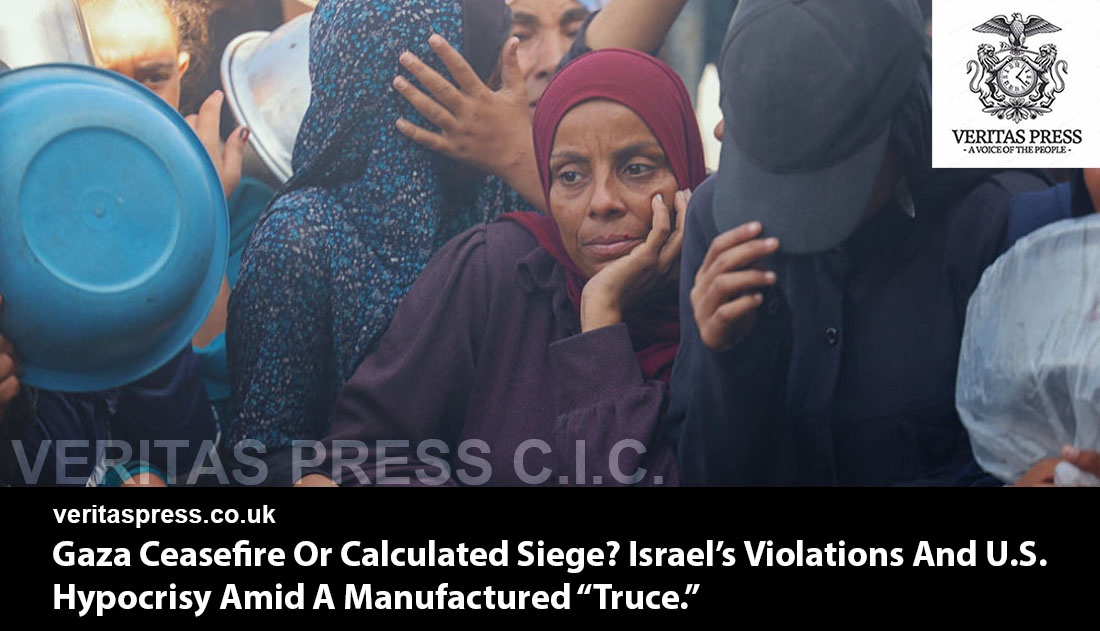
At al-Shifa and Kamal Adwan hospitals, medics say more children are dying from hunger than from new strikes. Dr Musab Farwana, a paediatrician, told Al Jazeera:
“We are still waiting for medical and food aid. The trucks arrive only when Israel allows them. Our patients are dying from starvation, dehydration, and infection. This is not peace, it is controlled suffering.”
Field reports by Médecins Sans Frontières confirm that malnutrition rates have reached catastrophic levels. “This is siege warfare dressed up as a ceasefire,” said one MSF coordinator. “The bombs are fewer, but the deaths continue, just more slowly.”
UNRWA officials have echoed this. “There is no meaningful change on the ground,” said spokesperson Juliette Touma. “Aid remains blocked, and the people remain trapped. The ceasefire is being used to mask collective punishment.”
Bodies Beneath The Rubble: A Symbol Of Systemic Obstruction.
Weeks after the supposed truce, civil defence teams are still digging out bodies with hand tools. Bulldozers and cranes remain barred from entry, as Israel claims “security concerns.”
Volunteer rescuer Mahmoud al-Tarabin described it bluntly:
“We are digging graves, not rescuing. Israel will not let us bring in machines, so we pull bones from the sand.”
UN forensic experts warn that denying recovery equipment obstructs both humanitarian work and potential war crimes investigations. As long as heavy machinery and international teams are blocked, thousands of missing civilians will remain literally buried out of sight, a grim metaphor for the world’s selective blindness.
The West Bank: A Parallel Escalation.
While the ceasefire distracts global attention, Israeli settlers, backed by army patrols, have intensified attacks in the West Bank, displacing more than 15,000 Palestinians since the start of 2025, according to the UN Office for the Coordination of Humanitarian Affairs (OCHA).
UNRWA’s Roland Friedrich said:
“Gaza and the West Bank are one political entity. You cannot talk about calm in Gaza while the West Bank burns.”
Analysts argue that this “double-front” strategy, which chokes Gaza, seizes West Bank land, reflects Israel’s long-term goal of permanent control through fragmentation and exhaustion.
The Law And The Hypocrisy:
Under Article 33 of the Fourth Geneva Convention, collective punishment and starvation as a method of warfare are strictly prohibited. Yet the ongoing blockade and deliberate restriction of essential goods point to systematic violations.
International law scholar Leila Zakaria commented:
“When a state continues targeted killings and blocks food during a ceasefire, with its main ally’s approval, it ceases to be a security policy. It becomes a test of the world’s willingness to enforce law against its friends.”
Despite this, U.S. officials continue to shield Israel diplomatically, vetoing UN resolutions that demand accountability and parroting Israeli talking points about “security threats.” The hypocrisy is staggering: Washington condemns Russia for ceasefire violations in Ukraine but rationalises Israel’s breaches as “necessary defence.”
Conclusion: A Manufactured Ceasefire, A Managed Genocide.
The so-called Gaza ceasefire has not brought peace; it has institutionalised the violence. Behind every diplomatic press release lies a war recalibrated into siege: bombs replaced by hunger, invasion replaced by isolation, and genocide repackaged as “stability.” What Israel calls a truce, Palestinians describe as a continuation of war by other means. The silence of drones has only made the suffering quieter, not smaller.
Despite Washington’s triumphal rhetoric, the facts are undeniable. Israeli forces have continued targeted killings, armed incursions, and blockade-driven starvation since the truce began. Aid is still being blocked, children are still dying of hunger and dehydration, and hospitals have no fuel. Every “limited operation” and every denied truck form part of a deliberate strategy of slow destruction, a war designed to erase Gaza without the spectacle of bombardment.
Yet the United States continues to describe this devastation as progress. Vice President JD Vance hails the truce as “exceeding expectations,” while U.S. envoy Steve Witkoff boasts of “American-led stability.” But for the people of Gaza, these words represent betrayal and hypocrisy. The Trump administration has turned the ceasefire into political theatre, a mechanism to shield Israel from scrutiny while reinforcing its impunity.
The ceasefire in Gaza has become a cynical instrument, not to end the war, but to control its tempo. Israel’s continued targeted killings, aid obstruction, and settler violence expose the fiction of “restraint.” And the Trump administration’s complicity, praising the truce while ignoring the killings, underscores the moral bankruptcy of Western diplomacy.
As one Gaza doctor put it:
“The bombs have quieted, but the killing continues, by hunger, by disease, by silence.”
Until the blockade ends, aid flows freely, and accountability is enforced, the so-called ceasefire remains not peace, but a slower form of death sanctioned by the language of diplomacy.
In reality, Washington’s policy extends far beyond Gaza. The United States is now enforcing the normalisation framework of the Abraham Accords across the Middle East and Asia, coercing governments to accept Israeli integration as the price of U.S. favour and security guarantees. This campaign is not about peace; it is about sanitising Israel’s crimes and erasing the Palestinian cause from the international conscience. The accords have become a diplomatic disinfectant, cleansing genocide with trade deals and photo-ops.
Political analyst Leila Zakaria told The Guardian:
“The Abraham Accords are not a peace project; they are a political anaesthetic. They numb the region while Israel consolidates control, and they allow Washington to pretend that normalisation equals justice.”
The ceasefire, like the Accords, serves a singular purpose: to rewrite the narrative of power and control. By branding Israel’s military dominance as a regional partnership, the United States has constructed a moral inversion, where the oppressor is recast as peacemaker and the victim as obstacle. It is a policy of deception that links the starvation of Gaza’s children to the banquet tables of Gulf diplomacy and to lay the foundations of the new world order.
Meanwhile, the humanitarian toll remains catastrophic. More than 100,000 Palestinians have been killed, over 377,000 wounded and maimed, and thousands still missing beneath the rubble. Doctors report infants dying from malnutrition and medics collapsing from exhaustion, while UNRWA, WHO, and Médecins Sans Frontières warn of “state-manufactured famine.” Each day under blockade is a deliberate act of cruelty, a weaponisation of hunger that violates every moral and legal norm.
International law experts argue that Israel’s siege, coupled with targeted killings and systemic deprivation, meets the legal threshold for genocide under the Genocide Convention. Yet rather than confront this, the U.S. and its allies have chosen complicity, shielding Israel diplomatically, vetoing resolutions, and rewriting the vocabulary of war crimes into the language of “self-defence.”
As Muhanad Seloom of the Doha Institute for Graduate Studies notes:
“The U.S. is not merely failing to restrain Israel; it is helping to design the system of violence. The ceasefire, the normalisation deals, the aid restrictions, they are all parts of the same architecture of control.”
And despite these atrocities, Western governments continue to weaponise the term “antisemitism,” not to combat hate, but to silence truth and crush dissent. Students, journalists, and even aid workers are vilified for condemning Israel’s crimes, while state-backed campaigns conflate legitimate criticism of genocide with prejudice. This deliberate conflation serves one purpose: to sanitise the crimes of Israel and shield an apartheid regime from accountability. As media scholar Noura Erakat warns, “The fight against antisemitism has been hijacked to protect Israeli impunity and criminalise Palestinian existence.”
This is the heart of the hypocrisy: the world’s most powerful governments proclaim peace while underwriting occupation, and brand normalisation as justice while normalising impunity. The ceasefire is no longer a diplomatic milestone but a moral indictment, proof that international law can be suspended when the violator is an ally.
And so, Gaza remains the graveyard of global conscience. Its children die of thirst, hunger and from bombs while the architects of their suffering attend “peace summits.” Its cities lie in ruins while normalisation ceremonies are broadcast as triumphs. The ceasefire has become the camouflage of genocide, a weaponised silence enforced through aid, diplomacy, and lies.
As one exhausted doctor in Deir al-Balah said:
“They say the war is over, but we are still burying our dead. Maybe the world stopped watching, but the dying never stopped.”
Until the blockade ends, aid flows freely, dissent is protected, and those responsible are held accountable, the ceasefire remains a mirage, a political performance masking a policy of extermination. And until the Abraham Accords and Western propaganda stop serving as the diplomatic cover for Israel’s crimes, the promise of peace will remain the most brutal illusion of all.
As the International Court of Justice prepares to rule on Israel’s obligations as an occupying power, the world faces a stark choice: enforce international law or bury it beneath the rubble of Gaza. This ruling will not only test Israel, it will test the entire international order’s capacity to uphold justice against power. If the ICJ’s verdict is ignored or diluted, it will confirm what Gaza’s survivors already know: that for Palestinians, law and humanity end where Western interests begin.
Until that truth changes, the so-called ceasefire will remain not a path to peace, but a mirror of the world’s moral collapse, a world that watched genocide unfold and called it diplomacy.
And if the architects of this silence continue to dictate the terms of peace, one must ask:
What value does international law hold when the victims of its betrayal lie buried beneath its promise?